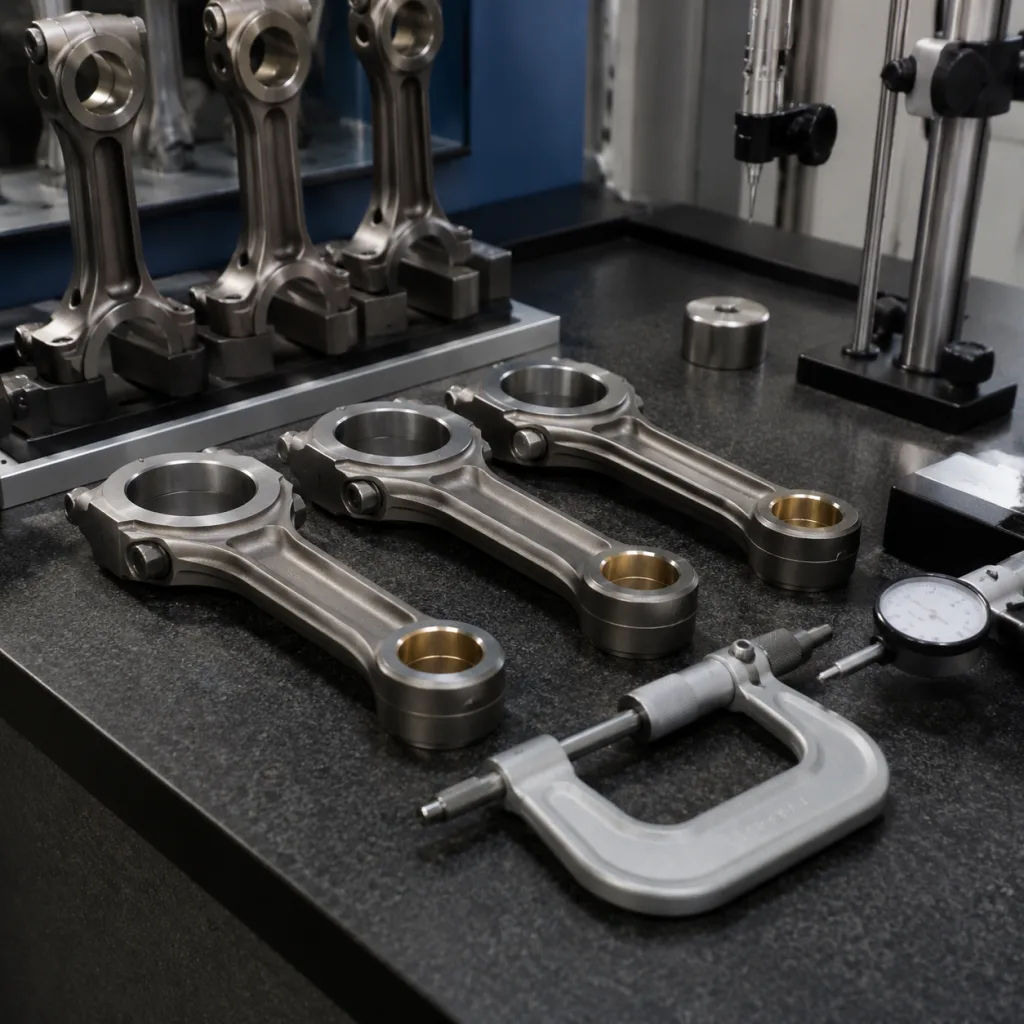
Sourcing Volvo-fit engine bearings takes more than matching a catalogue line to a price list. Main and connecting rod bearings are small parts, but they carry critical responsibility for crankshaft support, oil-film stability, fatigue resistance, and rebuild reliability across passenger car, light commercial, heavy-duty, marine, and industrial engine applications. A qualified engine bearing Volvo supplier should be able to document alloy construction, wall-thickness control, crush height, spread, oil-groove geometry, packaging traceability, and batch-level inspection before the first purchase order is placed. This guide explains how procurement teams can assess suppliers for aftermarket distribution, OEM service programmes, repair-chain replenishment, and private-label projects. It covers sourcing documents, factory-audit questions, MOQ and lead-time planning, interchange checks, and the quality controls Driventus applies to engine bearing production in Taizhou, Zhejiang. Driventus is an independent aftermarket manufacturer; Volvo and other brand names are referenced only to identify fitment and interchange.
What buyers should verify before approving a supplier
Engine bearings are precision wear components, so supplier approval should test more than catalogue coverage. For Volvo-fit applications, buyers need evidence that the factory controls metallurgy, geometry, surface condition, and repeatability from incoming strip material through final packed sets.
A practical approval file should include:
Material declaration for steel-backed bi-metal or tri-metal bearing construction
Nominal wall thickness and tolerance range by bearing family
Crush height, spread, and free-state shape measurement method
Surface-finish range for the running layer, back face, and parting faces
Oil-hole, oil-slot, and groove-position inspection method
Overlay, lining, or running-layer specification where applicable
Batch traceability from strip material to finished bearing set
Corrosion-prevention packaging validation for long-distance storage or sea freight
PPAP-style documents where the buyer requires OEM-type submission discipline
Current certification copies for IATF 16949:2016 and ISO 9001:2015
Importers should also confirm the supplier can prepare consistent customs documents, country-of-origin statements, commercial invoices, packing lists, and HS-code references. EU and UK buyers may need material-compliance files that consider REACH (EC) No 1907/2006 where applicable. North American and Australian buyers often place heavier emphasis on dimensional validation, packaging durability, barcode accuracy, and shipment-level traceability.
Typical bearing types for Volvo-fit engine programmes
Driventus manufactures and supplies engine bearing sets for aftermarket and programme-based customers. Depending on engine family, demand, and interchange data, coverage can include main bearings, connecting rod bearings, thrust washers, flanged thrust bearings, and camshaft bearings.
High-cycle load, fatigue resistance, and seizure prevention
Thrust washer / flanged bearing
Pair or set
Thrust-face thickness, flatness, surface finish
Axial crankshaft movement control
Camshaft bearing
Set by engine
OD, ID after installation allowance, oil-hole alignment
Press-fit stability and lubrication alignment
</tr></thead><tbody> </tbody></table>Buyers should keep OE part-number cross-references in a controlled format rather than relying on informal descriptions. A drawing, sample report, or RFQ may refer to OE-style numbers such as 06A… or 11251… when those references are relevant to the enquiry. Driventus does not claim approval, sponsorship, or endorsement by any vehicle manufacturer. Brand names and OE-style references are used only to identify fitment, application context, and interchange.
MOQ, lead time, and ordering structure
A dependable engine bearing Volvo supplier should separate standard catalogue replenishment, private-label packaging, and new development work. Each order type affects MOQ, tooling review, packaging setup, inspection time, and production scheduling differently.
Typical commercial structure for Driventus engine bearing programmes:
Standard catalogue replenishment: lower MOQ when tooling, specifications, and stock plans already exist; lead time usually depends on the current production batch, surface-treatment queue, inspection schedule, and export consolidation plan.
Distributor private label: MOQ increases because cartons, labels, barcodes, inserts, and master-case layout must be controlled as a separate packaging bill of material.
New bearing development: MOQ and timing depend on sample availability, drawing confirmation, strip material selection, size range, trial production, and validation requirements.
Mixed-container orders: engine bearings can be consolidated with pistons, gaskets, water pumps, crankshafts, and other engine components from our catalog, helping wholesalers reduce shipment administration and improve container utilisation.
For accurate RFQs, buyers should state annual forecast, first order quantity, destination port, preferred Incoterms, packaging requirements, label format, and required delivery window. This allows the supplier to quote a realistic replenishment programme instead of a one-time sample price that cannot support repeat supply.
Factory audit and quality-system evidence
Factory evaluation should focus on how the supplier prevents variation, detects nonconforming parts, and isolates affected lots. Certificates are useful, but they do not replace process evidence from the shop floor and inspection room.
Driventus operates under IATF 16949:2016 and ISO 9001:2015. The quality system covers incoming material inspection, process control, final inspection, corrective action, shipment release, and record retention. For engine bearings, audit discussions normally centre on measurement discipline, lot traceability, tooling condition, packaging control, and reaction plans.
Useful audit questions include:
1. How is strip material identified before blanking, forming, and finishing? 2. Which gauges or instruments are used for wall thickness, crush height, spread, OD, ID, width, and flatness? 3. How often are measuring instruments calibrated, and how is calibration status shown at the workstation? 4. What is the reaction plan when a batch trends toward a tolerance limit? 5. Can the supplier isolate incoming material, semi-finished goods, final inspected parts, and packed goods by lot number? 6. Are packaging materials specified to reduce corrosion risk during warehouse storage and sea freight? 7. How are inspection records linked to shipment documents and retained samples?
Where buyers require formal submissions, Driventus can support dimensional reports, control plans, inspection records, material declarations, and retained sample references. For application-specific development, custom manufacturing can include drawing review, sample analysis, trial production, first-article inspection, and agreed validation checkpoints.
Technical checks for Volvo-fit bearing interchange
Bearing interchange should not rely only on engine name, model year, or a single catalogue reference. Engine variants, crankshaft undersizes, repair history, regional specifications, and superseded part numbers can all change the required bearing set.
Buyers and technical teams should verify:
Engine code, displacement, and production range
Main journal and rod journal nominal diameter
Standard size or undersize requirement, such as 0.25 mm or 0.50 mm where applicable
Bearing width, shell profile, and tang position
Oil-groove length, oil-hole diameter, and lubrication alignment
Thrust bearing position, thrust-face style, and axial clearance requirement
Required packaging configuration, such as full set, half set, pair, or cylinder set
Cross-reference list, supersession notes, and sample markings supplied by the buyer
Dimensional confirmation before bulk orders
For new distributor programmes, Driventus recommends confirming first articles before bulk replenishment. The buyer may provide a sample, drawing, controlled cross-reference list, or used-part photos showing markings and wear location. Driventus can then compare key dimensions with production capability and issue inspection data with sample delivery.
This confirmation step reduces the risk of catalogue mismatch, especially where one engine family uses several crankshaft or bearing variants. It also supports consistent warehouse labelling for multi-location repair chains, e-commerce sellers, national distributors, and rebuild networks.
Why source from Driventus
Driventus is based in Taizhou, Zhejiang, and supplies engine and powertrain components to customers in more than 60 countries. The product range includes pistons, crankshafts, gaskets, water pumps, turbochargers, timing components, and engine bearings. For buyers searching for an engine bearing Volvo supplier, the benefit is a combination of manufacturing control, export documentation, technical review, and repeat-order support.
Procurement advantages include:
Engine-component sourcing from one coordinated manufacturer group
IATF 16949:2016 and ISO 9001:2015 quality-management framework
Batch traceability for production, inspection, packaging, and shipment records
Support for distributor cartons, barcode labels, item labels, and master-case specifications
Consolidated shipments across related engine-component categories
Technical review for drawings, samples, measurements, and OE-style interchange references
Export experience for EU, UK, US, Canada, Australia, Brazil, and other markets
Driventus does not present replacement bearings as vehicle-manufacturer-approved parts. The objective is OE-equivalent fitment, controlled material specification, stable documentation, and repeatable manufacturing for aftermarket and programme customers. Buyers can review related engine components at /products/engine-components.html or send a controlled RFQ package for technical assessment.
Frequently asked questions
Send the engine application, bearing type, size requirement, annual volume, first order quantity, destination country, destination port, packaging request, and any OE-style cross-references. Drawings, samples, photos of markings, or measured dimensions help confirm interchange before quotation.
Yes. Driventus can discuss private-label cartons, barcodes, item labels, master-case layout, and mixed-container planning. MOQ depends on the packaging specification, bearing family, forecast volume, and whether existing tooling and packaging materials can be used.
No. Driventus is an independent aftermarket manufacturer; Volvo and other brand names are referenced for fitment only. Products are supplied for replacement and programme sourcing based on dimensional, material, and quality-control requirements.
If you are evaluating a new engine bearing Volvo supplier, send your RFQ, forecast, interchange references, and packaging requirements for review. Our team will confirm feasibility, documentation needs, and next steps through [request a quote](/contact.html).