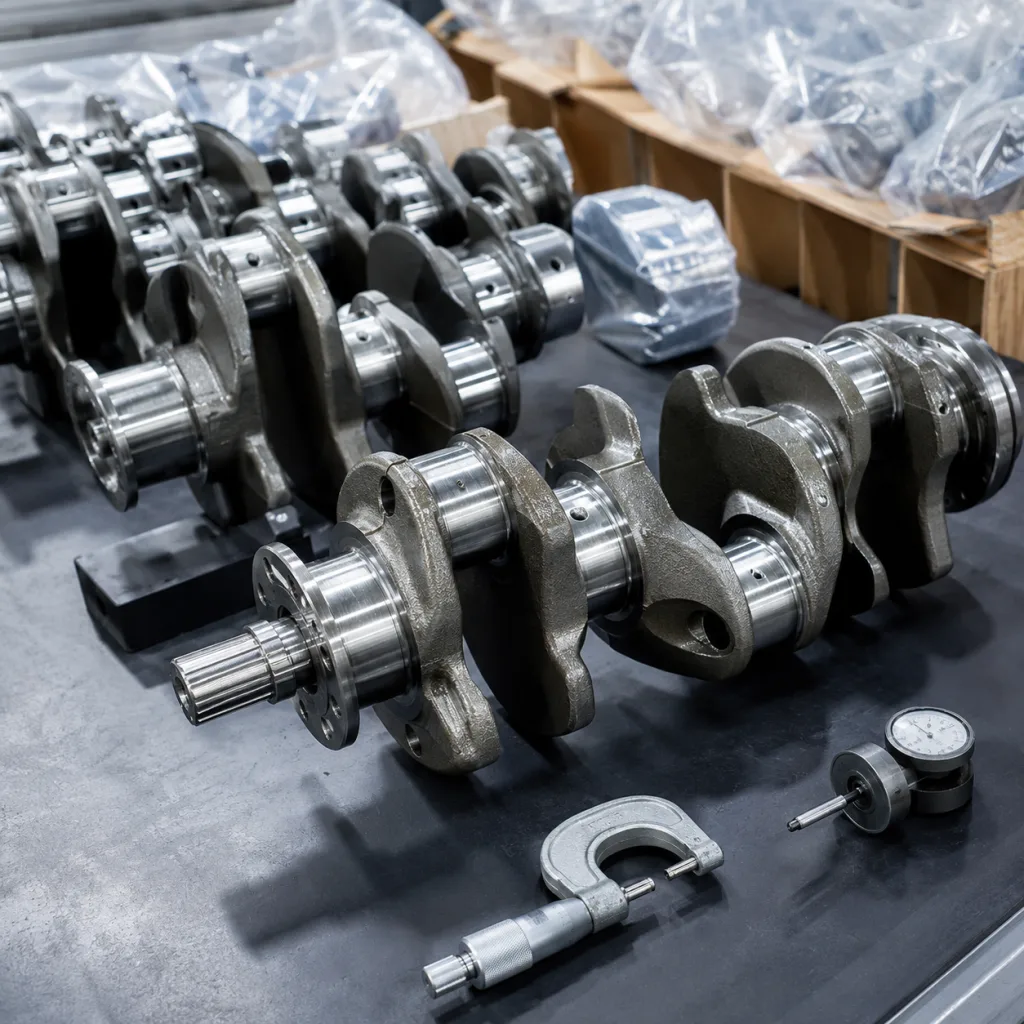
For importers, distributors, and programme buyers sourcing Skoda-fit engine bearings, supplier selection should go well beyond unit price. A dependable bearing manufacturer must control material selection, overlay consistency, crush height, oil clearance, packaging traceability, and batch documentation across repeat shipments. Driventus manufactures engine and powertrain components in Taizhou, Zhejiang, exports to more than 60 countries, and works under production controls aligned with IATF 16949:2016 and ISO 9001:2015. This guide explains how to evaluate an engine bearing Skoda OEM supplier for aftermarket and private-label programmes without implying vehicle manufacturer approval. It covers purchasing criteria, technical validation, MOQ and lead-time planning, documentation, fitment data, and audit questions that help sourcing teams compare factories using evidence rather than presentation claims. Driventus is an independent aftermarket manufacturer; brand names are referenced for fitment only.
What Buyers Should Confirm Before Supplier Approval
A Skoda-fit bearing programme may include main bearings, connecting rod bearings, thrust washers, and repair-size options for petrol and diesel engine families. Before issuing a purchase order, procurement teams should confirm that the supplier can manage both catalogue continuity and engineering control.
Key supplier approval checks include:
Business scope: engine bearing manufacturing, inspection, and export capability, not trading alone.
Quality certification: current IATF 16949:2016 and ISO 9001:2015 certificates with a relevant, valid scope.
Application control: fitment mapping by engine code, dimensions, and generic OE-style references such as OE 06A... only where applicable.
Drawing control: defined specifications for wall thickness, locating lug, oil groove, oil hole, crush, and spread.
Material control: steel backing, intermediate layer, overlay, and surface finish requirements.
Batch traceability: lot-number links between raw material, production date, inspection result, and shipment.
Export readiness: neutral, private-label, or distributor packaging with barcode and carton labelling options.
A credible engine bearing Skoda OEM supplier should be able to provide samples, dimensional reports, and a production control plan before mass production. Buyers can review related engine part categories in our catalog, including engine components for bundled sourcing.
Technical Requirements for Skoda-Fit Engine Bearings
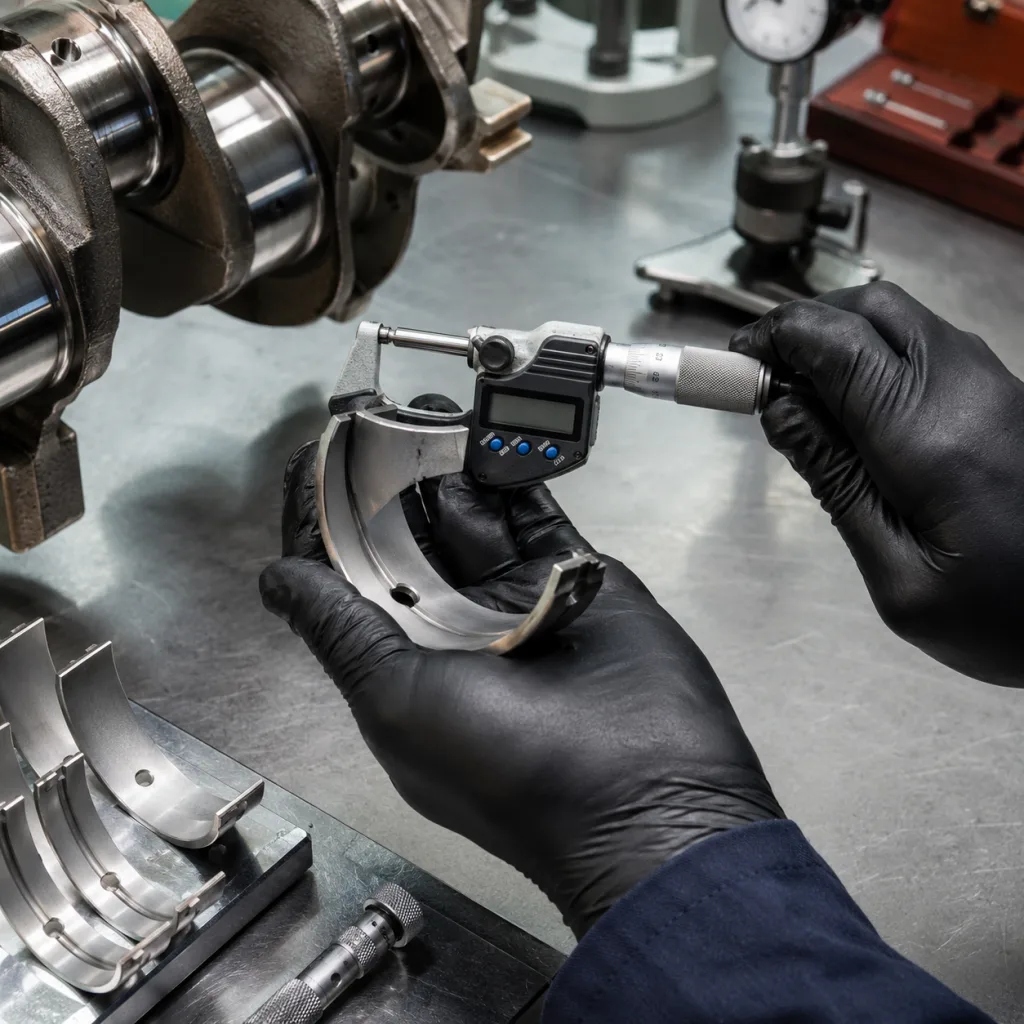
Engine bearings work under hydrodynamic lubrication, high cyclic loading, and repeated thermal expansion. Small dimensional deviations can change oil film behaviour, crankshaft contact, noise, and service life. Procurement teams should therefore evaluate technical capability through measured data, not visual appearance alone.
Item
What to Check
Procurement Relevance
Wall thickness
Controlled by calibrated gauge and sampling plan
Affects oil clearance and crankshaft fit
Crush height
Verified against housing bore requirements
Supports bearing retention after cap torque
Bearing spread
Checked before assembly
Helps shell positioning during installation
Overlay condition
Visual and metallurgical inspection
Reduces early scuffing risk
Oil holes and grooves
Position and edge finish inspection
Maintains oil feed alignment
Thrust face
Parallelism and surface finish
Controls crankshaft end float
Repair sizes
Standard and undersize options
Supports aftermarket engine rebuilding demand
</tr></thead><tbody> </tbody></table>Common bearing constructions include bi-metal and tri-metal designs. Bi-metal bearings may suit standard replacement ranges where cost, durability, and broad availability need to be balanced. Tri-metal bearings are often selected where load capacity, fatigue resistance, and seizure resistance are higher priorities. The final specification should match the engine family, crankshaft condition, target market, service expectations, and warranty policy.
Driventus can support custom manufacturing when buyers require controlled dimensions, private tooling, package artwork, or inspection criteria for a specific distributor programme.
Certification, Testing, and Factory Audit Evidence
For regulated markets in the EU, UK, US, Canada, Australia, and Brazil, documentation quality matters as much as sample appearance. IATF 16949:2016 and ISO 9001:2015 do not approve a part for a vehicle brand, but they indicate whether the factory operates a structured management system for automotive production.
Useful audit evidence includes:
Process flow diagram for cutting, forming, coating or plating, finishing, inspection, and packing.
Control plan covering key product characteristics and inspection frequency.
Measurement system analysis for critical gauges where applicable.
Incoming material records and supplier qualification files.
In-process inspection reports for dimensions and visual defects.
Final inspection report linked to shipment lot number.
Nonconforming product procedure and corrective action records.
Packaging drop or handling checks when export cartons are customised.
Environmental and chemical compliance should be discussed early, especially when the importer must maintain customer compliance files. For European customers, REACH (EC) No 1907/2006 may affect material declarations, coating information, and packaging documentation. Buyers should request composition information, plating or coating declarations, and packaging material details where required by their import process.
Driventus maintains a documented quality system for production control, inspection records, and continuous improvement activities. Factory audits can be arranged for qualified B2B sourcing projects.
MOQ, Lead Time, and Programme Planning
The purchasing model for engine bearings differs from spot buying finished consumer parts. A strong range requires stable coverage, repair-size availability, and repeatable carton configuration. MOQ and lead time depend on shell type, material, size range, packaging, tooling status, and whether the order uses a current catalogue specification or custom development.
Typical planning factors:
Standard catalogue items: lower MOQ when existing tooling and packaging are available.
Private-label packaging: higher MOQ because printed boxes, labels, and carton marks must be scheduled.
New application development: longer lead time for drawing confirmation, sample production, validation, and packaging setup.
Mixed container orders: useful for distributors combining bearings with gaskets, pistons, water pumps, and other engine components.
Forecast-based supply: recommended for high-turning Skoda-fit applications to reduce stock gaps.
For new customers, the first order often includes sample approval, a small pilot quantity, and then a scheduled production order. Import managers should align the supplier’s production calendar with vessel booking, customs documentation, and warehouse launch dates. Clear forecasts also reduce the risk of inconsistent batch availability across main bearings, rod bearings, and thrust washers.
When assessing an engine bearing Skoda OEM supplier, ask whether repeat orders can be produced from the same approved specification without uncontrolled material, dimensional, or packaging changes.
Cross-Reference Control and Fitment Data
Cross-reference accuracy is one of the main commercial risks in aftermarket engine bearing sourcing. A bearing set may appear visually similar but differ in lug position, oil groove pattern, thrust configuration, wall thickness, or repair-size marking. Fitment should be controlled through dimensions and engine application data, not copied from unverified online lists.
For Skoda applications, buyers may use internal references, distributor SKUs, engine codes, and generic OE-style references such as OE 06A... when they already exist in the customer’s data set. Brand names should be used only to identify fitment. Driventus is an independent aftermarket manufacturer; brand names are referenced for fitment only.
Recommended data fields for a sourcing file:
Buyer SKU and supplier part number.
Engine code or displacement family.
Bearing type: main, connecting rod, thrust washer, or set.
Standard size and repair sizes.
Quantity per engine or per set.
Critical dimensions and tolerance range.
Packaging unit, carton quantity, and barcode requirement.
Cross-reference notes and validation status.
This controlled data structure reduces shipment disputes, supports incoming inspection, and helps catalogue teams publish application data consistently across regional markets.
How to Compare Supplier Quotations
A low quotation is not useful if it excludes inspection reports, packaging, repair sizes, or stable repeat supply. When comparing suppliers, buyers should separate product cost from total programme cost: tooling, samples, artwork, inspection documentation, logistics readiness, claim handling, and reorder stability all affect the real purchasing outcome.
Quotation Item
Low-Risk Requirement
Question to Ask
Unit price
Linked to exact specification
Is the material and bearing structure confirmed?
MOQ
Realistic for sales velocity
Can mixed applications share production or packing runs?
Lead time
Includes packaging and inspection
Does timing start after artwork and sample approval?
Documentation
Batch inspection and traceability
Which reports ship with each order?
Packaging
Export-ready and scannable
Are labels, barcodes, and carton marks controlled?
After-sales support
Corrective action process
How are fitment or dimensional claims investigated?
</tr></thead><tbody> </tbody></table>For OEM / Tier-1 style sourcing, the supplier should also be able to discuss PPAP-style documentation where required by the buyer, although the exact submission level should be agreed contractually. For aftermarket distributors, the priority may be stable availability, clear application data, and packaging that matches warehouse operations.
Procurement teams can request a quote with target applications, annual forecast, packaging requirements, and any available drawings or measurement data.
Frequently asked questions
Yes. Driventus supports neutral and private-label packaging for qualified B2B orders, subject to MOQ, artwork approval, carton labelling requirements, and export schedule. Fitment references must be verified against buyer data and dimensions.
No. IATF 16949:2016 is a quality management system standard for automotive production. It does not mean approval or endorsement by any vehicle manufacturer. Driventus is an independent aftermarket manufacturer; brand names are referenced for fitment only.
Send bearing type, application or engine code, quantity forecast, standard and repair-size needs, packaging format, target market, and any drawings or sample measurements. This allows Driventus to confirm tooling, MOQ, lead time, and inspection documents.
For Skoda-fit engine bearing sourcing, share your application list, forecast volume, and packaging requirements with the Driventus team. Start a purchasing review at /contact.html