Procurement teams sourcing RAM engine bearings usually need more than a price list. They need stable bearing materials, controlled wall thickness, disciplined fitment cross-references, shipment documentation, and a supplier that can support distributor, fleet-repair, and remanufacturing demand without uncontrolled substitution. Driventus Auto Parts manufactures engine and powertrain components in Taizhou, Zhejiang, and exports to more than 60 countries. For buyers comparing an engine bearing ram supplier, the key evaluation points are material construction, dimensional control, batch traceability, certification, packaging, and the ability to support private-label or controlled cross-reference programs. This article explains how to assess supply capability, what specifications to confirm before placing a blanket order, and how Driventus supports B2B purchasing workflows for aftermarket distributors, OEM/Tier-1-style projects, and multi-location repair chains. Driventus is an independent aftermarket manufacturer; brand names are referenced for fitment only.
What B2B buyers should verify before selecting a supplier
Engine bearings are tolerance-sensitive wear components. A low unit price does not reduce sourcing risk if overlay consistency, crush height, bore fit, or oil-clearance control is weak. Before approving a supplier for RAM applications, procurement and quality teams should review evidence across four areas: production control, dimensional validation, material verification, and logistics discipline.
A practical supplier review should include:
Business scope: manufacturer, trading company, or mixed supply model. Ask which operations are in-house and which are subcontracted.
Certified management systems: IATF 16949:2016 and ISO 9001:2015, with certificate scope covering relevant engine-component manufacturing or machining activities.
Product scope: main bearings, connecting rod bearings, thrust washers, flange bearings, and repair sizes such as STD, 0.25 mm, 0.50 mm, and 0.75 mm where applicable.
Material control: backing steel grade, lining alloy, intermediate layer, overlay system, plating thickness, and approved material specifications.
Batch traceability: steel coil or strip lot, alloy batch, production date, inspection record, packing lot, operator or machine record, and retained sample policy where required.
Export documentation: commercial invoice, packing list, certificate of origin where required, bill of lading or airway bill data, and material declarations.
Compliance handling: REACH (EC) No 1907/2006 substance communication for EU importers where applicable, plus RoHS-style declarations if the buyer’s channel requires them.
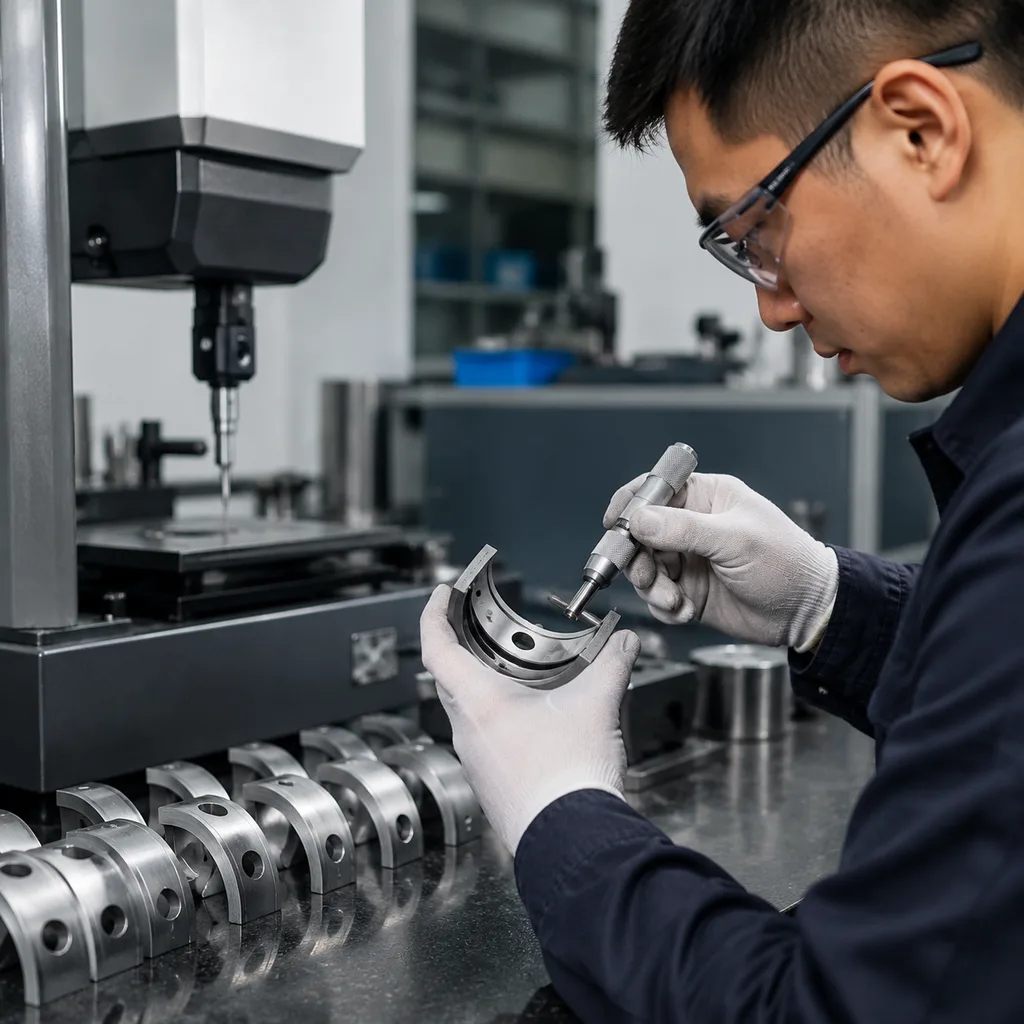
For a first qualification order, buyers should normally request 5 to 20 sample sets per key reference, then run incoming inspection against at least 10 pieces or 100% of the sample quantity if the sample lot is small. Practical dimensional checks usually include wall thickness repeatability, shell width, oil-hole position, tang position, and visual inspection for burrs, scratches, flaking, contamination, and edge damage.
Driventus operates as a vertically integrated Chinese manufacturer of engine and powertrain components, with export workflows designed for distributors, importers, and repair networks. Buyers can review related engine parts in our catalog and discuss bearing program requirements with engineering and export sales before order confirmation.
Bearing construction and specification points to control
For RAM engine bearing programs, buyers should not rely only on vehicle names or broad application descriptions. The purchase file should define construction, grade, size range, packaging, and inspection criteria. This is especially important for distributors managing several engine families, crankshaft repair sizes, and set configurations under one catalog program.
Typical aftermarket engine bearings use steel-backed bi-metal or tri-metal construction. A common bi-metal design uses a low-carbon steel backing with an aluminium-tin lining, often selected for durability and compatibility in many light-duty service conditions. A common tri-metal design uses steel backing, copper-lead or copper-based intermediate lining, and a thin soft overlay to improve conformability and seizure resistance in higher-load applications. The final selection should be based on engine duty cycle, oil quality, crankshaft condition, and the buyer’s validated specification.
Specification item
What to confirm
Practical target or check point
Bearing type
Main bearing, rod bearing, thrust bearing, thrust washer, or complete set
Confirm set count, upper/lower shell differences, oil groove style, and thrust location
Material system
Steel-backed bi-metal or tri-metal construction
Match buyer drawing or sample; do not accept unapproved material substitution
Overlay and lining
Copper-lead, aluminium-tin, or specified equivalent
Confirm lining alloy and overlay system; request material declaration with batch link
Size range
Standard, 0.25 mm, 0.50 mm, 0.75 mm, or 1.00 mm repair size where available
Mark each size separately on shell, inner pack, set box, and master carton
Wall thickness
Controlled per drawing and inspection plan
Common buyer tolerance window is often within ±0.005 to ±0.010 mm, subject to drawing
Crush height
Verified during sampling and mass production
Check in a defined fixture or housing condition; document method and limit
Surface finish
Visual and roughness checks as specified
Typical running-surface Ra target is often below 0.4 µm unless drawing specifies otherwise
Free spread and fit
Shell geometry before installation
Prevents loose shells, assembly difficulty, or loss of seating force
Marking and packing
Neutral, customer label, or private label
Include part number, size, position, production lot, and quantity for inventory control
</tr></thead><tbody> </tbody></table>A technically complete RFQ should include engine code, model year range, bearing position, repair size, annual quantity, target market, and required packaging. If a buyer uses OE part-number cross-references, they should be written in generic fitment format, such as OE 06A… or OE 11251…, unless the buyer provides its own authorised cross-reference list. Driventus does not claim approval, sponsorship, or endorsement by any vehicle manufacturer.
MOQ, lead time, and export packing expectations
An engine bearing ram supplier should be evaluated on fulfilment reliability as well as technical specification. For aftermarket distributors, demand is often split between fast-moving standard sizes and slower repair oversizes. For remanufacturers and repair chains, repeatability of set configuration and packing accuracy can be as important as total container volume.
Typical sourcing variables include:
MOQ by SKU, bearing position, or complete bearing set.
Mixed-SKU carton policy for trial orders and market launches.
Standard production lead time after sample approval.
Private-label artwork approval time and packaging material lead time.
Carton strength for sea freight, air freight, and parcel redistribution.
Pallet specification for EU, UK, US, Canada, Australia, Brazil, or other import channels.
Barcode, QR code, or customer part-number label requirements.
Corrosion protection, inner wrapping, and segregation of standard versus repair-size parts.
As a planning guide, trial orders are often structured at 100 to 300 sets per fast-moving reference, while repeat replenishment programs may be planned at 300 to 1,000 sets per SKU depending on material availability, packaging format, and whether the part is produced from existing tooling. Slow repair sizes can sometimes be combined into mixed programs if the total production run is efficient. Pricing usually improves when the buyer consolidates references by bearing family, confirms a 6- to 12-month forecast, and avoids repeated small private-label carton runs.
Lead time should be separated into three stages: sample preparation, sample validation, and mass production. For existing items with available material and tooling, samples may typically be prepared in about 10 to 20 working days. New or revised items may require 25 to 45 working days depending on drawing confirmation, tooling, and trial inspection. After approval, mass production is commonly planned in the 30 to 60 day range, with private-label cartons, special labels, or large mixed-SKU programs adding time if artwork or packaging materials are not approved early.
Driventus can support several purchasing structures, including scheduled blanket orders, mixed-SKU replenishment, and project-based production for defined engine families. Lead time depends on material availability, tooling status, order quantity, inspection requirements, and packaging complexity. Buyers should separate sample lead time from mass-production lead time in purchase contracts so engineering approval does not obscure shipment planning.
For distributors, neutral packaging can reduce launch time and simplify first shipments. For established programs, customer-branded boxes and carton labels improve warehouse picking accuracy and downstream channel presentation. Packaging should protect bearing shells from impact, corrosion, moisture, and mixed-position errors during long-distance transport. A practical export pack uses oil paper or anti-corrosion film around bearing shells, position-separated inner packs, set boxes or trays, 5-layer export cartons, carton weight typically controlled below 20 kg where possible, and pallets with stretch film plus corner protection for LCL or FCL shipment.
Factory audit and quality documentation
A credible supplier should be ready for document review and, where commercially justified, factory audit. Driventus maintains an automotive quality management framework aligned with IATF 16949:2016 and ISO 9001:2015. Buyers can review our quality system before requesting project documents.
A bearing supplier audit can cover:
Incoming material inspection and supplier control, including steel-strip certificates, alloy declarations, plating chemistry records, and approved-supplier lists.
Stamping, blanking, forming, boring, broaching, grooving, drilling, plating, surface treatment, deburring, washing, drying, and rust-prevention process control.
Calibration records for micrometers, bore gauges, height gauges, roughness testers, profile measurement tools, hardness testers, and optical projectors.
In-process inspection frequency and reaction plans for nonconforming parts, including first-piece approval at shift start and after tooling adjustment.
Final inspection records by lot, including dimensional, functional, visual, packaging, and label checks.
Traceability from raw material to finished cartons, ideally linking coil/strip lot, machine batch, inspection report, and master-carton number.
Corrective action process using 8D or an equivalent structured method, with containment timing and root-cause evidence.
Warehouse segregation for approved, pending, and rejected goods.
Packing inspection and label verification before shipment release.
Documents to request before approval
For new programs, procurement teams commonly request a capability summary, inspection plan, dimensional report, material declaration, packaging specification, sample approval record, and traceability example. Where the buyer operates under an OEM or Tier-1 purchasing model, additional PPAP-style documentation may be requested depending on the project scope. Published management standards such as IATF 16949:2016 and ISO 9001:2015 define system expectations, but the buyer and supplier should still agree on part-specific inspection criteria, acceptance limits, and change-control rules.
A useful inspection plan should state the actual characteristic, tool, sample size, frequency, and acceptance limit. For example, wall thickness may be checked with a calibrated point micrometer at defined locations; roughness may be checked with a profilometer on the running surface; width and tang geometry may be checked by caliper, gauge, or profile projector; and coating appearance may be checked under defined lighting. For production orders, buyers can request AQL-based final inspection, commonly AQL 1.0 for major defects and AQL 2.5 for minor cosmetic defects, unless the buyer’s own standard requires tighter control.
Custom manufacturing and cross-reference control
Some buyers require replacement coverage for existing aftermarket references. Others need a controlled bearing set for a remanufacturing operation, private-label range, or regional application catalog. Driventus supports custom manufacturing for projects where the buyer can provide drawings, samples, dimensional targets, validated application data, or a confirmed interchange list.
Cross-reference management should be handled carefully. A bearing set may appear interchangeable by vehicle name, but crankshaft journal dimensions, thrust location, production year, shell width, locating tang position, oil-hole pattern, oil-groove shape, and repair oversize can change the actual fitment. Procurement teams should maintain a controlled application file rather than relying on informal catalogue copying or unverified online interchange data.
Recommended controls include:
One internal buyer part number per confirmed specification.
Separate SKUs for standard and undersize/oversize repair dimensions.
Separate records for upper shell, lower shell, flanged shell, thrust washer, and full set where designs differ.
Drawing, sample, or dimensional approval before mass production.
Inspection reports tied to each production batch.
Clear packaging labels showing size, bearing position, set quantity, and production lot.
Written approval for any material, process, tooling, coating, marking, or packaging change.
Periodic catalog review when vehicle applications or service data are updated.
For custom programs, the fastest path is to provide 2 to 5 physical sample sets plus any available drawings or measured data. The approval loop normally includes sample receipt, reverse measurement, material review, drawing confirmation, trial production, dimensional report, buyer validation, and controlled release for mass production. If the buyer does not have drawings, Driventus can discuss measurement from samples, but the buyer should still validate the final application data and service-market coverage.
If the buyer is launching a RAM bearing program alongside pistons, gaskets, water pumps, timing parts, or other engine components, related product categories can be reviewed under engine components. This helps importers consolidate inspection, packing, shipment planning, and supplier communication with one manufacturing group.
How to structure an RFQ for faster quotation
A complete RFQ reduces clarification cycles and helps the supplier quote realistic cost, MOQ, and delivery. When contacting Driventus as an engine bearing ram supplier, include the technical and commercial details that affect material planning, production routing, inspection workload, and packaging preparation.
Suggested RFQ checklist:
Vehicle application and engine family, if available.
Engine code, displacement, model year range, and market region when known.
Bearing type: main, rod, thrust, thrust washer, or complete set.
Size: standard or repair oversize, such as STD, 0.25 mm, 0.50 mm, 0.75 mm, or 1.00 mm where required.
Existing reference number, drawing, sample, or validated cross-reference list.
Annual forecast, first order quantity, and expected reorder frequency.
Target EXW, FOB, CIF, DAP, or other Incoterms if pricing comparison requires it.
Target market: EU, UK, US, Canada, Australia, Brazil, or other region.
Required certification documents and compliance statements.
Packaging format: neutral, private label, bulk, or set box.
Label data: buyer part number, barcode, country of origin, size marking, production lot, and carton quantity.
Sample quantity and validation plan, including whether the buyer needs dimensional report only or installation/bench validation support.
Required Incoterms, destination port, and preferred shipment mode.
For trial orders, it is useful to identify the top 10 to 30 fastest-moving references and a smaller group of repair sizes. This gives the supplier enough volume to plan production while allowing the buyer to validate fitment, packaging, receiving inspection, and sell-through. A practical first RFQ can include an A/B/C forecast: A-items at 500 to 1,000 sets per year, B-items at 200 to 500 sets per year, and C-items or repair sizes at 50 to 200 sets per year. This helps the supplier recommend whether to quote by existing stock program, scheduled production, or combined batch.
To avoid price revisions, buyers should specify whether the quotation must include private-label box cost, barcode labels, palletizing, export carton printing, inspection reports, and sample freight. Tooling or fixture cost, if any, should be quoted separately from unit price. To begin a structured quotation, buyers may request a quote with their application list and target launch schedule.
Frequently asked questions
Yes. Driventus can support neutral packing, customer label packing, and private label programs subject to MOQ, artwork approval, and packaging specification. Labels can include buyer part numbers, size markings, barcodes, country-of-origin details, production lot numbers, and carton data for warehouse control.
Typical documents include certification evidence for IATF 16949:2016 and ISO 9001:2015, inspection plans, dimensional reports, material declarations, packing specifications, sample approval records, and traceability records. Additional PPAP-style or project-specific documents can be discussed during RFQ review.
No. Driventus is an independent aftermarket manufacturer; brand names are referenced for fitment only. The company supplies parts designed for aftermarket replacement or customer-defined programs and does not claim vehicle manufacturer approval or endorsement.
If you are comparing suppliers for a RAM engine bearing program, send your application list, target MOQ, annual forecast, repair-size mix, and packaging requirements for review. Contact Driventus here: /contact.html