A good engine bearing Mitsubishi supplier is not just a catalogue match. The decision affects warranty risk, crankshaft protection, distributor stock turns, workshop trust, and customs documentation. One wrong undersize, weak crush height, or untraceable batch can turn a low-cost purchase into an engine-removal claim.
Driventus manufactures engine and powertrain components in Taizhou, Zhejiang for B2B aftermarket distributors, OEM/Tier-1 programmes, and multi-location repair chains. Our engine bearing range supports common Mitsubishi passenger, light commercial, and selected industrial engine applications. Cross-reference work is based on buyer-provided OE references, samples, drawings, application data, and market requirements.
Driventus is an independent aftermarket manufacturer; vehicle brand names are used only for fitment reference. Use this guide as a sourcing framework: define the part, test the quotation, control the inspection points, audit the factory, and build an RFQ that leaves little room for assumption.
Start With the Part Definition, Not the Engine Name
A Mitsubishi engine family may use different bearing layouts across markets, repair sizes, production years, or overhaul practices. Start with the controlled part definition before discussing price. Confirm the bearing family, position, size code, repair undersize, set composition, quantity plan, and intended programme type.
The buying route changes the specification. Aftermarket distributors usually need broad coverage, mixed-SKU ordering, durable retail packaging, and repeat replenishment. OEM and Tier-1 buyers usually need drawing control, sample approval, PPAP-style files, and stricter change-management rules.
A quotation should lock down these points:
Main bearing, connecting rod bearing, thrust washer, flanged shell, or complete set configuration
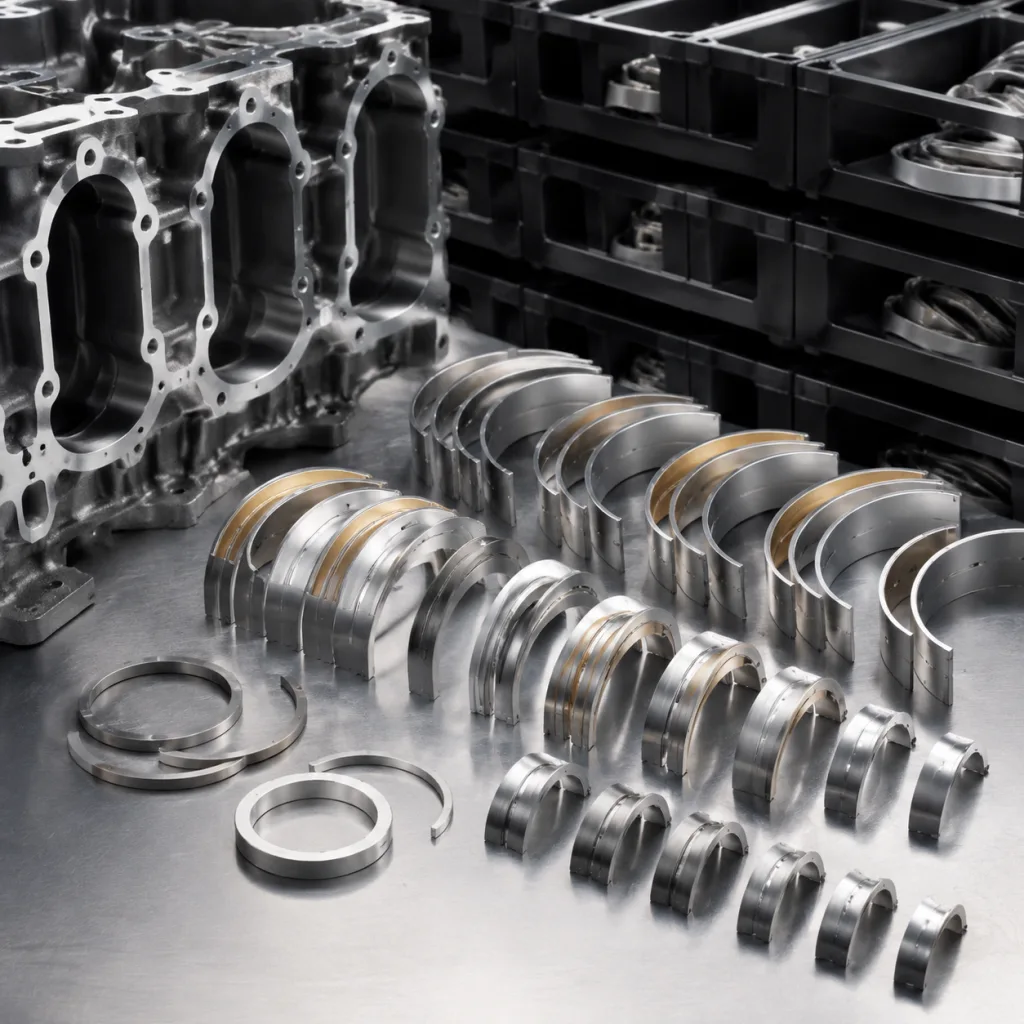
Standard and undersize options, commonly STD, 0.25 mm, 0.50 mm, and 0.75 mm where applicable
Material route, such as steel-backed aluminium alloy or copper-lead based tri-metal design where specified
Nominal wall thickness, half-shell width, flange or thrust width, and agreed inspection locations
Oil groove, locating tang, chamfer, parting-line relief, and thrust face geometry
Batch traceability by production lot, strip or lining material lot, inspection record, and carton label
Export carton dimensions, gross weight, palletisation, barcode format, and corrosion-protection method
Do not treat catalogue interchange as engineering equivalence. Two bearings may fit the same engine family yet differ in overlay thickness, eccentricity, oil-groove layout, crush height, tang position, or thrust-face design. Those differences influence lubrication, housing retention, and durability after installation.
For high-volume or warranty-sensitive orders, request controlled drawings, approved samples, and a dimensional inspection report before a blanket order. Buyers can review related engine components in our catalog and use custom manufacturing when a private drawing, sample-based development, or controlled specification is required.
Compare Terms by Total Risk, Not Unit Price
A cheap bearing set is not cheap if it creates mixed undersizes, corrosion claims, carton collapse, or slow containment after a workshop failure. Commercial comparison should include landed cost per sellable set, defect allowance, shelf-life expectation, packaging durability, claim response time, and the supplier’s ability to hold the same material and dimensions over repeat orders.
For a useful RFQ, state annual demand, first order quantity, destination port, packaging preference, target market, required certificates, and whether mixed-SKU shipment is acceptable.
Item
Typical procurement check
Notes for buyers
MOQ
100-300 sets per stocked SKU or USD 3,000-8,000 mixed order value
Lower MOQ may be possible for slow-moving stocked references; new development normally needs batch planning
Lead time
30-60 days after order confirmation
Stocked references may ship faster; new lining, overlay, inspection, or packaging work can extend timing
Samples
7-20 days if existing tooling is available
3-10 sample sets per reference is common; dimensional report should accompany approval samples
Price logic
By material, size, process, volume, and packaging
Tri-metal, thrust-face, private label, and low-volume references normally cost more than standard aluminium designs
Payment term
By agreement and credit review
First orders often use deposit plus balance before shipment; repeat buyers may negotiate staged terms
Packaging
Neutral, private label, bulk, or kit box
Private label artwork, barcode rules, inner bag, VCI paper, and carton drop strength should be approved before production
Country-specific customs, origin, REACH, or customer compliance documents should be confirmed at RFQ stage
</tr></thead><tbody> </tbody></table>Ask the supplier to explain what is included and what is excluded. Is the inspection report standard or charged separately? Are barcodes verified? Is VCI paper included in the quoted pack? Can cartons survive export handling and warehouse stacking? These questions matter because bearing failures can involve crankshaft damage, engine removal labour, replacement parts, and vehicle downtime.
Spec Deep-Dive: Dimensions That Decide Bearing Performance
Engine bearings operate under mixed and hydrodynamic lubrication. Small dimensional shifts can change oil film stability, housing retention, crankshaft clearance, and thrust control. The drawing or approved sample should define measurement datum, sampling plan, gauge type, fixture method, and acceptance tolerance.
Critical checks include:
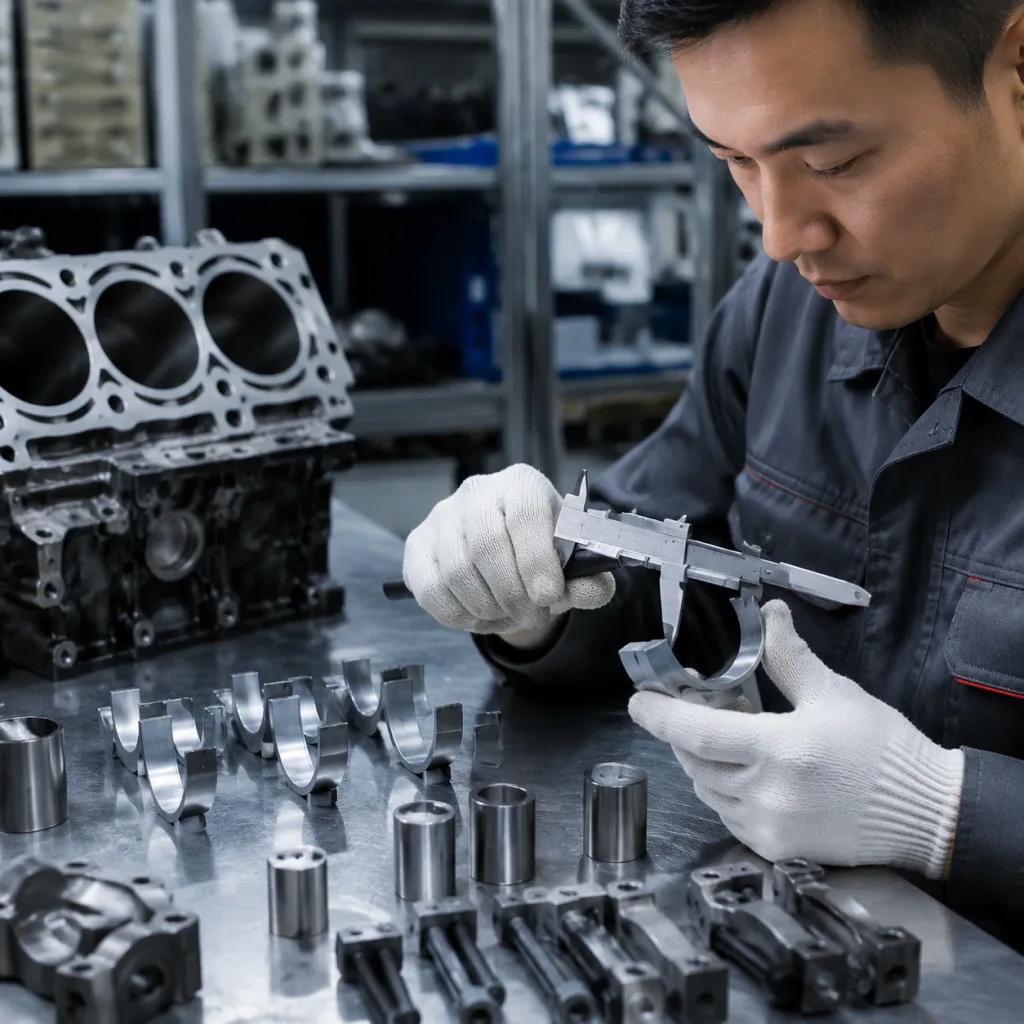
Wall thickness: measure with calibrated gauges at defined points; buyers often request reports to 0.001 mm resolution where the design requires it
Bearing crush: verify with a fixture and defined load method; do not accept only a visual or hand-fit check
Free spread: check before cap tightening so the half-shell installs correctly and does not feel loose in handling
Inside diameter after assembly: confirm in a housing fixture when clearance validation is required, especially for warranty-sensitive programmes
Width and thrust face: measure the running face and flange area; thrust washers and flanged shells need side-clearance control
Surface finish: inspect the running layer and parting faces against the drawing or approved master sample
Oil hole and groove alignment: prevent blocked oil feed, edge loading, or incorrect upper/lower shell pairing
Overlay or lining condition: check bonding, porosity, scoring, wiping, contamination, and corrosion after washing and packing
Hardness and structure: test according to the approved material route, with records linked to material batch and production lot
Management certificates help, but they do not replace product validation. Driventus operates under IATF 16949:2016 and ISO 9001:2015, with incoming inspection, process control, final inspection, calibration management, and corrective-action procedures. Buyers can review our quality system before scheduling an audit or requesting a supplier questionnaire.
For EU or UK-linked supply chains, confirm restricted-substance declarations against REACH (EC) No 1907/2006 where applicable. Packaging may also need recycling marks, local-language labels, corrosion protection, and treated wood pallets. Set these requirements before sample approval, not after production.
Audit Failure Modes Before They Reach the Carton
A factory audit should answer one question: can this supplier repeat the same bearing over many lots? First samples are not enough. Follow one real reference from material receipt through strip storage, blanking, forming, machining, broaching, surface treatment, washing, inspection, packing, storage, and final carton labelling.
Use the audit to expose failure modes:
Unverified steel strip, aluminium lining, copper-lead lining, overlay, or anti-corrosion material entering production
Incoming thickness, width, hardness, surface condition, or material identity released without evidence
Forming dies, broaching tools, gauges, or inspection fixtures used without identification, protection, maintenance, or records
Similar half-shells, upper/lower positions, thrust variants, or undersize references mixed in the same work area
First-off, in-process, or final inspections recorded without frequency, acceptance criteria, operator sign-off, or escalation rules
Calibration gaps for micrometers, dial indicators, bore gauges, surface roughness testers, hardness equipment, or custom fixtures
Washing that leaves abrasive particles, lint, moisture, fingerprints, or corrosion risk before inner packing
Inspection records that cannot be linked to carton, pallet, or shipment labels within 24 hours of a claim
Weak field-claim response, including unclear containment, root cause analysis, corrective action, replacement policy, or recurrence prevention
For OEM and Tier-1 projects, request APQP-style planning, control plans, process flow charts, FMEA, material reports, MSA, capability data for critical dimensions, and sample submission records. These files should match the agreed drawing and inspection standard. If traceability from material receipt to finished carton is unclear, the programme is high risk even when the first sample looks correct.
Scenario: Multi-Market Fitment Without Catalogue Chaos
A distributor may sell Mitsubishi-related engine bearings into several regions at once. The same engine family can appear with different vehicle names, production years, fuel types, repair practices, and supersession histories. Brand names alone are not a safe sourcing basis.
A cleaner approach combines engine code, bearing position, standard or undersize, crankshaft repair requirement, sample photos, buyer-owned reference numbers, and known supersession notes. Where the buyer supplies an OE reference, record it in a controlled format such as OE 11251… or the buyer’s internal number.
Driventus can support cross-reference work using buyer-provided data, sample inspection, and catalogue mapping. We do not claim approval or endorsement by any vehicle manufacturer; all vehicle names are used only to identify intended applications.
For multi-market distributors, control these fitment variables:
Country-specific engine variants, production years, fuel type, and market code
Standard versus undersize crankshaft repair demand, including 0.25 mm and 0.50 mm stocking ratios by market
Kit composition differences between main bearing sets, conrod bearing sets, thrust washer sets, and overhaul kits
Labelling language requirements for EU, UK, US, Canada, Australia, Brazil, and other target markets
Stock rotation for slow-moving oversize or undersize references, with batch age visible in warehouse records
Supersession rules when buyer reference numbers, catalogue numbers, or packaging labels change over time
A disciplined supplier will flag an uncertain cross-reference instead of forcing a match. That reduces returns, protects distributor credibility, and helps repair workshops order the correct bearing set the first time.
Step-by-Step RFQ That Prevents Rework
A strong RFQ makes the supplier quote the same product the buyer expects to receive. Use one structured spreadsheet. Avoid fragmented emails, screenshots, and catalogue-only requests.
Build the RFQ in this order:
1. Define the part description: main bearing, conrod bearing, thrust washer, flanged shell, or complete set 2. Add engine code, application notes, model years, market region, and fuel type where known 3. List standard and undersize range required, including STD, 0.25 mm, 0.50 mm, and 0.75 mm where applicable 4. State annual forecast, first order quantity, reorder frequency, and mixed-SKU shipment requirement 5. Specify target market and required compliance documents, such as inspection report, material declaration, or REACH statement 6. Confirm packaging type, label layout, barcode format, VCI or oil-paper protection, inner quantity, and carton strength requirement 7. Define inspection report format, sample quantity, approval process, and whether master samples must be retained 8. Add Incoterms, destination port, shipment window, pallet requirements, and whether partial shipment is acceptable 9. Set claim handling expectations, response time, evidence required, and containment method for suspected batch issues 10. Include buyer reference numbers, OE references supplied by the buyer, supersession notes, and any no-substitution rules
For private label or programme-specific parts, use custom manufacturing and provide drawings, approved samples, or inspection standards. For routine replenishment, buyers can start from our catalog, then send a consolidated RFQ. If the project needs sample validation, audit documents, mixed-SKU container planning, barcode artwork, or reserved capacity, contact Driventus early so materials, inspection resources, and packaging approval fit the shipment window.
Frequently asked questions
Yes. Availability depends on the engine family, bearing position, and tooling status. Common aftermarket ranges may include STD and selected undersizes such as 0.25 mm, 0.50 mm, or 0.75 mm where applicable. Buyers should confirm engine code, required size range, sample status, annual demand, and first order quantity before quotation.
At minimum, request evidence of IATF 16949:2016 or ISO 9001:2015 certification, batch inspection records, material declarations where required, and calibration control. For higher-risk programmes, also request control plans, dimensional reports, material batch traceability, and corrective-action records. For EU-linked supply chains, REACH (EC) No 1907/2006 declarations may also be relevant.
No. Driventus is an independent aftermarket manufacturer; brand names are referenced for fitment only. We do not claim approval or endorsement by any vehicle manufacturer. Cross-references are used to help buyers identify intended applications.
For bearing RFQs, sample checks, audit documents, or mixed-SKU distributor programmes, send your requirements, target market, application data, size range, forecast quantity, packaging preference, and required documents. You can [request a quote](/contact.html).