Procurement teams sourcing bearings for Honda applications need more than a size match. They need stable metallurgy, controlled clearance, repeatable dimensional inspection, and a supplier that can document every lot with measurable process controls. For aftermarket and OEM programmes, the practical question is whether the bearing set will maintain oil film, withstand repeated thermal cycling, and fit the intended crankshaft and housing geometry without hand fitting.
Driventus supplies engine bearings from Taizhou, Zhejiang, with in-house process control aligned to IATF 16949:2016 and ISO 9001:2015. We support buyers who need OE cross-reference management, sample approval, PPAP-style submission packs, and production release for export markets in the EU, UK, US, Canada, Australia, and Brazil. Driventus is an independent aftermarket manufacturer; brand names are referenced for fitment only.
What buyers should verify first
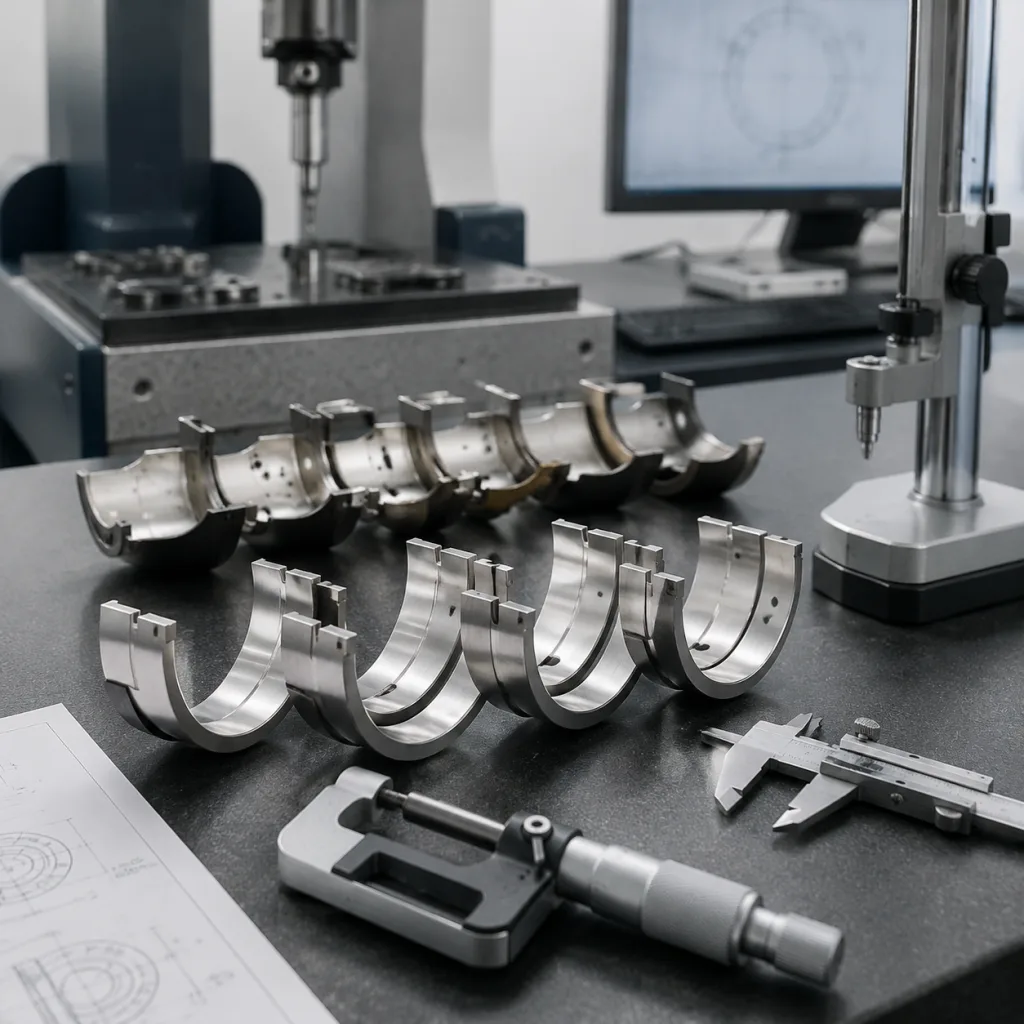
For an `engine bearing Honda OEM supplier` search, the first filter is not price. It is fitment control, clearance control, and process consistency. A bearing that is nominally correct but unstable in thickness, back-shell fit, or crush can create assembly variation and shorten service life.
Key checks:
OE cross-reference range and application coverage
Bearing type: main, rod, thrust, or flange bearing
Material system: tri-metal, aluminium alloy, or bi-metal construction
Nominal wall thickness and tolerance band
Oil clearance target versus measured journal and housing data
Back-shell fit, crush, and parting-line height control
Packaging and traceability by lot number
Documentation for IATF 16949:2016, ISO 9001:2015, and restricted-substance controls where required
For most Honda engine applications, buyers should ask for the nominal bearing size, any oversize or undersize option, and the associated clearance window before they compare suppliers. As a working check, many programmes define a nominal radial clearance around 0.020-0.060 mm depending on engine family and load case, while thrust control and crush requirements should be verified against the engine drawing and service data rather than assumed from the part number.
If you are screening suppliers, start with a drawing review and a sample set, then confirm the match against your engine code, crank journal size, housing bore data, and target clearance. For broader category sourcing, see our catalog and the engine family overview at /products/engine-components.html.
Typical engine bearing specifications
Engine bearings are small parts with tight functional requirements. Buyers should compare published data with measured data, not rely only on the part-number match.
Item
Common buyer check
Typical control target
Bearing type
Main / rod / thrust
Confirms load path and location
Construction
Bi-metal / tri-metal
Affects fatigue resistance and embedability
Wall thickness
Drawing-specific, often ±0.005 to ±0.010 mm
Controls oil clearance and crush
Back-shell thickness
Program-specific, often ±0.01 mm
Supports housing fit and retention
Pairing clearance
Measured with bore gauge or plastigage equivalent
Often set at 0.020-0.060 mm, engine dependent
Journal finish
Ra requirement from engine drawing; often very fine finish
Prevents hot spots and wipe
Eccentricity
Drawing-specific, often tightly controlled
Supports hydrodynamic film formation
Parting-line height
Program-specific
Reduces spinning and edge load
Traceability
Lot, date code, and work order
Supports claims and containment
</tr></thead><tbody> </tbody></table>The buyer-side document set should include dimensional report, material certificate, coating or overlay thickness report where applicable, packaging standard, and a sample approval record. For Honda programmes, ask whether the supplier can hold Cp/Cpk evidence on thickness or clearance-critical dimensions; many buyers treat Cpk 1.33 as the minimum release target on key characteristics, with tighter internal gates for export and warranty-sensitive programmes.
Published standards often referenced in validation include IATF 16949:2016, ISO 9001:2015, and REACH (EC) No 1907/2006 for substance control in export programmes. For performance screening on treated parts, buyers may also request test methods aligned to SAE J2527 where surface durability is relevant, although the exact test scope depends on the application.
How Honda programme sourcing is normally structured
Most buyers do not source one bearing at a time. They source against a parts list, a service level target, and a forecast.
A practical sourcing structure looks like this:
1. Identify the engine family and OE cross-reference set. 2. Confirm dimensions from the service data, not only the service label. 3. Request samples from the nominal size and any undersize or oversize variants. 4. Validate fit on the crankshaft journal and housing bore using measured tools, not visual fit alone. 5. Review packaging, barcode labels, and lot traceability. 6. Approve a pilot lot before full release. 7. Lock the reorder schedule against MOQ and lead time.
A buyer should also define the control logic up front. For example, if the program has a 3,000-unit annual demand with four SKUs, the sourcing plan may split into a 500- to 1,000-piece initial release, a 2% to 5% sample reserve, and replenishment lots sized to container efficiency rather than single-carton convenience. This matters because engine bearings are sensitive to cosmetic damage, corrosion control, and batch mixing.
For distributors and repair-chain buyers, a supplier should be able to keep repeat orders stable across multiple batches. That means controlled coating thickness, consistent shell forming, and repeatable inspection records. Driventus supports this with in-process checks, controlled packaging, and export packing designed for mixed-SKU fulfilment.
What Driventus supplies for procurement teams
Driventus manufactures engine and powertrain components for export B2B channels, including aftermarket distributors, OEM and Tier-1 supply chains, and multi-location repair groups. For bearing buyers, the commercial value is in controlled manufacturing and clear documentation.
What we can support:
OE part-number cross-references for fitment planning
Measured dimensional reports for key characteristics
Material and finish verification where the program requires it
We do not claim vehicle-maker endorsement or approval. Instead, we focus on dimensional consistency, procurement clarity, and repeatable supply. Buyers looking for factory review documents, certificates, and inspection scope can use our quality system page as the starting point for audit preparation.
From a process standpoint, procurement teams usually want three things before release: a signed sample approval, a confirmed pack standard, and a price schedule that clearly states what is included. That is the level at which sourcing becomes manageable for repeat orders.
Lead time, MOQ, and audit expectations
For buyers comparing suppliers, the commercial questions are usually the same: what is the MOQ, how long is the lead time, and how can the factory be audited?
A credible supplier should be able to explain:
Standard MOQ by part family and packaging format
Sample lead time versus mass-production lead time
Capacity for mixed-application orders
Incoming, in-process, and final inspection gates
Corrective-action response time after a claim
Price breaks tied to order size and forecast stability
Typical commercial logic is straightforward. Sample orders are usually priced higher per piece because they absorb setup, inspection, and packing overhead. Production pricing normally improves at higher volume bands, and a stable 12-month forecast can often justify better unit cost than a one-off buy. For many B2B buyers, the useful question is not simply "what is the lowest price?" but "what is the landed cost at the needed service level?" That includes packaging, export documentation, and the cost of holding buffer stock for line continuity.
In practice, lead time depends on tooling status, coating specification, and whether the item is a stock bearing or a special build. Stock-like catalog items may ship in 2 to 4 weeks after order confirmation, while special dimensions, coating changes, or private-label packaging can extend to 6 to 10 weeks depending on approval timing and raw-material availability. MOQ may be relatively low for standard catalog items and materially higher for custom marks, special packaging, or non-standard overlays.
Factory audit requests should cover process flow, traceability, calibration, incoming material checks, in-process inspection frequency, final audit criteria, and nonconformance handling. For procurement teams, a supplier audit is not a formality; it is the fastest way to check whether a quoted price is backed by stable manufacturing control.
When to request a quote
Request a quote when you have the engine code, OE reference, bearing type, quantity, and target delivery market. If the application has any risk factors, include journal diameter, housing bore, required clearance, and packaging requirements in the first enquiry.
A complete RFQ shortens the sample loop and reduces rework. It should include:
Engine family or OE reference
Bearing position and size variant
Annual forecast and first order quantity
Target Incoterms and destination port
Required documents and labels
Any special material or coating request
Target clearance window and measured journal size
Required MOQ acceptance range and expected reorder rhythm
To help price and lead-time evaluation, buyers should also state whether they need retail packaging, workshop bulk packs, or palletized export cartons. That information changes both unit cost and packing labor. If the application includes warranty exposure, request the supplier's inspection record format and the response time for nonconforming lots before you place the first order.
If you need a sourcing review for an engine bearing Honda OEM supplier programme, use request a quote to start the technical and commercial check. Driventus is an independent aftermarket manufacturer; brand names are referenced for fitment only.
Frequently asked questions
No. We use OE cross-references as a fitment reference, then confirm dimensions, variant, and packaging requirements before production release. For release, we also check journal size, housing bore, and the target oil-clearance window so the order is based on measured fitment, not only the catalog match.
Yes. We can share quality documentation, process details, inspection scope, traceability method, and dimensional reports so procurement teams can complete supplier review and audit preparation. Buyers may also request sample records, corrective-action workflow, and packaging control evidence before placing repeat orders.
The main risk is dimensional variation that affects oil clearance, crush, and journal alignment. Always verify sample fit and lot consistency before release. In practice, the biggest failure points are excessive thickness spread, poor back-shell fit, mixed lots, and clearance drift across repeat shipments.
If you are comparing suppliers for a new programme or re-sourcing an existing line, send your application data and volume target through /contact.html and we will review fitment, lead time, documentation, MOQ, and pricing structure.