engine bearing · 2026-06-08

Engine Bearing Fiat OEM Supplier Sourcing Guide

Procurement teams sourcing Fiat-fit engine bearings need more than a dimensional match. They need stable metallurgy, controlled wall thickness, traceable production lots, and export documentation that supports distributor, OEM, Tier-1, and repair-chain programmes. Driventus manufactures engine and powertrain components in Taizhou, Zhejiang, under IATF 16949:2016 and ISO 9001:2015 certified systems covering incoming material control, machining, inspection, packaging, and shipment release. This guide explains how to qualify an engine bearing Fiat OEM supplier, what data to request before sampling, and which factory controls matter for long-term supply. It is written for sourcing engineers, category buyers, and import managers comparing aftermarket and private-label supply from China. Driventus is an independent aftermarket manufacturer; vehicle brand names are referenced for fitment identification only.

What Buyers Should Confirm Before Sourcing

Fiat-fit main bearings, connecting rod bearings, and thrust washer sets are small parts with high consequence. A purchasing decision should be based on verified process capability, application accuracy, and release documentation, not only on unit price.

For first screening, ask the supplier to provide:

  • Application coverage by engine family, displacement, year range, and fuel type
  • Engine code or catalogue reference where available, supported by buyer data or reliable catalogue information
  • OE part-number cross-reference format only when supplied by the buyer, catalogue data, or approved interchange references
  • Bearing type: main, rod, thrust, flanged, or semi-flanged
  • Standard and undersize options, typically 0.25 mm, 0.50 mm, and 0.75 mm where applicable
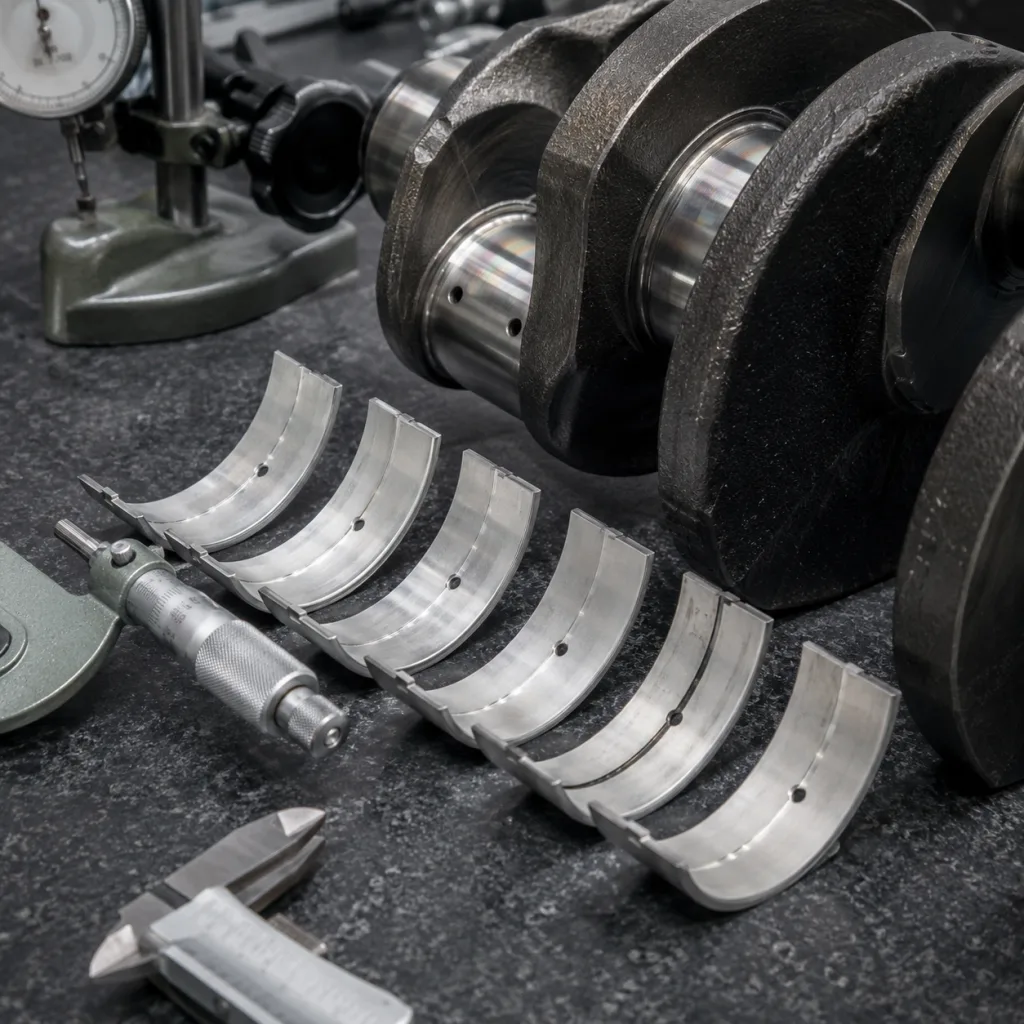
  • Material structure, such as steel-backed aluminium-tin or copper-lead overlay designs, depending on the application
  • Inspection method for wall thickness, crush height, oil-hole alignment, locating tang position, and surface condition
  • MOQ, sample lead time, production lead time, and carton/pallet packing method

A credible supplier should clearly separate catalogue fitment confirmation from vehicle manufacturer approval. Fitment references do not imply endorsement, authorisation, or approval by any vehicle brand. For broader engine component sourcing, buyers can review our catalog and engine-related product coverage before requesting drawings, samples, or interchange checks.

Factory Controls for Fiat-Fit Bearing Programmes

Engine bearing procurement is highly sensitive to variation across production lots. A few microns of uncontrolled wall thickness variation can alter oil clearance, especially after crankshaft grinding, line boring, or engine rebuilding work where tolerances are already being adjusted.

Driventus manages production under an IATF 16949:2016 and ISO 9001:2015 certified quality system. For bearing programmes, this gives buyers a basis for requesting evidence of controlled manufacturing steps rather than relying on visual inspection or final sampling alone.

Typical controls include:

</tr></thead><tbody> </tbody></table>Buyers should also ask whether nonconforming parts are segregated both physically and in ERP or batch-control records. For multi-country distribution, traceability from carton label to production batch is essential for containment if a field issue occurs. Strong lot discipline also helps importers answer customer questions quickly when multiple undersize grades or kit configurations are stocked in the same warehouse.

Specifications to Include in an RFQ

A clear RFQ reduces sampling cycles and avoids unnecessary interchange disputes. For an engine bearing Fiat OEM supplier search, buyers should provide engine application data and required commercial conditions in the same enquiry so the factory can check both technical feasibility and programme economics.

Recommended RFQ fields:

  • Vehicle application scope: Fiat model family, engine code if known, displacement, fuel type, and production years
  • Bearing position: main bearing, connecting rod bearing, thrust washer, or complete kit
  • Size grade: standard, 0.25 mm undersize, 0.50 mm undersize, or other requested grind size
  • Quantity forecast: first order, annual volume, and shipment frequency
  • Packaging: neutral, buyer brand, barcode label, kit box, or bulk service pack
  • Inspection requirement: PPAP-style sample report, dimensional layout, material certificate, or batch test record
  • Compliance needs: REACH (EC) No 1907/2006 declaration where required by the importing market
  • Logistics terms: EXW, FOB Ningbo/Shanghai, CIF, DAP, or buyer-nominated forwarder
  • Target approval process: sample quantity, test plan, approval deadline, and any importer-specific forms

For private-label or application-specific requirements, Driventus can support custom manufacturing based on buyer drawings, samples, or approved specifications. The scope should be defined before tooling review, especially when a programme requires special oil grooves, locating tang geometry, overlay material, flanged bearing details, or non-standard undersize grades. If the buyer is replacing an existing supplier, sharing historic claim data or critical-to-quality dimensions can also shorten the validation process.

MOQ, Lead Time, and Audit Expectations

Supplier qualification often slows down when commercial expectations are not aligned early. Engine bearings have lower freight volume than heavy castings, but programme economics still depend on tooling, batch setup, material availability, inspection requirements, and packaging complexity.

Typical sourcing variables include:

Control point Procurement relevance Evidence to request
Incoming strip or backing materialConfirms base material consistencyMaterial certificate, supplier lot record
Forming and sizingAffects crush, spread, and housing retentionIn-process inspection sheet
Machining or boringControls wall thickness and bore geometryDimensional report by cavity, machine, or fixture
Oil-hole and groove processingSupports lubrication flow and application fitFeature inspection record, drawing check
Surface treatmentAffects embedability, conformability, and seizure resistanceCoating or plating process record
Final inspectionConfirms shipment release criteriaAQL report or 100% check record for key dimensions
PackagingPrevents corrosion, deformation, and mixed lotsLabel sample, carton spec, pallet photo

</tr></thead><tbody> </tbody></table>Factory audits should cover more than certificates. Buyers should review calibration records, incoming inspection, process control plans, nonconformance handling, final inspection, warehouse segregation, and export packing. Remote audits can be useful for first screening, while an on-site audit gives better visibility into fixture condition, lot discipline, operator training, and whether inspection practice matches the documented control plan.

Driventus exports to 60+ countries and can prepare commercial invoices, packing lists, certificates of origin where applicable, and product documentation requested for customs or importer files. Buyers planning consolidated shipments should also confirm carton dimensions, pallet height, label format, and mixed-SKU packing rules before production release.

Quality Risks and How to Reduce Them

Common bearing supply risks are preventable when the purchasing specification is complete and the supplier has disciplined process control. The goal is to reduce uncertainty before production, not to discover problems during warehouse receiving or field installation.

Key risks to manage:

  • Incorrect application mapping: Validate engine code, crankshaft size, and bearing position before ordering.
  • Mixed undersize grades: Require carton and inner-pack labels that clearly separate STD, 0.25 mm, 0.50 mm, and other grades.
  • Wall thickness variation: Request a dimensional layout from multiple pieces across the batch, not just one sample set.
  • Oil-hole or groove mismatch: Confirm feature position against the intended engine application or approved drawing.
  • Poor surface protection: Confirm rust-prevention oil, VCI bag, or another agreed packing method for sea freight.
  • Packaging deformation: Specify inner support, carton strength, and palletisation method where long-distance transport is involved.
  • Unclear claim process: Agree on evidence requirements, containment timing, and replacement or credit procedure before shipment.

For markets with strict importer controls, buyers should maintain a technical file containing drawings or catalogue references, material declarations, inspection records, packaging labels, and shipment traceability. This supports internal supplier scorecards and reduces time spent resolving fitment or batch questions.

A price comparison should include rework cost, claim handling, delivery reliability, packaging suitability, and the cost of carrying excess inventory. The lowest quotation is not always the lowest landed risk, especially for engine components where a small dimensional issue can create a high-value claim.

Working With Driventus on Fiat-Fit Engine Bearings

Driventus supplies engine bearings and related engine components for aftermarket distributors, wholesalers, OEM/Tier-1 projects, and multi-location repair chains. The company is vertically integrated in Taizhou, Zhejiang, with manufacturing and quality teams supporting piston, crankshaft, gasket, water pump, turbocharger, and bearing programmes.

A typical sourcing process is:

1. Buyer sends application list, annual forecast, target packaging, and required documentation. 2. Driventus checks catalogue coverage, tooling availability, and technical feasibility. 3. Commercial team confirms MOQ, sample lead time, production lead time, and logistics terms. 4. Engineering or quality team prepares samples and dimensional records where required. 5. Buyer approves sample, label, carton, and shipment plan before mass production. 6. Production proceeds under the agreed specification and packaging requirements. 7. Final inspection and export packing are completed before shipment release.

For supplier evaluation, buyers may request certificates for IATF 16949:2016 and ISO 9001:2015, representative inspection templates, packaging examples, and factory audit coordination. Driventus can also discuss consolidation with other engine components through our catalog to reduce shipment complexity, improve container planning, and simplify communication across multiple product lines.

Frequently asked questions

Yes. Driventus can support neutral packaging, buyer-branded packaging, barcode labels, and kit boxes where MOQ, artwork, label data, and approval requirements are agreed before production.

Typical documents include a dimensional inspection report, material certificate where applicable, batch traceability record, packing specification, and certificates for IATF 16949:2016 and ISO 9001:2015.

No. Fitment references are used for application identification only. Driventus is an independent aftermarket manufacturer; vehicle brand names are referenced for fitment only.

Send your application list, annual forecast, target MOQ, and documentation requirements to confirm availability and lead time. To discuss samples or programme pricing, [request a quote](/contact.html)

Request a Quote
Item Standard catalogue supply Custom or private-label programme
MOQLower for active referencesHigher due to setup and packaging
Sample lead timeOften 2–4 weeks if tooling existsUsually 4–8 weeks after drawing confirmation
Production lead timeCommonly 30–60 days depending on batch loadCommonly 45–75 days after sample approval
DocumentationInspection report and invoice packing dataAdditional dimensional, material, and process records
PackagingNeutral export cartonsBuyer label, barcode, kit box, pallet plan
Change controlCatalogue-based confirmationBuyer approval for material, tooling, or label changes