Engine Bearing Buick Wholesale: B2B Sourcing Guide
Procurement teams sourcing engine bearing Buick wholesale parts need more than a competitive unit price. Each bearing must match the correct engine family, crankshaft journal size, shell width, thrust arrangement, oil clearance target, and material specification for the application. For distributors, importers, and repair networks, the main sourcing risks are dimensional mismatch, inconsistent overlay thickness, poor batch traceability, and packaging that does not support repeat replenishment. Driventus manufactures engine bearings in Taizhou, Zhejiang, and supplies aftermarket engine components to customers in more than 60 countries. Its quality controls are aligned with IATF 16949:2016 and ISO 9001:2015. Driventus is an independent aftermarket manufacturer; vehicle and brand names are used only to identify fitment. This guide explains what wholesale buyers should confirm before ordering, including OE cross-reference checks, bearing material options, validation steps, lead time, MOQ, and audit readiness. It is intended to help purchasing teams qualify a supplier before moving from samples to repeat orders.
What wholesale buyers need to verify first
For an engine bearing Buick wholesale enquiry, the first step is fitment confirmation by engine code and OE cross-reference, not by vehicle name alone. A single Buick model line can include different engine variants across model years, and those variants may use different crankshaft journal diameters, thrust bearing positions, shell profiles, or bearing thicknesses.
Minimum data to confirm
- OE part reference or interchange number, where available, such as OE 06A107065 when the buyer already uses that convention
- Engine family, displacement, and model year range
- Main bearing or connecting rod bearing application
- Bearing position within the engine set
- Crankshaft journal diameter and bearing width
- Required oil clearance range after assembly
- Thrust bearing location and face width, if applicable
- Coating, overlay, or material preference
- Pack quantity, inner box format, and export carton configuration
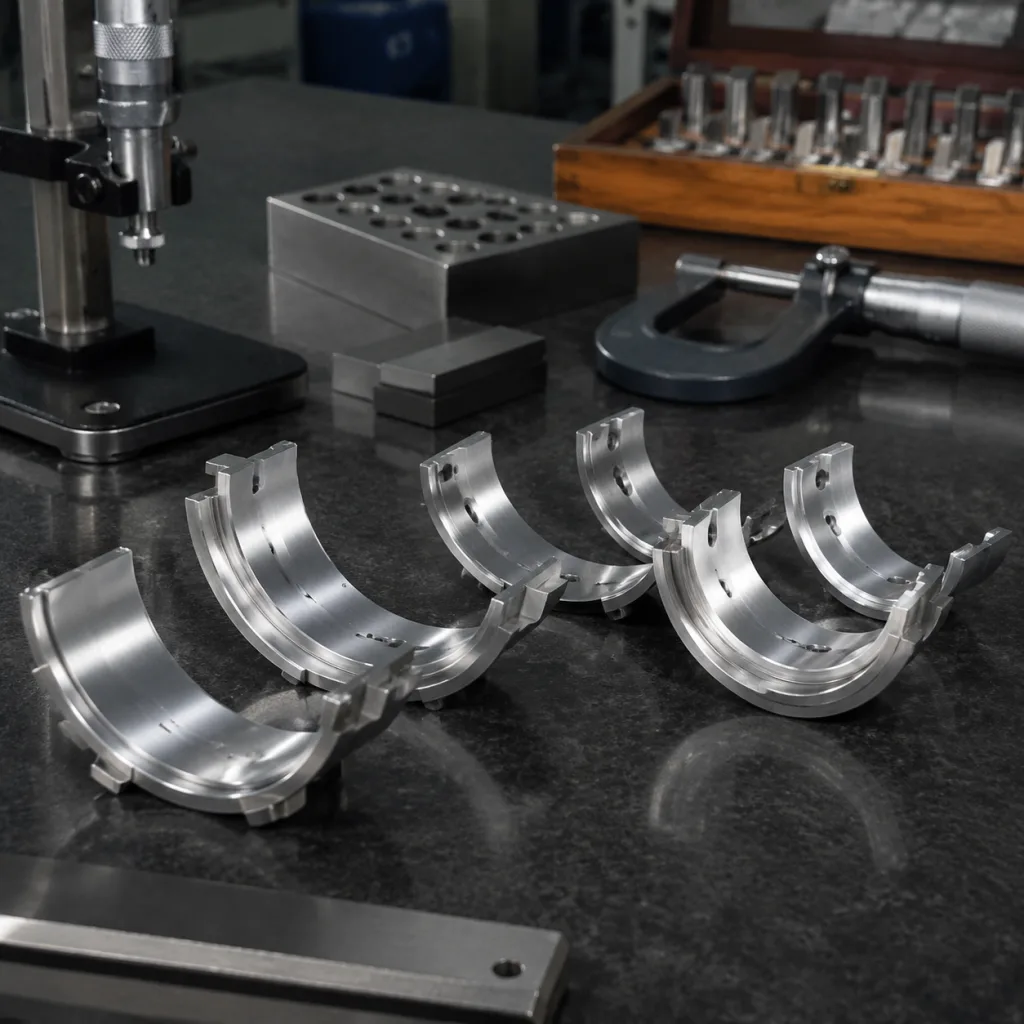
For B2B buyers, a common sourcing error is relying on a visual match. Two bearing shells can look similar but differ in wall thickness, tang position, chamfer, oil hole placement, or thrust face geometry. Those small differences can affect crush fit, oil film formation, and crankshaft alignment. Before a production order is released, the buyer should compare the proposed part against an approved OE sample, drawing, or controlled technical file.
If the application is part of a service programme, fleet maintenance contract, or regional distribution range, request dimensional approval before ordering in volume. A clear approval record reduces disputes later, especially when several part numbers are being consolidated under one wholesale supply agreement.
Specification points that affect service life
Engine bearing performance depends on more than the nominal outside shape. Geometry, surface finish, wall thickness control, and material stack-up all influence load capacity, oil retention, and resistance to wear during start-up and high-temperature operation. For wholesale supply, buyers should compare production tolerances and batch consistency, not just catalogue descriptions.
| Item | What to verify | Why it matters |
|---|---|---|
| Shell construction | Steel-backed, aluminium alloy, or copper-lead based bearing structure | Determines load capacity, fatigue resistance, and embeddability |
| Overlay or coating | Lead-free overlay, low-friction coating, or application-specific surface layer | Improves start-up protection and wear control where specified |
| Journal size | Match to crankshaft main or connecting rod journal diameter | Prevents excessive or insufficient oil clearance |
| Wall thickness and width | Measured against OE sample, drawing, or agreed tolerance | Supports correct crush fit, alignment, and oil film stability |
| Thrust control | Thrust shell position, face width, and surface finish | Helps control crankshaft end play |
| Oil features | Oil hole, groove, and chamfer geometry | Supports lubrication path and assembly fit |
| Surface finish | Uniform finish with no burrs, scratches, or plating defects | Reduces scoring and early wear risk |