Engine Bearing BMW Manufacturer China: Sourcing Guide
For procurement teams buying engine bearings for BMW applications, the priority is not the lowest unit price. It is dimensional consistency, metallurgical control, repeatable clearance, and supply that can pass customer audits. Driventus manufactures engine bearing components in Taizhou, Zhejiang, and supplies B2B buyers across aftermarket, OEM, and repair network channels. We support bearing programmes with stable process control, lot traceability, and documented inspection records.
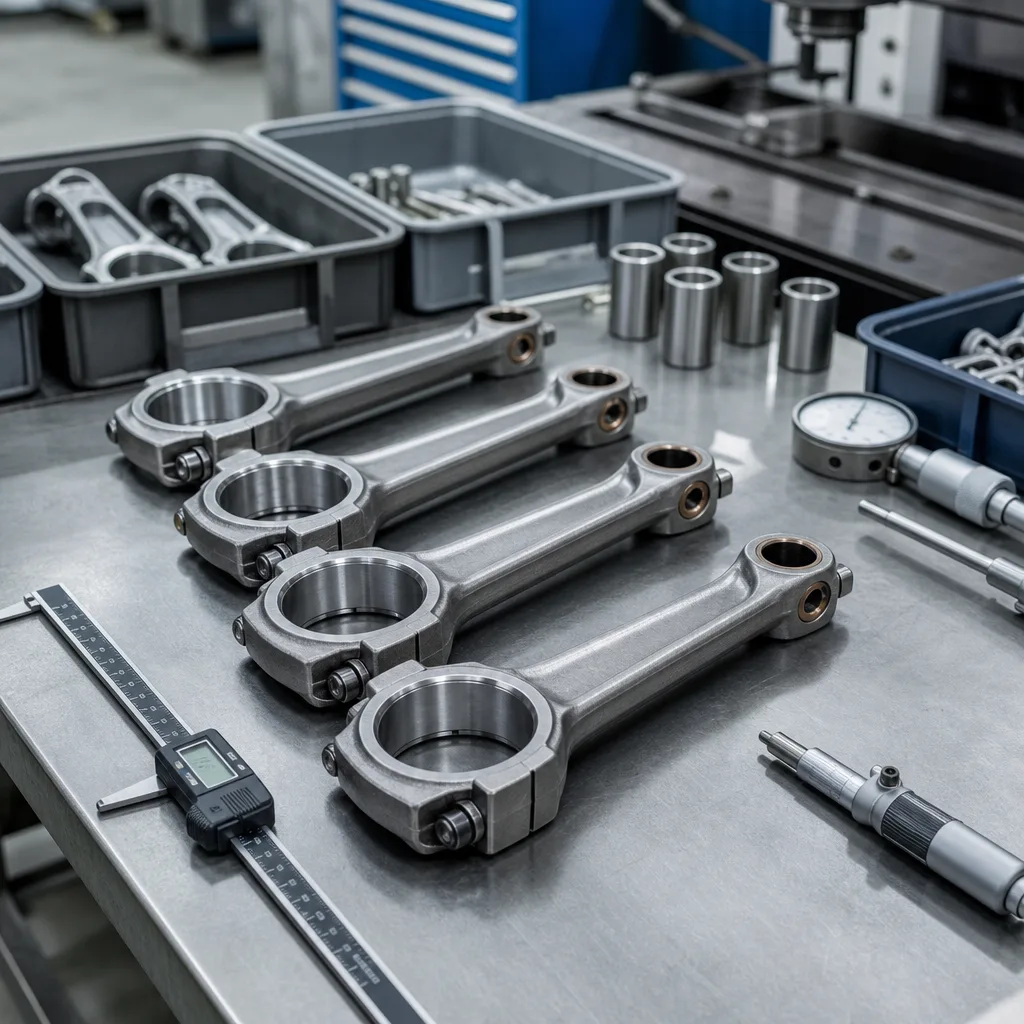
Driventus is an independent aftermarket manufacturer; brand names are referenced for fitment only. For BMW-related sourcing, buyers usually need main bearings, connecting rod bearings, and thrust washers matched to OE dimensions or validated against sample engines. We work to published quality systems including IATF 16949:2016 and ISO 9001:2015, with material and environmental compliance aligned to REACH (EC) No 1907/2006 where applicable. If you are comparing suppliers in China, use measurable criteria: shell thickness, overlay quality, crush, tang, oil groove geometry, and packaging traceability.
What procurement teams should verify first
When evaluating an engine bearing BMW manufacturer China, start with the fitment and control plan, not the brochure.
OE cross-reference: confirm the application by engine family and OE 06A…-style reference where applicable.
Material stack: verify steel back, intermediate layer, and overlay composition.
Surface finish: request Ra data for the bearing running surface.
Traceability: ask for heat number or batch code on cartons and master packs.
Compliance: confirm IATF 16949:2016, ISO 9001:2015, and REACH (EC) No 1907/2006 declarations.
For buyers building a supplier shortlist, our catalog is the fastest starting point: our catalog.
Dimensional and material requirements for BMW engine bearings
BMW engine bearings are specified around precise running clearances. A supplier should be able to hold geometry within a narrow band and document how that control is achieved.
Item
What to verify
Typical procurement question
Shell thickness
Consistency across all halves
What is the thickness tolerance by size?
Inner diameter
Matches crank journal or housing bore
Can you supply measured data by lot?
Crush and spread
Proper seating in the housing
How do you verify shell retention?
Overlay
Anti-friction layer integrity
What is the overlay material and thickness?
Backing steel
Strength and deformation resistance
Which steel grade do you use?
Oil groove / hole
Correct lubrication path
Can you match OE groove geometry?
</tr></thead><tbody> </tbody></table>For engine programmes, a supplier should also state whether the bearing is tri-metal, bi-metal, or steel-backed aluminium alloy. If your team needs a different specification, our custom manufacturing service supports drawing-based development and controlled sample approval.
Common validation checks
Visual inspection under magnification for scoring, pinholes, and plating defects
Dimensional sampling by lot
Crush measurement during trial assembly
Oil clearance measurement with plastigage or metrology tooling
Short-duration validation run before mass release
Supply model, MOQ, and lead time for B2B buyers
For distributors and import managers, supply conditions matter as much as product geometry. Buyers usually ask three questions: what is the MOQ, how long is production, and how stable is the re-order lead time.
A practical China supply programme should include:
MOQ by part number or by bearing family
Sample lead time for first articles
Mass production lead time after approval
Carton and pallet packing specification
Export documentation set for customs clearance
Spare capacity for repeat orders on fast-moving references
Driventus supports forecast-based planning for aftermarket distributors, OEM / Tier-1 sourcing, and multi-location repair groups. For a broader view of component coverage, see our catalog and the engine component overview at engine components.
If your purchasing process requires target pricing against a drawing set or sample, request a quote with engine code, OE reference, annual volume, and destination market.
Quality system and inspection controls
A bearing supplier should be able to show how product quality is controlled from incoming material to final packing. Driventus operates under documented procedures aligned with IATF 16949:2016 and ISO 9001:2015.
Inspection and control points typically include:
Incoming steel and alloy verification
In-process dimensional sampling
Surface and coating inspection
Hardness and bond integrity checks where relevant
Final audit of packing, labels, and batch traceability
For regulated markets, buyers may also request declarations tied to REACH (EC) No 1907/2006 and customer-specific material reporting. Our quality system page explains the documentation package we can provide for supplier approval, PPAP-style submissions, and recurring order control.
A factory audit should focus on measuring equipment calibration, process capability records, traceability discipline, and nonconformance handling. Those items are more useful than general statements about capacity.
How Driventus supports BMW fitment programmes
For BMW-related bearing sourcing, fitment accuracy depends on referencing the correct engine code, journal size, and repair class. We do not claim approval or endorsement by any vehicle manufacturer. Driventus is an independent aftermarket manufacturer; brand names are referenced for fitment only.
We support sourcing teams with:
Drawing-based development for replacement bearings
Dimensional matching against OE sample parts
Material selection for application-specific load and speed demands
Sample submission before bulk production
Export packing suitable for distributor warehousing and cross-dock delivery
Where a buyer needs a private-label or programme-specific version, custom manufacturing can be used to define dimensions, coating, packaging, and labeling. For standard programme enquiries, request a quote with the engine model, OE 06A…-style reference if available, quantity, and target certification requirements.
This approach reduces the risk of misfit, high return rates, and inconsistent rebuild quality across multiple distribution regions.
Buyer checklist before placing a trial order
Use a trial order to verify both product and supplier control. A small mistake in bearing selection can cause immediate assembly rejection or early engine damage.
Checklist:
1. Confirm engine family and bearing position: main, rod, or thrust. 2. Match the OE reference and repair size. 3. Request dimensional inspection data for the first lot. 4. Verify packaging labels, batch code, and carton count. 5. Ask for material declaration and compliance documents. 6. Test fit a sample set on the intended crankshaft and block. 7. Record torque, oil clearance, and running inspection results. 8. Approve the part only after a controlled validation run.
For procurement teams comparing multiple suppliers, the strongest offer is the one with measurable tolerance control, traceability, and repeatable replenishment. Price matters, but returns and downtime cost more.
Frequently asked questions
Yes, when the engine family and OE reference are provided. We use the reference for fitment confirmation and do not claim manufacturer approval. Sample validation is recommended before bulk purchase.
We can provide quality documents tied to IATF 16949:2016 and ISO 9001:2015, plus material and compliance declarations such as REACH where applicable.
Yes. We can support drawing-based development, private-label packing, and programme-specific specifications through our custom manufacturing process.
If you need a bearing supplier with documented quality control, stable export packing, and fitment support for BMW applications, contact our team to review your part numbers and volume plan. Start here: /contact.html