Cylinder Liner Mazda Supplier: Sourcing Guide for Buyers
Procurement teams sourcing a cylinder liner Mazda supplier need more than a price list. They need dimensional consistency, traceable materials, stable lead times, and documentation that supports incoming inspection and supplier qualification. For diesel and petrol engine programmes, the liner must match bore size, flange geometry, protrusion, surface finish, and heat-treatment requirements used in the target engine family. Driventus supplies engine and powertrain components from Taizhou, Zhejiang, to aftermarket distributors, OEM and Tier-1 channels, and multi-location repair chains in 60+ export markets. We manufacture under IATF 16949:2016 and ISO 9001:2015 controls. Driventus is an independent aftermarket manufacturer; brand names are referenced for fitment only. This article outlines what buyers should verify when comparing suppliers, including MOQ, lead time, audit documents, packaging, and fitment cross-reference practices such as OE 06A107065 where applicable.
What buyers should check in a Mazda cylinder liner source
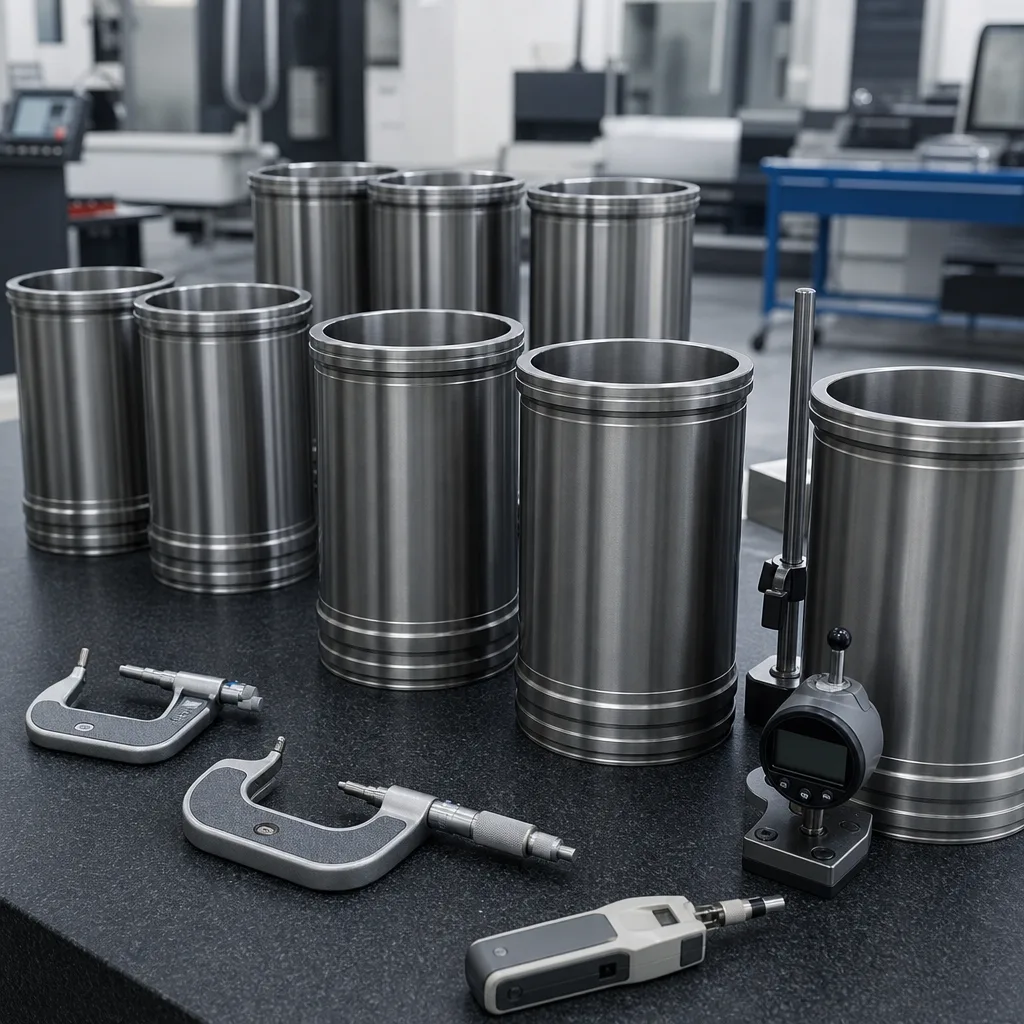
A cylinder liner supplier should be able to support repeatable fitment, not only sample approval. For Mazda applications, buyers usually need confirmation of bore diameter, outer diameter, wall thickness, liner height, flange width, and finish condition. These details affect compression sealing, piston clearance, and service life.
At minimum, request the following:
- Material grade and heat-treatment route
- Dimensional tolerance by feature
- Surface finish on the running bore
- Straightness, roundness, and ovality limits
- Packaging method for corrosion prevention
- Traceability to batch or lot number
- Inspection report with measured values
If the part is part of a repair programme, ask for OE cross-reference confirmation in the form OE 06A107065 only when the engine family documentation already uses that pattern. Avoid assumptions based on casting appearance alone.
Supply capability, MOQ, and lead time
For B2B sourcing, the supplier’s commercial model matters as much as its machining capability. A factory that can produce a stable liner diameter but cannot support forecasted demand will create shortages in distribution and workshop channels.
Typical buyer questions include:
- What is the MOQ per part number or engine family?
- Can mixed-SKU cartons be built for distributor orders?
- What is standard lead time for repeat orders?
- How are urgent replenishment orders handled?
- Which ports and incoterms are supported?
Driventus works with export programmes that require predictable replenishment, batch traceability, and carton labelling suitable for warehouse scanning. For buyers managing multiple regions, ask for a production plan tied to monthly forecast rather than only spot orders. This is especially important for cylinder liner Mazda supplier searches where demand may be split across legacy engines, repair chains, and private-label distribution.
Technical specifications and inspection points
A sourcing decision should be based on measurable properties. The table below shows the fields procurement teams should request before approval.
| Specification item | What to verify | Why it matters |
|---|---|---|
| Bore diameter | Nominal size and tolerance band | Piston clearance and sealing |
| Outer diameter | Size and roundness | Press fit and block retention |
| Wall thickness | Minimum and nominal value | Strength and heat transfer |
| Liner height | Flange or protrusion dimension | Head gasket sealing |
| Surface finish | Honed or finished bore Ra | Ring seating and wear |
| Material | Alloy cast iron or equivalent | Durability and machinability |
| Hardness | Measured range | Wear resistance |
| Corrosion protection | Oil, VCI, or coated packing | Shelf-life and transport |