engine bearing · 2026-06-03

Engine Bearing Alfa Romeo OEM Supplier for B2B Sourcing

For buyers searching for an engine bearing Alfa Romeo OEM supplier, the real risk is not the part name. It is whether every repeat order holds the same wall thickness, crush, oil clearance, overlay thickness, bore conformity, and surface finish, and whether each shipment comes with inspection and traceability records that a receiving-quality team can actually use. Driventus supplies B2B customers that need stable fitment data, documented quality control, export-ready packaging, and repeatable production standards for Alfa Romeo engine bearing programmes. Driventus is an independent aftermarket manufacturer; brand names are referenced for fitment identification only. Buyers can use our catalog, quality system, and custom manufacturing options to qualify a source before placing a trial order. The right sourcing decision depends on bearing construction, target assembled clearance, coating specification, thrust control, traceability depth, and delivery model. For distributor programmes, workshop networks, OEM buyers, and Tier-1 channels, those details matter more than a generic product description.

What buyers should verify before RFQ

A workable sourcing file for an Alfa Romeo engine bearing programme should identify the bearing family, OE reference where available, engine code, crankshaft journal size, housing bore, and the dimensional target from an approved drawing or sample report. Quoting from a vehicle model alone creates avoidable risk because main bearing width, thrust position, oil-hole pattern, locating lug geometry, and undersize availability can vary by engine generation, repair market, or regional catalogue.

Before asking for pricing, verify:

  • Bearing type: main bearing, con rod bearing, thrust washer, flanged bearing, or complete bearing set
  • Application data: Alfa Romeo model, engine code, displacement, production year range, aspiration type, and fuel type where relevant
  • OE reference, aftermarket reference, buyer drawing number, or approved sample identification
  • Material stack: steel-backed tri-metal, aluminium-tin bi-metal, polymer-coated shell, or another approved construction
  • Journal diameter, housing bore, shell wall thickness, bearing width, crush height, locating lug position, oil hole layout, oil groove design, and edge relief
  • Standard size and undersize requirements, such as STD, 0.25 mm, 0.50 mm, 0.75 mm, or buyer-specific repair sizes
  • Target assembled oil clearance, taper and ovality limits, surface roughness requirement, and roundness requirements after housing assembly
  • Overlay thickness, coating thickness, corrosion protection, storage-life requirement, and anti-rust packing method
  • Packing format, private-label rules, barcode content, carton quantity, inner protection, master carton, and pallet configuration
  • Required documents: material declaration, dimensional inspection record, traceability code, production lot reference, and sample approval report where required

A complete RFQ lets the supplier separate true catalog-fit items from parts that need drawing review, sample measurement, or tooling confirmation. It also gives procurement, engineering, and quality teams a common technical basis for comparing offers instead of judging by unit price alone. If you are building a broader engine programme, review our catalog and engine components first, then match the bearing set to the engine application rather than the vehicle badge alone.

Bearing constructions and where each fits

Engine families do not use one universal bearing structure. The right construction depends on unit load, lubrication regime, crankshaft material, journal finish, repair-market expectations, and the approved specification. The table below is meant as a practical procurement view, not a marketing comparison.

</tr></thead><tbody> </tbody></table>For buyers, material choice is only part of the decision. The supplier also has to repeat the same lining hardness, overlay thickness, crush, wall profile, oil-hole position, and edge finish from batch to batch. These are small parts, but a few microns of variation in wall thickness or coating build can change oil-film clearance at assembly. A qualified engine bearing Alfa Romeo OEM supplier should be able to explain the chosen construction, identify the control points that protect fitment, and state clearly whether the offered part is a catalog item, a controlled substitute, or a custom-manufactured part against the buyer's drawing.

Quality controls and material compliance

Supplier review should cover both the factory system and the part-level release checks. Driventus operates under IATF 16949:2016 and ISO 9001:2015 controls, with traceability and inspection records linked to production lots. Buyers can review more detail in our quality system. For engine bearings, the most important controls are the ones that protect fit, oil clearance, material integrity, surface condition, and consistency between repeat shipments.

Typical controls for engine bearings include:

  • Incoming material verification for steel strip, aluminium-tin lining material, copper-lead or lead-free intermediate layers where specified, overlay stock, plating chemistry, and coating materials
  • Chemical and material confirmation where the buyer requires a declared material composition, restricted-substance declaration, or material conformity statement
  • In-process dimensional checks for wall thickness, width, crush height, parting-line condition, free spread, locating lug geometry, oil-hole position, and thrust-face dimensions where applicable
  • Verification of oil holes, oil grooves, chamfers, edge relief, flange geometry, and bearing back cleanliness
  • Surface inspection for scoring, porosity, burrs, plating defects, coating gaps, contamination, handling marks, and foreign material that could affect crankshaft contact
  • Hardness, bonding, coating adhesion, bend test, or overlay thickness checks when specified in the control plan
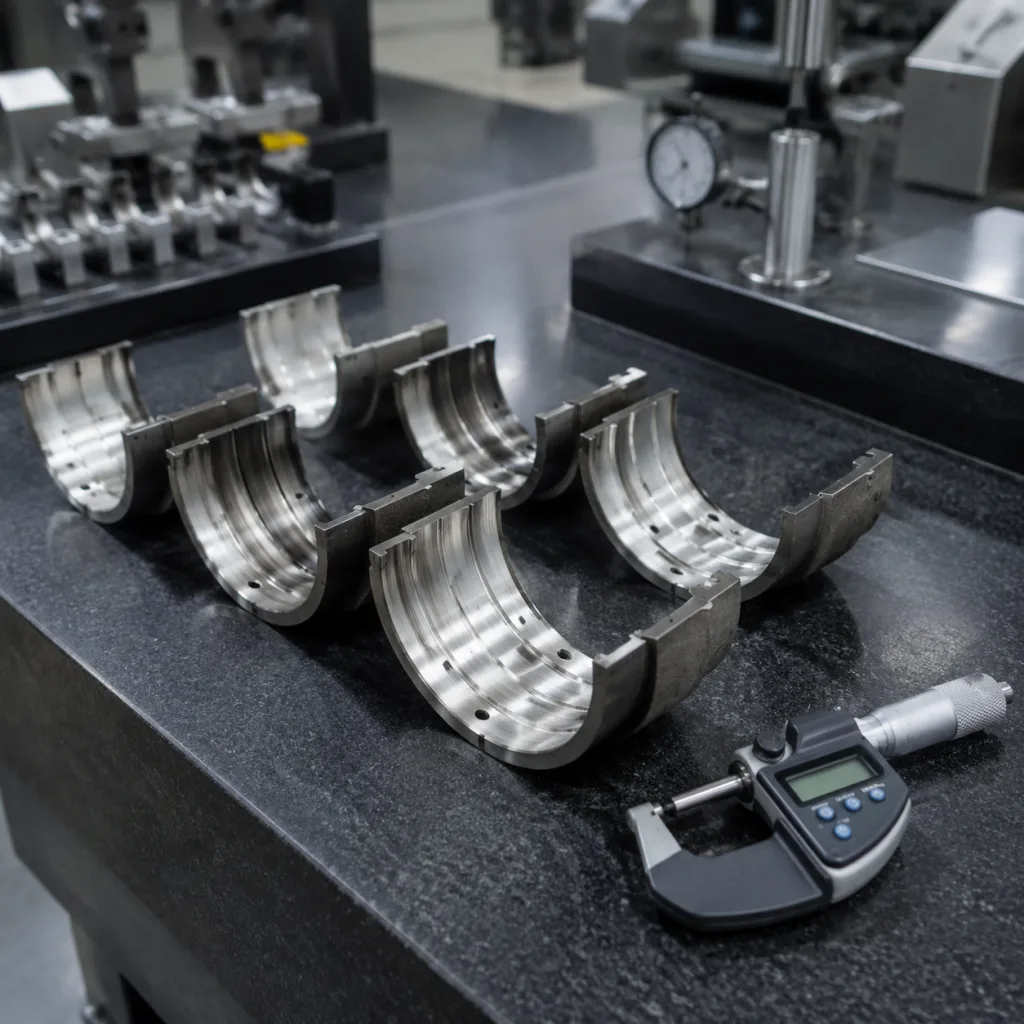
  • Gauge control for micrometers, bore gauges, height gauges, profile projectors, and other measuring equipment used for release inspection
  • Final lot control with sample inspection, packing verification, barcode review, label traceability, and retained production records
  • Documented nonconformance handling, corrective action records, rework control, and lot segregation procedures

For EU and UK customers, material declarations can be aligned with REACH (EC) No 1907/2006 requirements and other customer-specific restricted-substance lists when needed. If a programme calls for customer-specific validation, we can work to the buyer's test plan and release criteria, including initial samples, dimensional reports, material records, packing checks, and production lot records. For applications connected to regulated vehicle programmes, documentation can be coordinated alongside vehicle-level requirements where applicable, while the bearing itself is controlled through the approved drawing, inspection plan, and lot release process. The aim is simple: give sourcing and quality teams enough evidence to approve the supplier before the first commercial shipment is released.

Lead time, MOQ, and custom manufacturing

In B2B sourcing, order structure, engineering status, and validation workload usually matter more than a single unit price. New buyers often start with a sample or pilot lot, then move to repeat supply after dimensional approval, material confirmation, running-fit review, and packaging sign-off. MOQ depends on the bearing family, tooling status, strip material availability, coating requirement, private-label carton specification, and the number of size variants in the order. Repeat items can usually be scheduled faster than first-order programmes because the drawing, gauge set, inspection plan, and packing standard already exist.

A typical sourcing path includes technical confirmation, reference cross-check, sample preparation, buyer inspection, packaging approval, and production release. Catalog items with existing tooling may move quickly once the application and reference data are confirmed. Parts requiring modified wall thickness, changed thrust face, alternate coating, special undersize, revised oil-hole pattern, or private-label packing need more engineering review because the bearing must remain controlled after the requested change.

Where a buyer needs a modified wall thickness, different coating, alternate material construction, added undersize, or private-label packing, our custom manufacturing process supports drawing review, sample measurement, prototype or pilot-lot confirmation, and production release. That is the right route when a programme needs a controlled substitute rather than a generic shelf item.

A practical RFQ should include:

  • Application, Alfa Romeo engine code, displacement, and production year range
  • OE reference, buyer drawing, aftermarket cross-reference, or approved sample details
  • Required size range, including standard and undersize options
  • Annual volume, first-order quantity, forecast split by quarter or shipment, and expected reorder frequency
  • Target market: distributor, workshop chain, fleet service network, OEM channel, or Tier-1 programme
  • Packaging and barcode requirements, including private-label artwork, label data fields, carton quantity, and pallet limit if required
  • Required delivery terms, destination country, import documentation needs, and preferred shipment schedule
  • Required documents for supplier approval, incoming inspection, restricted-substance review, and customs support

Clear commercial inputs help avoid late changes to carton count, label rules, pallet height, export marks, or documentation. They also let Driventus recommend the most stable supply plan for the buyer's approval cycle and reorder pattern.

How to qualify a supplier for export programmes

For buyers in the EU, UK, US, Canada, Australia, Brazil, and other export markets, supplier qualification usually comes down to technical control, document discipline, packaging reliability, and commercial consistency. A qualified engine bearing supplier should be able to show that the part was produced under a controlled process and that future shipments will match the approved sample in dimensions, material construction, surface condition, packing, and labeling.

A supplier qualification package may include:

  • Factory profile, quality certificates, and process flow for the bearing family
  • Material traceability by batch or lot, including declared material construction and restricted-substance declarations where required
  • Dimensional inspection records with measurable acceptance limits, actual readings, sample size, measuring method, and lot identification, not only pass/fail notes
  • Sample approval records for new or modified specifications, including drawing revision, size status, and packing approval where applicable
  • Packing specification showing carton quantity, inner protection, rust-prevention method, label layout, barcode data, master carton, pallet method, and gross weight control
  • Export packing designed to resist moisture, vibration, compression, and carton collapse during long-distance sea, air, or multimodal handling
  • Stable reorder quality across successive shipments, supported by lot records, consistent labeling, and controlled change notification
  • Responsive engineering support when the buyer changes the drawing, coating, size range, oil-hole layout, undersize plan, or packing specification

If your team is comparing sources, ask for the documentation package before requesting a price-only quote. A low unit price is not useful if the bearing arrives without traceability, if the label does not match the buyer's receiving system, if size variants are mixed without clear identification, or if the carton fails during export movement. For distributor programmes, this protects inventory accuracy and customer confidence. For OEM and Tier-1 channels, it helps procurement align with quality approval, incoming inspection, supplier development, and change-control requirements. When you are ready to move from screening to sourcing, use request a quote with the application details, target volume, documentation needs, and destination market.

Frequently asked questions

Yes. When the buyer provides the OE reference, approved sample, or drawing, we match the confirmed dimensional, material, size, and packing requirements. We do not claim manufacturer approval or endorsement; brand names are used only to identify fitment.

Typical documents include lot traceability, dimensional inspection records, material declarations, packing details, and quality-system information. Additional records can be prepared to support buyer audits, sample approval, restricted-substance review, and internal qualification.

Yes. Private-label cartons, barcode labels, carton marks, inner protection, and export-ready packing can be built into the project from the first RFQ, provided the artwork, label rules, carton quantity, and destination requirements are confirmed in advance.

Send your drawing, OE reference or approved sample details, annual volume, and packaging requirements through [request a quote](/contact.html). We will confirm the right bearing construction, documentation package, and supply plan for your Alfa Romeo engine bearing programme.

Request a Quote
Construction Typical use Strengths Trade-offs
Steel-backed tri-metalHigh-load main and con rod applications, turbocharged engines, performance-sensitive repair programmesStrong fatigue resistance, good embeddability, stable under load, suitable where crankshaft conditions vary in the service marketHigher material cost, tighter control needed for overlay thickness, plating quality, intermediate layer integrity, and bonding consistency
Aluminium-tin bi-metalVolume passenger-car engines and cost-sensitive aftermarket programmesGood corrosion performance, efficient production, stable for many standard-duty engines, often suitable where specifications call for aluminium alloy liningLess forgiving if lubrication is poor, if debris is present, or if crankshaft roughness and geometry are outside specification
Polymer-coated bearing shellApplications where cold-start wear, start-stop duty, run-in behaviour, or friction control is specified by the buyerAdded surface protection, improved conformability during initial operation, potential friction and scuffing benefitCoating thickness and adhesion must be tightly controlled because excess build-up can reduce oil clearance
Thrust washer or flanged bearingAxial control points in the crankcase, crankshaft end-play control, service repair kitsManages crankshaft axial movement and protects the housing faceMust match crank and housing geometry exactly, including oil groove, tab, flange width, and thrust-face finish