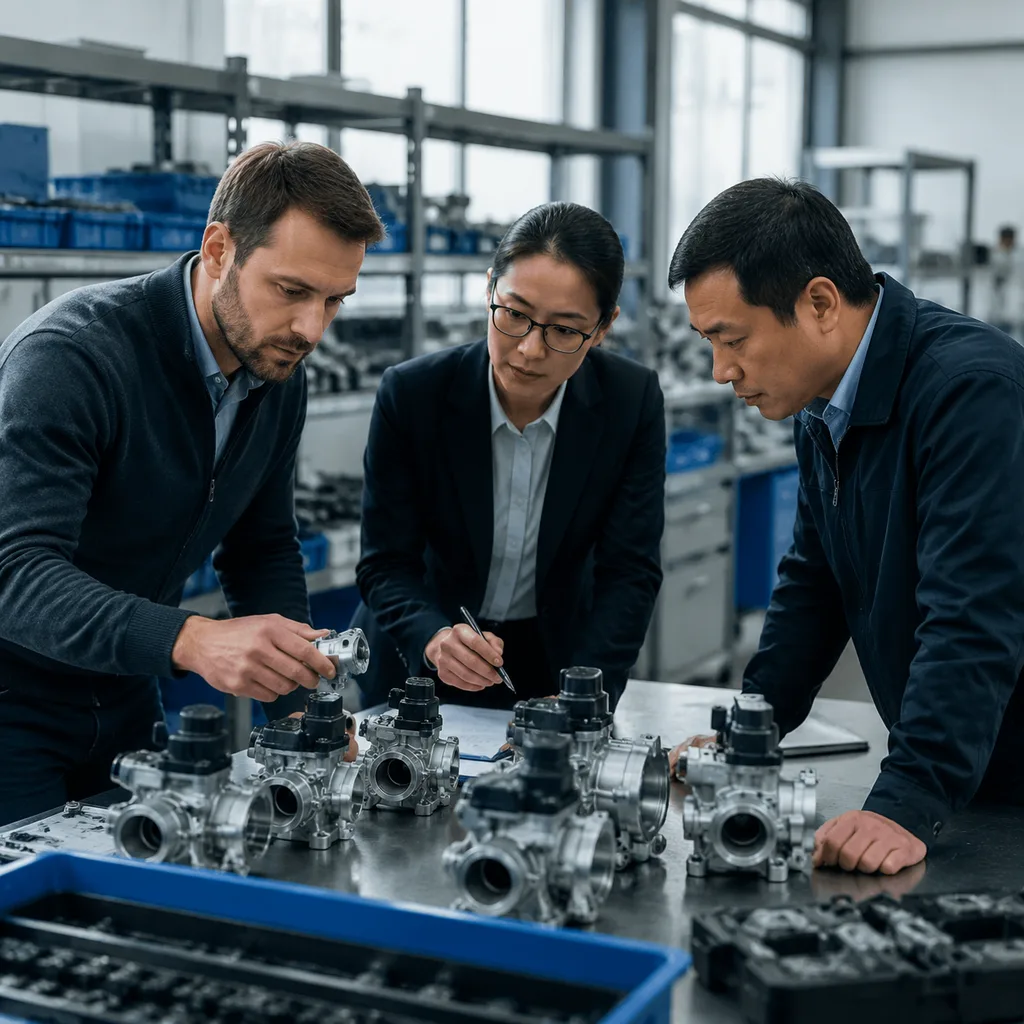
Sourcing an EGR valve for Alfa Romeo applications takes more than matching a catalogue image. Importers, distributors, and programme buyers need dimensional conformity, controlled exhaust-gas flow, repeatable actuator response, reliable sealing, and documents that can stand up to customer audits and customs review. Driventus is an independent aftermarket manufacturer; Alfa Romeo and other brand names are referenced for fitment identification only. We supply B2B customers that need engine-code verification, production-lot traceability, controlled sample approval, and export-ready paperwork for the EU, UK, North America, Australia, Brazil, and other regulated markets. For procurement teams comparing Chinese manufacturers, the real questions are practical: can the factory hold the drawing, confirm OE cross-reference logic, validate the valve under thermal, vibration, leakage, and soot-contamination conditions, and support stable repeat orders? This guide explains what to verify before a trial order, which test evidence matters, and how to compare suppliers without leaning on broad marketing claims.
What buyers should verify first
For Alfa Romeo fitment, begin with the engine code, emissions standard, connector style, and mounting interface. The vehicle badge is not enough. The same model name can carry different engine families, ECU strategies, EGR cooling layouts, actuator types, and connector revisions across markets. A correct EGR valve must match the exhaust-gas path, cooler or bypass arrangement where fitted, commanded opening range, feedback signal, gasket interface, and installation envelope used by the engine management system.
Before issuing an RFQ, build a fitment file that engineering, purchasing, warehouse receiving, and warranty teams can all rely on. A complete file reduces sample disputes, wrong-market stock, and mixed shipments, especially when several OE numbers supersede into one aftermarket reference.
Use this buyer checklist before you issue an RFQ:
Engine code, displacement, fuel type, power rating, and model year range
OE number, supersession number, or approved interchange reference from service data or the customer
Alfa Romeo model, sales region, and emissions standard, such as Euro 4, Euro 5, or Euro 6
Mounting bolt pattern, bolt-hole diameter, gasket face size, port shape, and installation depth
Cooler integration, coolant pipe position, bypass arrangement, and hose connection angle where the system uses cooled EGR
Actuator type, position sensor requirement, supply voltage, signal type, and ECU feedback requirement where applicable
Supplied gasket, O-ring, clamp, seal, screw, or hardware requirements
Target market compliance, including REACH (EC) No 1907/2006 where applicable
Packaging label data, barcode format such as EAN-13 or Code 128, country-of-origin marking, and private-label requirements
A strong Chinese manufacturer should be ready to work from more than a part number. Photos, measured dimensions, VIN-derived fitment data, service references, and a used OE sample can all help confirm the application, but they should support the engineering file rather than replace it. For B2B programmes, the most dependable sequence is to confirm the engine family first, validate the physical interface second, and then approve the electrical, leakage, and functional characteristics against an agreed reference sample.
If you are building a wider sourcing list, start with our catalog and then narrow the fitment by engine family, OE reference, connector version, and sales region.
How a Chinese manufacturer should support procurement
A serious supplier should answer more than price and lead time. Buyers need evidence that the plant can hold the same build standard across repeat orders, manage engineering changes, and issue shipment documents that match the commercial invoice and product labels. This is especially important when sourcing an egr valve alfa romeo manufacturer china programme, because landed cost is only one part of the buying decision. The larger procurement risk is a valve that passes a visual check but fails fitment, actuator response, seat leakage, connector retention, or document review after the shipment has arrived.
Support should run from RFQ through repeat delivery. At RFQ stage, the supplier should confirm the OE reference, drawings or measured data, expected MOQ, sample availability, tooling status, production history, and whether the requested application is active, dormant, or requires new development. During sampling, they should provide dimensional results, functional test data, material information, connector details, gasket specification, and packaging options. Before mass production, they should confirm the approved revision, first-article status, carton markings, export documents, and any customer-specific inspection requirements.
Buyer question
What to expect
Why it matters
Can you support sample-to-production transfer?
First article inspection, approved reference sample, revision record, and controlled BOM
Reduces mismatch between sample and mass production
Can you support low and medium MOQs?
Clear MOQ breakpoints, batch planning, and lead time by quantity
Helps distributors test demand without excess stock
Do you provide traceability?
Lot code, production date, operator or line record, inspection report, and retention rule
Written change notice, affected-lot control, sample reapproval, and updated inspection standard
Prevents unapproved changes from entering stock
</tr></thead><tbody> </tbody></table>Good procurement support also includes clear commercial communication. Buyers should ask about EXW, FOB, CIF, DAP, or DDP availability where appropriate, estimated net and gross weight, carton dimensions, pallet loading, sample charges, tooling charges if any, payment terms, and production lead time after deposit or PO release. For repeat orders, the manufacturer should be able to state capacity assumptions, normal lead time, peak-season lead time, and any long-lead components such as actuators, sensors, or special connectors.
Driventus supplies engine and powertrain components for aftermarket and OEM-type programmes, with custom manufacturing available when a customer needs a specific housing, actuator, connector, gasket package, calibration variant, label set, or distributor packaging programme.
Materials, tolerances, and validation tests
An EGR valve works in a harsh environment: hot exhaust gas, soot loading, acidic condensate, vibration, thermal cycling, and frequent duty-cycle changes. Material choice and assembly control matter more than external appearance. A clean casting and smooth surface help, but buyers should pay closer attention to the valve seat, shaft or pintle movement, actuator control, gasket compression, connector sealing, and leak rate. Those areas usually decide whether the valve performs reliably after installation.
For Alfa Romeo applications, the valve body may need to manage hot exhaust gas, cooled exhaust flow, or a layout connected to an EGR cooler. The manufacturer should understand the difference between a visual copy and a production-controlled part. Port geometry affects flow; seat finish affects leakage; actuator speed affects ECU control; mounting-face flatness affects gasket sealing; and connector quality affects field reliability. Variation in valve travel, bolt-hole position, or feedback signal can trigger diagnostic trouble codes, unstable idle, poor drivability, emissions failure, or premature warranty claims.
Typical points buyers should ask for
Valve body material, such as aluminium alloy casting or stainless steel where required by the application, plus corrosion protection method
Machining datum, mounting-face flatness target, bolt-hole position tolerance, and thread inspection method
Pintle, poppet, or flap seat material, wear resistance, and sealing surface finish
Shaft guidance, return movement, spring force where applicable, and resistance to soot-related sticking
Actuator response stability across the agreed operating temperature range
Position sensor output, connector pin assignment, terminal plating, insulation resistance, and continuity checks where applicable
Gasket or O-ring material, compression behaviour, and thermal-ageing performance
Connector retention force, terminal pull-out resistance, and seal integrity
Leak performance before and after thermal cycling or contamination exposure
Port flow consistency against approved sample, reference drawing, or agreed flow curve
Validation should match the application, not just a generic bench check. For automotive programmes, buyers often reference IATF 16949:2016 and ISO 9001:2015 for process control. Depending on customer scope, durability and emissions-related development may also reference ECE R-83, SAE J2527, ISO 16750 electrical and environmental conditions, or ISO 9227 salt spray for corrosion exposure. The exact test plan depends on the target market, customer requirement, and whether the order is for aftermarket replacement, distributor stock, or an OEM-type programme.
A practical validation package may include dimensional inspection with critical-to-fit dimensions recorded, leak testing at an agreed pressure differential, actuator cycling, electrical resistance or signal checks, thermal cycling, vibration checks, salt spray where corrosion exposure is relevant, and endurance testing under heat and soot-like contamination. The supplier should state the test method, acceptance criteria, sample size, inspection frequency, and reaction plan if a sample fails. A claim that the part was "tested" is not enough; procurement teams need results that can be reviewed, repeated, and linked to the production lot.
Quality system and audit readiness
Procurement teams should review the supplier's quality file before placing volume business. That file should show how incoming material is controlled, how machining and assembly checks are recorded, and how nonconforming parts are contained. For EGR valves, audit readiness is not only about certificates on a wall. It is about whether the manufacturer can prove that the approved sample, production fixture, inspection method, actuator setting, and shipped lot all follow the same requirement.
At minimum, ask for:
Quality manual, process flow diagram, and control plan or equivalent inspection map
Calibration status for calipers, height gauges, leak testers, electrical testers, flow benches, and torque tools
Incoming material certificates for castings, machined parts, actuators, sensors, terminals, seals, and gaskets where relevant
First article inspection report for new or revised items, including critical dimensions and functional checks
In-process inspection records for machining, cleaning, assembly torque, actuator installation, and functional testing
Final inspection report with leak, electrical, visual, packaging, and critical-dimension results
Lot traceability method, date code format, carton-to-lot link, and record retention period
Nonconforming-material control, segregation method, rework approval, and scrap record
Corrective action process for defects, customer complaints, and field returns
Packaging inspection standard for labels, barcodes, cartons, pallet marks, and export markings
A capable manufacturer should also explain how it separates approved production from development samples, prevents mixed revisions, and controls substitute components. For warranty-sensitive parts, ask how returned samples are analysed. A useful 8D or corrective action report should identify the failure mode, containment action, root cause, corrective action, verification of effectiveness, and prevention plan. It should not stop at a generic statement that operators were retrained.
Audit preparation should include both factory process evidence and shipment evidence. Factory evidence may include calibration records, operator instructions, inspection fixtures, leak-test logs, actuator-test records, nonconforming-material records, and golden-sample control. Shipment evidence may include commercial invoice, packing list, certificate of origin, conformity statement, carton labels, pallet photos, product traceability data, and the final inspection report. When these records are consistent, customs clearance, customer receiving inspection, warranty review, and reorder approval become much easier.
Our quality system is built around documented inspection, traceability, and export control. For buyers who need broader engine-component sourcing around the same platform, see engine components for related product families.
How to compare suppliers without guessing
When two quotes look similar, compare the manufacturing assumptions behind them. The cheapest offer can hide the highest field cost if the supplier is buying inconsistent actuators, skipping thermal validation, using unsuitable gasket materials, omitting leak records, or relying on visual matching instead of engine-code confirmation. A well-built comparison should separate unit price from total sourcing cost, including sampling time, incoming inspection effort, defect sorting, customs delays, repacking, customer returns, lost sales, and channel confidence.
Look at these trade-offs directly:
1. Tooling ownership: who controls the moulds, machining fixtures, test rigs, gauges, and revision history 2. Process discipline: whether inspection is recorded by lot and operation, or only by occasional sample 3. Fitment control: whether the supplier validates by engine code, OE cross-reference, connector version, and measured interface rather than visual match alone 4. Delivery stability: whether quoted lead time is repeatable across peak demand, repeat orders, and actuator or casting supply constraints 5. Change control: whether engineering updates, material changes, connector substitutions, or seal changes are approved before shipment 6. Test depth: whether functional, leak, thermal, flow, vibration, and electrical checks are documented with acceptance criteria 7. Documentation quality: whether commercial documents, labels, conformity statements, COO, inspection records, and traceability data align 8. Warranty handling: whether the supplier can analyse returned parts, identify failure mode, and issue meaningful corrective action
A useful supplier scorecard should include weighted categories, not just a price column. For example, procurement teams can score fitment confidence, quality documentation, sample performance, MOQ flexibility, lead time reliability, communication speed, export experience, warranty support, and private-label control. This makes the award decision more transparent when one manufacturer is cheaper but weaker on testing, traceability, or document discipline.
Before awarding a larger order, request a controlled sample lot and inspect it against the same checklist that will be used for production receiving. Confirm that the sample packaging, label data, gasket kit, connector, actuator response, leak performance, and mounting dimensions match the approved requirement. Where possible, keep a signed golden sample or approved reference sample with the revision date, supplier lot, and customer approval record for future comparison.
For buyers scaling from trial orders to repeat supply, the best suppliers are the ones that can defend the drawing, the test data, the lot record, and the production schedule. A dependable Chinese manufacturer should make it easier for the buyer to manage fitment, compliance, inventory, and warranty risk across every reorder.
Frequently asked questions
Yes. Engine code is the correct starting point for fitment control, especially where the same model badge has different emissions packages or connector versions. We confirm mounting, connector, actuator, gasket, and application details before release.
For most B2B buyers, IATF 16949:2016 and ISO 9001:2015 are the core quality references. Depending on destination and programme, REACH (EC) No 1907/2006, ISO 16750, ISO 9227, and emissions-related development references may also be relevant.
Yes. We support custom manufacturing for drawing-controlled variants, connector or actuator differences, gasket kits, packaging changes, and market-specific fitment requirements. Share the target engine family, OE reference, annual volume, and sample or measured data.
If you are qualifying a new supply line for Alfa Romeo EGR valves, send the engine code, OE reference, annual volume, and target market. Use our [request a quote](/contact.html).