EGR Cooler Jaguar Supplier: Technical Sourcing Guide for B2B Buyers
Sourcing an EGR cooler for Jaguar applications is not simply a matter of finding a tube assembly that bolts into position. Procurement teams need confidence in the stainless metallurgy, the consistency of the vacuum or furnace brazing process, the coolant- and exhaust-side leak performance, and the records that link each finished batch back to incoming material and final inspection. For aftermarket and private-label programmes, the right supplier must also handle OE cross-reference checks, accessory-kit control, carton labelling, palletisation, and export documentation without creating extra work downstream. Driventus is an independent aftermarket manufacturer; Jaguar and other brand names are used for fitment identification only. We manufacture engine and powertrain components in Taizhou, Zhejiang, and supply B2B customers in more than 60 countries. Our quality management system is certified to IATF 16949:2016 and ISO 9001:2015. When evaluating an EGR cooler Jaguar supplier, buyers should focus on OE dimensional match, cooler core construction, flange flatness, pressure drop, corrosion resistance, leak-test standard, audit support, and stable replenishment. This guide explains what to check before RFQ release, how to compare supplier capability, and which documents should be agreed before shipment.
What buyers should verify before sourcing
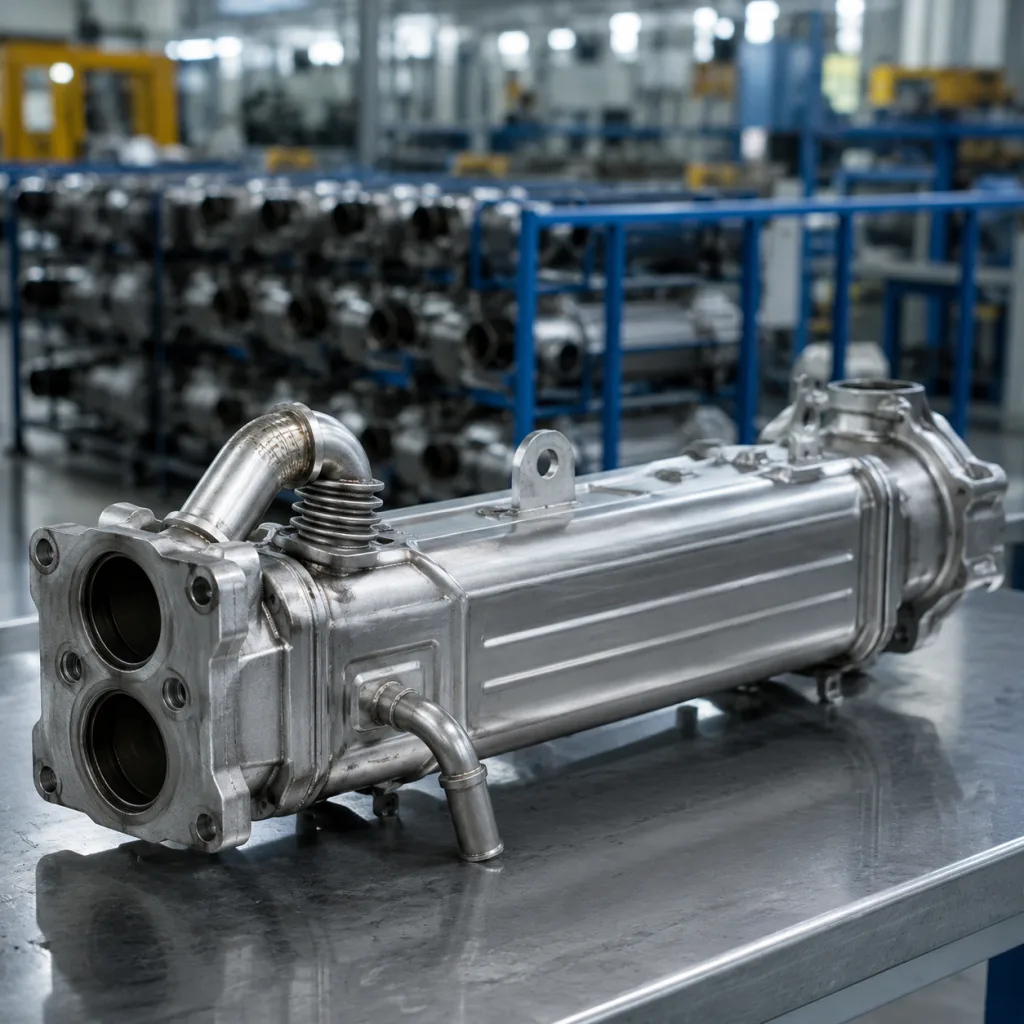
EGR coolers tend to fail for familiar, preventable reasons: soot blockage, brazed-joint fatigue, coolant-side corrosion, exhaust pulsation, vibration around brackets, gasket-face distortion, and thermal cracking at welded or brazed interfaces. That is why supplier capability matters. Before approving an EGR cooler Jaguar supplier, buyers should confirm whether the company is an actual manufacturer or a trading source, which process steps are handled in-house, and how each lot is controlled from incoming stainless strip, tube, flange, and casting inspection through brazing, welding, leak testing, marking, and final packing.
Fitment evidence should come first. Ask the supplier to identify the OE reference being matched, the engine family, emission configuration, model-year range, and any known supersession numbers or regional variations. Two coolers can look nearly identical and still differ in flange thickness, bolt-hole centre distance, tube routing, sensor boss position, gasket-face flatness, coolant port clocking, bypass-valve interface, or bracket geometry. A difference of only 1-2 mm at a pipe angle or bracket location can lead to installation claims, exhaust leakage, coolant hose interference, or stress loading once the part reaches the distributor channel.
Quality discipline should be reviewed early, not treated as a final step after price negotiation. A factory working under IATF 16949:2016 and ISO 9001:2015 practices should have documented controls for incoming stainless steel grade, tube forming, fin or plate stacking, brazing temperature profile, weld parameters, leak-test pressure, inspection records, nonconforming product segregation, and corrective action handling. Buyers should request evidence of the documented quality system, including certificate validity, certification scope, lot traceability method, gauge calibration control, and sample inspection records suitable for B2B audit review.
Production stability deserves the same attention as the sample. Confirm monthly capacity by part family, normal sample lead time, minimum order quantity, repeat-order lead time, safety-stock options, carton and pallet specification, and whether the supplier can reserve capacity against a rolling forecast. For Jaguar-fit aftermarket programmes, reliable repeat supply is often as important as the first approved part because distributors need consistent components, gaskets, labels, cartons, barcodes, and customs documents across multiple shipments.
Specification points that affect fit and durability
A sound technical specification goes well beyond a part number match. A serious EGR cooler Jaguar supplier should be able to discuss stainless steel grade, tube or plate-fin core structure, shell thickness, flange machining, vacuum or controlled-atmosphere brazing, TIG or laser weld control, coolant-side sealing, exhaust-side sealing, and surface treatment. These choices influence corrosion resistance, thermal cycling performance, pressure drop, heat-transfer efficiency, and installation reliability.
For fit, compare the supplier drawing or dimensional sheet with the target OE reference. Key checkpoints include overall length, flange-hole centre distance, bolt-hole diameter, gasket land width, gasket surface roughness, pipe outside diameter, coolant inlet and outlet position, bracket location, sensor or bypass connection points, and the angle of any formed tubes. Critical dimensions should be listed with tolerances rather than approved by appearance alone. Machined flange flatness, tube end roundness, and bracket position, for example, should be measurable on the inspection plan. If the cooler is supplied with gaskets, clamps, bolts, O-rings, blanking plates, or heat shields, each accessory should be clearly listed in the bill of materials and packing specification.
For durability, ask how the supplier validates leak performance and resistance to thermal stress. Common controls include 100% air-decay or water-immersion leak testing, pressure-hold checks on coolant passages, exhaust-side sealing checks, visual inspection of brazed seams, burst-test sampling, stainless material verification, and critical-dimension sampling. The supplier should state whether testing is performed on every part or by sampling, the test medium, hold time, acceptance limit, pressure standard, and the process for identifying, segregating, reworking, scrapping, and recording failed units.
For export programmes, paperwork can be as important as the part in the box. Ask for a clean packing list, commercial invoice format, batch identification, carton label layout, barcode format if required, pallet dimensions, gross and net weight, and any material declaration needed in the destination market. If the target channel is an OEM, Tier-1, fleet, or private-label programme, the supplier should be able to discuss custom manufacturing for bracket changes, hose connection updates, accessory kits, or packaging formats while still controlling the drawing revision, inspection plan, approved material list, and first article approval record.
How Driventus supports B2B sourcing
Driventus supports B2B buyers by combining manufacturing control with sourcing documentation that distributors, importers, and programme managers can use internally. In an EGR cooler Jaguar supplier evaluation, our role is not just to quote a unit price. We review the application data, confirm the reference being targeted, check the required accessory kit, and align the technical file before volume supply begins.
Our team can review OE numbers, cross-reference lists, sample photos, installation requirements, customer drawings, and packaging standards to identify the correct cooler configuration. For private-label range development, we can discuss carton structure, neutral or customer-label packing, barcode requirements, country-of-origin marking, pallet limits, and shipment marking so the product arrives ready for the destination warehouse or distributor channel. In repeat export business, this helps reduce relabelling, repacking, and document corrections after arrival.
Lead time should be discussed in weeks, with the sample route and production route kept separate. Buyers should confirm whether sample production, first article approval, and repeat-order replenishment use the same tooling, fixtures, welding route, brazing process, leak-test method, operators, and inspection checkpoints. That detail affects repeatability. A controlled supplier should also explain whether tooling is owned, shared, or customer-specific, how wear parts are maintained, and how engineering changes are reviewed, approved, recorded, and reflected on labels or batch records.
Driventus manufactures engine and powertrain components in Taizhou, Zhejiang, and serves B2B customers in more than 60 countries. For Jaguar-fit EGR coolers and related aftermarket components, we can support RFQ review, sample approval, drawing confirmation, private-label packing, export paperwork, and repeat-order planning. Brand names are used only to identify fitment compatibility; Driventus is an independent aftermarket manufacturer.
Comparing supplier offers without losing technical control
When several factories are quoting, fix the technical baseline before comparing price. Otherwise, buyers may be looking at different stainless grades, core designs, brazing routes, leak-test pressures, packaging levels, accessory kits, warranty assumptions, or traceability depth. The simplest way to stay in control is to send every potential EGR cooler Jaguar supplier the same RFQ package and require the same response format.
Ask each supplier for a common file set: OE cross-reference list, application list, dimensional sheet, material specification, process overview, pressure or leak-test summary, packaging specification, business certificates, quality certificates, and export document examples. Where possible, include clear photos, mating-part dimensions, or a physical sample of the target part, then ask each supplier to mark any deviations. A supplier that flags a small difference early, such as a changed coolant-port angle or superseded bracket, is usually safer than one that confirms everything without engineering review.
During quotation comparison, separate technical cost drivers from commercial terms. Stainless steel grade, tube wall thickness, core structure, brazing quality, included gaskets, carton strength, inspection frequency, batch traceability, and private-label packing can all affect the final price. Payment terms, MOQ, sample cost, tooling cost, incoterm, shipment method, and replenishment lead time should sit in a separate commercial table so a low quote does not conceal a weaker specification.
Communication quality is another useful test. A capable manufacturer should answer technical questions directly, provide consistent drawings and documents, and explain limits clearly when a request affects tooling, fixtures, leak-test method, packaging, or lead time. This matters even more for distributors building a long-term Jaguar-fit product range, because the supplier must support replenishment, claim review, batch traceability, and document requests after the first purchase order is complete.
Documentation and audit readiness
Documentation turns a quoted part into a controlled supply item. Before shipment, buyers should agree which records will be available for the specific EGR cooler batch and which documents will travel with the goods. At minimum, the shipment file should include the commercial invoice, packing list, batch or lot identification, final inspection record, carton label details, pallet details, and quantity reconciliation. Depending on the destination market, material declarations, compliance statements, certificate of origin, or customer-specific forms may also be required.
Audit readiness should cover both quality and traceability. Buyers may request the supplier's IATF 16949:2016 and ISO 9001:2015 certificates, business licence, process flow, control plan summary, incoming material control method, gauge calibration status, final inspection checklist, nonconforming material process, and corrective action process. For EGR coolers, records related to leak testing, critical dimensions, stainless material verification, brazing temperature control, weld inspection, and visual inspection are especially relevant because they connect directly to field performance.
A clear quality file also helps distributor customers pass their own compliance reviews. When a downstream customer asks for evidence, the importer should be able to retrieve the supplier certificate, inspection summary, batch reference, carton label, packing list, and pallet details without rebuilding the file from scattered emails. This reduces delays at customs, during customer audits, and during warranty or claim review.
If your programme requires a factory capable of engineering changes, align the drawing revision process before releasing the first order. Confirm who approves changes, how old stock is separated, how labels identify the revised version, whether old and new versions can be mixed in one shipment, and whether new samples or first article approval are required. For projects involving bracket updates, coolant-port changes, bypass-interface changes, accessory kits, or private-label requirements, see custom manufacturing and define the approval workflow before production begins.
Frequently asked questions
Ask for OE cross-reference, application data, dimensional drawing, stainless material specification, leak-test method and pressure, traceability details, accessory list, and packing specification. Confirm sample lead time, repeat-order lead time, and first article approval criteria.
Yes. We can review OE references, customer drawings, application data, accessory kits, and packaging requirements for programme-specific supply. Driventus is an independent aftermarket manufacturer; brand names are referenced for fitment only.
At minimum, include commercial invoice, packing list, batch identification, carton or pallet details, and inspection records. For regulated or customer-audited programmes, add material declarations, certificate of origin, and compliance statements where requested.
If you are building a sourcing shortlist for Jaguar-fit EGR coolers, send your OE reference, target volume, sample requirement, and delivery market details. We will review the application and respond with a technical and commercial proposal at /contact.html.
Request a Quote