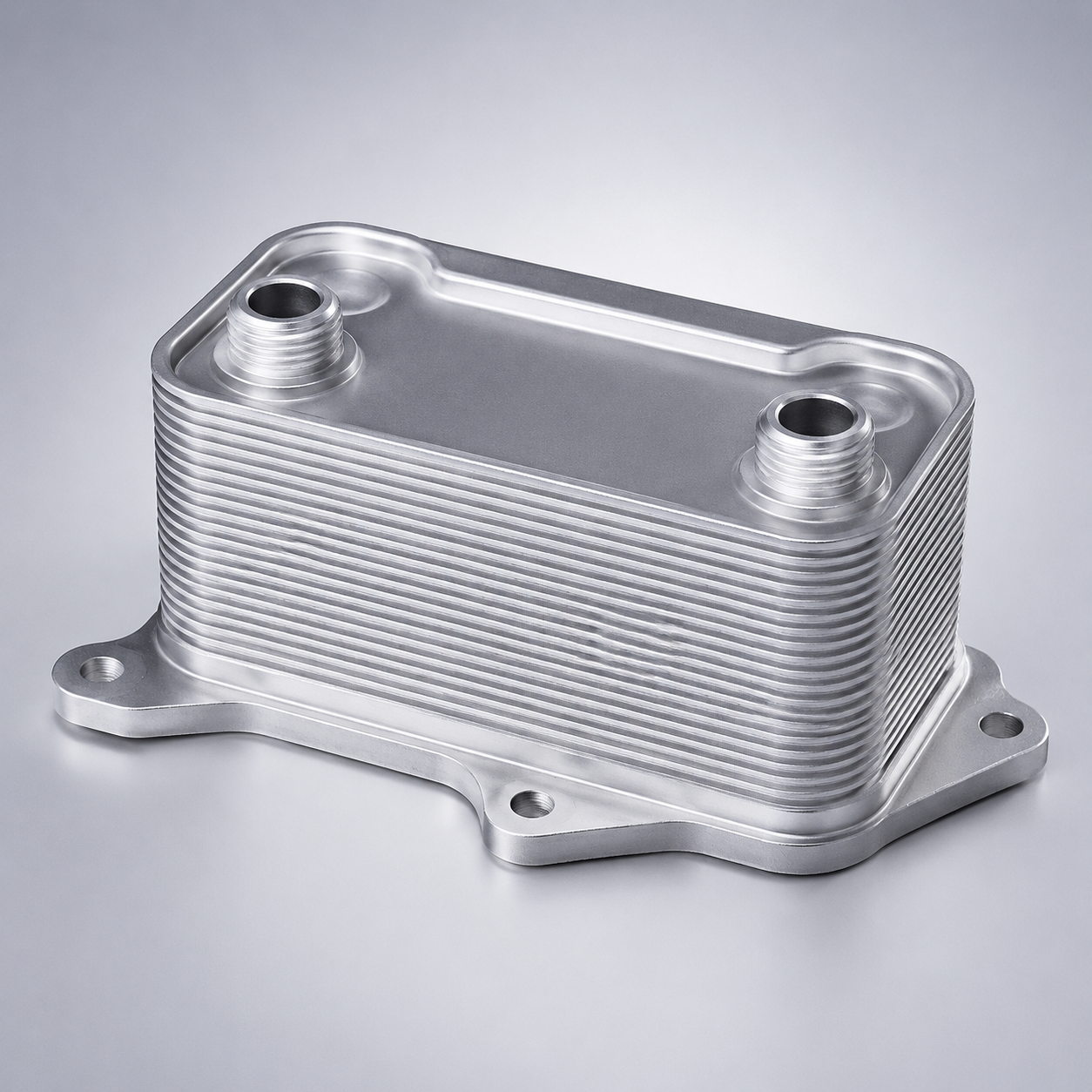
Buying Cadillac EGR coolers at wholesale volume is where catalogue data meets manufacturing control. A part can carry the right cross-reference and still fail the programme because the bracket is off, the coolant port angle is wrong, the weld process drifts, or the next production lot does not match the sample. That is the real sourcing risk.
For an egr cooler cadillac wholesale programme, procurement teams should lock four things before chasing price: exact fitment, construction specification, test evidence, and repeatable supply terms. Engine family, emissions package, coolant and exhaust interfaces, mounting points, heat load, packaging, and traceability all affect whether the order becomes usable inventory or a return problem.
Driventus is an independent aftermarket manufacturer. Cadillac and other brand names are referenced only for fitment identification. We manufacture engine and powertrain components in Taizhou, Zhejiang, under IATF 16949:2016 and ISO 9001:2015 quality systems. Use this guide to pressure-test suppliers before sampling, confirming tooling, approving carton data, or issuing a purchase order.
Decision Gate 1: Prove The Part Identity Before Pricing
Do not start with the cheapest quote. Start with the part identity. For Cadillac applications, the same model line may have different engine codes, emissions packages, coolant routing, turbo layouts, brackets, and sensor clearances across production years and markets. A visual match is not enough.
Before comparing suppliers, lock the application and the physical interface:
Confirm vehicle platform, engine family, model year range, VIN range if available, fuel type, turbo configuration, and emissions market
Match the OE reference, for example OE 06A107065 when the application data calls for that style of cross-reference
Measure inlet and outlet diameters with calipers, including nominal size and tolerance, for example 19.0 mm +/- 0.2 mm where agreed
Check flange thickness, bolt-hole diameter, mounting centre distance, port clocking, and gasket land width against a known-good sample
Confirm bracket datum points; a 2-3 mm offset can create hose stress or installation interference
Check material grade for the cooler core, headers, shell, and weld zones, with material certificates by batch where available
Request coolant-side leak test data, exhaust-side pressure criteria, thermal cycle validation, and final inspection records
Confirm packaging, barcode labels, carton quantity, pallet height, and lot traceability for warehouse receiving
A quotation becomes useful only after those details are fixed in writing. Otherwise, two suppliers may appear to quote the same Cadillac EGR cooler while actually offering different materials, test limits, accessories, carton formats, or fitment assumptions.
Supply-Chain Failure Modes That Create Returns
Most wholesale problems do not start with a dramatic defect. They start with small uncontrolled variables: a sample from one fixture and bulk parts from another, undocumented weld changes, mixed revisions in one shipment, or cartons that warehouse teams cannot trace by SKU.
Ask supply questions that expose those risks:
1. What is the normal production lead time after order confirmation: 25-35 days for repeat stocked tooling, or 45-60 days when material allocation, fixtures, or packaging artwork must be prepared? 2. What MOQ applies to stocked parts versus made-to-order parts: 50-100 pieces per SKU for common references, or 200-500 pieces per SKU for dedicated production and private label packing? 3. Can the supplier support mixed-SKU cartons or mixed-pallet shipments for distributors without losing SKU-level traceability? 4. Are samples pulled from the same tooling, welding fixtures, pressure-test equipment, line, and inspection process used for bulk production? 5. Is there documented control for weld procedure, leak testing, final inspection, quarantine of nonconforming parts, and engineering change approval?
Importers, warehouse distributors, and multi-branch repair groups should also require consistent carton packing, barcode labels, gross and net weight data, and clear part-number mapping. Landed cost is not just unit price. It includes sample cost, tooling or fixture charges, MOQ, carton cube, pallet loading, warranty reserve, and replenishment lead time.
If a supplier cannot state those items clearly, the commercial risk is already present. A low unit price will not compensate for unclear traceability, unstable lead times, or undocumented production changes.
Supplier Capability Comparison: Basic Source Vs Controlled Source
Buyer criterion
Basic source
Qualified OEM/aftermarket source
Fitment support
OE number only
OE number, engine code, photos, sample comparison, and critical dimensions
Dimensional control
Visual match
Measured flange, port, bracket, and bolt-centre tolerances recorded
Material traceability
Limited
Heat/material traceability by batch with stainless grade confirmation
Leak testing
Not always stated
100% coolant-side pressure test or defined sampling plan with recorded limits
Thermal validation
Usually unavailable
Thermal cycle, vibration, and corrosion checks defined for the part family
Process control
General claim
Weld, braze, fixture, assembly, and rework controls documented
Certification
None or vague
IATF 16949:2016, ISO 9001:2015
Packaging
Generic
Retail, warehouse, private label, barcode, and pallet options
Lead time visibility
Approximate
Confirmed production window, inspection date, and shipment plan
Commercial clarity
Unit price only
MOQ, price breaks, sample policy, incoterms, warranty, and document set stated
Technical support
Email only
Drawing review, sample sign-off, PPAP-style evidence where required, and change control
</tr></thead><tbody> </tbody></table>For buyers handling Cadillac programmes across multiple regions, the qualified-source column is the practical benchmark. It reduces returns, protects catalogue accuracy, limits chargebacks, and makes replenishment planning easier across branches or customer groups.
When comparing quotes, force every supplier onto the same basis: same material grade, same leak-test pressure, same accessories, same carton configuration, same incoterm, and same annual volume assumption. Without that discipline, the comparison is just a list of prices, not a sourcing decision.
Spec Deep-Dive: Materials, Welds, Leak Tests, And Validation
An EGR cooler lives between two hostile systems. Exhaust gas brings heat, soot, condensate, acidic moisture, and vibration. Coolant passages bring pressure fluctuation, chemical exposure, and long service intervals. The part has to survive both without internal leakage, external seepage, cracked welds, loose joints, or flow restriction problems.
Review the specification at process level, not only part-number level:
Core material and wall thickness, commonly specified in the 0.4-0.8 mm range depending on tube design and duty cycle
Header, shell, and tube material grade, often stainless grades such as 304, 316L, or 409 depending on design requirements
Braze or joining process where applicable, including furnace control or process temperature records
Coolant-side pressure test criteria, such as 100% air-under-water or dry leak testing at an agreed pressure and hold time
Exhaust-side pressure or flow checks where the design requires restriction control
Thermal cycling, vibration, salt spray or condensate corrosion exposure, and post-test leakage inspection
Cleanliness limits so weld spatter, metal chips, or brazing residue do not enter coolant or exhaust passages
Quality-system language only matters when it connects to records. Suppliers should be able to operate within IATF 16949:2016 and ISO 9001:2015 controls, including incoming material inspection, fixture calibration, operator work instructions, final inspection, and nonconformance handling.
For EU sales, buyers may also request REACH (EC) No 1907/2006 declarations depending on material content and destination. If the cooler is sold as part of an emissions-related replacement package, document the local regulatory position instead of assuming one rule applies everywhere.
Driventus supplies aftermarket parts only and does not claim vehicle manufacturer approval, endorsement, or affiliation.
Scenario: The Cooler Fits The Photos But Fails The Install
A common Cadillac sourcing problem looks harmless at first. The supplier sends photos. The casting shape, tube path, and flanges look correct. The sample even bolts up loosely. Then the installer finds the coolant hose sits under tension, the gasket face does not land evenly, or a sensor boss sits too close to surrounding hardware. The difference may be only a few millimetres.
That is why fitment review needs multiple checks:
Ask for dimensional drawings before committing to a large purchase order, including bolt-centre distance, flange face angle, port diameter, and bracket datums
Compare the new part against a known-good sample from the target market using photos from front, rear, top, side, and installed orientation
Check port orientation from multiple angles, not just front-view photos; clocking errors of 5-10 degrees can affect hose routing
Verify whether ancillary gaskets, seals, clamps, bolts, O-rings, or hardware are included, and list them separately on the quote
Confirm whether the application is diesel or petrol, turbocharged or naturally aspirated, and whether a bypass valve or sensor boss is required
Run a first-article inspection on 3-5 samples before releasing a 100-piece or larger purchase order
Once the part family is defined, links to our catalog and the broader engine components range help internal buyers keep references aligned across purchasing, warehouse, catalogue, and service teams.
How Driventus Handles Sampling, Approval, And Repeat Orders
Driventus operates as a vertically integrated manufacturer in Taizhou, Zhejiang, with production control across engine and powertrain components. For wholesale buyers, the advantage is coordination: engineering feedback, tooling review, quality inspection, and shipment planning can move through one manufacturing workflow instead of being split across unrelated traders and factories.
During sourcing, buyers can request:
Technical drawing review before sampling, with critical-to-fit dimensions marked for confirmation
Production sample approval against agreed dimensions, material grade, weld quality, leakage limits, and included accessories
Bulk order planning by SKU, MOQ, price break, carton configuration, pallet loading, and shipment window
Private label, neutral packaging, or warehouse-ready labelling for regional distributors, including barcode and part-number mapping
Pre-shipment inspection records, carton photos, packing list, invoice, and certificate or declaration documents required for import files
Change control documentation when a drawing revision, material update, process change, supplier change, or packaging change is introduced
The practical goal is simple: the approved sample, the purchase order, the inspection records, and the shipment labels should describe the same product. Our quality system page summarises the certifications and production controls used in our factory. For buyers with special packaging, labelling, dimensional, or programme requirements, custom manufacturing is available for qualified projects.
Commercial Q&A To Settle Before The Purchase Order
Wholesale sourcing often fails after sample approval because the commercial terms were treated as secondary details. Settle them before order release so purchasing, logistics, warehouse, and aftersales teams are working from the same assumptions.
Ask the supplier to state these items in writing:
MOQ per part number, with separate figures for standard packing, private label packing, and new-tooling items
Price breaks at realistic order quantities, for example 50, 100, 300, and 500 pieces per SKU where applicable
Sample charge policy, refundable tooling or fixture charges if any, and sample lead time, commonly 7-15 days for available parts or 20-35 days when production setup is needed
Standard lead time and peak-season lead time, including the point at which the clock starts: deposit received, artwork approved, or sample signed off
Warranty scope, claim evidence required, credit/replacement process, and response time for suspected batch issues
Packing quantity per carton, carton dimensions, gross weight, net weight, pallet configuration, and maximum pallet height
Document set included with shipment, such as commercial invoice, packing list, bill of lading, certificate of origin if needed, material declaration, and inspection summary
Payment terms, incoterms, shipment handover point, and responsibility for export documents or destination charges
These details can affect landed cost more than a small difference in unit price. A supplier with clear carton counts, fewer claims, reliable documentation, and predictable replenishment usually lowers total cost of ownership. When comparing vendors, ask each one to quote on the same sample, packaging, inspection, incoterm, and shipment basis.
When Independent Aftermarket Supply Makes Sense
Independent aftermarket supply is useful when the buyer needs availability, replenishment control, and stable cost across several sales channels. It is not a shortcut around engineering verification. Dimensions, materials, test criteria, packaging, and compliance requirements still need to be confirmed before volume approval.
The procurement case is strongest when buyers need:
Broader supply options for hard-to-source Cadillac applications and ageing vehicle parc demand
Support for distributor stock programmes, e-commerce fulfilment, fleet maintenance, and repair network demand
Lower exposure to single-source shortages when OE-service channels or regional distributors have limited stock
Flexibility in packaging, labelling, barcode format, carton quantity, and private label execution
Better replenishment planning when demand is recurring, especially when forecasts are shared 60-90 days ahead
Alignment of MOQ, price breaks, and shipment consolidation across several engine component SKUs
Driventus is an independent aftermarket manufacturer; Cadillac and other brand names are referenced for fitment only. That disclosure is not boilerplate. It protects internal compliance, customer communication, and catalogue accuracy by avoiding any implication of vehicle manufacturer endorsement.
Frequently asked questions
Yes. We can work from OE cross-reference data, dimensional drawings, sample photos, and application details. Final fitment should still be confirmed against engine family, model year, market specification, port dimensions, bracket position, and included hardware before bulk ordering.
IATF 16949:2016 and ISO 9001:2015 are the main quality-system references. Depending on destination market and material content, REACH (EC) No 1907/2006 declarations may also be requested. Buyers should also ask for batch traceability, inspection records, and leak-test criteria for the specific cooler.
Yes. We can support neutral cartons, barcode labelling, and private label programmes when the order volume, artwork, and product definition are suitable for a controlled production run. MOQ, carton quantity, label format, and lead time should be confirmed before order release.
Send the OE reference, vehicle application, target annual volume, destination market, requested MOQ, packing requirement, and any drawings or sample photos. The fastest path is to [request a quote](/contact.html) with those details included so fitment, price, sample timing, and lead time can be reviewed together.
For procurement, the next step is a fitment and commercial review against your target Cadillac application, destination market, MOQ, forecast volume, packaging requirement, and lead-time target. Send your requirements through [request a quote](/contact.html) and we will respond with the relevant sourcing options.