EGR cooler · 2026-06-18

EGR Cooler Acura Wholesale Sourcing Guide

Procurement teams evaluating egr cooler acura wholesale programs should not start with the lowest quote. The expensive problems usually appear later: a flange that sits 0.4 mm out of position, a coolant neck that stresses the hose, a brazed joint that passes one sample test but leaks after thermal cycling, or cartons that arrive with unprotected ports. Those failures create warranty noise, emergency replenishment and distributor distrust.

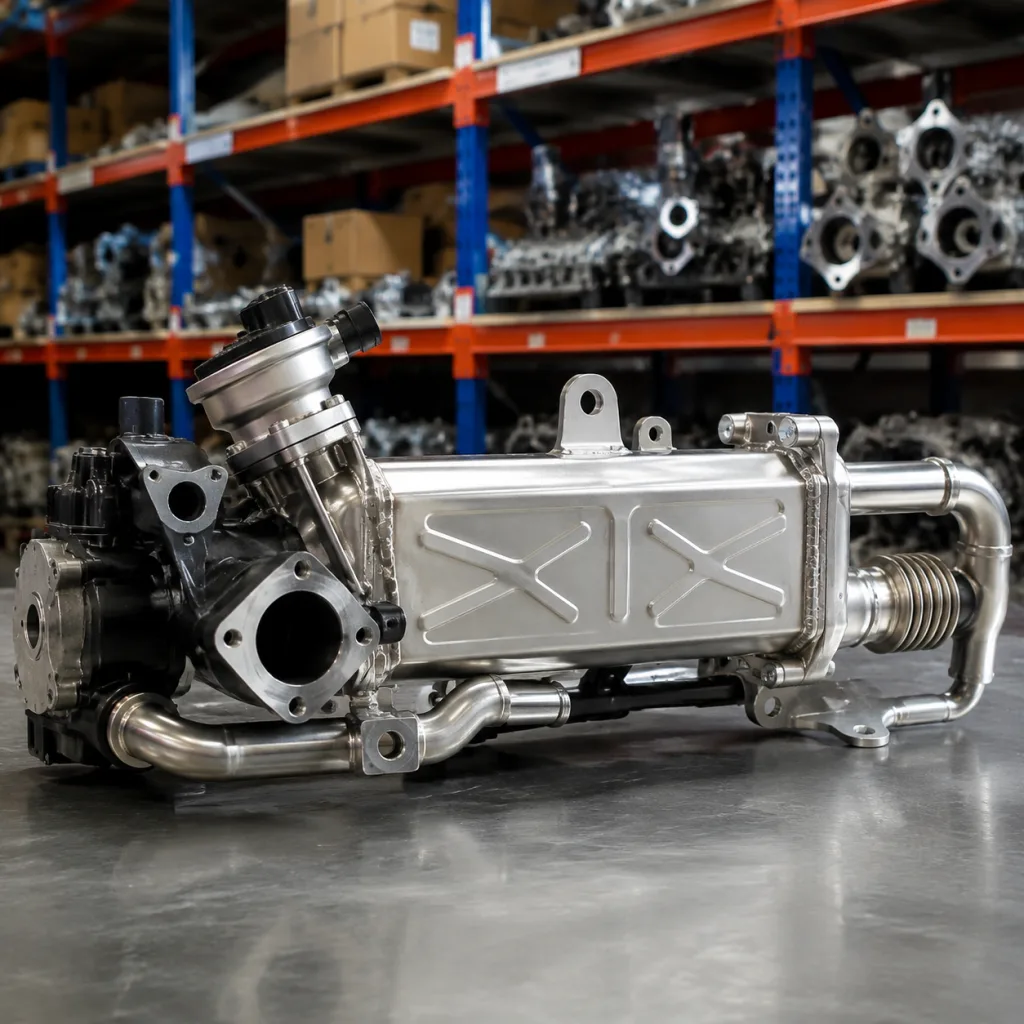
A better sourcing process treats the EGR cooler as a controlled heat-exchanger program, not a commodity line item. The part must hold OE-style installation geometry, resist coolant-side leakage, survive exhaust-side heat, stay clean internally and arrive with documents that satisfy import, warehouse and warranty teams. Distributor and repair-chain buyers need predictable landed cost and repeatable fit. OEM and Tier-1 buyers may also require PPAP-style evidence, lot traceability and disciplined engineering-change control.

Driventus manufactures engine and powertrain components in Taizhou, Zhejiang, and exports to more than 60 countries. This guide shows how to qualify an Acura-fit EGR cooler supplier, structure an RFQ and identify the controls that reduce field-return exposure. Driventus is an independent aftermarket manufacturer; brand names are referenced for fitment only.

Start With the Failure Modes, Not the Fitment List

An EGR cooler is a compact heat exchanger working in a harsh corner of the engine bay. It sees exhaust gas temperatures that can exceed 600°C during load events, coolant pressure commonly around 1.0–1.5 bar in service, vibration, thermal cycling and acidic condensate. In wholesale programs, failures usually trace back to process variation: inconsistent brazing, shallow weld penetration, distorted mounting flanges, internal contamination, weak cleaning or uncontrolled material substitution.

For Acura applications, the sourcing file should begin with how the part can fail in the field:

  • Coolant leakage from brazed joints, welded seams, end tanks or hose connections
  • Installation misfit caused by flange flatness, bolt-hole position, bracket angle or port orientation drift
  • Exhaust leakage at gasket faces or valve-interface surfaces
  • Flow restriction from incorrect internal geometry, weld spatter, loose scale or debris
  • Hose sealing complaints caused by bead profile, outside diameter or neck angle variation
  • Transit damage where ports, studs or thin brackets are not protected
  • Warranty disputes caused by missing lot codes, incomplete leak-test records or unclear inspection criteria

Once those risks are listed, the fitment data becomes more useful. Buyers should source by engine family, emissions layout, mounting position, coolant-port orientation and OE-style part-number cross-reference where available. If a buyer provides a reference such as OE 18710… or OE 18715…, the supplier should treat it as a fitment reference only, not as a claim of vehicle manufacturer approval or genuine-part status.

The RFQ should state whether the cooler is for naturally aspirated or turbocharged layouts, whether an EGR valve or bypass feature interfaces with the assembly, and whether the target vehicle uses a gasket, O-ring or hose-clamp coolant connection.

Include these RFQ fields before discussing price:

  • Annual forecast and first order quantity by SKU, for example 300, 500 or 1,000 pieces per part number
  • Target market: EU, UK, US, Canada, Australia or Brazil
  • Fitment range, engine codes and model years, if available
  • Required packaging: neutral, customer brand or bulk service pack
  • Labelling rules: barcode, country of origin, batch code and customer SKU
  • Inspection level: standard outgoing inspection, AQL 1.0/2.5/4.0, or buyer-defined critical-characteristic sampling
  • Documentation: material declaration, leak-test report, dimensional report and certificate copies
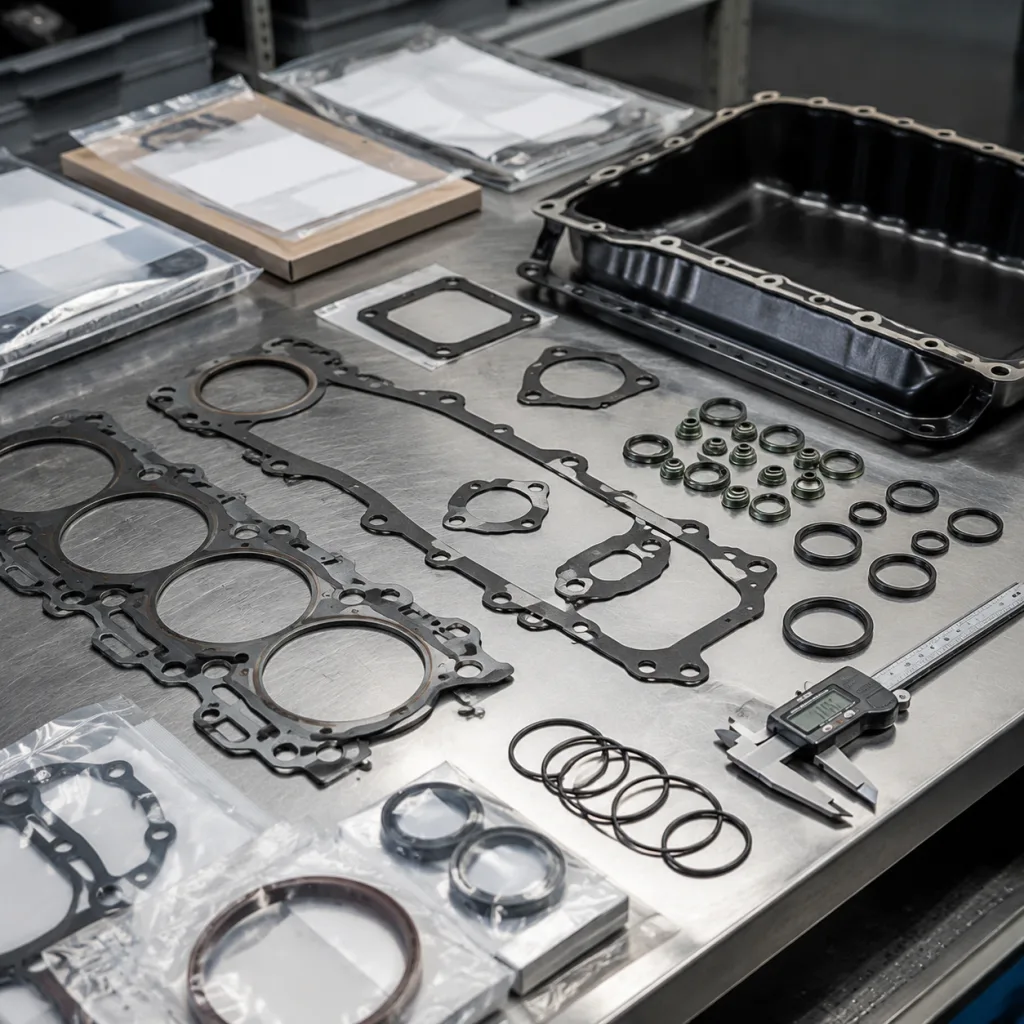
  • Accessory scope: cooler-only supply or kit supply with gaskets, clamps, O-rings, studs or fasteners
  • Commercial frame: EXW/FOB/CIF/DDP comparison basis, replenishment frequency and partial shipment rules

Buyers can review related engine parts through our catalog, including EGR cooler assemblies, gaskets and supporting engine components.

Use This MOQ and Lead-Time Decision Tree

Do not compare MOQ as a single number. A 100-piece launch order may be realistic when the SKU uses existing tooling, shared stainless tube stock and neutral cartons. A 1,000-piece MOQ may be justified when the buyer needs custom brackets, printed boxes, private barcodes, special gaskets or PPAP-style validation.

Use this sequence before supplier nomination:

1. Confirm tooling status. Existing tooling usually lowers risk and lead time. Modified or new tooling may require 30–60 days plus sample approval. 2. Separate sample capability from batch capability. One-off samples can look correct while production lots vary in flange flatness, tube alignment, coolant-neck angle or weld bead consistency. 3. Freeze the supply scope. Compare cooler only versus kit, 100% leak test versus sampling, neutral versus branded packaging, and FOB versus CIF on the same basis. 4. Check hidden cost adders. Gaskets, caps, pallets, artwork, fumigation, labels and inspection reports can turn a low quote into an average one. 5. Match MOQ to replenishment rhythm. Slow-moving SKUs need mixed-container rules; fast movers can support larger batches and better price tiers.

Typical commercial points to clarify before nomination:

</tr></thead><tbody> </tbody></table>Ask the factory how it controls fixtures, leak testing, brazing cycles, final cleaning and change approvals. The answer matters more than the brochure. Stable batch production depends on locked fixtures, calibrated gauges, trained operators and clear authority for engineering changes.

Driventus can support catalogue supply and custom manufacturing where buyers need private tooling, market-specific packaging, or controlled changes to port orientation, bracket design or gasket interface. MOQ depends on part family, tooling status, validation workload and packaging requirements. Buyers should confirm MOQ by SKU rather than assume one figure applies to all EGR coolers.

Audit the Process Route From Tube Stock to Packed Carton

For EGR cooler Acura wholesale sourcing, a factory audit should follow the product, not the meeting-room presentation. A polished cooler can still carry loose chips inside. A dimensionally correct sample can still fail in the field if production fixtures are not locked, calibrated and maintained.

Driventus operates under IATF 16949:2016 and ISO 9001:2015. Buyers should verify certificate scope, expiry date and issuing body, then connect the certificates to actual shop-floor records. The quality system should cover incoming inspection, in-process checks, final testing, nonconforming-product control and traceability.

Walk the route in order: incoming tube and plate storage, cutting, forming, core assembly, brazing or welding, machining, washing, leak test, dimensional check, final visual inspection, port capping and packing. At each station, ask what can go wrong and how the operator knows before the defect reaches the carton.

Key audit checks include:

  • Incoming material identification for stainless steel, aluminium or brazing filler materials, supported by heat number, material grade and supplier certificate
  • Fixture control for flange location, tube position, port angle and bracket geometry, with master sample or go/no-go gauge sign-off
  • Coolant-side leak testing at a defined pressure such as 3.0 bar air-under-water or pressure-decay equivalent, with 30–60 second hold time and zero visible bubbles
  • Exhaust-side sealing or flow checks where the design requires it, especially for welded shells, bypass passages or valve-interface faces
  • Visual inspection criteria for weld undercut, spatter, cracks, porosity and incomplete brazing, with acceptance photos for operators
  • Dimensional inspection for port centre distance, flange flatness, bolt-hole position and gasket-face condition; critical hole positions commonly need ±0.20–0.30 mm control against the approved drawing or sample
  • Internal cleanliness control after machining, welding or brazing, including no loose chips, scale, weld balls or oil residue visible at ports
  • Batch traceability from raw material to packed carton, with lot code linked to test date, operator, fixture and leak-test station
  • Calibration records for pressure gauges, fixtures and measuring equipment, normally on 6- or 12-month intervals depending on device criticality
  • Nonconforming product segregation and corrective action records, including quarantine labels, disposition authority and rework verification

Request the previous three production lots of the same or similar EGR cooler. Compare leak-test failure rate, rework rate and customer complaint history. If the factory cannot show lot-level records, treat any quoted warranty rate as unsupported.

Compliance expectations vary by market. For EU buyers, material declarations may need to support REACH (EC) No 1907/2006 obligations. For emissions-related replacement parts, the buyer remains responsible for determining local regulatory requirements, including where rules reference emissions performance frameworks such as ECE R-83.

Define the Specification Where Disputes Usually Start

Many EGR cooler disputes begin with a vague instruction: “make same as sample.” That is not enough. A supplier may reproduce visible geometry but miss internal flow path, wall thickness, gasket compression height, cooler-core volume or sensor-boss alignment. Drawings, measured samples and agreed inspection points give both sides a defensible standard.

Lock the specification around installation, sealing, durability and handling:

  • Fitment reference: Acura model range, engine code and OE-style cross-reference if available
  • Core material: Stainless steel or aluminium construction according to original design requirement; define grade where known, such as 304/316 stainless or equivalent
  • Wall thickness: Tube, shell and flange thickness measured at agreed points; typical drawing tolerances should state nominal value plus allowable deviation rather than “same as sample”
  • Flange flatness: Agreed maximum deviation measured on a defined datum surface, commonly ≤0.10–0.20 mm for gasket faces depending on size
  • Bolt-hole tolerance: Agreed positional tolerance against drawing or approved sample, commonly ±0.20–0.30 mm for installation-critical holes
  • Coolant connection: Hose diameter, bead profile, angle and centreline position; define outside diameter tolerance such as ±0.10–0.20 mm where hose sealing is critical
  • Exhaust connection: Port shape, gasket face finish, fastening pattern and surface roughness target where measurable
  • Pressure test: Coolant-side test pressure, hold time and acceptable pressure drop; for example 3.0 bar for 60 seconds with no visible bubbles or agreed decay limit
  • Thermal validation: Thermal cycling profile agreed between buyer and supplier, such as repeated hot-gas/coolant cycles from ambient to 500–650°C gas-side exposure and return to ambient
  • Flow requirement: Exhaust-side or coolant-side flow restriction measured against an approved sample to avoid overheating or EGR efficiency complaints
  • Internal cleanliness: Residue, loose particles and oil contamination limits where required; define whether white-cloth wipe, particle count or visual borescope check applies
  • Surface condition: Clean, dry, no loose scale, no installation-critical weld spatter, no sharp burrs on hose or gasket-contact areas
  • Packaging: Corrosion protection, port caps, inner bag, carton drop resistance, pallet standard and maximum gross weight per carton

For repair-chain programs, decide early whether the item is a cooler-only SKU or a complete kit. Kits with gaskets and fasteners reduce bay delays but add bill-of-material and packaging controls. Cooler-only supply may better match existing branch inventory systems. Either approach works if the BOM, label content and service-pack configuration are frozen before mass production.

A first-article approval should include one dimensioned report, a leak-test record, photos of all interfaces, packaging sample approval and signed golden sample retention at both buyer and supplier sites.

Build the Import File Before the Shipment Exists

Wholesale buyers should request documents early. Port delays often come from preventable details: missing country-of-origin marking, inconsistent carton labels, unclear HS-code descriptions, unmatched weights or incomplete material declarations.

A standard documentation pack may include:

Item What to request Practical benchmark
MOQSKU-level MOQ and mixed-container rules100–300 pcs for stocked catalogue SKUs; 500–1,000 pcs for new or slow-moving SKUs
Sample lead timeTooling status and validation scope7–15 days for stocked samples; 20–35 days for modified tooling
Production lead timeCapacity, packaging and inspection plan30–45 days for repeat orders; 45–75 days for new packaging or first production
Tooling statusExisting, modified or new toolingExisting tooling lowers risk; new tooling may require 30–60 days plus sample approval
Price logicTiered quote by quantityCompare 100/300/500/1,000 pcs and separate tooling, gasket and packaging costs
Payment termsDeposit, balance and credit reviewCommon export structure is 30% deposit and 70% before shipment unless credit is approved
IncotermsFOB Ningbo/Shanghai or agreed alternativesEnables landed-cost comparison including freight, duty, brokerage and warehouse handling
After-sales evidenceFailure analysis process and response time48-hour acknowledgement and 5D/8D report within 7–15 working days is a useful target

</tr></thead><tbody> </tbody></table>For North American buyers, labels should match internal SKU, UPC or warehouse barcode requirements, with scannable carton labels tested before production packing. For EU and UK buyers, carton markings, material declarations and importer records should be checked against local obligations. For Brazil, align the document set with broker requirements before production, especially when consolidating mixed automotive parts or combining EGR coolers with other engine components.

Use this workflow before purchase-order release:

1. Freeze the commercial invoice description, HS-code proposal, country-of-origin statement, carton label format and packing-list fields. 2. Confirm whether the SKU ships as cooler only or kit, and make the invoice description match the actual contents. 3. Approve barcode, carton label and pallet mark samples before mass packing. 4. Before shipment, compare PO, invoice, packing list, carton labels and pallet marks line by line. 5. Correct mismatches in part number, quantity, gross weight, origin mark or barcode before vessel booking.

This discipline prevents warehouse relabelling and customs rework. It also gives the warranty team a clean trail if a distributor later reports leakage, misfit or missing accessories.

Build the Import File Before the Shipment Exists

Compare Suppliers by Total Risk, Not Unit Price

A low unit price can vanish after the first round of field returns, shipment delays, installation complaints or repacking labour. A stronger comparison looks at total sourcing risk: process discipline, evidence quality, export readiness and after-sales response.

Use this scorecard to separate capability from claims:

Document Typical use
Commercial invoice and packing listCustoms clearance and receiving; should match SKU, quantity, carton count, net weight and gross weight
Certificate of origin, if requiredDuty treatment and trade documentation
ISO 9001:2015 and IATF 16949:2016 certificatesSupplier qualification file, with scope and expiry checked
Dimensional inspection reportFirst article and periodic verification of critical dimensions
Leak test summaryBatch release evidence showing pressure, hold time, date, lot and result
Material declarationREACH (EC) No 1907/2006 support and restricted-substance review
Packaging specificationWarehouse, courier and e-commerce handling control
Traceability formatWarranty investigation and recall containment
Artwork approval filePrivate-label packaging control, including version number and barcode verification
Pre-shipment inspection reportQuantity, appearance, packaging, label and functional-check evidence before balance payment

</tr></thead><tbody> </tbody></table>A buyer seeking egr cooler acura wholesale supply should also require a pre-shipment inspection plan. The plan should identify sampling quantity, inspected characteristics, acceptance rules, defect categories and reporting format. Classify leakage, blocked ports, wrong part, missing gasket and incorrect label as critical. Treat distorted brackets, flange flatness failure and poor weld appearance as major. Reserve minor status for small cosmetic marks outside sealing areas. Buyers commonly use AQL levels such as critical 0, major 2.5 and minor 4.0, but any rule works only when both sides approve it before production.

For total-cost comparison, build a landed-cost sheet with unit price, tooling amortisation, gasket and fastener cost, inner box and master carton cost, inland freight, ocean or air freight, duty, customs brokerage, inspection fees, warehouse receiving and expected warranty allowance. A supplier quoting 3–5% higher FOB may still be cheaper if it reduces repacking, field leakage and emergency replenishment.

If a supplier resists measurable criteria before production, treat that as a qualification risk. If the supplier welcomes drawings, samples, inspection rules and batch records, the program has a better chance of staying quiet after launch.

Driventus can quote standard catalogue items or review buyer samples for private-label programs. For a controlled RFQ, include annual volume, target launch date, packaging needs, destination market and any OE-style cross-reference. Buyers can request a quote with drawings, samples or application data.

Frequently asked questions

Provide application data, engine code if known, OE-style cross-reference if available, annual forecast, first order quantity, packaging type, target market and required documents. Photos and samples help, but drawings or measured critical dimensions such as flange flatness, bolt-hole position, coolant-port diameter and pressure-test requirement reduce quotation uncertainty.

Yes. Driventus can support neutral, customer-branded or bulk packaging depending on MOQ, artwork requirements and destination-market labelling rules. Packaging specifications should confirm barcode format, carton strength, port caps, inner bag, label position and pallet requirements before mass production to avoid warehouse relabelling.

No. Fitment references identify compatibility for sourcing and catalogue purposes only. Driventus is an independent aftermarket manufacturer; brand names are referenced for fitment only.

For current MOQ, lead time and documentation options for Acura-fit EGR cooler programs, send the target SKU list, forecast, preferred Incoterm, packaging requirement and destination market. Our team can review the sourcing package and respond through /contact.html

Request a Quote
Criterion Strong supplier evidence Buyer risk if absent
Process certificationValid IATF 16949:2016 and ISO 9001:2015 scopeWeak process discipline
Leak testingDefined pressure, hold time and records, ideally 100% coolant-side testingCoolant leakage claims
Dimensional controlCMM, gauges or fixture reports for flange and port geometryInstallation misfit
Tooling controlTool maintenance, fixture approval and engineering-change recordsLot-to-lot variation
Packaging validationCarton drop review, port protection and pallet handling standardTransit damage
TraceabilityBatch code on product or carton linked to test and material recordsSlow warranty containment
Engineering supportDrawing review, sample feedback and first-article reportLonger development cycle
Export experienceShipments to target regions with complete document packsDocumentation errors
Commercial stabilityTiered price, MOQ, lead-time and validity period stated in writingUnplanned cost increases