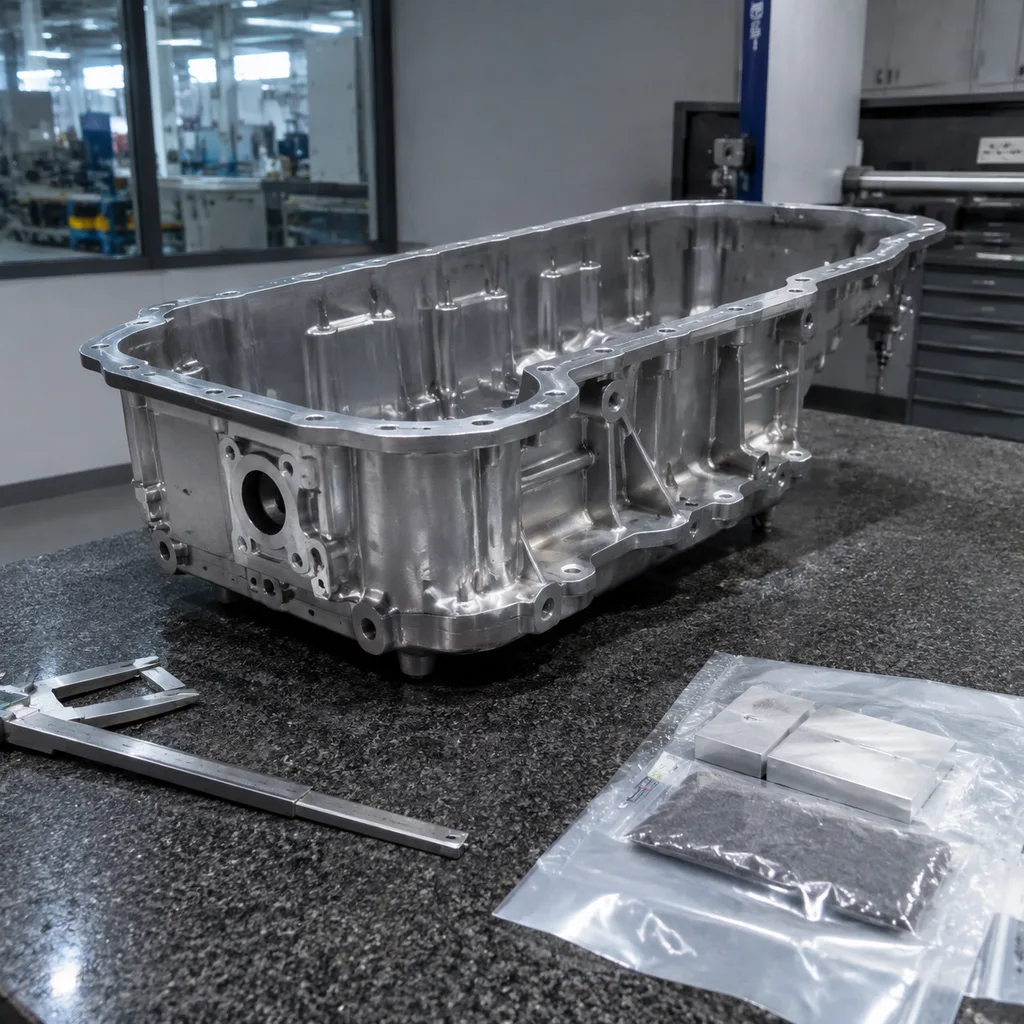
Dual Mass Flywheel Lexus OEM Supplier Sourcing
Sourcing a Lexus-fit dual mass flywheel is not a simple drawing-match exercise. Procurement teams need measurable evidence that the part will control torsional vibration, maintain starter and clutch compatibility, hold dynamic balance over repeated production, and arrive with reliable traceability and export packing. Commercial requirements matter as much as engineering: MOQ, private-label options, lead time, warranty handling, audit access, and documentation can decide whether a programme is practical.
Driventus manufactures engine and powertrain components in Taizhou, Zhejiang, under IATF 16949:2016 and ISO 9001:2015 certified systems. We support aftermarket and contract manufacturing programmes when buyers provide OE samples, drawings, performance targets, inspection data, or fitment references. Driventus is an independent aftermarket manufacturer; Lexus, Toyota, and other vehicle brand names are used only to identify fitment demand and do not imply approval or endorsement.
What actually matters in a Lexus-fit flywheel brief
A dual mass flywheel is not just a heavy steel assembly. It has to absorb torsional vibration, match the clutch system, engage the starter cleanly, and stay within balance and runout limits after machining, assembly, and packing.
For a dual mass flywheel Lexus OEM supplier search, model name alone is rarely enough. Buyers should anchor the brief to engine code, transmission code, clutch diameter, flywheel outside diameter, bolt pattern, pilot or bearing location, and a reference sample when available. The more exact the fitment data, the less room there is for avoidable quote noise.
Typical inputs for a usable RFQ:
- Vehicle platform, engine code, transmission code, drive type, and model years
- OE-style reference numbers, interchange numbers, and supersession notes if available
- Sample part, drawing, scan data, inspection report, or target performance data
- Clutch diameter, flywheel OD, total height, step height, and target mass
- Bolt quantity, pitch circle diameter, centre bore, pilot or bearing location, and dowel position
- Ring gear tooth count, outer diameter, tooth pitch or module, and installed runout target
- Angular free play, damping torque window, grease spec, and temperature range
- Annual forecast, trial quantity, first-market region, and reorder rhythm
- Packaging need: neutral carton, private label, barcode, application label, or pallet bulk
- Validation need: dimensional report, balance data, endurance plan, material confirmation, or PPAP-style file
If a drawing is unavailable, Driventus can still work from a sample and a fitment checklist. Quotations are more reliable when critical machined dimensions are measured to 0.01 mm and general envelope dimensions to 0.1 mm. For faster feasibility review, buyers should include clear photos of the crank face, clutch face, ring gear, side profile, and any markings.
Driventus supports aftermarket distribution, private-label programmes, and contract manufacturing. Browse our catalog for related engine and drivetrain items, then submit a fitment list or sample request for review. Lexus and Toyota names are used only to describe independent aftermarket fitment demand.
Where supplier programs fail: the control points buyers should test
Most sourcing problems in dual mass flywheels are not pricing problems. They are control problems. A part can look correct on paper and still fail in the field if the damping curve drifts, the ring gear runs out, or the clutch face is finished inconsistently.
Driventus operates under IATF 16949:2016 and ISO 9001:2015 frameworks. Buyers can review our quality system before a desktop audit or plant visit. For regulated markets, material declarations and substance control may also need to align with REACH (EC) No 1907/2006 and customer-specific requirements.
| Control point | How it is verified | What to agree up front | Why it matters |
|---|---|---|---|
| Crank mounting face | CMM or fixture inspection | Flatness and runout target, often in the 0.03–0.08 mm range depending on application | Prevents vibration, installation complaints, and repeat rework |
| Bolt hole position | Gauge and dimensional report | Hole diameter, PCD, and position tolerance from drawing or master sample | Protects crankshaft fit and assembly speed |
| Ring gear concentricity | Dial indicator or CMM | Typical TIR target 0.10–0.20 mm unless tighter is specified | Reduces starter noise and premature wear |
| Friction face finish | Roughness check and visual inspection | Common Ra target 0.8–1.6 µm with no chatter, burn marks, or burrs | Supports smooth clutch engagement |
| Dynamic balance | Balance machine record | Residual unbalance limit linked to part mass and speed; G6.3 or tighter when required | Lowers NVH and bearing load |
| Angular free play | Functional rotational test | Degree range and end-stop feel matched to sample or spec | Confirms damping behaviour lot to lot |
| Spring and damper assembly | Process checks plus functional test | Spring set, grease mass, rivet height, and torque curve by lot | Controls durability and torsional response |
| Heat treatment | Hardness test and furnace record | Ring gear and wear-zone hardness confirmed to drawing or sample | Reduces cracking and tooth wear |
| Traceability | Lot code and record linkage | Material, machining, assembly, balance, and packing records tied together | Supports claims handling and containment |
| Buyer type | Main concern | Useful metric | Driventus support |
|---|---|---|---|
| Aftermarket distributor | Range coverage, MOQ, export packing, catalogue fitment, margin stability | Fill rate, landed cost, carton damage rate, reorder lead time | Fitment review, private-label packing, consolidated shipments, label planning |
| OEM or Tier-1 supplier | Process control, audit readiness, documentation, controlled change | Audit score, PPAP status, capability evidence, change approval timing | Quality files, engineering review, sample approval support, controlled change process |
| Multi-location repair chain | Availability, installation consistency, warranty clarity, branch identification | Return rate, noise complaint rate, barcode accuracy, stockout rate | Batch traceability, application labelling, claim analysis support, repeat-order planning |