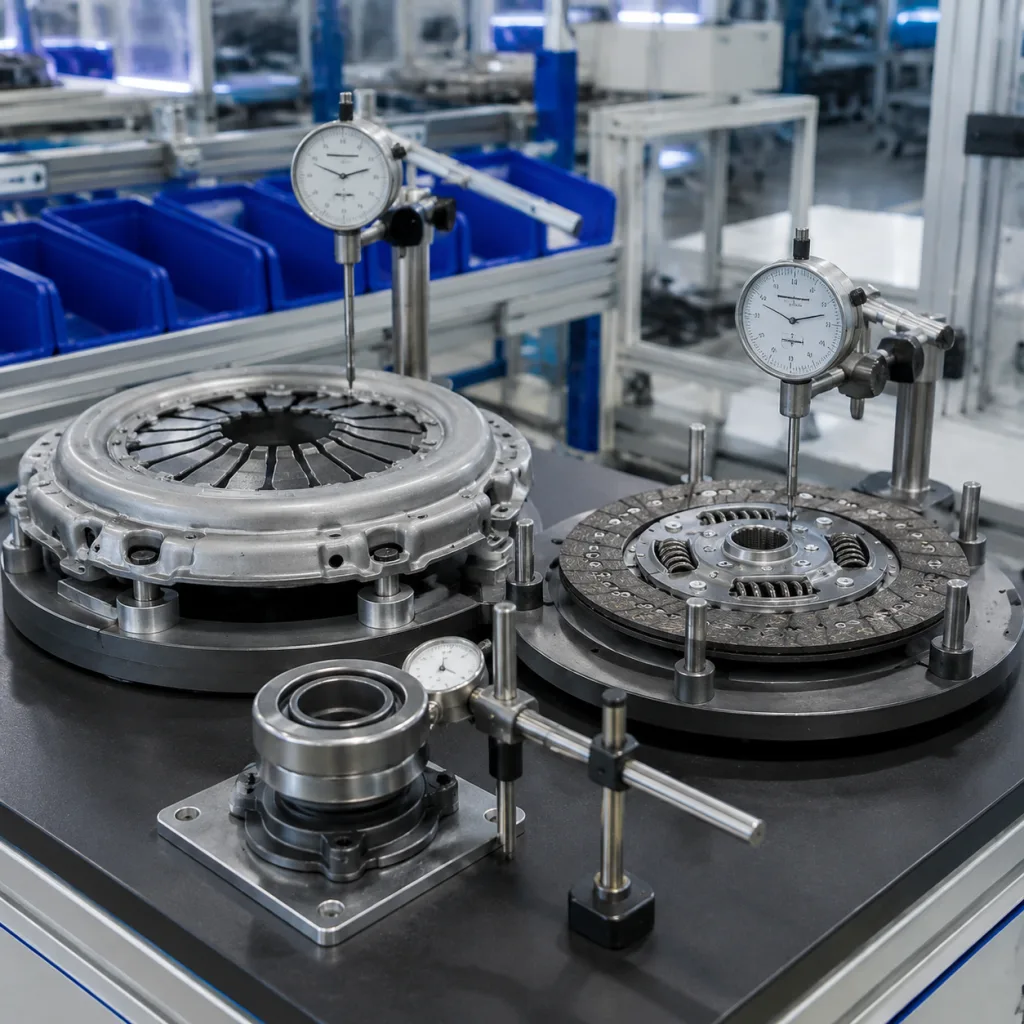
Dual Mass Flywheel Iveco Supplier for B2B Sourcing
Commercial vehicle distributors, fleet-maintenance programs, and repair-chain buyers need dual mass flywheels that fit correctly, hold torsional damping within specification, and arrive with predictable documentation. For Iveco applications, sourcing risk extends beyond headline price to hub float, spring preload, friction surface hardness, ring gear concentricity, and batch traceability. Driventus manufactures engine and powertrain components in Taizhou, Zhejiang, and supplies B2B customers in Europe, the UK, North America, Australia, and Brazil. This article explains how to qualify a dual mass flywheel Iveco supplier, what technical evidence to request, and how Driventus manages RFQ review, sampling, production, and export packing. Driventus is an independent aftermarket manufacturer; brand names are referenced for fitment only.
How to Qualify an Iveco Flywheel Supplier Without Guesswork
When buyers source a dual mass flywheel for Iveco applications, the real decision is not who is cheapest. It is who can prove fitment, repeatability, and shipment control. A low quote that misses runout, damping travel, or packaging discipline becomes expensive quickly.
Driventus supports aftermarket distributors, importers, and repair-chain procurement teams with application-based sourcing rather than consumer-level selection. Buyers may provide sample parts, drawings, OE cross-reference data, or existing aftermarket references. If a part family includes a generic OE reference such as OE 06A107065 or OE 11251…, it should be used only as a fitment cross-reference and verified against the physical sample or approved drawing before production.
Typical supply scope includes:
Dual mass flywheel assemblies for diesel commercial vehicle applications
Ring gear installation with runout verification and tooth-count confirmation
Friction-surface machining with surface roughness and hardness checks
Torsional damping verification by batch plan
Neutral export packaging or customer-specified carton artwork
Barcode labels, batch labels, and palletised shipment support
For launch projects, Driventus asks buyers to confirm the engine family, clutch diameter, starter pinion engagement, and any special torque rating targets. A typical review pack includes application photos, sample measurements, and a target market list, which helps the factory verify whether the reference is for a 2.3L, 3.0L, or heavier-duty drivetrain variant before quoting.
Buyers can review related drivetrain and engine coverage through our catalog. For programmes requiring drawings, proprietary packaging, or special validation plans, Driventus also supports custom manufacturing.
Failure Modes That Turn a Good Price Into a Bad Buy
A dual mass flywheel is a safety- and durability-sensitive rotating component. Procurement teams should evaluate both the component design and the supplier’s production discipline. Price comparisons are useful only after fitment, materials, process controls, and warranty terms are aligned.
Sourcing checkpoint
What to request
Typical buyer target
Why it matters
Application confirmation
Vehicle model, engine code, clutch diameter, reference sample or drawing
100% match before RFQ closure
Prevents incorrect crankshaft or clutch interface
Dimensional inspection
PCD, centre bore, mounting holes, ring gear OD, total height
±0.10 mm on critical mounting features, unless drawing states tighter control
Confirms installation compatibility
Dynamic balance control
Batch inspection record and balance tolerance method
Residual imbalance target documented by supplier, often ≤ 40 g·cm for many aftermarket assemblies, subject to part size
Reduces vibration and bearing load
Spring and damper data
Torsional angle range and damping curve where available
Travel and preload values tied to approved sample
Supports NVH and service life performance
Surface treatment
Rust protection, friction face finish, storage condition
Dry film or oil protection suitable for 90-day export storage, if required
Reduces claims during sea freight and warehousing
Packaging test evidence
Carton strength, inner support, pallet plan
Drop-resistant pack with no part-to-part contact
Prevents impact damage to heavy flywheels
Traceability
Heat number, batch number, inspection record
Full lot traceability through finished goods
Enables controlled response if field issues occur
</tr></thead><tbody> </tbody></table>For European buyers, material and chemical compliance should be assessed against REACH (EC) No 1907/2006 where applicable to supplied articles and packaging materials. For quality management, Driventus operates under IATF 16949:2016 and ISO 9001:2015 frameworks; buyers can review the quality system before audit planning.
Procurement teams should also ask how the supplier handles deviation approvals. For example, if a pilot lot shows ring-gear runout outside the internal target but still within drawing tolerance, the supplier should document containment, re-inspection scope, and whether the lot is released, sorted, or remade. That process detail is often more important than a generic certificate.
What a Competent Iveco Program Looks Like in Practice
A reliable dual mass flywheel Iveco supplier should state production assumptions early in the RFQ process. Commercial vehicle flywheels are heavy, batch-dependent items, and tooling, machining, assembly, and balancing capacity can affect delivery dates.
Driventus manages RFQs through application review, sample confirmation, quotation, pre-production sampling where required, and batch production. The following ranges are typical planning references, not fixed contractual terms:
MOQ: commonly 100–300 pieces per reference for regular aftermarket supply, depending on casting, forging, or stocked semi-finished parts.
Target quotation response: usually 1–3 working days for a complete RFQ with photos and dimensions; 3–5 working days if sample measurement or engineering review is needed.
Sample lead time: usually 30–60 days when new machining, validation, or packaging confirmation is required.
Mass production lead time: usually 45–75 days after sample approval, deposit, and packaging artwork confirmation.
Price logic: first orders are usually priced higher when tooling verification, fixture setup, and sample approval are included; repeat orders can improve by around 3%–8% when the same casting, ring gear, and packaging specification is reused.
Export terms: FOB Ningbo or Shanghai are common; CIF and DAP can be discussed for established accounts.
Documentation: commercial invoice, packing list, certificate of origin where required, inspection summary, and customer-specific shipping marks.
For repeat references, lead time may be shorter if raw castings, ring gears, or validated tooling are available. For new references, buyers should plan additional time for dimensional confirmation, torsional checks, and packaging drop-risk review. A short procurement window can create avoidable risk if the supplier has not verified the damper characteristics against the intended clutch and engine application.
As a practical buying rule, procurement teams should lock three variables before issuing a PO: approved sample number, packaging spec revision, and delivery window. If any one of those changes after quotation, the supplier may need to reprice because balance checks, carton redesign, or rework can change total cost.
Quality Controls Behind a Stable Supply
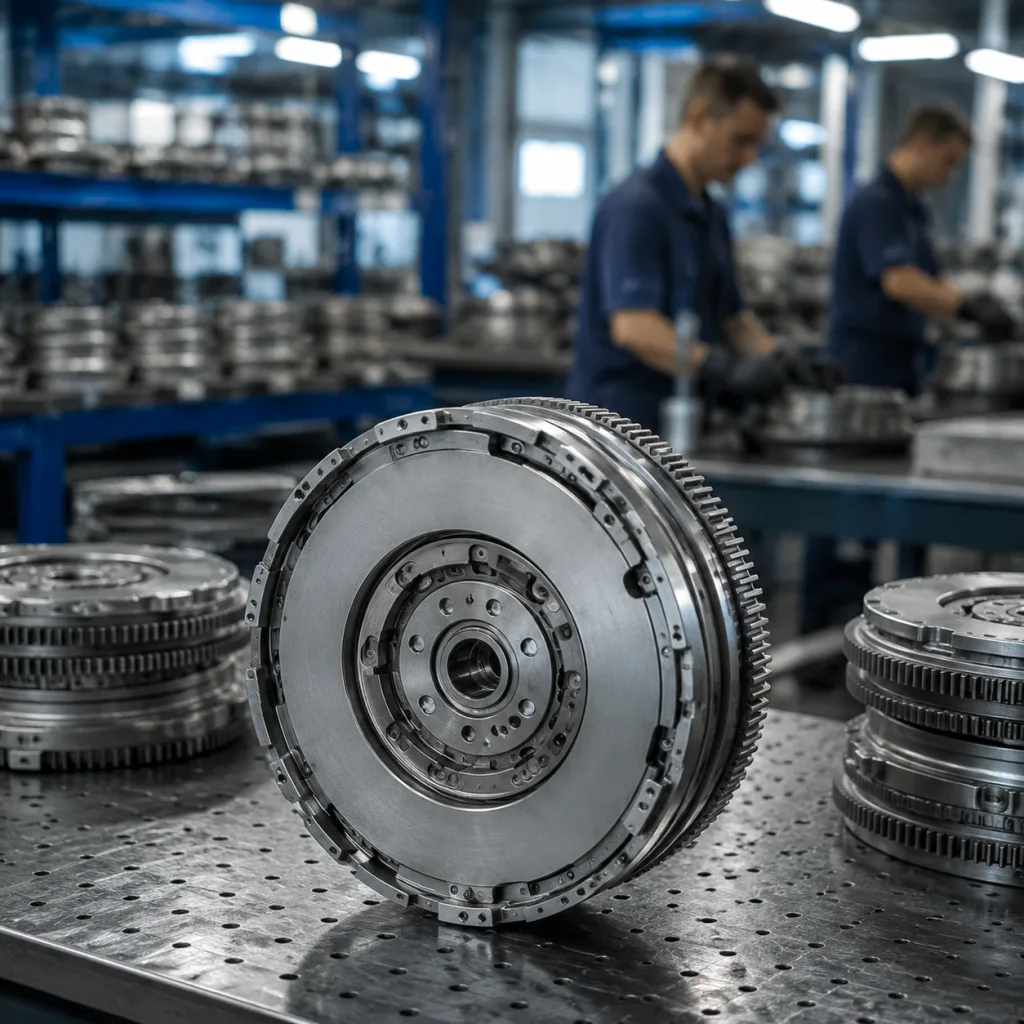
Dual mass flywheel production combines metallurgy, precision machining, spring assembly, grease control, and dynamic testing. Driventus applies process control points suited to rotating engine and driveline components.
Key controls include:
Incoming inspection for castings, forgings, springs, fasteners, and ring gears
Chemical composition and hardness verification according to the approved control plan
CNC machining control for mounting faces, pilot bore, bolt holes, and clutch contact surface
Ring gear fitment and concentricity inspection
Axial and radial runout measurement
Rotational free play and secondary mass movement checks
Dynamic balance inspection based on part size and application requirement
Anti-corrosion oiling, VCI protection, or equivalent export preservation where specified
Final inspection with batch record retention
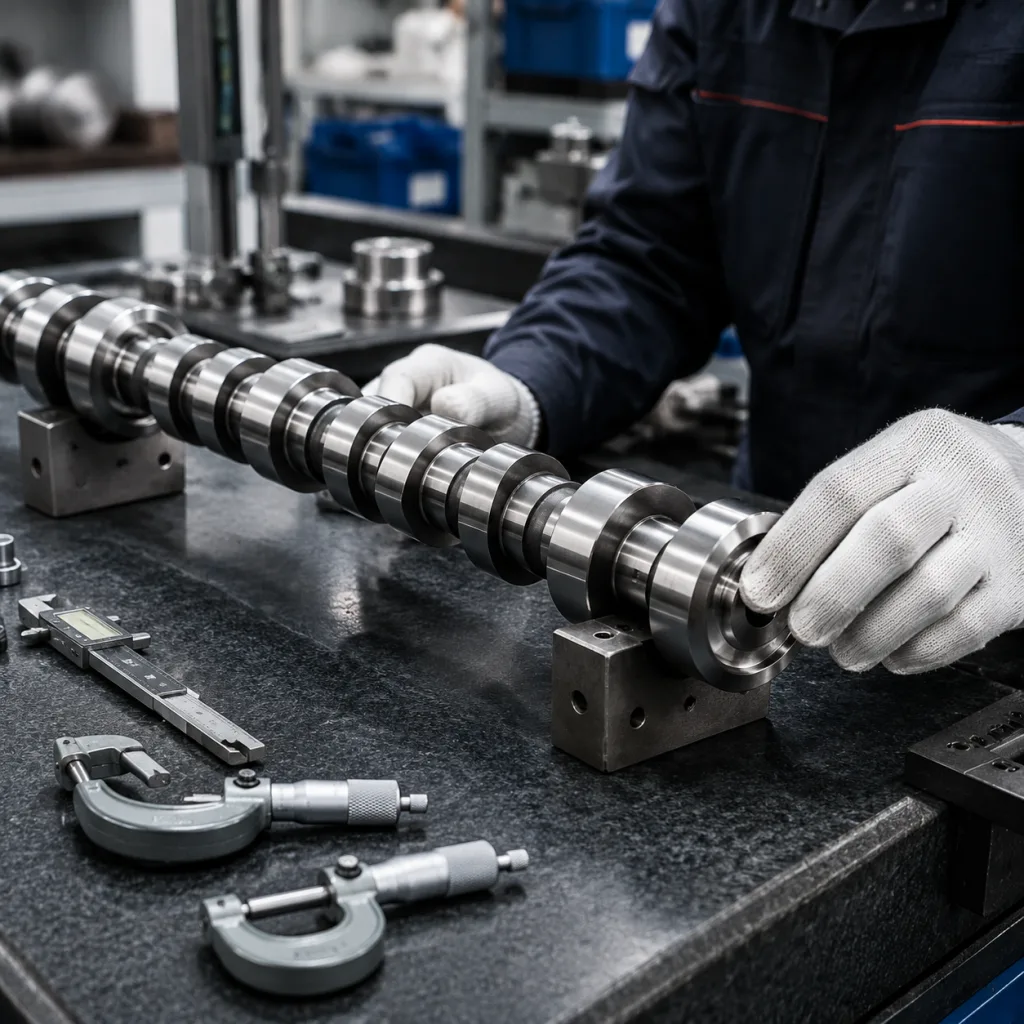
Typical controlled characteristics for buyer review include mounting-face runout, ring-gear radial runout, free angular travel, and torque-transfer consistency across the damping arc. Buyers can request the factory’s inspection template to see whether results are recorded by piece, by sample frequency, or by lot. That matters because a vague “qualified” statement does not show whether the supplier measures every unit, every tenth unit, or only the first and last pieces in a batch.
Audit Evidence to Request
Before nominating a supplier, importers and category buyers should request evidence that links production claims to actual records. Useful documents include process flow charts, control plans, inspection templates, calibration records, corrective action examples, and traceability samples. Certification alone does not prove that a specific reference is controlled correctly, but IATF 16949:2016 and ISO 9001:2015 provide a recognised framework for process discipline, corrective action, and customer-specific requirements.
Driventus can support remote audits with production photos, short inspection videos, document samples, and live video review of selected production areas, subject to confidentiality and scheduling. For customers with tighter service expectations, the factory can also agree on an AQL or 100% critical-characteristic check list before the first shipment so the release criteria are explicit.
Packaging and Export Specs Buyers Should Lock Early
Dual mass flywheels are dense components with machined faces that can be damaged by impact, moisture, or poor pallet design. A procurement specification should include packaging requirements, not only the product reference and price.
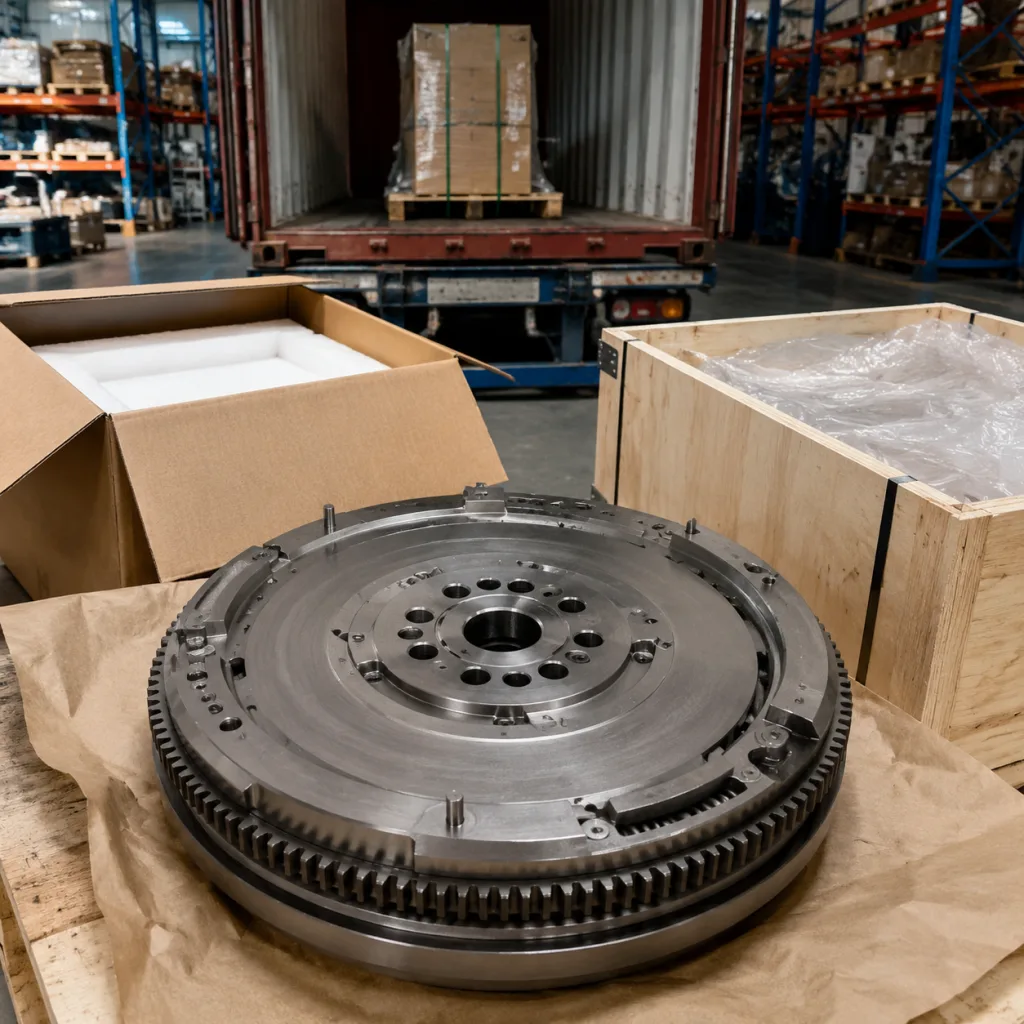
For export shipments, Driventus can provide neutral cartons, distributor-branded cartons, or bulk pallet packaging where suitable. The packaging plan normally considers unit weight, centre of gravity, rust prevention, carton compression strength, and container stacking. Heavy flywheels should not be allowed to move inside the carton during inland transport or sea freight.
Recommended packaging specification points:
Individual inner protection for machined friction faces
Rust preventive treatment suitable for the intended storage period
Carton with part number, quantity, gross weight, net weight, and batch code
Barcode or QR label if required by the distributor’s warehouse system
ISPM 15-compliant wooden pallets where wooden packaging is used
Pallet height and gross weight limits aligned with the buyer’s warehouse equipment
Photo confirmation before loading for first orders or new packaging designs
Carton compression target and drop-test expectation stated in the PO, if the buyer needs a specific transit profile
A practical export spec often includes maximum carton weight, such as 18–25 kg for manual handling, and a pallet gross limit matched to the receiving warehouse, such as 500–800 kg depending on local equipment. If the buyer needs mixed-SKU packs, the carton divider and label map should be agreed before production so counting errors do not become receiving claims.
For Brazil, the EU, the UK, the US, Canada, and Australia, importers should confirm local labelling, customs documentation, and packaging disposal requirements before shipment. Driventus can align carton marks and document format with buyer instructions, but the importer remains responsible for local import classification and regulatory filing.
What to Include in an RFQ So Quoting Does Not Stall
A complete RFQ reduces quoting errors and shortens sampling time. When buyers ask for a dual mass flywheel Iveco supplier quotation, they should provide enough technical and commercial information for the factory to confirm feasibility.
Useful RFQ data includes:
Vehicle application, engine displacement, production year range, and transmission type
Existing aftermarket reference or generic OE-style cross-reference, if available
Clear photos of both sides, ring gear, bolt pattern, and clutch face
Critical dimensions: outside diameter, total height, centre bore, PCD, bolt count, and clutch face diameter
Annual forecast and first-order quantity
Target market and warranty expectation
Packaging requirement: neutral, private label, or bulk
Compliance needs, including REACH (EC) No 1907/2006 declarations where applicable
Audit requirements and preferred inspection level
Incoterms, destination port, and required shipment date
The fastest RFQs usually include a physical sample or a complete dimension sheet. If a sample is not available, buyers should at least provide measured values, photos with scale, and the target OE reference so the engineering team can judge whether an existing tooling set can be adapted. This helps the supplier avoid quoting an unbuildable reference or a part that would need a new ring gear, new hub machining, or a different damping stack.
Driventus reviews the RFQ, confirms whether an existing reference is available, and identifies whether a sample or drawing is required. If the product falls outside current coverage, the engineering and sourcing teams assess tooling, machining fixtures, assembly components, and validation requirements before quoting. Procurement teams can request a quote with drawings, photos, or sample information.
Frequently asked questions
Yes. Driventus can support neutral packaging or buyer-specified carton artwork after artwork approval and order confirmation. Packaging specifications should include label format, barcode needs, carton strength, pallet limits, destination-market requirements, and any case-pack count so the warehouse receives a repeatable unit.
Buyers should request evidence of a quality management system aligned with IATF 16949:2016 and ISO 9001:2015, plus part-level inspection records. Certification should be supported by control plans, calibration records, traceability samples, corrective action examples, and, where relevant, sample balance and runout reports for the exact reference.
No. Driventus is an independent aftermarket manufacturer; brand names are referenced for fitment only. Any OE-style number or vehicle name is used to identify application compatibility and must be verified during RFQ review.
If you are qualifying a dual mass flywheel Iveco supplier for distribution, fleet repair, or private-label supply, send the application data, forecast, and packaging requirements for review. Contact Driventus here: /contact.html