Clutch Kit Hyundai Manufacturer China: Sourcing Guide
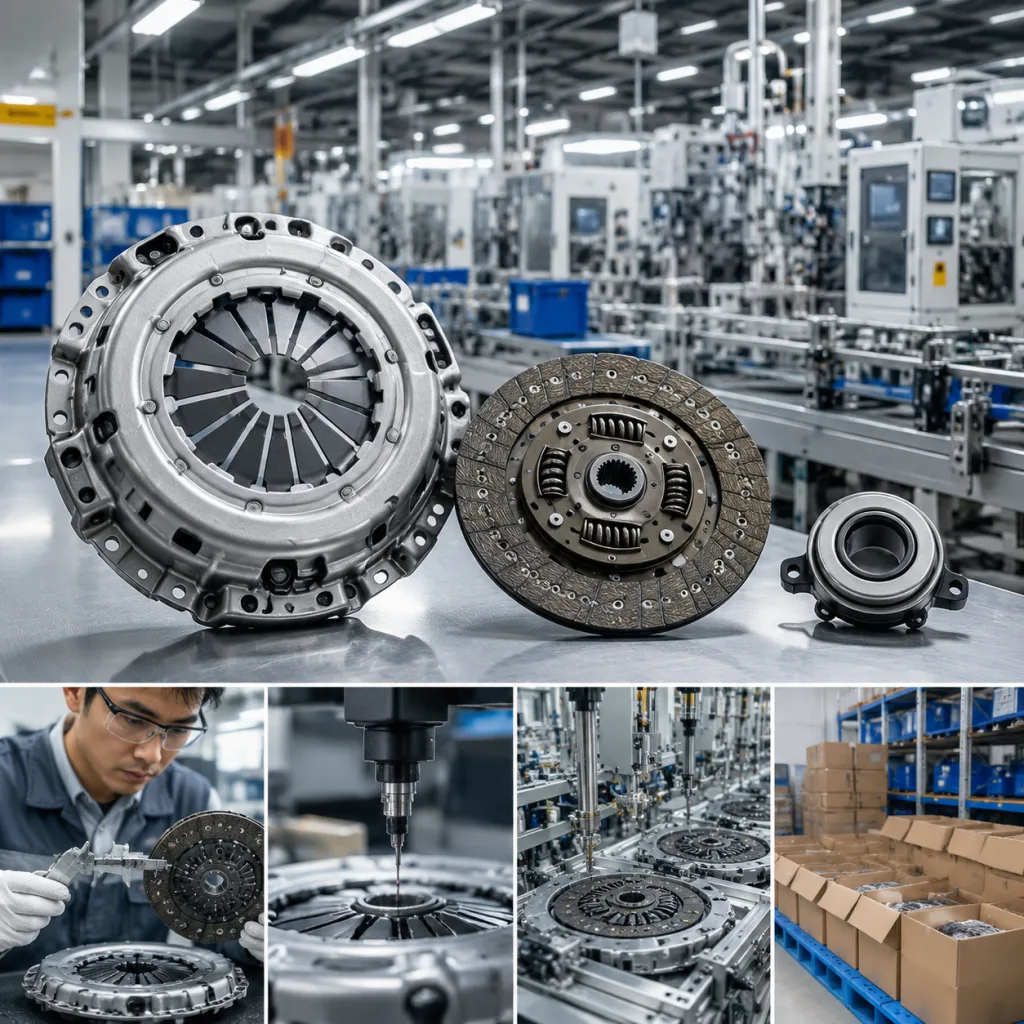
Procurement teams sourcing a clutch kit Hyundai manufacturer China usually need more than a part number match. They need verified OE fitment, stable material control, test data, and a supply base that can support repeat orders without dimensional drift. For Hyundai applications, the clutch kit scope typically includes the pressure plate, clutch disc, release bearing, and, where specified, the alignment or installation hardware needed for assembly. Driventus is an independent aftermarket manufacturer; brand names are referenced for fitment only. A proper sourcing review should cover disc diameter, spline count, facing material, clamp load, cover thickness, runout, balance, packaging, and batch traceability. It should also check the supplier’s quality system, change control, and export capability. The points below outline how procurement teams compare Chinese clutch kit suppliers for aftermarket distribution, OE service parts, and multi-location repair networks.
Decision checklist: verify the fit before the price
When a procurement team searches for a clutch kit Hyundai manufacturer China, the first filter should be fitment control, not price. Start with the application, the OE reference, and the dimensional stack-up so the quote request is grounded in the actual vehicle build.
Spec checklist for sourcing review:
- OE cross-reference: confirm the OE part number, engine code, transmission type, and model year range.
- Disc geometry: verify outside diameter, spline count, hub offset, hub thickness, and sprung or solid hub design.
- Pressure plate data: confirm clamp load, diaphragm spring geometry, cover height, cover flatness, and bolt pattern.
- Release bearing: check bore, face type, contact angle, grease retention, and allowable axial play.
- Friction material: confirm facing type, rivet depth, lining thickness, and thermal resistance window.
- Tolerances: request runout, balance, and thickness tolerances on the drawing before sampling.
- Packaging: confirm whether the kit ships with pilot bearing, alignment tool, or installation hardware.
- Traceability: ensure batch code, production date, and carton label remain readable through export handling.
Typical buyer-side acceptance targets for quotation comparison are useful even before sampling: disc OD within ±0.2 mm of drawing, spline fit verified to the transmission input shaft, hub runout no more than 0.30 mm on the assembled disc, and pressure-plate clamp load held within the supplier’s declared production window. Ask for drawings, samples, and inspection records before placing a production order. If the supplier cannot tie the kit back to a controlled drawing, the risk of dimensional variation rises quickly.
Failure modes: where clutch kit sourcing goes wrong
Most sourcing problems show up after the first shipment, not during quoting. The common failure modes are predictable.
- A supplier matches the part visually but misses spline depth, hub offset, or cover height.
- The clutch disc passes fitment on one transmission variant and binds on another.
- Clamp load varies between lots because the spring set and cover stamping are not controlled tightly.
- Friction material changes quietly, which alters pedal feel and launch behavior.
- Packaging looks fine at dispatch, then fails in transit because carton strength was never validated.
- Traceability breaks down when batch marks are missing or unreadable on receipt.
The practical fix is simple: define the critical-to-fit dimensions first, then require the supplier to show how each one is measured, recorded, and released. If that process is weak, a lower unit price usually becomes a higher warranty bill.
Quality system: what a credible supplier must show
A serious supplier should show an audited quality system and documented process control. For most B2B buyers, the baseline is IATF 16949:2016 and ISO 9001:2015. For export markets, material and chemical compliance may also require REACH (EC) No 1907/2006 declarations, plus relevant customer-specific statements.
Driventus maintains a vertically integrated manufacturing base in Taizhou, Zhejiang, which helps control machining, stamping, friction assembly, and final inspection. That matters because clutch kit variation often comes from uncontrolled sub-suppliers rather than the final assembler.
Quality checks that procurement should request:
- Incoming material reports for steel, friction facing, and bearing components.
- Runout and balance inspection records for the disc assembly.
- Clamp-load verification for the pressure plate.
- Dimensional reports showing cover height, finger height, rivet depth, and hub offset.
- Salt-spray or corrosion evidence for exposed steel parts when specified.
- Final audit records with AQL or 100% checks, depending on the item.
- Control-plan evidence for critical-to-fit dimensions and process-change approvals.
Ask the supplier to state the measuring equipment used, the calibration interval, and the inspection frequency for each critical characteristic. A credible supplier should be able to show gauge R&R or at least calibration certificates for key tools, plus retention samples from the same lot. You can review the process framework on our quality system.
Commercial trade-offs: MOQ, lead time, and landed cost
For import managers, unit price is only one part of landed cost. Carton efficiency, defect rate, rework rate, and lead-time stability can change total cost more than a small quote difference.
| Factor | What to confirm | Why it matters |
|---|---|---|
| MOQ | Per OE reference or per mixed programme; typical launch MOQ may be 100–300 kits per SKU, while reorder MOQs can be lower if raw material is shared | Affects inventory exposure |
| Lead time | Sample, pilot run, and mass production; samples often take 7–15 days, pilot orders 20–35 days, and repeat production 30–45 days depending on tooling and volume | Impacts replenishment planning |
| Packing | Single kit, bulk carton, pallet pattern, carton count, and carton strength | Changes freight density and damage risk |
| Documentation | Invoice, packing list, COO, test data, and lot traceability | Speeds customs and receiving |
| Change control | Tooling, materials, or process changes; request written notice before changes | Protects fitment consistency |
| Price logic | Ask whether the quote is EXW, FOB, or CIF; clarify whether sample charges are refundable against first order | Prevents hidden cost gaps |