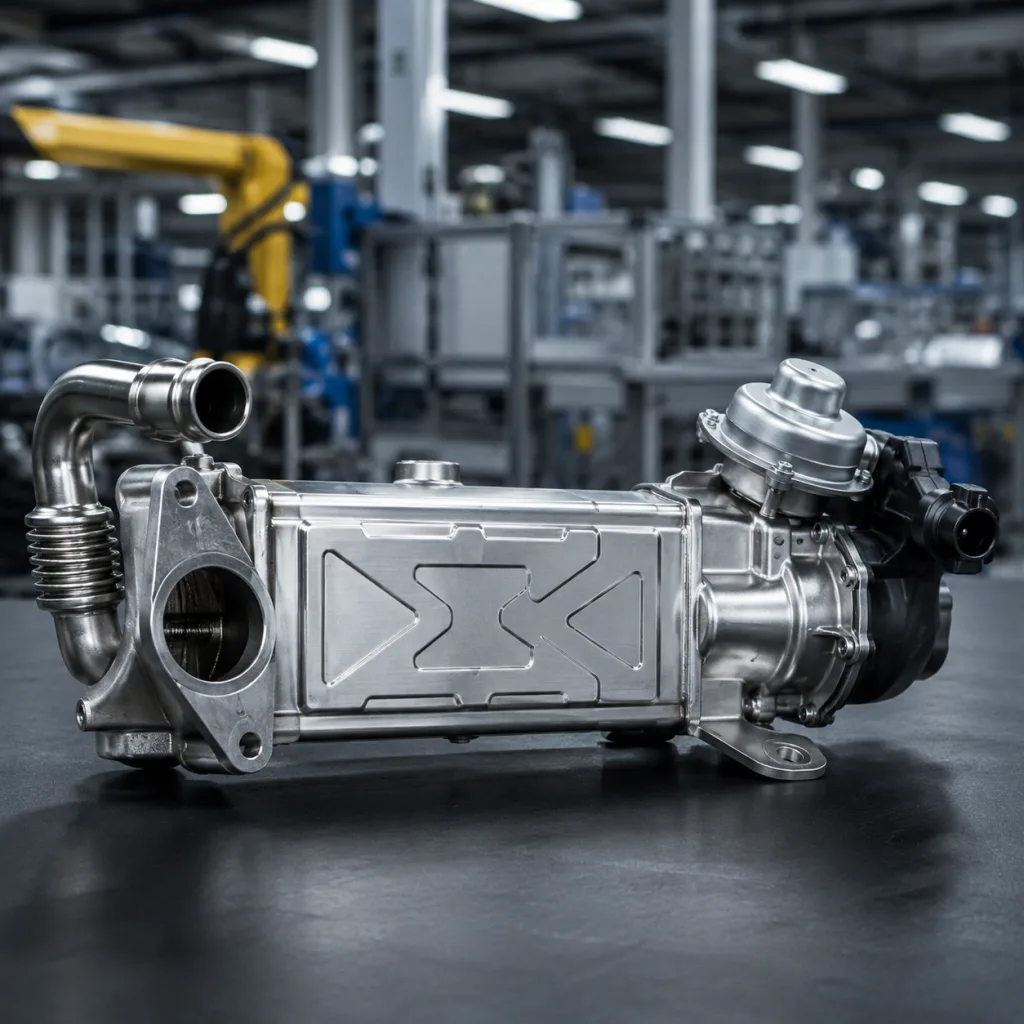
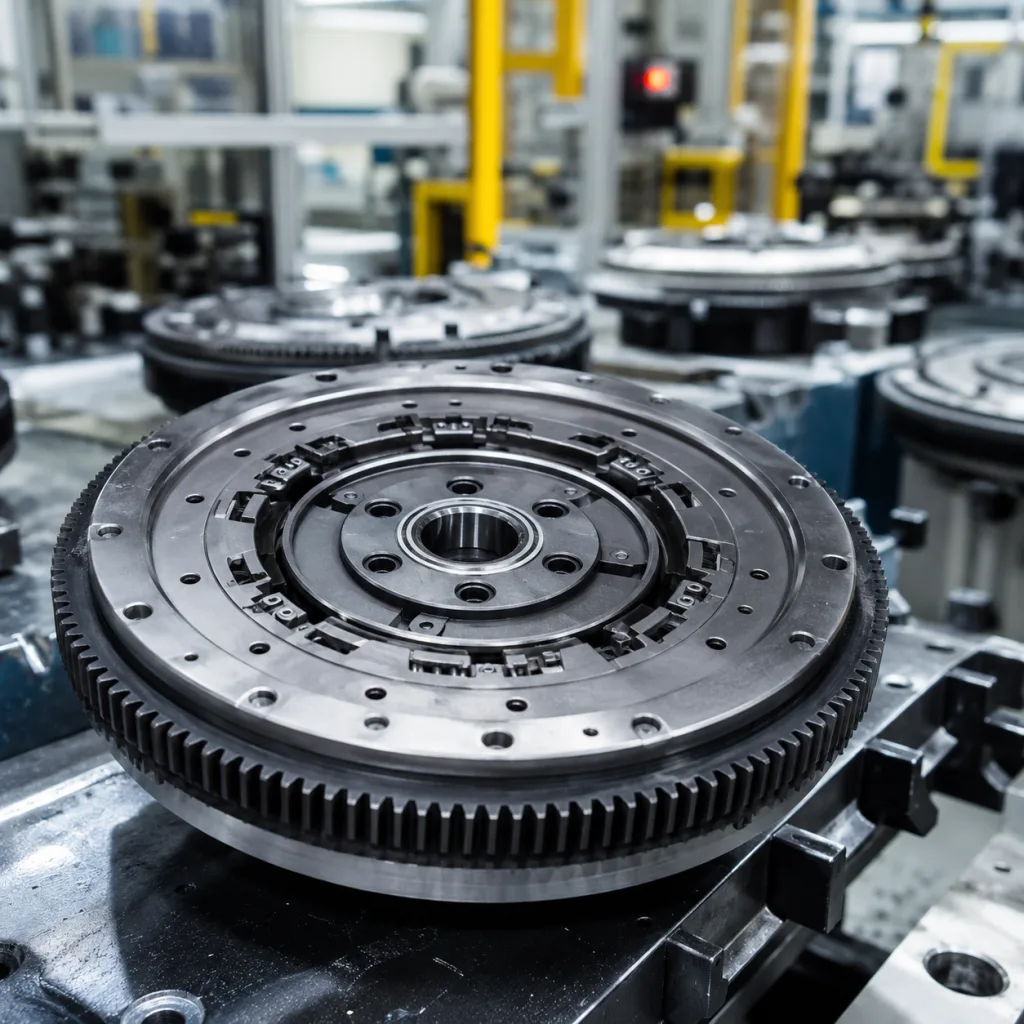
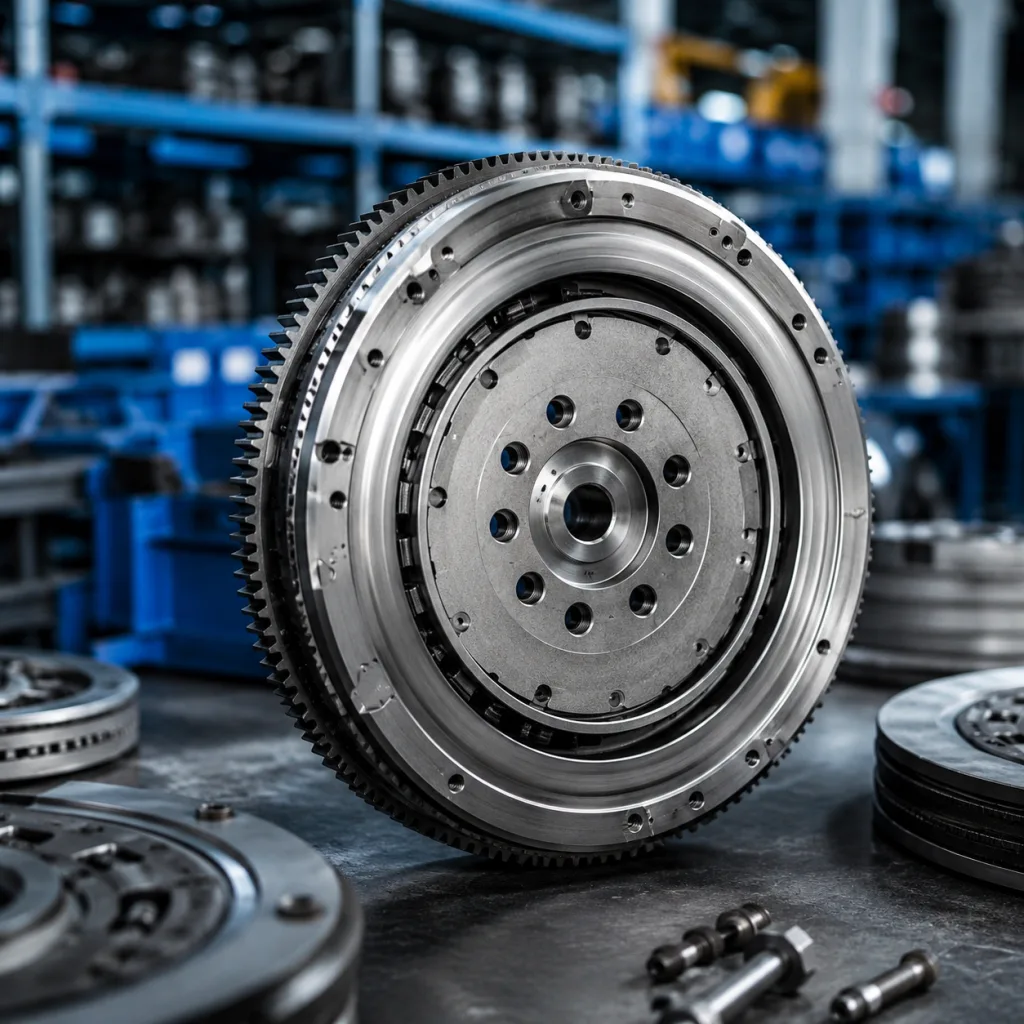
Choosing a dual mass flywheel Buick supplier is rarely just a catalogue exercise. Procurement teams need to confirm the OE cross-reference, engine code, transmission pairing, torque rating, bolt-circle geometry, crankshaft flange interface, ring gear specification, and the supplier’s ability to hold the same standard across repeat production lots. A dual mass flywheel is a precision drivetrain assembly; small shifts in spring rate, rotational inertia, friction-face runout, axial clearance, angular free play, grease retention, or dynamic balance can affect clutch feel, idle vibration, gear rattle, and service life. Driventus manufactures engine and powertrain components in Taizhou, Zhejiang, with IATF 16949:2016 and ISO 9001:2015 systems supporting controlled production, inspection, and traceability. Driventus is an independent aftermarket manufacturer; Buick and other brand names are referenced for fitment only. Buyers in the EU, UK, US, Canada, Australia, and Brazil can use this guide to assess technical fit, audit readiness, and commercial suitability before moving to samples or volume orders.
What buyers should verify before sourcing
When sourcing from a dual mass flywheel Buick supplier, start with application control. Buick model names alone are not enough, because one vehicle line may use different flywheel variants depending on engine family, crankshaft pattern, gearbox code, clutch diameter, emissions package, and production date. A capable supplier should connect the part to a defined OE reference and show how the fitment was validated for the intended application.
Start with the essentials:
OE cross-reference and full application list
Engine code, displacement, fuel type, and torque output band
Transmission code, clutch kit pairing, and release-system type
Model year range, production cut-in/cut-out dates, and regional build differences
Outer diameter, ring gear tooth count, bolt circle, dowel location, offset, and crankshaft pilot interface
Rotational inertia and torsional damping range for the intended engine torque pulse
Axial clearance, angular free play, secondary-mass rock, and friction-face runout
Friction-face hardness, surface roughness, and heat-check acceptance criteria
Dynamic balance grade, residual unbalance limit, and balance correction method
Surface protection, corrosion resistance, and export packaging standard
A quotation with only a part number and unit price leaves too much technical risk. Ask for a specification sheet that identifies the measurement method, sampling plan, gauge type, and inspection limits used in production. That detail matters for distributors managing warranty exposure, workshops that need predictable installation behavior, and fleet operators working across large vehicle populations. A supplier that can explain the application clearly is usually easier to manage after the first shipment as well.
Typical technical specification points
The exact Buick application will vary by engine and transmission, but procurement teams usually need the same core data to compare suppliers fairly. The task is not simply to check whether the part bolts on. It is to confirm that the flywheel will perform correctly under the engine torque profile, clutch clamp load, starter engagement, and operating temperature range of the target vehicle.
Item
What to confirm
Why it matters
OE reference
Application-specific OE number or verified interchange, including supersessions
Confirms the correct fitment family
Vehicle data
Engine code, gearbox code, model year, market, and production date range
Prevents cross-fit errors between similar Buick applications
Interface dimensions
OD, crank bolt PCD, dowel position, offset, ring gear tooth count, and pilot bore
Controls installation fit and starter engagement
Material
Cast iron or steel friction mass, alloy steel hub/drive plate, and qualified spring set
Affects burst strength, thermal stability, and fatigue life
Mass and inertia
Assembly weight and rotational inertia value or validated OE-equivalent range
Influences drivability, launch feel, and vibration damping
Runout
Friction-face and mounting-face runout measured on a defined datum
Impacts clutch engagement quality, judder, and noise
Axial clearance
End play within the released specification
Controls damping function, noise, and wear behavior
Angular free play
Primary/secondary angular travel, stop position, and hysteresis curve if available
Determines torsional absorption performance
Friction surface
Hardness, surface roughness, flatness, and heat-spot acceptance criteria
Affects clutch life, bedding behavior, and heat tolerance
Balance
Dynamic balance record and residual unbalance limit by production lot
Reduces vibration at idle and operating speed
Corrosion protection
Rust-preventive oil, phosphate, or coated finish with storage-life target
Supports ocean freight, warehouse storage, and shelf life
</tr></thead><tbody> </tbody></table>Define the documentation package during the RFQ stage, before samples are produced. If your channel needs GS1-compatible barcodes, batch codes, multilingual cartons, private-label cartons, customer part numbers, or country-of-origin marking, state those requirements early. Clear technical definition shortens approval time, reduces revisions, and avoids the frustrating situation where a part is mechanically correct but commercially unusable because the labeling or packing standard does not match the buyer’s warehouse workflow.
Why certification and auditability matter
For powertrain parts, documentation is part of the product. Many buyers source internationally, so the factory must support quality reviews, traceability checks, and export documentation without slowing the supply chain. Driventus operates under IATF 16949:2016 and ISO 9001:2015, supporting structured process control, corrective action, change control, calibration management, and consistent inspection discipline.
For international shipments, buyers often need more than a certificate on file. They need evidence that each batch can be tied back to a production date, work order, material lot, heat-treatment or machining record where applicable, assembly record, and final inspection release. For European shipments, material declarations may also need to support REACH (EC) No 1907/2006, RoHS where requested by the buyer, or other customer-specific compliance forms.
Documents commonly requested in supplier qualification:
Current IATF 16949:2016 and ISO 9001:2015 certificates with valid scope and expiry date
Process flow, PFMEA summary, and control plan
Incoming, in-process, and final inspection records
Dimensional inspection report with datums and measuring equipment identified
Material certificate or material declaration where applicable
Dynamic balance report or lot-level balance release record
Traceability format by lot, batch, serial code, or production work order
Packaging and labeling specification
Gauge calibration status for key measuring equipment
Corrective action process for nonconformities, including containment and 8D-style response where required
For a first remote audit, request current certificates, sample inspection records, control-plan extracts, and photographs of measuring equipment, storage conditions, assembly stations, and packaged stock. Larger programs may also require PPAP-style evidence or a comparable approval package aligned to the buyer’s internal release process. The more clearly a supplier can document its quality system, the easier it is to scale from sample orders to repeat production without quality drift.
Commercial terms that reduce supply risk
Technical fit is only half the decision. A reliable sourcing program also needs commercial terms that protect continuity of supply. When buyers compare suppliers, the cheapest unit price can become expensive later if lead times are unstable, packing is weak, revision control is unclear, or fast-moving SKUs cannot be replenished on schedule.
Commercial points to align early:
MOQ by part number, product family, or private-label carton type
Sample lead time, pilot order lead time, and standard production lead time
Annual capacity, monthly capacity, and peak season constraints
Safety stock or reserved capacity for urgent replenishment
Incoterms such as EXW, FOB Ningbo/Shanghai, CIF, or DAP depending on buyer preference
Destination port, consolidation warehouse, and forwarder handover process
Payment terms, currency handling, and bank charges
Carton count, gross weight, pallet pattern, label format, and barcode requirements
Mixed-SKU batching, container loading, and consolidation options
Warranty claim handling, evidence requirements, and credit/replacement process
For regional distributors, service level and replenishment stability often matter more than a small price reduction. If you are building a broader powertrain program, it can also help to align this part with related items in our catalog and, where relevant, engine components. That makes freight planning, vendor consolidation, and inventory control easier across a wider parts portfolio.
A strong quotation should also explain what happens when volume changes. Ask how the factory handles forecast swings, emergency orders, engineering changes, superseded OE references, and updates to packaging specification. Clear answers on those points are a useful sign that the supplier can support a distribution business, not just a one-off purchase order.
How Driventus supports custom programmes
Some Buick applications need more than a standard off-the-shelf part. A customer may require modified packaging for a specific warehouse system, an alternate anti-corrosion process for humid or coastal markets, a private-label carton, or an OE-equivalent design with customer-specific documentation and label formats. In these cases, custom manufacturing can be used to define the drawing, inspection plan, release samples, and packaging standard before mass production begins.
Common customisation requests
Application-specific balancing specification and residual unbalance target
Alternate rust-preventive oil, VCI bag, phosphate, or coated finish for humid or high-salt climates
Barcode labels, buyer part numbers, and batch-code format
Export carton count, pallet configuration, gross weight, and container-loading changes
Inspection documents for distributor onboarding or internal part approval
Logo-free or private-label packaging programs
Batch traceability format matched to the buyer’s ERP or warehouse management system
Sample approval package with dimensional report and reference photos
Custom work should be based on approved drawings, approved samples, OE cross-reference evidence, or a controlled specification sheet. Verbal references and assumptions are not enough. For drivetrain parts, small changes in offset, ring gear position, friction-face height, or mass distribution can affect starter engagement, clutch release, vibration behavior, and installation consistency. Driventus can support the process with dimensional reports, pre-production samples, and controlled communication, so the final part matches the agreed target rather than a generic reference. That reduces rework risk and helps the buyer move from approval to repeat supply with less friction.
How to evaluate a supplier before issuing a PO
Before placing a purchase order, run a short, structured supplier review. It is the quickest way to filter out vendors that can quote quickly but cannot support stable production, documentation, revision control, or export handling.
1. Confirm the application by OE reference, engine code, gearbox type, clutch kit pairing, and vehicle data. 2. Review interface dimensions, inertia targets, runout limits, axial clearance, angular free play, and balance requirements. 3. Check certificate validity, factory scope, calibration control, and traceability method. 4. Ask for sample photos, dimensional reports, balance records, inspection records, and packaging photos. 5. Confirm MOQ, sample timing, production lead time, payment terms, and replenishment policy. 6. Verify export support, HS code handling, carton format, palletization, and label requirements for your destination market. 7. Ask how nonconforming parts are handled, including containment, root-cause analysis, corrective action, and replacement or credit process.
A factory that can answer these points clearly is usually easier to manage over time. If you are comparing several vendors, send each one the same specification sheet and request a like-for-like quotation. That keeps the commercial comparison honest and reduces the risk of hidden deviations after order confirmation. For a direct review of fitment, pricing, documentation, or sampling, you can request a quote.
Frequently asked questions
OE cross-reference is the starting point, but it should not be the only control. You should also confirm the engine code, gearbox type, clutch kit pairing, vehicle year range, regional market, and key dimensions such as bolt pattern, offset, ring gear specification, and friction-face diameter. The same vehicle line may use different flywheel variants, and a part that shares an interchange reference can still differ in mass, balance, axial clearance, or angular travel limits depending on the application.
At minimum, ask for the product specification, dimensional inspection report, current quality certificates, traceability format, and final inspection release record. For dual mass flywheels, it is also useful to request balance data, packaging specification, sample photos, and batch-linked inspection records. If the shipment is going into Europe or another regulated market, you may also need material declarations, REACH-related statements, or buyer-specific compliance forms.
Yes. Driventus supplies B2B customers including aftermarket distributors, OEM/Tier-1 buyers, and repair chains. The company operates as an independent aftermarket manufacturer, and brand names are referenced only for fitment and application identification. Buyers can use the same sourcing process for private label, distributor stock, sample approval, or controlled supply programs.
If you are qualifying a dual mass flywheel Buick supplier, send your OE reference, engine and transmission data, target volume, packaging requirements, and destination market for a controlled quotation. Start here: /contact.html