Dual Mass Flywheel Opel Manufacturer in China
Procurement teams sourcing a dual mass flywheel for Opel applications usually need more than a price list. The order has to match clutch geometry, torsional damping, bearing fit, bolt pattern, starter ring position, and export packing requirements. Driventus manufactures engine and powertrain components in Taizhou, Zhejiang, and supplies B2B customers including aftermarket distributors, wholesalers, repair-chain programmes, and OEM/Tier-1 purchasing teams. For Opel-fit dual mass flywheel programmes, we support drawing review, sample validation, private-label packing, batch traceability, and export documentation. Our production and quality controls are aligned with IATF 16949:2016 and ISO 9001:2015. Driventus is an independent aftermarket manufacturer; brand names are referenced for fitment only. Buyers can review related engine and drivetrain items in our catalog or contact our team early when planning a new sourcing programme.
When an Opel DMF Should Be Sourced from China
A dual mass flywheel is usually sourced by application risk, not by part name alone. For Opel programmes, the real decision is whether the supplier can hold the damping window, fitment stack-up, and packaging standard across repeated lots.
Driventus supports sourcing projects for:
- Aftermarket distribution under customer brand or neutral brand
- Consolidated import programmes for clutch and flywheel kits
- Repair-chain replenishment with stable part-number coverage
- OEM/Tier-1 development discussions where drawings and validation plans are available
- Mixed-container shipments including pistons, gaskets, water pumps, and other powertrain components
If the buyer already has a drawing, sample, TecDoc-style application list, or generic OE cross-reference such as OE 06A… or OE 11251…, our engineering team checks the fitment-critical dimensions before quoting. We do not claim vehicle manufacturer approval or endorsement.
Buyers reviewing adjacent product categories can start with our catalog and share the target application list with annual volume by SKU.
Failure Modes That Make a Cheap DMF Expensive
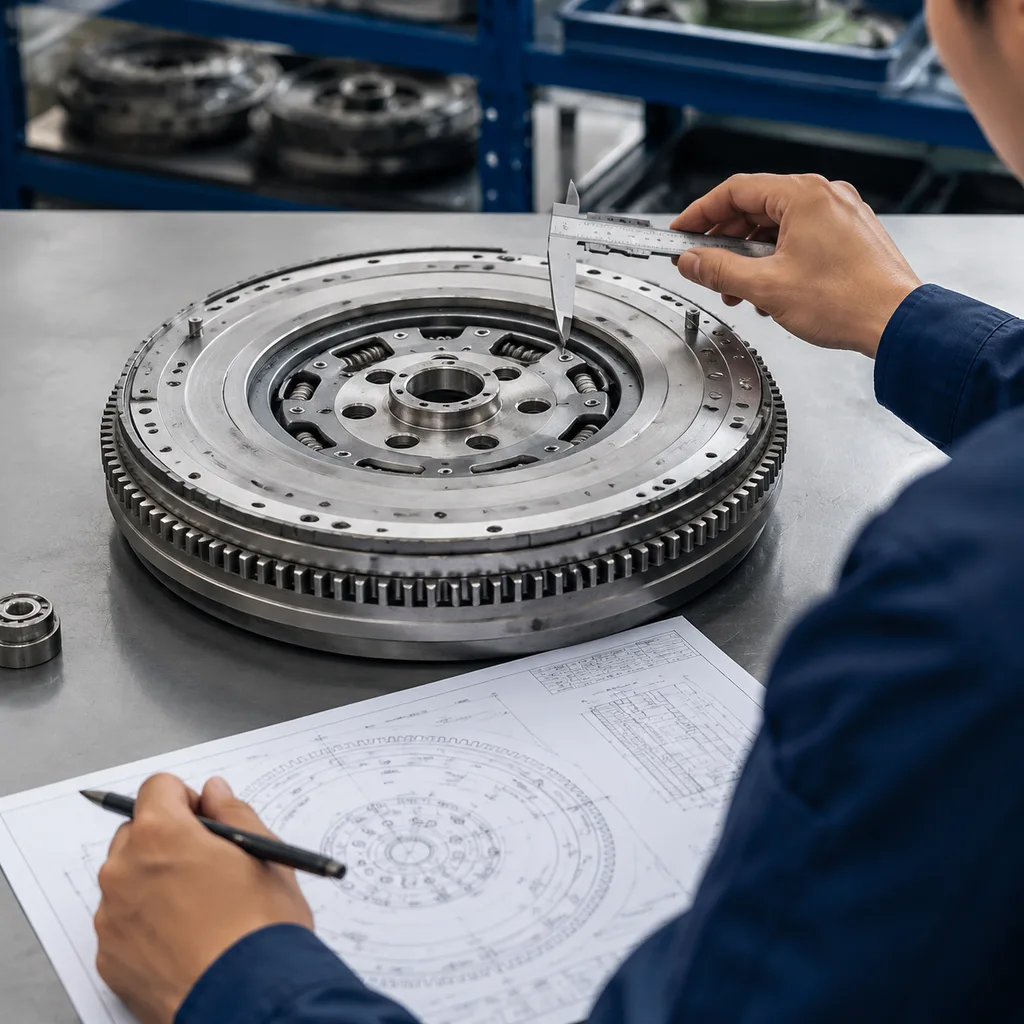
A dual mass flywheel contains primary and secondary masses, arc springs, friction elements, grease, bearing components, and a starter ring. Small deviations can show up later as clutch judder, noise, premature wear, or installation failure.
Typical failure modes to screen out early:
- Incorrect outside diameter or clutch face diameter, which breaks kit compatibility
- Wrong crankshaft bolt pattern or pilot fit, which causes mounting issues or runout
- Ring gear tooth count or position errors, which affect starter engagement
- Wrong installed height or offset, which changes release travel and gearbox fit
- Free-angle and rock-angle drift, which reduces damping performance
- Poor surface flatness or runout, which shortens clutch life
- Weak grease selection or sealing, which hurts high-temperature durability
- Imbalance, which creates vibration after installation
Typical procurement documents requested by importers include product drawing, inspection report, material statement, packing specification, label artwork, carton drop-test requirements, and country-of-origin documentation. Where chemical compliance is relevant for the destination market, declarations can be reviewed against REACH (EC) No 1907/2006. A clear quotation should state whether supply is flywheel only, flywheel with bolt set, or a complete clutch-and-DMF kit.
What to Inspect in the Spec Sheet
Before quotation, Driventus requests a clear technical data pack whenever possible. That keeps the RFQ focused and cuts the risk of a sample that looks right but fails on one dimension.
| Item to confirm | Why it matters for purchasing approval |
|---|---|
| Outside diameter and clutch face diameter | Confirms clutch kit compatibility and housing clearance |
| Crankshaft bolt pattern and pilot fit | Prevents incorrect mounting or runout issues |
| Ring gear tooth count and position | Ensures starter engagement and noise control |
| Installed height and offset | Affects clutch release travel and gearbox fit |
| Maximum free angle and rock angle | Indicates damping range and wear acceptance criteria |
| Friction surface flatness and runout | Supports clutch life and pedal feel consistency |
| Grease specification and sealing method | Influences high-temperature durability |
| Balance grade requirement | Reduces vibration after installation |