Dual Mass Flywheel BMW OEM Supplier: Sourcing Guide
For procurement teams evaluating a dual mass flywheel BMW OEM supplier, the main priorities are repeatable quality, fitment control, cost transparency, and dependable supply. A dual mass flywheel must match the original installation envelope, torque capacity, damping behavior, ring gear geometry, and clutch interface; otherwise, it can trigger drivability complaints, noise issues, and warranty exposure. Driventus supplies independent aftermarket and OEM-channel buyers from Taizhou, Zhejiang, with vertically integrated production for engine and powertrain parts. We manufacture to controlled specifications and support cross-reference sourcing for BMW applications where OE data is available. Driventus is an independent aftermarket manufacturer; brand names are referenced for fitment only. Our programs are built around IATF 16949:2016, ISO 9001:2015, PPAP-style documentation, and batch traceability. For buyers in the EU, UK, US, Canada, Australia, and Brazil, the real sourcing decision is not just unit price, but auditability, lead time, and the ability to maintain dimensional consistency across serial production.
What procurement teams should verify first
A dual mass flywheel is a wear-sensitive torsional component, so BMW-fit sourcing should begin with application confirmation rather than price comparison. Before placing a trial order, procurement teams should verify the following:
OE reference or VIN-based application data, such as `OE 21208618515` where supplied in the buyer’s documentation
Tooth count, starter ring gear position, pilot bore, mounting pattern, and friction surface offset
Torque damping curve, angular deflection range, and idle rattle control target
Input shaft spline compatibility and clutch kit pairing
Balanced assembly status and runout limits
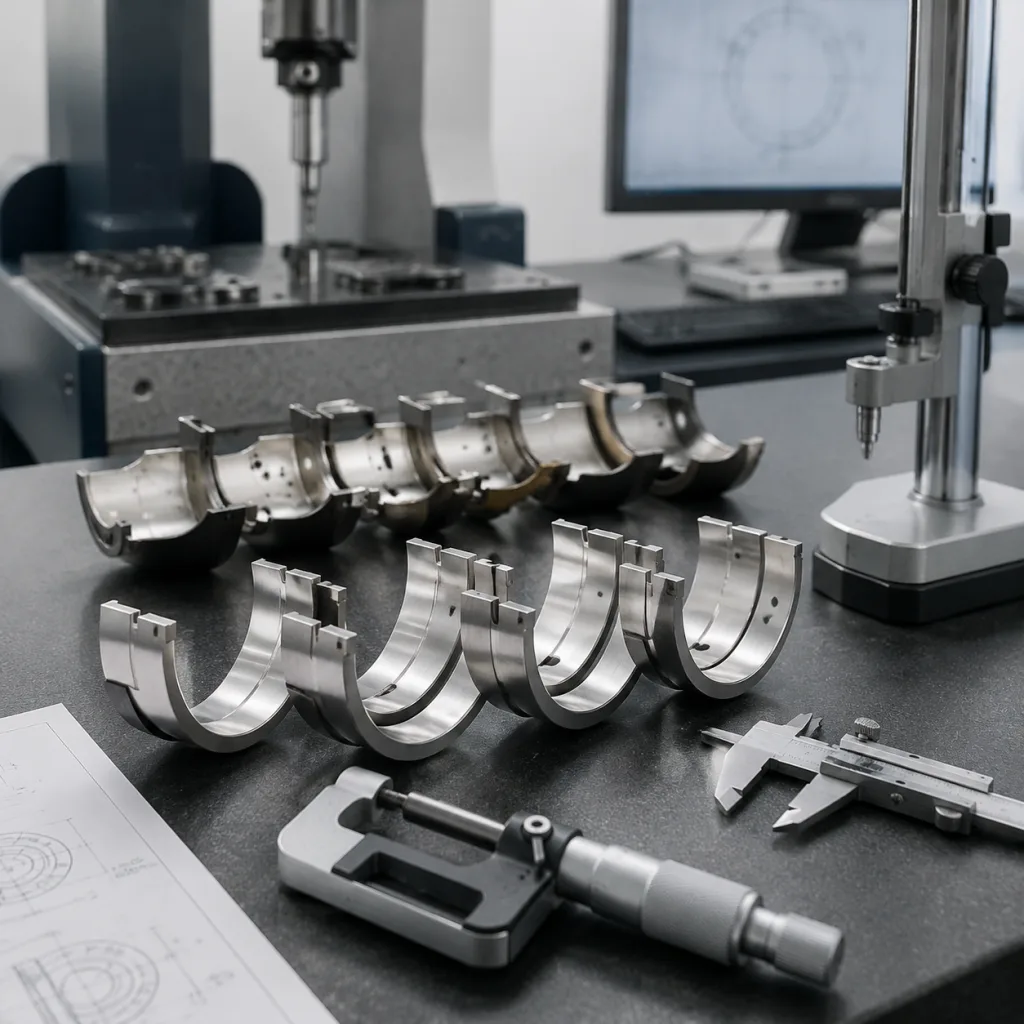
For buying teams that need a concrete acceptance basis, ask the supplier to quote the nominal dimensions, tolerance band, and inspection method on the same sheet. A practical first-pass request should include overall diameter, mounting thickness, bolt-circle PCD, center bore, tooth count, total mass, and axial runout. Typical buyer-side controls for this part category are `±0.10 mm` on critical locating features, `±0.20 mm` on non-locating machined faces, and `≤0.05 mm` axial runout after balancing, unless the vehicle program specifies tighter limits. In practice, the first pass should be a fitment and dimensions review. A lower unit cost adds no value if the part misses NVH targets, complicates installation, or creates rework at the vehicle bay.
Factory capability and supply controls
Procurement managers usually need evidence that the supplier can reproduce the same geometry and damping performance across batches, not just a one-time sample. Our production and release process is built to support that requirement.
Control point
What it covers
Buyer benefit
Incoming material control
Steel, cast components, springs, and friction elements
Stable base quality
Machining control
Facing, bores, bolt circle, and gear features
Dimensional repeatability
Dynamic verification
Balance and rotational consistency checks
Lower vibration risk
Traceability
Lot coding and batch records
Faster claim analysis
Export packaging
Corrosion protection and transit-safe packing
Lower damage rate
</tr></thead><tbody> </tbody></table>For sourcing decisions, buyers typically want three commercial controls tied to quality: first article approval, lot traceability, and release criteria. A usable request-for-quote should ask for sample quantity, mass production lead time, and whether the first batch is built from pilot tooling or full production tooling. Typical factory practice for this category is a sample lead time of `7–15` days for catalog references, `25–35` days for the first production run after approval, and `35–45` days when new tooling, logo tooling, or packaging development is required. We operate under IATF 16949:2016 and ISO 9001:2015, and we can support document packs for distributor onboarding and supplier approval. Buyers can review our catalog and the broader engine components range when building a mixed-part program.
Fitment, validation, and replacement equivalence
A BMW dual mass flywheel should be treated as an OE-equivalence item, not a generic rotating assembly. Even when the external envelope appears similar, the internal spring pack and secondary mass inertia can differ enough to change launch feel and gearbox noise.
Validation checks before approval
1. Confirm OE cross-reference data from the buyer or the vehicle application sheet. 2. Measure overall diameter, mounting depth, and friction face height. 3. Verify starter ring gear tooth count and position. 4. Check clutch kit match, including pressure plate height and release travel. 5. Review sample performance against the target torque and idle vibration range.
When buyers require hard numbers for validation, request a dimensional report that lists overall diameter, pilot bore, bolt-hole diameter, PCD, installation height, and ring gear runout. A normal production-control target for the flywheel face is `≤0.03 mm` face wobble at inspection, `≤0.08 mm` static imbalance per assembly, and no visible burrs or heat-checking on the friction surface. For functional equivalence, the supplier should also state the recommended test window for damping behavior, such as angular deflection and return force measured against the OE benchmark or a customer-approved master sample. Where customers require tighter control, Driventus can align to sample-based inspection, dimensional reports, and application-specific packaging. That is often the difference between a controlled replacement program and a high-return complaint stream.
Commercial terms that matter in B2B sourcing
For distributors, wholesalers, and multi-location repair networks, sourcing success depends on commercial structure as much as product quality. Buyers usually ask about MOQ, lead time, and replenishment logic before they approve a supplier.
Typical commercial questions include:
Minimum order quantity per reference
Normal production lead time for standard applications
Sample lead time for first article approval
Carton packing quantity and pallet configuration
Export documentation for customs clearance
For this product family, a practical MOQ structure is often `20–50` units per reference for stocked catalog items, `100` units or more for private-label runs, and higher thresholds for new tooling or custom packaging. A buyer should also ask for a price ladder by volume, because the landed cost on a dual mass flywheel is usually more sensitive to shipment density and packaging than to raw unit price alone. As a sourcing rule, request at least three breaks in the quote: trial order, repeat order, and annual-contract volume. Buyers should also confirm whether the quoted price includes inner box, outer carton, desiccant, anti-rust protection, and export palletization. Driventus also supports custom manufacturing when the buyer needs a project-specific version for a regional catalog or private-label program. If you are consolidating suppliers, a single factory that can supply flywheels alongside other powertrain parts reduces inbound complexity and helps standardize approval workflows.
Standards, compliance, and audit readiness
A credible supplier should be able to show how parts are controlled, not just state that they are controlled. For international buyers, the most relevant framework is a documented quality system backed by product-specific test records.
We support buyer review against:
IATF 16949:2016 for automotive process control
ISO 9001:2015 for quality management
REACH (EC) No 1907/2006 where material compliance declarations are required
Buyer-specific PPAP or PSW-style submission packs where requested
For procurement teams, audit readiness reduces approval time. A useful audit pack should include dimensional inspection reports, balance records, material certificates, lot traceability, packaging approval, and corrective-action response time. If a program requires a claim response, buyers should also confirm the warranty communication path and the evidence package needed to support rejection analysis, such as photos, returned part retention, and batch code capture. If you need supplier documentation, product traceability, or a production discussion with engineering and purchasing, use our quality system page as the starting point.
Frequently asked questions
Yes. We supply B2B buyers with application-matched parts, batch traceability, export packaging suitable for distributors and wholesalers, and dimensional data for approval. Brand names are referenced for fitment only.
Yes. We support custom manufacturing, packaging, and document packs for approved programs through our OEM service process. For private-label projects, we can quote MOQ, branding, carton layout, and target lead time together so buyers can compare landed cost.
Send the OE reference if available, vehicle application, annual volume, target market, and any dimensional or packaging requirements. If you have it, include the desired tolerance band, sample quantity, target monthly forecast, and whether you need a standard or private-label carton. We will return a sourcing proposal and lead-time estimate.
If you are qualifying a dual mass flywheel BMW OEM supplier, send your reference list, target volume, and required tolerance band for a technical review and quotation at /contact.html