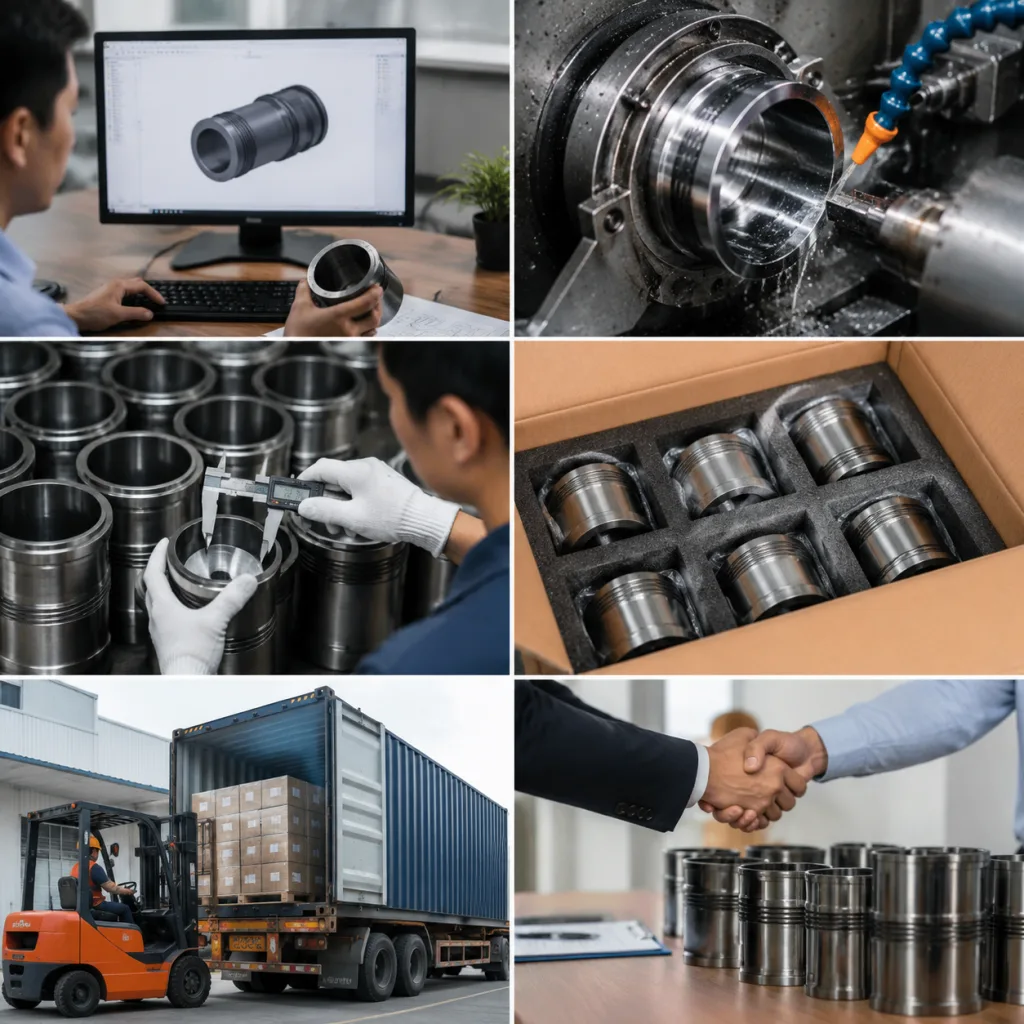
Buying cylinder sleeves at wholesale level is a specification decision first and a price decision second. For Hyundai applications, the right part depends on the engine family, bore geometry, sleeve style, and the level of process control behind every batch. Get those wrong and the cost shows up later as rework, slow installs, or warranty exposure. Driventus is an independent aftermarket manufacturer; brand names are referenced for fitment only. We supply B2B buyers with cylinder sleeves for engine and powertrain applications from Taizhou, Zhejiang, backed by IATF 16949:2016 and ISO 9001:2015 systems. If you are sourcing for distribution, OE replacement, or private-label programmes, the real question is not just whether the sleeve fits, but whether the supply is repeatable, documented, and commercially stable.
How to judge a Hyundai sleeve before you price it
Start with the engine code and the exact rebuild scenario. A cylinder sleeve that looks interchangeable can still fail the job if the bore, wall thickness, flange height, or press fit are off by a small amount.
Minimum purchase checks
Engine code and application year range
Sleeve type: dry, wet, or flanged
Nominal bore and finish size
OD tolerance and block interference target
Deck height and ring land relationships
Packaging and corrosion protection
A usable RFQ should read like a dimensional brief, not a fitment note. Include the target bore, wall thickness, tolerance window, and whether the sleeve is for standard replacement or an oversize repair. Numbers matter: `86.00 mm bore`, `0.03-0.05 mm press interference`, `±0.01 mm bore tolerance`, and `Ra 0.4-0.8 μm` are the kind of details that let a supplier quote accurately. If you reference an OE number, keep it in the request as a cross-reference only, not as proof of interchangeability. For fitment support, buyers can review our catalog and engine components overview.
When wholesale price is really a process question
Many buyers compare unit price first, then discover the true cost sits in machining time, inspection depth, and order structure. That is where cylinder sleeve Hyundai wholesale programmes often diverge: a simple dry sleeve can be economical, while a tighter bore spec or special wet/flanged design can change the quote fast.
Factor
Typical procurement impact
Buyer action
Material grade
Affects wear resistance and machinability
Specify chemistry and hardness range
Dimensional tolerance
Affects press fit and rebuild success
Request measured tolerances by batch
Surface finish
Affects ring seating and oil control
Define Ra target where needed
Order quantity
Affects unit price and tooling amortisation
Consolidate SKUs when possible
Packaging
Affects corrosion risk in transit
Require VCI or equivalent protection
</tr></thead><tbody> </tbody></table>A better comparison is commercial tier by commercial tier. Sample lots, pilot runs, and volume releases should not be priced as if they are the same job. Ask for breaks at `100`, `500`, and `1,000` pieces, and confirm whether the quote includes machining, inspection, inner wrap, VCI protection, and carton labeling. For distributors, the lower landed cost usually comes from stable repeat orders, not chasing the cheapest initial quotation.
Failure modes that hurt engine rebuilds
The most expensive sleeve is the one that passes a basic visual check but fails in service. In practice, the common failure modes are dimensional drift, poor concentricity, weak surface finish control, and inconsistent batch hardness.
Watch these control points
Roundness and cylindricity after finish machining
Bore size at multiple measurement points
Concentricity between bore and OD
Flange flatness where applicable
Micro-hardness or hardness verification when specified
Corrosion protection and shelf-life control
Procurement teams should ask for acceptance values, not generic certificates. Typical sourcing specs may include OD tolerance of `±0.01-0.02 mm`, bore tolerance of `±0.005-0.01 mm` after finish, roundness within `≤0.005 mm`, and concentricity within `≤0.01 mm`, subject to the engine design. If the sleeve is honed, specify cross-hatch angle and surface roughness; too smooth can affect ring seating, while too rough can accelerate wear. For serial supply, request first-article samples, in-process gauge records, and lot-level final inspection reports. Where relevant to the application, material and coating expectations should remain compatible with REACH (EC) No 1907/2006 requirements for the EU market. Driventus’ quality system is structured for batch traceability, dimensional control, and export documentation.
A practical sourcing path from RFQ to release
The cleanest buying process is to separate the enquiry into distinct steps and avoid mixing sample approval with mass-production terms.
1. Confirm engine family, sleeve type, and target dimensions. 2. Review drawing, sample, or OE cross-reference for fitment risk. 3. Agree tolerance window, finish requirement, and packaging format. 4. Validate MOQ, lead time, and sample schedule. 5. Release pilot batch, then move to volume order after approval.
MOQ and lead time depend on whether the sleeve already exists in production. Standard catalog sleeves may support `50-100 pcs` per size, while non-standard or private-label runs often need `200-500 pcs` or more to cover setup and inspection. Typical lead times range from `2-4 weeks` for stock-supported items to `4-8 weeks` for new production, with custom development taking longer if samples or packaging approvals are included. Buyers should also confirm when the clock starts: PO date, deposit date, or sample approval date. That one detail often changes the real schedule more than the published lead time. If you need a modified bore, special length, or packaging built around your warehouse process, custom manufacturing is the correct route.
How Driventus handles wholesale enquiries
Driventus supplies engine and powertrain components to aftermarket distributors, OEM / Tier-1 suppliers, and multi-location repair chains. For cylinder sleeve enquiries, we align the technical file with the buying method: catalogue selection for fast-moving SKUs, private-label control for distributors, and drawing-based supply for engineered programmes.
What procurement teams usually receive
Part drawing review against your target engine family
Material and process confirmation
Sample or pilot batch before volume release
Batch identification and packing specification
Export documents for cross-border shipment
The workflow is simple: send the engine code, target bore, sleeve type, quantity tier, and required tolerance window; we review the drawing or sample; then we confirm feasibility, MOQ, unit pricing, and production lead time before sampling or mass production. If the programme needs lot traceability, carton labeling by SKU, or barcoded packing for warehouse intake, that can be defined before the first shipment. If your team needs a supplier review, factory audit file, or RFQ support, start with request a quote. We will confirm fitment data, commercial terms, and the practical lead time for your target market. Driventus is an independent aftermarket manufacturer; brand names are referenced for fitment only.
Frequently asked questions
Yes. We support wholesale enquiries with batch-based production, fitment confirmation, and export packaging. Share the engine code, sleeve type, target quantity, and tolerance window for a formal quotation.
Typical documents include dimensional confirmation, batch traceability, inspection records, and commercial packing details. We can also support supplier audit requests tied to IATF 16949:2016 and ISO 9001:2015.
Yes. If the sleeve needs a non-standard bore, length, or packaging format, we can review it through our custom manufacturing process and confirm feasibility before sampling.
If you are comparing suppliers for a cylinder sleeve Hyundai wholesale programme, send the engine code, target volume, and required tolerance window. Start here: /contact.html