Cylinder Liner vs Glyco Alternative: A Sourcing Comparison
For procurement teams, the question is not whether a cylinder liner is available, but whether a Glyco alternative truly matches the engine’s geometry, sealing stack, and wear profile. A replacement can work when dimensions, material, hardness, and surface finish are proven against the specification; it fails when one of those variables drifts. That is where claims, coolant leaks, bore distortion, and downtime usually start. Driventus supplies cylinder liners for aftermarket, OEM, and Tier-1 programs with documented process control and export-focused production. Driventus is an independent aftermarket manufacturer; brand names are referenced for fitment only. This guide focuses on the decision points buyers actually use: when a cylinder liner vs Glyco alternative is acceptable, when it is not, and what evidence to request before ordering. For part selection, sourcing scope, and programme support, see [our catalog](/products.html), our [quality system](/quality.html), and [custom manufacturing](/oem-services.html).
Start with the fit decision, not the brand name
In sourcing terms, *cylinder liner vs Glyco alternative* is a fitment and validation question first, and a brand-reference question second.
Before comparing suppliers, buyers should answer three things:
- Does the liner match the block geometry and sealing stack?
- Does the material and hardness suit the duty cycle?
- Is there evidence for wear, compression retention, and coolant sealing?
If those answers are not clear, the part is not interchangeable, no matter how close the catalog description looks. Driventus is an independent aftermarket manufacturer; brand names are referenced for fitment only.
Where alternatives fail first
Most sourcing problems do not come from the bore diameter alone. They come from the small details that change how the liner sits in the block.
Common failure modes include:
- Incorrect liner protrusion, which shifts head-gasket loading
- Poor outer-diameter control, which weakens press fit retention
- Wrong flange height, which changes deck sealing behavior
- Inconsistent bore finish, which affects ring seating and oil control
- Weak coolant-seal geometry, which leads to leaks after thermal cycling
If an alternative changes one of these variables, the engine may pass a visual check and still fail in service. That is why dimensional parity matters more than a generic interchange claim.
Spec check: the numbers that decide equivalence
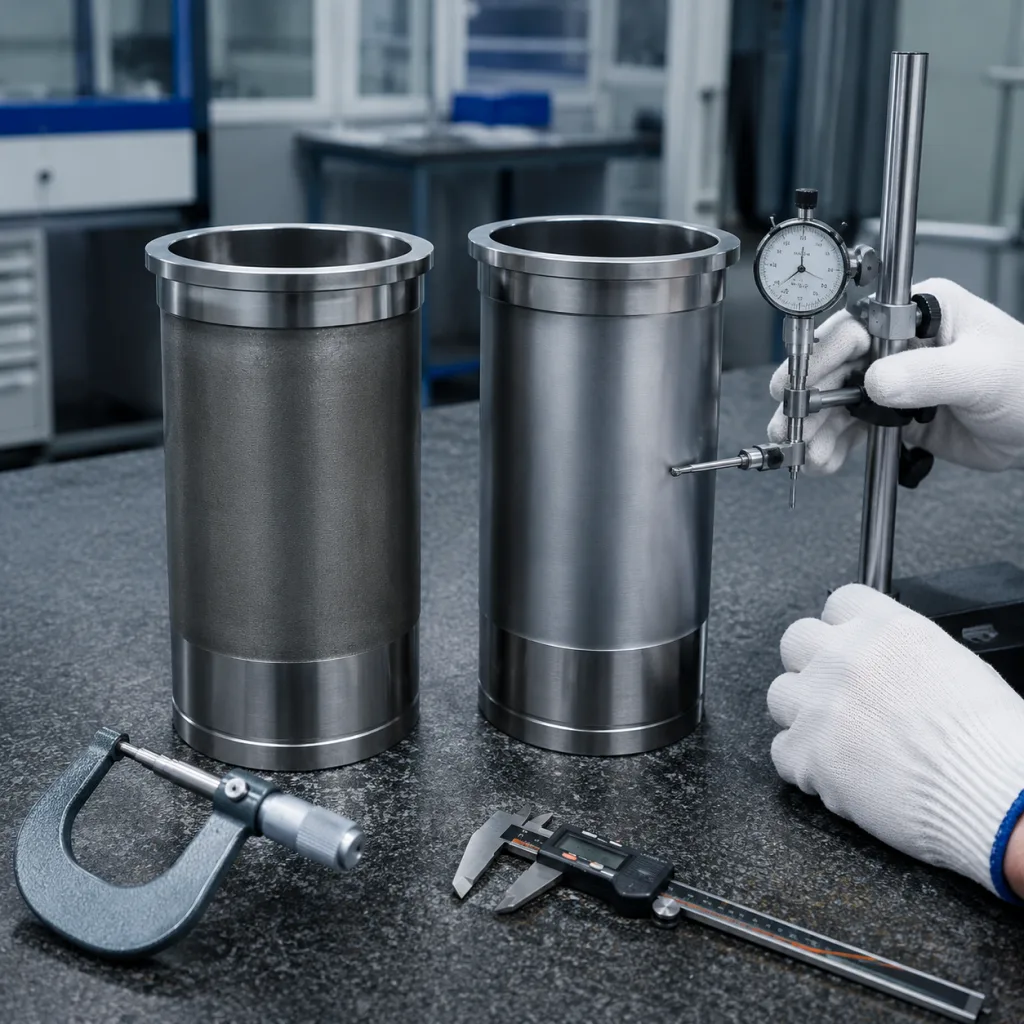
Cylinder liners are not commodity items. A procurement team should ask for the actual data, not a broad promise of compatibility.
Request these values on quotation and sample approval:
- Bore diameter and straightness
- Outer diameter and interference fit range
- Flange thickness and flange height
- Installed protrusion above deck
- Wall thickness and concentricity
- Surface roughness of the running bore
- Hardness range after machining and heat treatment
Small deviations can alter piston-to-liner contact, oil consumption, and sealing load. The liner also has to stay round after press-fit installation. A supplier should provide inspection records tied to IATF 16949:2016 and ISO 9001:2015 controlled processes, not only a generic certificate.
Materials and durability: what to verify beyond cast iron
Most replacement liners use cast iron because it gives stable wear behavior and compatible thermal expansion. Some programs require a nitrided or coated surface, or a specific pearlitic structure to improve scuff resistance. The material choice should follow the engine duty, not the supplier’s default catalog offering.
Useful validation checks include:
- Rockwell or Brinell hardness
- Metallographic review of microstructure
- Hydrostatic or air leak test on coolant passages
- Thermal cycling for distortion-sensitive block designs
- Wear testing against the intended piston ring pack
If the application has compliance requirements, confirm the relevant standard set before release. Depending on the engine family and market, REACH (EC) No 1907/2006, ECE R-83, or SAE J2527 may apply to related validation or material compliance programmes.
When a Glyco alternative is a safe buy
An alternative is worth considering when the engine family is well documented, the OEM geometry is stable, and the supplier can show dimensional repeatability across batches. That is often true for mature passenger car, light commercial, and selected industrial programmes.
A good-case scenario usually looks like this:
- The engine code is stable and widely serviced
- The liner design has standard dry, wet, or flange-supported geometry
- Batch inspection data is available before shipment
- The replacement has been validated against the ring pack and coolant sealing design
This is the point where a Glyco alternative can reduce sourcing friction without increasing risk. The price only matters after the fit and test data are proven.
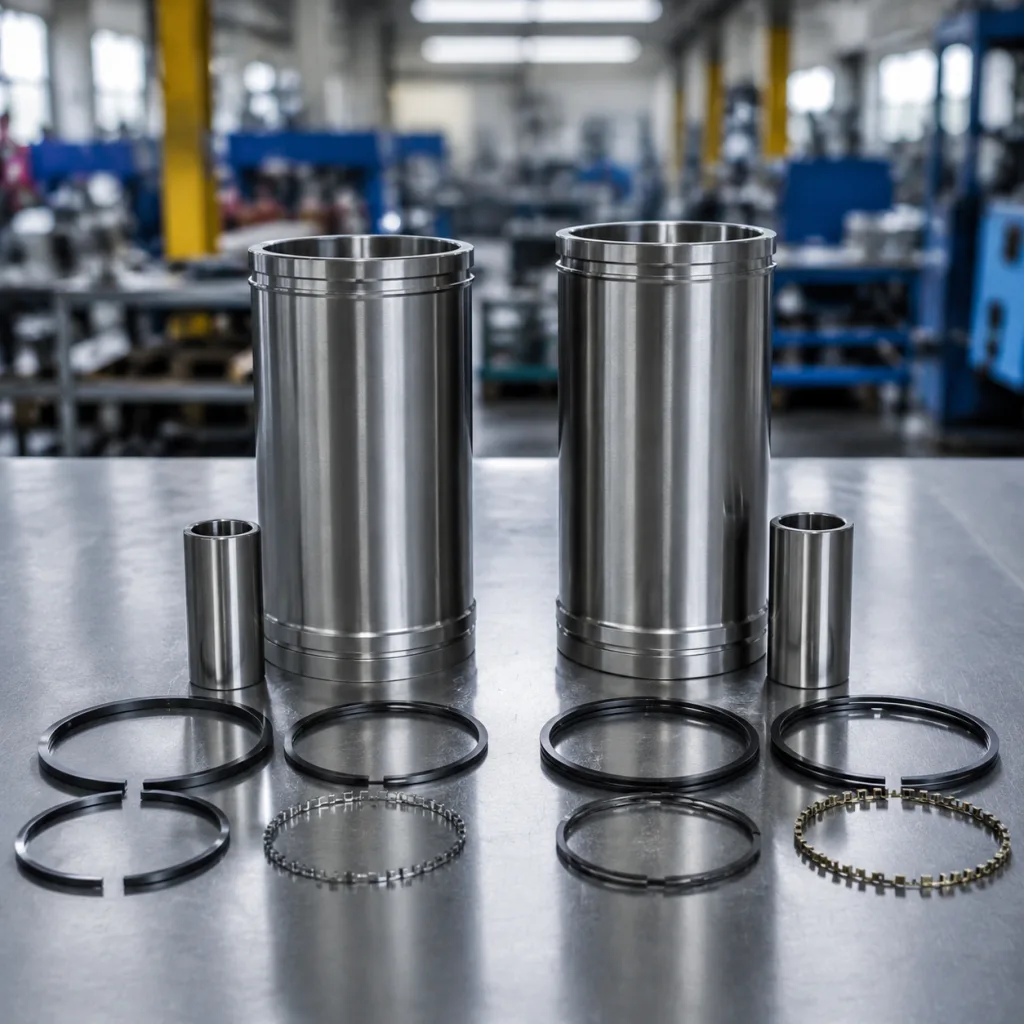
Procurement workflow: a practical checklist
Use a short, repeatable review sequence before releasing an order.
1. Cross-reference the engine code and OE number, such as OE 06A107065 where applicable. 2. Request material specification, hardness range, and surface finish values. 3. Confirm whether the liner is dry, wet, or flange-supported. 4. Ask for dimensional inspection reports from the current batch. 5. Check packaging and corrosion protection for export transit. 6. Verify lead time, MOQ, and repeat-order stability.
If your programme needs a non-catalogue fitment, Driventus can support custom manufacturing after dimensional review. For standard SKUs and related engine parts, see our catalog and engine components.
Frequently asked questions
No. It is interchangeable only when dimensions, material, hardness, and sealing geometry match the engine specification. Validation data should confirm fit and durability before release.
Ask for OE cross-reference, dimensional drawing, material grade, hardness, surface roughness, inspection records, MOQ, and lead time. For export orders, confirm packaging and corrosion protection too.
No. Driventus is an independent aftermarket manufacturer; brand names are referenced for fitment only. The company supplies equivalent aftermarket parts and custom programmes based on specification.
If you need a dimensional check, batch inspection data, or a replacement programme for cylinder liners, send your drawing or OE reference and we will review it with you. Please [request a quote](/contact.html).
Request a Quote