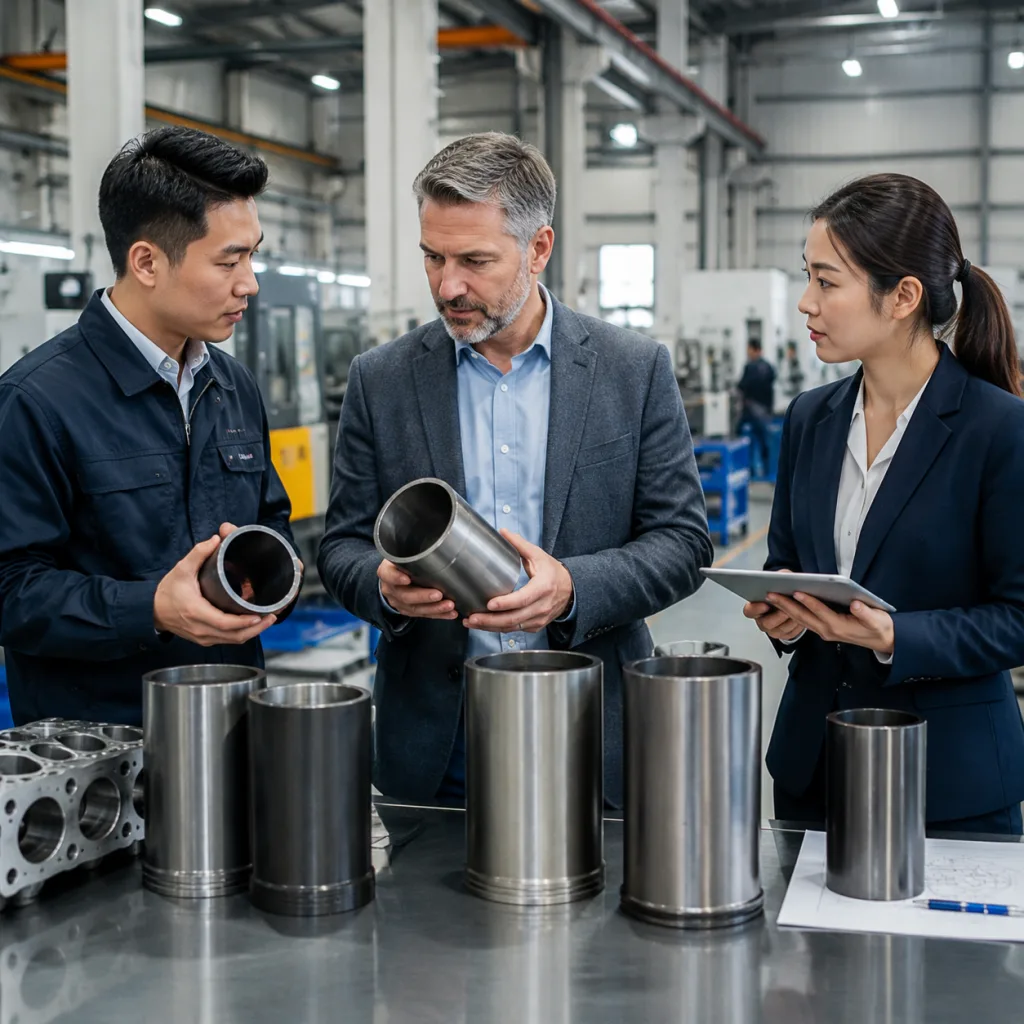
When buyers search for a cylinder liner Infiniti supplier, the real question is not who can quote fastest. It is who can prove fitment, hold tolerances, and keep supply stable after the first order.
For Infiniti applications, the supplier should confirm bore size, flange geometry, wall thickness, material grade, and surface finish against the exact engine family. They should also back the quote with inspection records, traceability, and a realistic lead-time commitment.
Driventus is an independent aftermarket manufacturer; brand names are referenced for fitment only. We manufacture engine and powertrain parts in Taizhou, Zhejiang, and export to more than 60 countries. Our quality system is built around IATF 16949:2016 and ISO 9001:2015, which matters when you need repeatable lots rather than one-off samples. This article focuses on how to decide whether a supplier is technically fit, where sourcing programs fail, and when custom manufacturing is the safer route for hard-to-source applications.
Start with fitment, not the vehicle badge
A cylinder liner Infiniti supplier should be evaluated from the engine outward, not from the vehicle nameplate backward. One model line may hide multiple engine revisions, repair sizes, or block variants, and a generic quote rarely protects you from that.
Before you request pricing, verify:
Engine code and revision level
Bore diameter, outer diameter, and total height
Flange thickness and seat width
Wall thickness and interference fit tolerance
Material specification, usually alloy cast iron or ductile iron
Honing allowance and target surface finish
Coating or corrosion protection for storage and transit
Traceability method by batch or heat number
If you have an OE cross-reference, keep it explicit. A reference such as OE 06A107065 is useful only when the engine family is also stated. For procurement, the drawing and inspection plan matter more than a sales description.
Where sourcing programs usually fail
Most sourcing problems do not start with the liner itself. They start with assumptions.
A programme can fail when the buyer approves a part based on a photo, accepts a quote without a dimensional sheet, or uses the wrong engine code for a multi-variant application. The next common failure is inconsistency: the sample fits, but the next batch shifts on critical dimensions or surface finish.
Watch for these warning signs:
The supplier cannot explain how dimensions are controlled
The quotation is tied only to a vehicle model
No sample inspection report is available
Material traceability is vague or absent
Lead time changes every time you reorder
Packaging is not defined for export storage
If any of those appear early, treat them as risk signals. A low unit price does not help if the part creates rework, returns, or line stoppages later.
Compare suppliers on more than price
A useful comparison is technical and operational, not just commercial. For a cylinder liner Infiniti supplier, the best choice is often the one that reduces follow-up work for engineering, quality, and logistics teams.
Evaluation item
What to ask
Procurement impact
Engineering support
Can the factory review a drawing, sample, or worn part?
Lowers fitment risk
Certification
Is the plant certified to IATF 16949:2016 and ISO 9001:2015?
Supports supplier approval
Dimensional control
Are critical dimensions measured and recorded?
Improves lot consistency
Material traceability
Is heat or batch traceability available?
Helps with claims and audits
Lead time
What is the normal production lead time and re-order window?
Affects inventory planning
MOQ
What is the minimum order quantity by part number?
Impacts SKU rationalisation
Custom work
Can the supplier make non-catalogue sizes?
Important for legacy engines
</tr></thead><tbody> </tbody></table>A strong supplier should support both repeat catalogue supply and small-volume engineering changes. That matters for distributors, repair chains, and OEM or Tier-1 buyers with mixed demand profiles.
Lead time, MOQ, and stock strategy
Lead time is often the deciding factor once the part is technically approved. Standard parts should have predictable replenishment; special sizes usually need a longer schedule because machining, heat treatment, and final inspection may require a dedicated run.
Ask for a clear answer on:
1. Standard production lead time by part family 2. MOQ by diameter and material grade 3. Sample lead time for first article approval 4. Packing specification for export cartons or pallets 5. Re-order point recommendations for steady demand
A practical supplier will state what can be held in stock, what is made to order, and what requires tooling or process setup. That is more useful than a headline price if the part must support multi-location repair chains or cross-border distribution.
Spec deep-dive: what should be controlled
Once fitment is confirmed, the next question is whether the supplier can hold the spec across lots. For cylinder liners, small shifts can create big downstream problems.
The main controls usually include:
Incoming material verification
Rough and finish machining checks
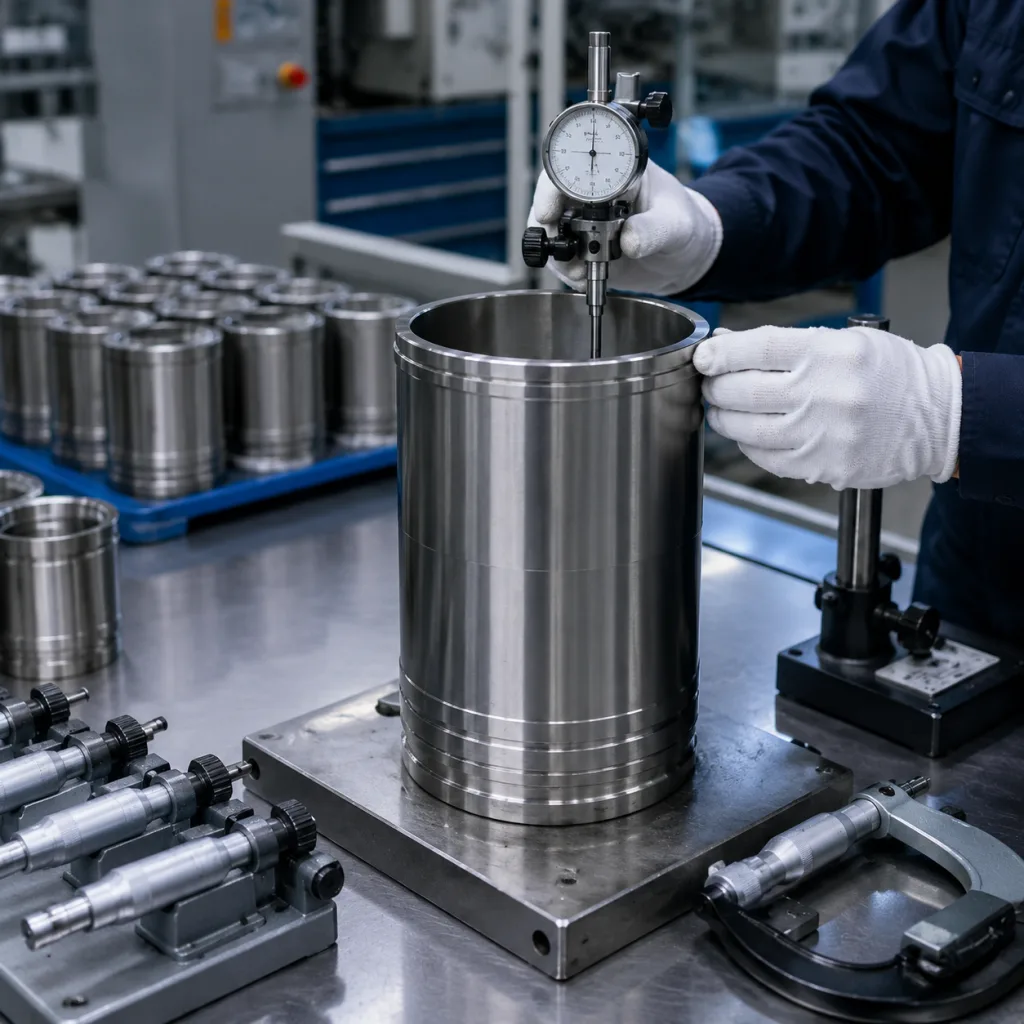
Roundness, taper, and concentricity measurement
Height, wall thickness, and flange inspection
Visual inspection for cracks, porosity, and surface defects
Final packing verification and batch labelling
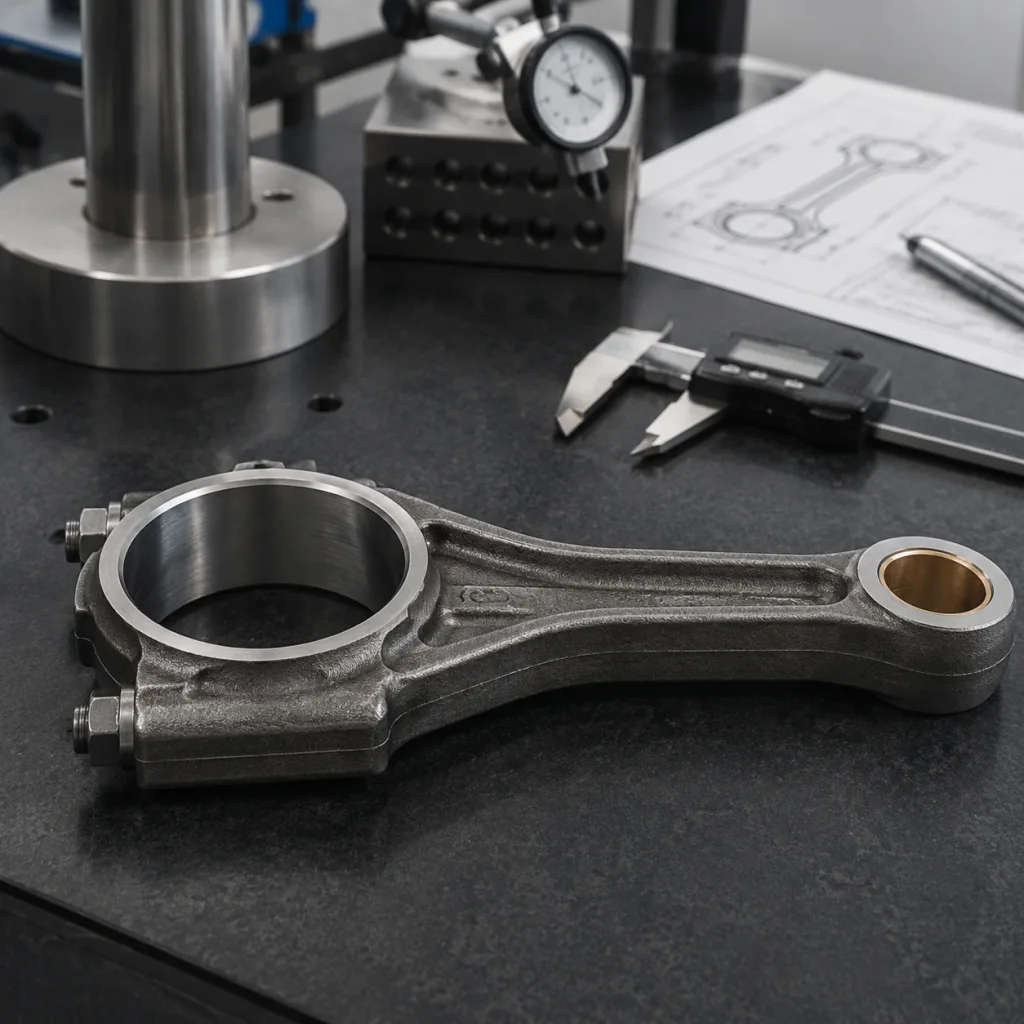
If you are reviewing a new source, request the drawing, quality manual summary, sample inspection report, and traceability format. For export programs, buyers in the EU, UK, US, Canada, Australia, and Brazil may also ask for compliance statements aligned with REACH (EC) No 1907/2006 where relevant to materials and surface treatments.
When custom manufacturing is the safer route
Custom manufacturing makes sense when the engine family is discontinued, the original liner is no longer available, or the block has been repaired beyond the standard oversize range. In those cases, the supplier needs to work from a sample, a worn original, or a controlled drawing.
Driventus provides custom manufacturing through our OEM services, with support for dimension matching, process review, and production documentation. This is useful when buyers need a non-catalogue height, a modified flange profile, or a controlled interference fit for a specific block revision. Our custom manufacturing page explains the process, while our catalog and quality system show the broader range of engine components and inspection controls.
How to request a quote without delays
To shorten quotation time, send the following information:
Vehicle or engine family
OE reference if available
Required quantity and target annual volume
Sample, drawing, or measurement sheet
Material preference and finish requirement
Target market and packaging need
If you are sourcing a cylinder liner Infiniti supplier for a new programme, also specify whether you need a prototype run, PPAP-style documentation, or direct mass production. For related engine parts, you can also review our engine components.
Driventus is an independent aftermarket manufacturer; brand names are referenced for fitment only. If you need pricing, stock status, or a technical review, request a quote and include the part data in your message.
Frequently asked questions
Yes. We support aftermarket and B2B sourcing for engine components, including cylinder liners matched by engine code, dimensions, and drawing. Brand names are referenced for fitment only.
Ask for the drawing, inspection report, material traceability, sample photos, and the factory’s certification details. IATF 16949:2016 and ISO 9001:2015 are especially useful for supplier review.
Yes. Custom manufacturing is available for legacy engines, repair oversizes, and special flange or height requirements. Share a sample or drawing to confirm feasibility and lead time.
If you are sourcing a repeatable cylinder liner programme, send your engine data, target volume, and OE reference through /contact.html and we will review the fitment.