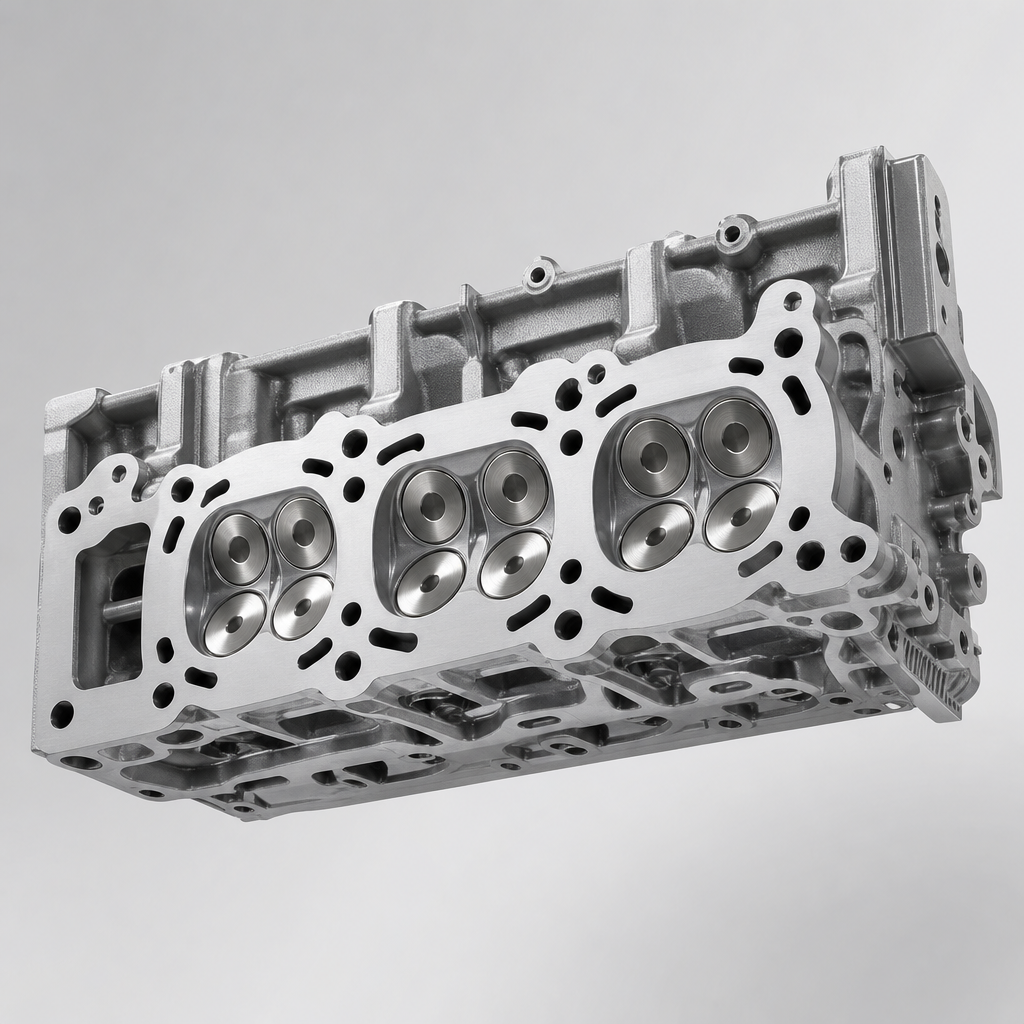
Cylinder Head Volvo Manufacturer China: B2B Sourcing
For importers and category buyers, sourcing from a **cylinder head volvo manufacturer china** supplier is rarely just a price comparison. The real exposure sits in dimensional consistency, alloy control, machining repeatability, traceability, and the factory's ability to produce reliable validation records. Cylinder heads are highly tolerance-sensitive parts. Even small deviations in deck flatness, valve seat concentricity, cam bore alignment, guide clearance, or pressure tightness can turn into costly warranty issues across several markets.
When procurement teams review Chinese sources for Volvo-fitment cylinder heads, five questions usually need answering early: which references are in regular production, what MOQ applies, how long replenishment takes, which quality controls are documented, what the actual tolerance window is on critical features, and whether the supplier can support private-label or drawing-based programmes. Buyers also need process detail they can act on: whether the head is supplied bare or assembled, whether machining is completed in-house, what leak-test pressure and hold time are used, what sample size is checked per batch, and how claims are handled if one lot fails after arrival.
This article outlines a practical sourcing framework for distributors, OEM service buyers, and repair-chain purchasing teams evaluating a cylinder head volvo manufacturer china source. Driventus is an independent aftermarket manufacturer; brand names are referenced for fitment only.
Start with the go/no-go screen, not the catalogue
A shortlist should be built on manufacturing control, not on how many Volvo references appear in a PDF. The first pass is simple: can the supplier explain how the part is made, checked, traced, and packed in numbers rather than sales language?
Use the opening screen below:
Material route: cast iron or aluminium alloy grade, melt control, degassing method, porosity management
Leak and crack control: pressure-test procedure, test medium, hold time, penetrant inspection or equivalent where relevant
Traceability: batch records tied to casting date, furnace or heat number, machining lot, and final inspection
Packaging: anti-corrosion protection, impact protection around valve-seat areas, desiccant where needed, export carton or pallet specification
Document readiness: inspection reports, dimensional records, material records, compliance declarations for destination markets
Then press for evidence under IATF 16949:2016 and ISO 9001:2015. Not just certificates. Ask how non-conforming castings are quarantined, how tool wear is tracked, how machining offsets are corrected, and how often critical dimensions are checked.
The fastest way to separate serious suppliers from generic traders is to ask for actual limits by SKU. Many buyers will want to see deck flatness around 0.05 mm to 0.08 mm, valve seat concentricity within 0.03 mm to 0.05 mm, guide bore tolerance to drawing, gasket-face finish in a defined Ra range, and a finished-head pressure test such as 0.3 to 0.5 MPa for 60 to 180 seconds, depending on design and test standard. If the answer stays vague, the risk is already visible.
If the programme may later expand into related engine parts, it also makes sense to review our catalog and the broader engine components range during the same sourcing cycle.
Use a comparison table that exposes real supplier differences
Most quotes look close on paper. The differences usually show up in process discipline, traceability, and commercial flexibility.
Check area
What to ask for
Why it matters
Certification
Valid IATF 16949:2016 and ISO 9001:2015 certificates
Confirms formal process control and a documented quality management system
Casting control
Foundry process summary, alloy records, degassing method, porosity controls
Cylinder head durability depends on stable casting integrity
Directly affects installation success and field life
MOQ
Standard MOQ by SKU, trial MOQ, and mixed-container programme rules
Important for aftermarket inventory planning
Lead time
Tooling lead time, pilot-run timing, repeat-order timing, peak-season timing
Helps distributors manage replenishment risk
Packaging
Unit pack, master carton, pallet pattern, gross weight, drop resistance
Reduces transit damage claims
Compliance
Material declarations relevant to REACH (EC) No 1907/2006 where applicable
Supports EU import compliance workflows
Audit access
Factory audit policy, process walk-through, sample retention, NCR handling
Gives buyers confidence beyond brochure claims
</tr></thead><tbody> </tbody></table>One useful comparison exercise is to ask each factory to show one closed production lot from start to finish: incoming casting record, first-piece approval, in-process inspection sheet, final dimensional report, leak-test record, packaging photo, and shipping mark. A disciplined cylinder head volvo manufacturer china supplier should retrieve that file quickly.
This is where weak systems show themselves. If traceability lives in handwritten notes that cannot be tied to the shipment label, repeat supply becomes harder to trust.
Driventus maintains a documented quality system for exported engine and powertrain components, with batch traceability and inspection records aligned to customer programme requirements.
Map MOQ and lead time by sourcing scenario
MOQ and lead time only make sense when matched to the commercial model. Buyers often compare quotations without separating stock supply, mixed-load buying, and private-label development. That creates false comparisons.
Standard catalogue supply
For regularly produced references, MOQ is often set at carton or pallet quantity per SKU. In practice, buyers commonly see a trial MOQ of 20 to 50 pcs per SKU for stock items, with repeat orders moving to 50 to 100 pcs if dedicated packaging is required. This is usually the lowest-risk route for distributors testing a new part family.
Mixed-load distributor programme
Some suppliers allow mixed SKUs within one container when part numbers share production windows and packaging format. Typical rules include a minimum of 10 to 20 pcs per SKU, a total order value threshold, or a minimum cubic volume per shipment. This helps regional wholesalers avoid overloading inventory into one slow-moving reference.
Drawing-based or private-label programme
Branding, customised packaging, laser marking, or application-specific machining changes the economics. MOQ normally rises because of setup cost, packaging material stock, approval sampling, and slower first-run throughput. Buyers should expect MOQ to start from 100 to 300 pcs per reference in many aftermarket programmes, and higher if new fixtures, gauges, or dedicated castings are involved.
Before approving a supplier, ask for these figures in writing:
Trial-order MOQ
Repeat-order MOQ
Typical production lead time after deposit or PO release
Peak-season lead time
Sample lead time for audit approval
Container loading capacity by part family
Reorder trigger recommendation based on historical production cadence
Price breakpoints at different order volumes
Commercially, compare EXW unit price, export packing cost, palletisation cost, sample charge, and any one-time setup fee as separate lines. A low unit price can become expensive if pressure testing, assembled-head content, branded cartons, or inspection reports are treated as extras.
For lead time, many factories quote 30 to 45 days for repeat orders on standard items. Private-label or engineering-change orders may run 45 to 75 days, depending on fixture readiness, packaging approval, and foundry schedule. Sample approval can add 7 to 21 days if dimensional reports, leak-test records, and packaging confirmation are required before mass production release.
For projects that require tailored packaging, machining changes, or customer-specific inspection plans, custom manufacturing should be discussed before commercial approval. That avoids a mismatch between the quoted lead time and the real engineering scope.
Read the quality plan through failure modes
A cylinder head fails in service for specific reasons: porosity, sealing loss, seat geometry drift, guide wear, thread damage, thermal distortion, or assembly mismatch. The supplier's control plan should read like a response to those risks.
Typical controls include:
Chemical composition verification for the selected alloy or cast iron grade
Hardness checks at defined zones, for example Brinell or Rockwell according to the material route
Deck flatness measurement after machining
Valve seat concentricity and width checks
Guide bore measurement and guide-to-valve stem clearance review where assembled
Cam bore or cam tunnel alignment checks, depending on design
Thread inspection for fastener holes and accessories
Pressure or leak testing on finished heads
Surface finish verification on gasket-contact faces
If assembled heads are supplied, go deeper. Ask how the factory controls valve material, stem diameter, spring free height, installed load, retainer fit, seal fitment, and keeper compatibility. If those components are bought externally, the next question is whether incoming control is based on 100% key-characteristic checking, sampling to AQL, or supplier certificate review only.
Sampling logic matters too. Many buyers expect 100% pressure testing on finished heads, while dimensional checks may follow a fixed plan such as first 5 pcs, then 1 pc every 20 to 50 pcs, with tighter checks after tool change. That frequency should be written into the control plan, not improvised on shift.
Typical buyer-facing tolerance requests include deck flatness not exceeding 0.05 mm to 0.08 mm, valve seat runout within 0.03 mm to 0.05 mm, valve seat width within drawing range, guide bore size held within the specified micrometer band, and gasket-face surface finish controlled to the target Ra value on the application drawing. The exact values depend on the Volvo-fitment reference. The important point is that the supplier states them clearly instead of hiding behind "as per standard".
For road-going applications sold into regulated markets, buyers often need supporting evidence that the part will not compromise intended emissions-related engine function when correctly installed. A cylinder head is not certified in the same way as a complete vehicle, but programme documentation may still be reviewed alongside standards and regulatory frameworks such as ECE R-83 in relevant historical contexts, depending on the destination market and application.
By contrast, brake and friction standards such as SAE J2527 have no relevance to cylinder head validation. That is a useful test in itself. If a supplier sends a generic test list covering unrelated part categories, the sourcing file is not being managed carefully.
A competent supplier should be able to provide batch-linked inspection data, not only a generic statement of conformity. At minimum, buyers should expect a lot number, inspection date, inspector sign-off, measured values for key dimensions, leak-test result, and pack quantity tied back to the shipment mark.
Run a factory audit in production order
A quotation tells you price. An audit tells you whether the supplier can hold quality six orders later.
The most practical way to assess a Chinese factory is to follow the production flow from casting receipt to final packing.
Use this checklist:
Review incoming casting inspection criteria and sample frequency
Confirm whether machining fixtures are dedicated or shared across part families
Check calibration status of CMMs, pressure rigs, roughness testers, and thread gauges
Ask how process capability is monitored on critical dimensions
Inspect segregation procedure for rejected castings and rejected finished parts
Review sample retention and lot traceability labels
Confirm carton marking, pallet control, and export packing photographs
Verify complaint-handling workflow, root-cause method, and corrective-action timing
If buyer teams cannot visit in person, ask for a live video audit through the machining line, test area, warehouse, and packaging station. Static photos rarely show real process flow, handling discipline, or material segregation.
A useful audit sequence looks like this:
1. Start at raw casting receipt. How is casting ID marked? How are suspect porosity areas checked? What is the rejection route? 2. Move to machining. Are fixtures dedicated or shared? How are datums established? When are cutters replaced? What measurement triggers offset correction? 3. Review final inspection. Who signs off deck height, seat geometry, thread condition, and leak test? Where are records stored? 4. Finish at packing. Is each head capped, bagged, oiled or VCI-protected as required, and protected against corner impact inside the carton?
Complaint handling also deserves hard numbers. Ask for target containment timing after a claim, the standard 8D or equivalent corrective-action format, and whether replacement stock can be prioritised inside 7 to 14 days for approved cases. For aftermarket distributors, response speed often matters almost as much as unit price.
When discussing Volvo-fitment programmes with any cylinder head volvo manufacturer china source, also ask whether the supplier supports engineering updates, replacement of worn fixtures, periodic gauge revalidation, and scheduled PPAP-style or sample re-approval after a major process change. Those details usually have a bigger effect on supply stability than a small unit-price difference.
Driventus supports distributor, wholesaler, and OEM-service enquiries with documented process information and application review. Buyers can request a quote with target annual volume, required pack format, destination market, and whether bare or assembled heads are needed for a more accurate commercial assessment.
Frequently asked questions
MOQ depends on whether the part is in standard production, the packaging format, and whether the programme is private-label. For regular aftermarket references, buyers often see trial MOQs around 20 to 50 pcs per SKU, while repeat orders may move to 50 to 100 pcs. Private-label or drawing-based programmes commonly require 100 to 300 pcs or more per reference because of setup, packaging, and approval cost.
At minimum, request valid IATF 16949:2016 and ISO 9001:2015 certificates, inspection reports for critical dimensions, pressure-test records showing test pressure and hold time, packaging specification, and any applicable material or compliance declarations needed for your destination market. For higher-risk programmes, also request a control plan, sample CMM report, traceability format, and complaint-handling procedure.
Yes, but buyers should confirm this early. Custom packaging, branding, laser marking, or drawing-based machining usually changes MOQ, sample timing, tooling requirements, and approval procedure. It can also extend lead time from a typical 30 to 45 days for repeat stock orders to 45 to 75 days or more if engineering review and first-sample approval are required.
If you are sourcing Volvo-fitment cylinder heads and need a clear review of MOQ, lead time, tolerance control, inspection scope, or factory capability, contact Driventus to discuss your programme at /contact.html