Choosing a cylinder head mini OEM supplier usually comes down to a few practical questions: can the supplier support a realistic MOQ, hold stable machining capability, repeat validation, and provide export-ready documentation without turning a small or mid-volume program into an inventory burden? Driventus supplies aluminium and cast iron cylinder heads for aftermarket distributors, OEM and Tier-1 programs, and multi-location repair chains that need controlled production rather than spot purchasing. We work to drawing-based requirements, approved sample control, batch traceability, and controlled inspection records under IATF 16949:2016 and ISO 9001:2015. Driventus is an independent aftermarket manufacturer; brand names are referenced for fitment only.
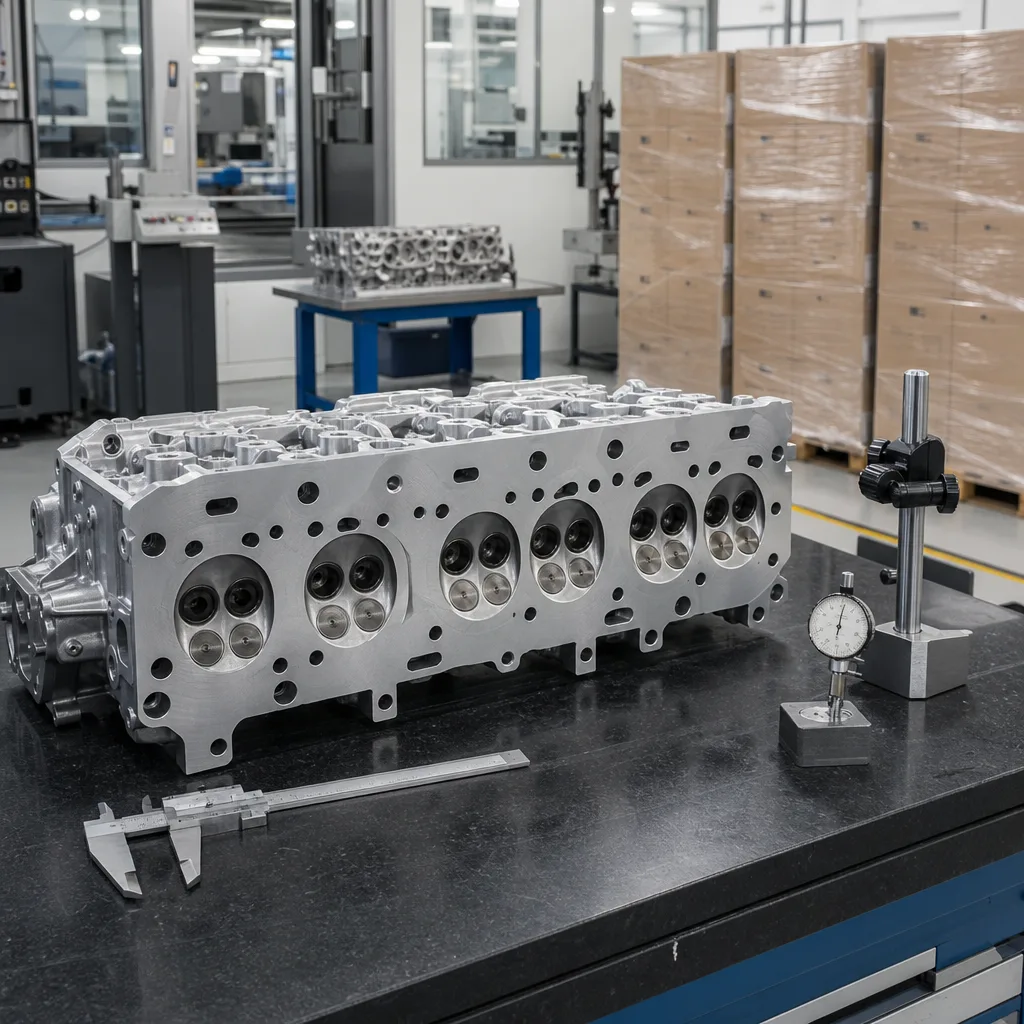
In practice, buyers do not approve a cylinder head just because the casting looks right or the unit price is appealing. They look at deck flatness, valve-seat runout, valve-guide alignment, coolant-jacket leak performance, gasket-face roughness, residual chip control, packaging protection, and the evidence behind each batch. A qualified mini OEM supplier should be able to explain how the first sample is approved, how the process is kept under control during repeat production, and how nonconforming parts are contained before shipment. The sections below outline what to check before RFQ, what to ask during an audit, and how to reduce launch risk while keeping procurement volume realistic.
What Buyers Should Expect
Procurement teams should separate a trading broker from a manufacturing partner early in the sourcing process. A broker may help locate available stock, but a cylinder head mini OEM supplier is expected to control the technical file, production route, inspection criteria, and shipment records. That distinction matters because cylinder heads are high-risk engine components. One uncontrolled machining change can cause combustion sealing failure, coolant leakage, oil cross-leakage, valve-train noise, misfire, overheating, or warranty claims across an entire batch.
A real mini OEM supplier should be able to maintain drawing control, sample approval, process records, and batch traceability rather than simply forwarding photos and prices. Buyers should expect structured answers on material grade, casting source, heat treatment, machining fixtures, inspection frequency, pressure-test method, packaging standard, and the escalation path if a deviation is found. The supplier should also state whether the part is built to a customer drawing, an approved sample, an OE cross-reference, or a fitment-based aftermarket specification.
Capability
Broker
Mini OEM supplier
What buyers should ask
Drawing control
Often limited to part number matching
Revision-controlled drawing, approved sample, BOM, and specification file
Which drawing revision, sample level, or fitment reference is frozen for production?
Which documents, labels, and packing photos ship with the goods?
</tr></thead><tbody> </tbody></table>For ongoing sourcing, buyers should also look at communication discipline. The supplier should confirm specifications in writing, separate assumptions from verified data, and avoid promising universal fitment where drawings, samples, or application data have not been reviewed. If you are comparing adjacent powertrain parts, browse our catalog or review engine components.
Materials And Machining Controls
Cylinder heads fail for avoidable reasons when casting quality and machining discipline are not aligned. The casting has to be sound enough to survive pressure testing, heat cycling, and machining allowance removal. The machining process then has to hold flatness, bore geometry, seat location, thread form, and sealing-face finish from the first part to the last part in the batch. For procurement teams, the useful question is not only whether the part fits once. It is whether the supplier can reproduce the same fitment and sealing performance shipment after shipment.
For aluminium cylinder heads, porosity control, heat treatment, alloy consistency, and machining stability usually matter most. Common production risks include shrinkage porosity in coolant jackets, distortion after heat treatment, excessive gasket-face roughness, loose or misaligned valve-seat inserts, and burrs in oil galleries. For cast iron cylinder heads, wall consistency, guide alignment, casting cleanliness, core-shift control, and final deburring usually drive yield. A capable supplier should understand how the casting route affects machining allowance, how fixtures locate the head during rough and finish operations, and how inspection data is used to prevent dimensional drift.
Typical inspection points
Deck flatness after finish machining, commonly controlled around 0.05 to 0.10 mm across the gasket face depending on engine family, gasket design, and customer drawing.
Gasket-face surface roughness, often specified in Ra or Rz values according to the gasket supplier requirement; MLS gaskets usually need tighter finish control than composite gaskets.
Valve-seat runout/concentricity and guide alignment to the engine drawing, commonly checked with a seat runout gauge, pilot gauge, CMM, or dedicated bench fixture.
Pressure testing of coolant jackets and oil galleries at the agreed test pressure, hold time, and leakage limit, with records tied to batch or serial identification.
Cam bore, tappet bore, injector bore, glow-plug or spark-plug bore, and dowel locations where applicable to the engine family.
Thread depth, thread pitch, thread cleanliness, and insert quality where plugs, sensors, manifolds, injector clamps, or fasteners are installed.
Washing, drying, and residual chip control after machining, especially around blind passages, oil galleries, coolant ports, and threaded holes.
Batch labels that show casting heat or lot, machining lot, inspection status, production date, and packing identity.
The supplier should be able to describe how each critical feature is measured, not just state that inspection is performed. Buyers can ask for gauge lists, CMM report examples, leak-test records, fixture-control procedures, calibration status, and photos of protective packaging for machined faces. A supplier that cannot explain these controls will struggle to support repeat orders, especially when the program moves from trial quantity to scheduled replenishment.
Validation And Standards
For B2B sourcing, documentation matters as much as the part itself. It proves what was made, how it was checked, and which acceptance standard applied. A practical validation file should include dimensional reports, material certificates, pressure-test records, surface-finish confirmation where required, and a clear statement of the inspection method used on each critical feature. For a first sample, buyers should also request photos of part marking, carton labels, pallet labels, machined-face protection, and corrosion-control packaging so the receiving team knows what to expect.
Our quality system is built around IATF 16949:2016 and ISO 9001:2015, the baseline most procurement teams expect for controlled automotive supply. In a cylinder head program, that quality framework should translate into revision control, incoming casting inspection, process inspection, final inspection, nonconforming-product handling, calibration records, lot release records, and corrective action when results move outside agreed limits. The certificate is only part of the value. What matters day to day is the supplier's ability to maintain a controlled process across repeat production.
Depending on market and customer requirements, additional declarations may reference REACH (EC) No 1907/2006 for substance compliance, especially where materials, coatings, cleaning agents, or packaging are reviewed by a regulated customer. Corrosion or transport exposure can be validated through customer-specific salt-spray, humidity, or packaging tests where required. ECE R-83 may be relevant only where the replacement component is part of a regulated emissions-sensitive vehicle program and the buyer requires evidence that the part does not affect certified performance. The exact scope should be confirmed during RFQ so the supplier does not quote a standard replacement part when the buyer needs program-level validation.
Documentation should also show whether the order is for fitment-only replacement, pilot build, service-part supply, or long-run OEM supply. Those categories carry different expectations for PPAP-style evidence, dimensional layout, durability data, and customer sign-off. We do not claim vehicle-manufacturer approval or endorsement. Clear scope prevents false assumptions during sourcing, reduces rejection risk at receiving inspection, and gives both sides a written baseline if engineering changes occur later.
MOQ, Lead Time, And Trial Orders
The "mini" in mini OEM usually means the supplier can support lower-volume programs without forcing a high annual commitment. That is useful for distributors testing new references, regional warehouse programs, export customers managing mixed containers, and repair chains that want controlled inventory without buying a full mass-production run. It does not mean informal production. Strong small-volume programs still need frozen specifications, sample approval, inspection records, and clear packaging rules.
MOQ depends on the cylinder head reference, casting availability, machining setup time, fixture requirements, and the level of validation requested. If an existing casting, core package, and machining fixture can be used, a pilot order can often be planned with a practical trial quantity. If new tooling, a new core box, special machining fixtures, revised ports and chambers, or additional sensor and plug locations are required, the economic MOQ will be higher because engineering, validation, and setup costs must be spread across the program. Buyers should ask the supplier to separate tooling, sampling, testing, packing, and unit price so the cost structure is visible.
Lead time is shaped by tooling or fixture readiness, machining sequence, and the amount of validation required before release. The first lot is usually slower because the supplier must lock the gauge set, verify fixtures, confirm casting stability, run leak testing, complete first-article measurement, and approve the packing method. Repeat orders move faster once the process window is stable, especially when the buyer provides a rolling forecast, reorder schedule, or blanket order with scheduled releases.
A workable sourcing plan usually defines:
Target annual volume by part number and by destination market.
Acceptable pilot quantity and the decision point for moving to repeat orders.
Required tests before release, including dimensional layout, pressure test, material check, hardness or heat-treatment confirmation where applicable, and surface-finish requirements.
Inspection report format, language, and whether reports are needed for every batch, launch lots, or customer-selected audits.
Packaging standard for export, warehouse handling, pallet stacking, moisture protection, and protection of gasket faces, guides, valve seats, and ports.
Labelling requirements for part number, batch number, production date, fitment reference, quantity, carton number, and country-specific import data.
Whether the program needs custom manufacturing for port, chamber, coolant-passage, plug, sensor-location, or machining-datum changes.
For a quotation, attach the drawing, approved sample information if available, expected build rate, destination market, target launch date, and any required inspection report format. That shortens the back-and-forth, makes pricing more reliable, and helps the supplier identify whether the program is best handled as a pilot build, repeat aftermarket supply, or a controlled OEM-style project.
Audit Checklist Before RFQ
Before sending an RFQ, check whether the supplier can answer technical, quality, and commercial questions without delay. The point is not paperwork for its own sake. It is to find out whether the supplier understands the cylinder head as a controlled engine component and whether they can support the program after the first shipment. A strong audit conversation should make the production route, inspection plan, quotation assumptions, and release criteria visible.
Use the checklist below before sharing a formal RFQ package:
Which casting route, alloy grade, heat treatment, hardness range, and machining sequence are used for the reference.
Which dimensions are controlled as critical-to-quality, including deck face, valve seats, guides, cam bores, injector or plug bores, threaded features, dowel locations, and sealing areas.
Whether CMM data, pressure-test records, material certificates, heat-treatment records, and surface-finish checks are available for samples and production lots.
How the supplier handles drawing changes, superseded revisions, customer deviations, temporary concessions, and engineering change notices.
Whether the supplier can provide first-sample reports, pilot-lot inspection results, batch traceability, and lot release records after mass release.
How nonconforming parts are identified, isolated, reworked if permitted, scrapped, and reported to the customer.
Whether cartons, pallets, labels, moisture protection, and corrosion protection meet the destination warehouse and transport route.
Whether the quotation clearly separates tooling, fixture cost, sample cost, test cost, packing cost, and piece price.
Whether lead time is quoted separately for sample build, pilot order, repeat production, and any customer-specific validation stage.
For buyers managing OE cross-references, the supplier should state how fitment is verified and what happens if the customer drawing changes. Fitment may be confirmed by drawing, sample comparison, application data, 3D scan, CMM layout, or customer-approved reference, but the method should be written down before production starts. The right partner will not overstate scope. They will define the part, the test method, the acceptance limits, and the documentation package in writing before production starts.
For a broader view of product coverage, review our catalog and compare it against your current sourcing list before moving to sample approval. A clean RFQ package with drawings, target volumes, validation requirements, and packing expectations gives a cylinder head mini OEM supplier the information needed to quote accurately and launch with fewer surprises.
Frequently asked questions
Ask for the current drawing revision, dimensional report, material certificate, pressure-test record, and packaging specification. If your program is controlled, also request the inspection plan, traceability method, gauge list, calibration status, first-sample report, and any customer-specific validation data before you approve the first lot.
Yes. Small-volume programs are usually managed with a pilot quantity, frozen inspection criteria, and a clear repeat-order path. That approach suits distributors, regional launch plans, engineering runs, and repair-chain programs where the aim is to validate fitment, documents, leak-test results, and packaging before scaling.
The most important checks are deck flatness, valve-seat runout, guide alignment, pressure testing for coolant and oil passages, gasket-face surface finish, thread quality, residual cleanliness, and final dimensional inspection on critical features. The exact limits should match the engine drawing and the acceptance standard agreed during RFQ.
Send drawings, target volume, destination market, and required tests if you want a feasibility review or quotation. Start here: [request a quote](/contact.html).