cylinder head · 2026-06-07

Cylinder Head Infiniti Manufacturer China: Technical Sourcing Guide

Procurement teams searching for a cylinder head Infiniti manufacturer China are usually balancing three priorities: OE-level fitment, documented quality control, and dependable replenishment. A replacement cylinder head must match the original installation envelope, coolant and oil passages, combustion chamber geometry, valve train layout, gasket interface, and surface finish closely enough to assemble consistently across batches. For distributors, engine rebuilders, and repair networks, cross-reference accuracy, export packaging, and lead-time discipline are just as important as the casting itself. Driventus manufactures engine and powertrain components in Taizhou, Zhejiang, and exports to 60+ countries under IATF 16949:2016 and ISO 9001:2015 systems. Driventus is an independent aftermarket manufacturer; Infiniti and other brand names are referenced for fitment identification only. This guide explains what buyers should confirm before placing a bulk order, how to review technical evidence, and when custom manufacturing is the better route for a specific application or private-label programme.

What buyers should verify before sourcing

For any cylinder head programme, the first decision is fitment accuracy, not unit price. Buyers should confirm the engine code, valve count, fuel system, camshaft arrangement, emissions configuration, and OE cross-reference before requesting samples or opening price negotiations.

A practical sourcing checklist:

  • OE reference, engine family, and model-year range
  • Casting material, heat-treatment route, and hardness target where specified
  • Machined deck flatness and gasket-face surface roughness
  • Valve-seat concentricity, seat angle, and seat width
  • Valve guide bore size, guide material, and clearance specification
  • Thread quality for spark plugs, manifolds, sensors, and accessory ports
  • Water-jacket pressure-test or crack-test record
  • Export packaging standard and pallet protection

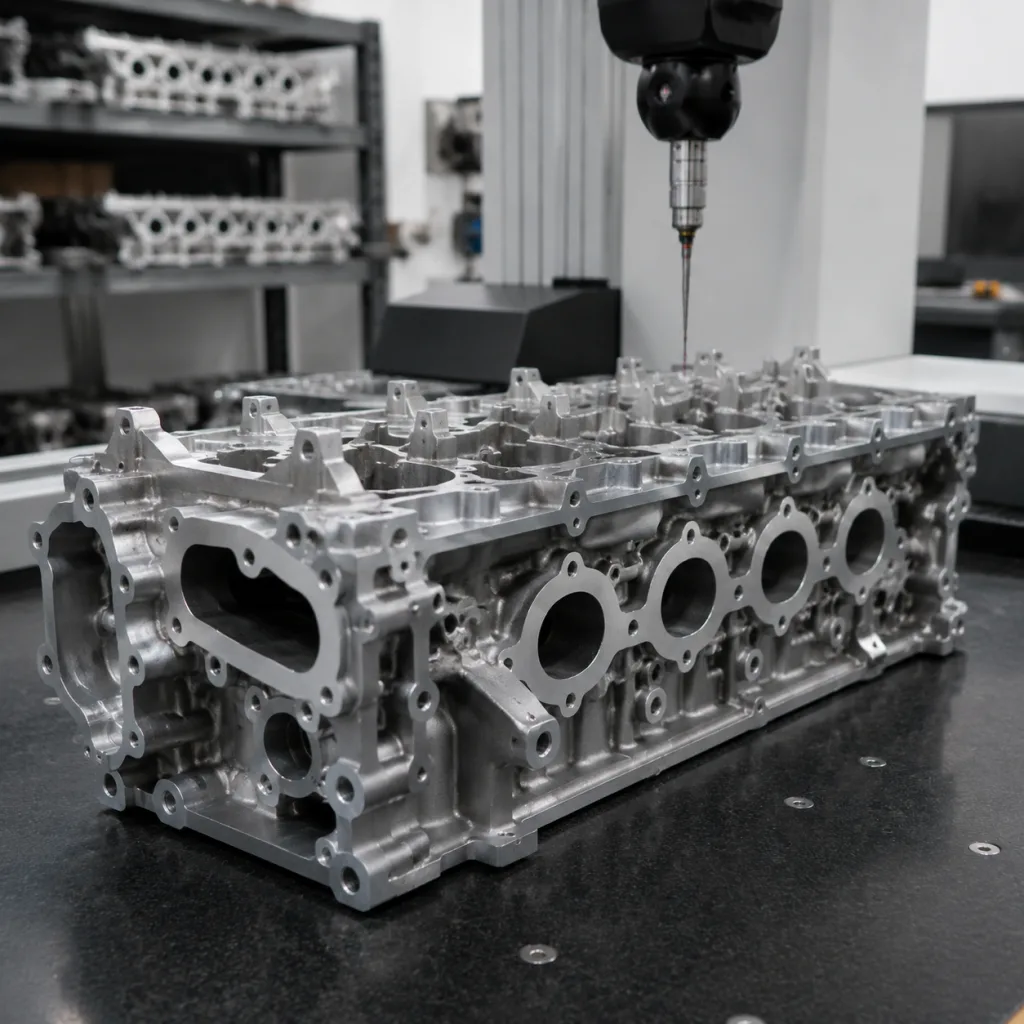
For Infiniti applications, buyers may group several platform references under one purchasing file, especially when servicing regional catalogues. That approach is workable only when the casting number, machining envelope, coolant passages, oil galleries, and gasket interface are truly the same. Similar-looking heads can differ in sensor ports, cam journals, EGR provisions, or manifold mounting details. When the cross-reference is uncertain, request dimensional drawings, photos of all machined faces, and a first-article inspection report before approving volume production.

How Driventus supports B2B sourcing

Driventus supplies cylinder head programmes for aftermarket distributors, OEM and Tier-1 supply chains, engine rebuilders, and multi-location repair networks. The emphasis is controlled manufacturing and repeatable export supply, not catalogue-only trading.

Key sourcing points:

</tr></thead><tbody> </tbody></table>The production route is built around repeatability: casting control, heat treatment where specified, CNC machining, thread and surface inspection, pressure testing, cleaning, protective packing, and final release. For buyers comparing China-based suppliers, the central question is whether the factory can hold the same dimensions and inspection discipline across reorders. A sample that looks acceptable is useful; a supplier that can reproduce it consistently is what protects margins and customer relationships.

Technical points that affect performance and warranty risk

Cylinder heads create warranty exposure when a part appears to fit but does not seal, cool, lubricate, or assemble correctly under real engine conditions. Procurement, engineering, and quality teams should review the following technical points before approving a cylinder head Infiniti manufacturer China programme:

  • Deck flatness after finish machining
  • Combustion chamber volume and chamber-to-chamber consistency
  • Valve seat angle, runout, contact width, and installed depth
  • Valve guide bore size, guide clearance, and material compatibility
  • Cam bore alignment and cap fit where applicable
  • Surface roughness at gasket contact faces
  • Thread accuracy on spark plug, sensor, coolant, oil, and manifold ports
  • Water jacket and oil gallery pressure integrity under test
  • Cleanliness after machining, especially in internal passages

Common verification methods

  • Dimensional inspection against drawing, OE sample, or approved master sample
  • Dye penetrant, crack detection, or other casting checks on critical areas
  • Water jacket pressure testing with defined pressure and hold time
  • Surface finish measurement on the gasket face
  • Thread gauge checks for threaded ports
  • Assembly trial with valves, guides, plugs, manifolds, or cam components where relevant

Published standards should be referenced where they apply, including IATF 16949:2016, ISO 9001:2015, REACH (EC) No 1907/2006 for restricted substances, and customer-specific validation requirements. Some programmes may also require corrosion, coating, packaging, or environmental testing using recognised methods such as SAE J2527, depending on the buyer specification and the component exposure conditions.

When custom manufacturing is the better option

Not every sourcing project fits a standard aftermarket replacement part. Custom manufacturing may be more efficient for low-volume export models, older engine families, catalogue-specific cross-references, or distributor programmes that need controlled packaging and part marking.

Custom manufacturing is appropriate when you need:

  • A defined OE 06A... or 11251... cross-reference already used in your catalogue structure
  • Programme-specific carton design, labelling, barcoding, or pallet configuration
  • Machining changes for a regional engine variant
  • A cylinder head supplied with matched gasket, valve, guide, or plug components
  • Private-label control for distributor or repair-network programmes
  • A documented approval process before repeat production

Driventus provides custom manufacturing for approved programmes after drawing review, sample confirmation, technical feasibility assessment, and process agreement. This route is often best when buyers want to consolidate multiple supply lines into one controlled source while keeping the same end-customer fitment claim. It also helps when a catalogue position is commercially important but the available open-market supply is inconsistent.

How to compare suppliers before audit or trial order

For a high-value engine component, supplier comparison should be evidence-based. A low unit price has limited value if the cylinder head requires rework, causes gasket failure, arrives with damaged packaging, or creates downstream claims.

Compare these items side by side:

1. Certification scope and evidence of process control 2. Material traceability and casting source control 3. Availability of dimensional reports and first-article inspection data 4. Pressure-test coverage by piece, batch, or lot 5. Ability to support repeat orders from the same tooling and machining process 6. Packaging suitable for ocean freight, mixed-SKU pallets, and warehouse handling 7. Response speed for sample approval, drawings, photos, and technical questions 8. Change-control procedure for tooling, machining, materials, or packaging

If you want to review related engine parts alongside cylinder heads, see our catalog and the broader engine range at engine components. For buyers planning supplier onboarding, the quality system should be reviewed before release of a trial order.

A structured supplier audit should include incoming material controls, machining capability, gauge calibration, inspection records, nonconformance handling, packaging checks, and engineering change control. Those factors reduce warranty exposure more effectively than a simple price comparison and give purchasing teams a clearer basis for long-term supplier approval.

Frequently asked questions

Yes. Driventus supports application-specific programmes based on OE cross-reference, engine code, sample confirmation, and dimensional review. Brand names are referenced for fitment identification only.

Typical export documents include commercial invoice, packing list, and shipping records. Technical files such as inspection data, pressure-test information, or batch records can be provided according to the approved programme.

Yes. Through [custom manufacturing](/oem-services.html), Driventus can support programme-specific packaging, labelling, barcoding, and controlled sourcing after technical review and approval.

If you are building a cylinder head programme and need fitment confirmation, trial-order support, or supplier review, [request a quote](/contact.html).

Request a Quote
Item Typical buyer requirement Driventus approach
CertificationIATF 16949:2016, ISO 9001:2015Documented process control, traceability, and quality records
MOQProgramme-dependentFlexible support for new SKUs, pilot orders, and approved replenishment plans
Lead timeStable availability for repair-market demandPlanned production, shipment scheduling, and export packing
ValidationFit, sealing, pressure integrity, and machining consistencyDimensional checks, functional inspection, and pressure-test control
DocumentationCommercial invoice, packing list, COA or inspection data where requiredExport documentation prepared for B2B shipment