Cylinder Head Cadillac OEM Supplier: Sourcing Guide
A cylinder head Cadillac OEM supplier should not be chosen from a unit-price column alone. The real test is repeatability: casting stability, machining control, pressure-test discipline, clean packaging, and traceability that still works when a warranty claim arrives months later. For distributors, Tier-1 buyers, and repair-chain category teams, the failure points are familiar: dimensional drift, porosity, valve-seat movement, deck sealing issues, damaged cartons, missing plugs, mixed cam caps, and weak batch records. Driventus manufactures engine and powertrain components in Taizhou, Zhejiang, and exports to more than 60 countries. Our cylinder head programmes serve independent aftermarket and private-label channels, with process controls aligned to IATF 16949:2016 and ISO 9001:2015. This guide gives B2B buyers a sharper way to assess Cadillac-fit cylinder head sourcing: what to define first, which risks to test, how to compare quotes, and when to release regular orders. Driventus is an independent aftermarket manufacturer; brand names are referenced for fitment only.
Start With Fitment Boundaries, Not a Price Request
A Cadillac-fit cylinder head programme starts with application limits. Not tooling. Not MOQ. Not “best price.” Procurement teams first need to define the engine family, model-year range, combustion chamber configuration, camshaft layout, valve count, emission market, and supply format: bare, semi-loaded, or fully assembled.
Before comparing suppliers, lock these inputs:
Application coverage by engine family, displacement, VIN or model-year range, and left/right bank where applicable
OE part-number cross-reference format where relevant, with supersession notes and non-authorised references marked for fitment only
Supply scope: bare casting, machined head, semi-loaded head, or fully assembled head
Included parts: valves, guides, seats, springs, plugs, seals, cam caps, dowels, and one-time-use fasteners
Traceability fields: batch, carton, production date, inspection operator, and shipment lot
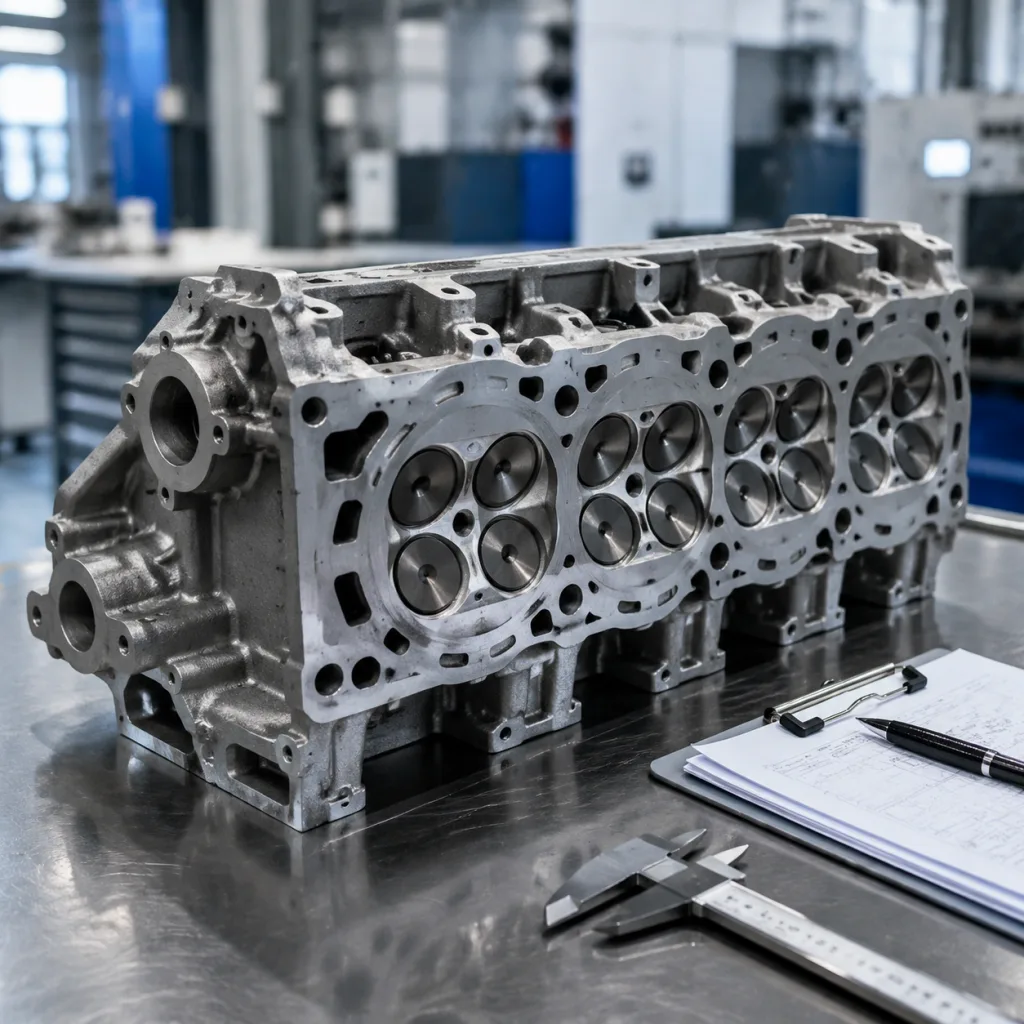
A supplier with broad catalogue claims but no fixture data, CMM history, pressure-test records, or casting revision control is not ready for a serious programme. Cylinder heads rely on tight geometry around cam bores, valve seats, deck surfaces, oil galleries, coolant passages, and threaded mounting points. A small deviation can become a leak, noise complaint, misfire, or installation delay.
For the RFQ, ask for a coverage matrix. Each SKU should show engine code, bank position, supply type, casting revision, stock status, tooling status, sample lead time, and carton dimensions. This avoids a common mistake: comparing a stock bare head from one source with a newly tooled assembled head from another.
Driventus supplies B2B buyers through our catalog and engine-component programmes, including cylinder heads for aftermarket distribution, private-label channels, and custom sourcing projects.
Commercial Terms Change by Programme Maturity
When buyers search for a cylinder head Cadillac OEM supplier, MOQ and lead time should follow the product status. A validated aftermarket SKU is not the same commercial problem as a new casting that needs patterns, fixtures, gauges, sample runs, and approval loops.
Sourcing scenario
Typical MOQ basis
Indicative lead time after approval
Main price drivers
Buyer documents to prepare
Existing aftermarket application
20–50 pcs per SKU or mixed pallet
30–45 days
Machining hours, pressure test, assembly scope, carton type
</tr></thead><tbody> </tbody></table>Driventus usually recommends a staged path: 1–3 sample pieces for dimensional and fitment review, a 10–30 piece pilot order for packaging and installation feedback, then scheduled blanket orders or container consolidation. Small orders expose problems cheaply. Large orders repeat them expensively.
Lead time should be counted only after the technical file is confirmed, deposit or credit approval is complete, packaging artwork is approved, and samples are signed off. A bare head, a pressure-tested machined head, and a fully assembled private-label head have different production clocks.
Separate the price into material, casting, machining, assembly components, inspection, packaging, tooling amortisation, and logistics. A fully assembled head may cost more per unit but reduce local labour, valve-seat matching work, and warranty exposure. A low quote that excludes plugs, cam caps, pressure testing, or export packaging is not really a low quote.
For stable programmes, request annual-volume tiers such as 100, 300, 500, and 1,000 pieces per SKU, plus mixed-SKU consolidation rules. A useful commercial sheet includes EXW or FOB price, MOQ, sample cost, tooling cost, payment terms, packing quantity, carton size, gross weight, pallet quantity, and estimated container loading.
Where Cylinder Head Programmes Usually Fail
Cylinder head sourcing failures rarely come from one dramatic mistake. They come from weak controls repeated across batches: one fixture shift, one unverified subcomponent, one carton that cannot survive export handling, one traceability gap after a claim.
Driventus operates under IATF 16949:2016 and ISO 9001:2015 frameworks. Buyers can review our quality system when preparing supplier qualification files.
Audit the points that create field failures:
Raw material specification and foundry batch traceability, including alloy grade or casting material reference and heat number where applicable
Heat-treatment records where applicable, with furnace batch, time, temperature, and hardness-check data retained by lot
CNC machining programme control, tool-offset approval, first-piece inspection, and fixture-maintenance history
Valve-seat and guide installation records, including interference fit, press force or process setting, and post-installation checks
Pressure testing for coolant and oil passages, with defined pressure, hold time, leakage allowance, and test-medium control
Deck flatness, cam-bore alignment, thread inspection, chamber-volume verification, and critical hole-position checks by CMM or dedicated gauges
Cleaning for oil galleries, coolant passages, and machined surfaces, including chip-removal checks and rust or oxidation protection
Final visual inspection for casting defects, burrs, sealing-surface damage, plug installation, and incorrect assembly components
Batch labels linking cartons to production, inspection, rework status, and shipment records for the agreed warranty period
A buyer-ready traceability pack should connect purchase order, production batch, casting lot, machining date, inspection report, pressure-test record, packing list, and shipment invoice. For higher-risk launches, add pre-shipment inspection using AQL sampling, 100% pressure-test record review, and a retained golden sample or signed master sample.
Documentation depth depends on the customer. Distributors usually focus on labelling, packaging integrity, and warranty traceability. Tier-1 or OEM-service buyers often need corrective action formats, supplier change-control procedures, 8D response timing, and proof that engineering changes are locked before production release.
Check environmental and chemical compliance early. Packaging, coatings, cleaning agents, and supplied materials may need to align with REACH (EC) No 1907/2006 for European-market products. Cylinder heads are not emission-control devices by themselves, but sealing, combustion chamber geometry, and oil and coolant flow affect downstream performance and warranty outcomes.
Spec Deep-Dive: Controls Worth Naming in the RFQ
Avoid vague phrases such as “high quality,” “OE type,” and “premium grade.” They do not tell a supplier what to measure. A cylinder head is a structural, thermal, and sealing component, so the RFQ should name the characteristics that decide fitment and durability.
Specify these points clearly:
Material: aluminium alloy or cast iron as defined by application and sample data, with chemical composition and hardness range available on request
Deck surface: flatness, roughness, and milling direction agreed by drawing, master sample, or inspection plan
Packaging: corrosion protection, machined-surface protection, foam or molded support, carton drop expectations, pallet stability, and moisture protection
Starting tolerances must be confirmed against the drawing or approved sample. Buyers often request deck flatness in the 0.03–0.05 mm range over the sealing face, valve-seat runout within about 0.03 mm, chamber-volume variation within about ±1 cc where relevant, and 100% coolant-passage pressure testing before packing. Overhead-cam applications also need cam-cap matching and line-bore alignment controlled as a set.
Bare vs Assembled Supply
Bare heads suit machine shops and specialist rebuilders because they allow local selection of valves, springs, seals, and final assembly settings. Fully assembled heads reduce installation time for repair-chain networks and wholesale customers, but they add risk unless subcomponent sourcing, assembly sequence, torque records, spring installed height, valve protrusion, and final inspection are controlled.
When comparing quotes, check whether valves, springs, stem seals, cam caps, plugs, pressure testing, cleaning, sealant, export packaging, and palletisation are included. The clean comparison is a line-by-line quote with included components marked “yes/no,” sample inspection level stated, and warranty claim documents listed before the PO is issued.
Scenario: Moving From Stock SKU to Custom Programme
A buyer may start with stock Cadillac-fit cylinder heads, then discover the required application is missing, packaging must carry a distributor brand, or the warranty team needs tighter traceability. At that point, the project shifts from catalogue buying to development management.
Driventus supports custom manufacturing for B2B customers that can provide samples, drawings, demand forecasts, target markets, and inspection priorities.
A strong development file includes:
Physical sample or verified drawing, ideally with one new or low-mileage reference part and one field-return example if available
Cross-reference list, using generic formats where brand-owned numbers are not authorised and marking references for fitment identification only
Annual volume forecast by SKU and launch phase, separated into sample, pilot, first production, and 12-month repeat demand
Packaging format, label data, barcode rules, carton dimensions, pallet height limit, and destination-country marking
Inspection characteristics ranked by warranty and fitment risk, including deck, cam bores, valve seats, chamber volume, galleries, and threads
Sample approval method, test method, acceptance criteria, and sign-off owners for engineering, quality, purchasing, and packaging
Engineering, quality, logistics, and purchasing contacts, plus expected response time for drawing questions and deviations
Cross-reference management needs discipline. Brand names and OE references can identify fitment, but they do not imply manufacturer approval, authorised supply, or genuine-part status. Driventus is an independent aftermarket manufacturer; brand names are referenced for fitment only.
A new cylinder head project usually moves through sample measurement, 3D scan or CMM report, casting feasibility review, pattern and core-box review, machining fixture design, trial casting, trial machining, pressure testing, assembly validation where required, packaging approval, pilot batch, and production release. A typical approval file may include 20–40 critical characteristics, pressure-test records for every sample, photos of casting and machined surfaces, and a deviation list for buyer approval.
Change control should cover material changes, machining programme updates, tool replacement, fixture modification, subcomponent supplier changes, inspection-plan revisions, packaging updates, and carton-label revisions. Buyers should define notice period, sample requirements, and whether existing inventory can ship after a change.
Pre-PO Q&A for Supplier Qualification
Before issuing a production PO, treat supplier qualification as a short interrogation. The goal is not paperwork for its own sake. It is to find fitment, documentation, packaging, and communication problems while the order is still small enough to fix.
What should be confirmed first? Application scope, supply type, annual demand, target unit price range, and required Incoterm.
Which system documents matter? Certification evidence for IATF 16949:2016 and ISO 9001:2015, plus a process flow and control-plan summary for the product family.
What sample evidence should be reviewed? Sample inspection report, CMM report where applicable, pressure-test method, and traceability label format.
What packaging checks are easy to miss? Carton strength, pallet protection, gross weight, barcode scan result, origin marking, and label placement.
When should repeat orders begin? Only after one sample or pilot batch passes fitment, leak, torque, assembly, and packaging checks.
How should warranty handling be agreed? Define claim evidence, response time, quarantine method, credit process, and corrective-action format before shipment.
What turns a trial into regular supply? Sample approval, commercial sign-off, and a written rule for engineering or packaging changes.
Export execution also belongs in qualification. Check carton marking, HS code handling, commercial invoice accuracy, pallet fumigation status where relevant, container-loading protection, moisture control, and photo records before shipment. These details affect landed cost and customer service.
A practical pre-PO file should include the approved drawing or master sample, confirmed supply scope, approved packaging artwork, MOQ, price tier, lead time, payment term, inspection standard, warranty process, and shipment term. If these items cannot be locked before the PO, treat the order as a development batch rather than regular supply.
Frequently asked questions
Provide engine application, supply type, annual volume, target market, target price range, packaging requirements, and any approved sample or drawing. If cross-references are available, share them for fitment identification only. Driventus does not claim vehicle manufacturer approval.
Yes. Driventus supports neutral and private-label packaging for qualified B2B programmes. MOQ and lead time depend on SKU count, carton artwork, label control, barcode requirements, and whether the head is bare, semi-loaded, or fully assembled.
Buyers may request certification evidence, inspection reports, CMM data where applicable, pressure-test records, material or casting traceability, control-plan summaries, and packaging specifications. Audit scope can be aligned with IATF 16949:2016 and ISO 9001:2015 expectations.
If you are qualifying a cylinder head Cadillac OEM supplier for distribution, repair-chain, or custom sourcing programmes, share your application list, annual volume plan, target supply scope, and packaging requirements with Driventus. You can [request a quote](/contact.html).