Crankshaft Volkswagen Wholesale: Buyer Sourcing Guide
Crankshaft Volkswagen wholesale programmes fail most often on specification control, not on basic demand. Buyers need a clear definition of engine code, stroke, journal diameters, fillet radius, heat treatment, balance grade, and packaging before they place volume. Driventus is an independent aftermarket manufacturer; brand names are referenced for fitment only. That matters because Volkswagen applications often share similar external dimensions while differing in internal detail, revisions, and OE cross references. A supplier can ship a part that looks correct and still create returns if the journal finish, thrust width, or dynamic balance is outside the buyer's target. For distributors, repair chains, and OEM-facing buyers, the goal is simple: lock down fitment, document quality, and keep incoming inspection stable across repeat orders. The sections below show the procurement checks that matter, the documents to request, and the supply model that works for wholesale buying across EU, UK, US, Canada, Australia, and Brazil.
What to specify on a purchase order
A purchase order for a Volkswagen crankshaft should read like a technical release, not a short stock request. The supplier needs enough detail to control machining, inspection, and pack-out.
Minimum buyer data
- Engine code and displacement
- OE or aftermarket cross reference used by your team
- Number of main and rod journals
- Stroke and counterweight layout
- Main journal, rod journal, and thrust-face dimensions
- Fillet radius and any undercut requirement
- Heat-treatment target and surface hardness range
- Dynamic balance target and allowable residual unbalance
- Surface protection, oiling, and rust-prevention requirement
- Packaging spec, label format, and pallet configuration
If your catalogue references a Volkswagen fitment family, verify against the buyer BOM rather than relying on a photo or a partial description. For catalog browsing, see our catalog and the broader engine components range.
Material and process controls that reduce returns
For wholesale supply, the material route is only one part of the decision. Buyers should ask how the blank is formed, how journals are finished, and how each lot is traced back to heat and batch.
A stable crankshaft programme normally includes:
- Controlled forging or cast blank production
- Rough machining before heat treatment
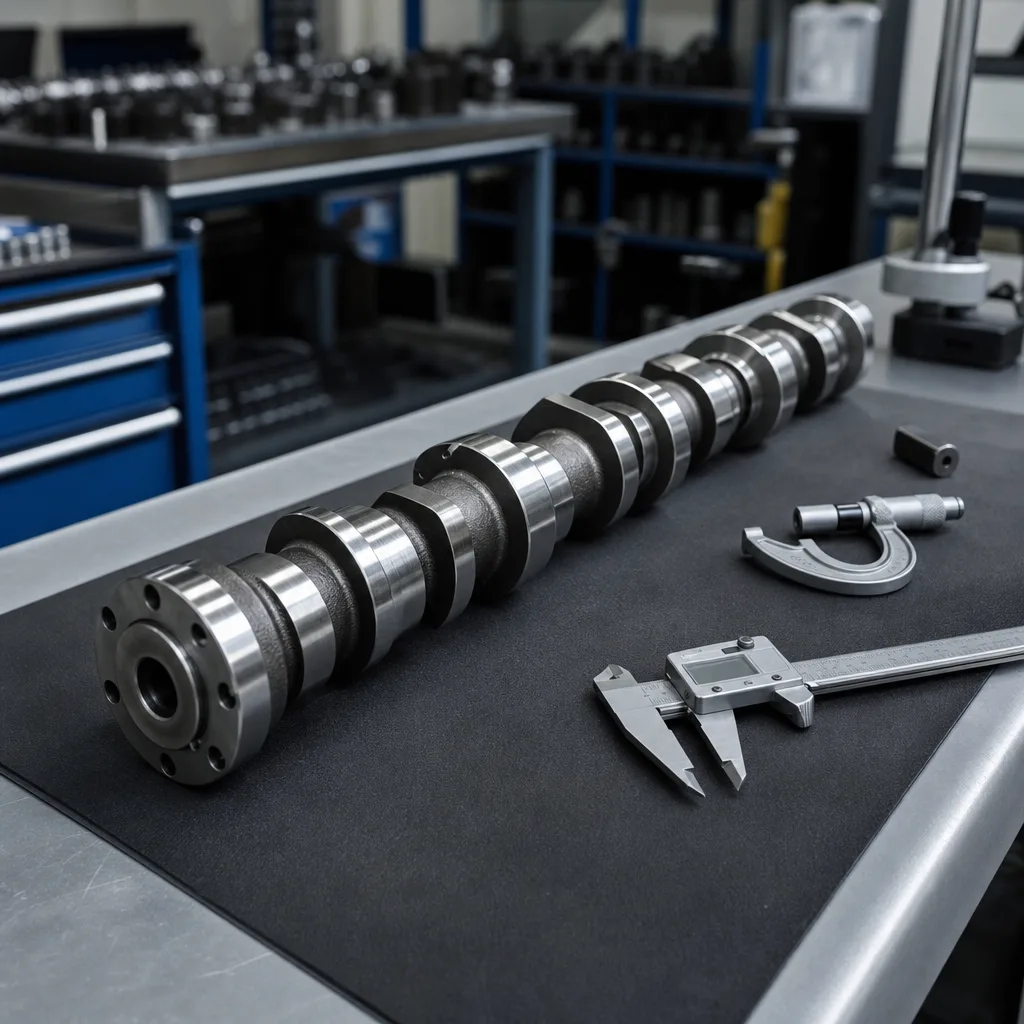
- Finish grinding on all journal surfaces
- Dynamic balancing after final machining
- Magnetic particle or equivalent crack screening where specified
- Lot traceability from raw material to finished pack
Driventus aligns production and documentation with IATF 16949:2016 and ISO 9001:2015, which matters when your receiving team needs repeatable inspection data and a clear nonconformance path. If your programme also requires substance control, ask for REACH (EC) No 1907/2006 status on the materials and any coatings used. Technical buyers can review the documentation approach in our quality system.
Cast or forged: which route fits your channel?
Wholesale buyers do not buy the same crankshaft specification for every channel. A distributor programme, a workshop-chain replacement line, and an OEM-support item can sit at different points on the cost-versus-margin curve.
| Attribute | Cast crankshaft | Forged crankshaft |
|---|---|---|
| Unit cost | Lower | Higher |
| Fatigue margin | Adequate for many standard applications | Higher, especially under load |
| Machining effort | Moderate | Moderate to high |
| Typical channel fit | Price-sensitive aftermarket | Higher-stress or premium fitments |
| Tooling and setup | Usually simpler | Usually more controlled |
| Validation focus | Dimensional match and balance | Dimensional match, balance, and material integrity |