Crankshaft Pulley Renault Manufacturer China: Sourcing Guide
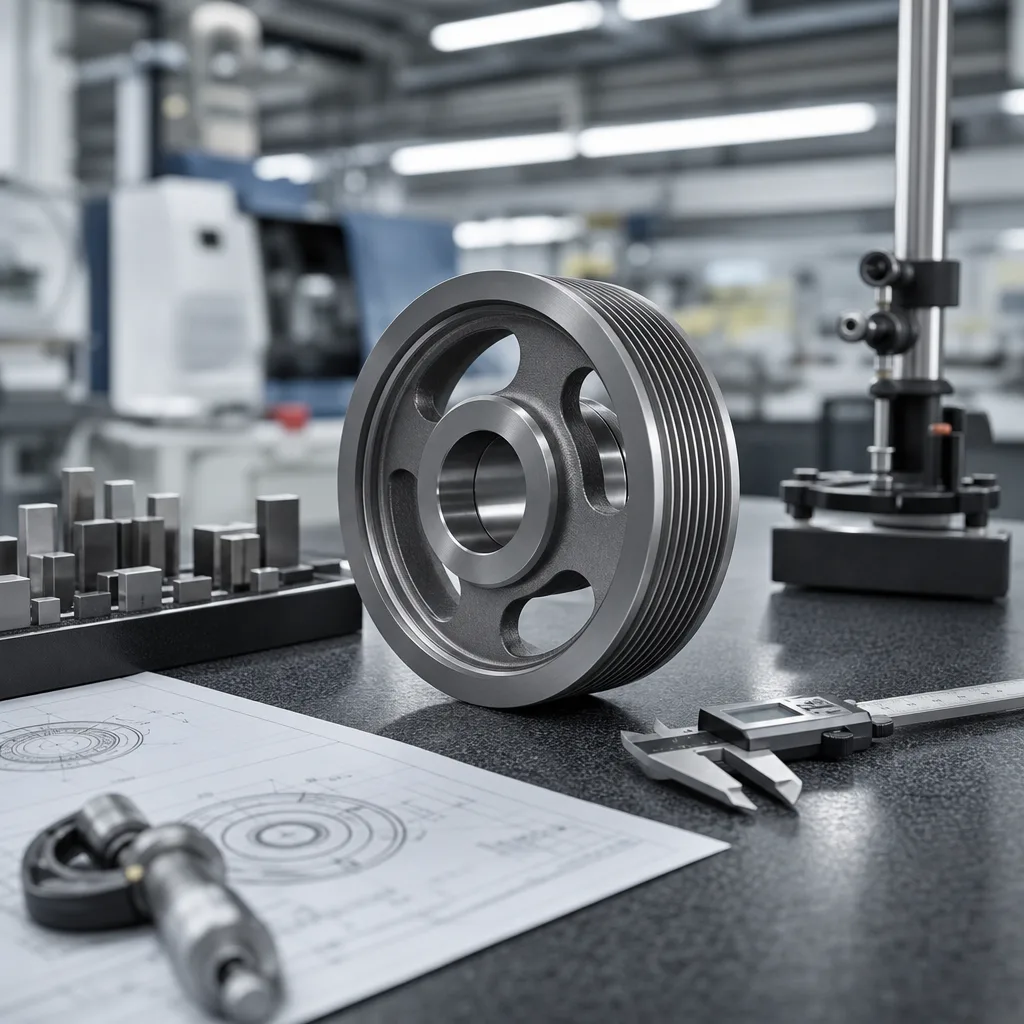
For procurement teams sourcing a crankshaft pulley for Renault applications, the main questions are fitment control, repeatable quality, and supply stability. A supplier in China can be a practical option if it can hold dimensional tolerances, verify material and balance, and document process control under IATF 16949:2016 and ISO 9001:2015. Driventus is an independent aftermarket manufacturer; brand names are referenced for fitment only. For buyers comparing suppliers, the key is not price alone. It is whether the pulley matches OE dimensions, damper performance where applicable, groove profile, and runout limits, while also supporting clear OE cross-references such as OE 06A107065 when a customer request includes them. This article explains what to verify, how to compare suppliers, and which documents to request before placing a production order.
What buyers should verify first
For Renault crankshaft pulley sourcing, start with the engineering interface rather than the catalog photo. The critical checks are:
Outer diameter and belt groove profile
Bore, keyway, and offset geometry
Torsional damper construction, if the OE design uses one
Static and dynamic balance requirements
Surface finish and corrosion protection
Packaging for export and barcode traceability
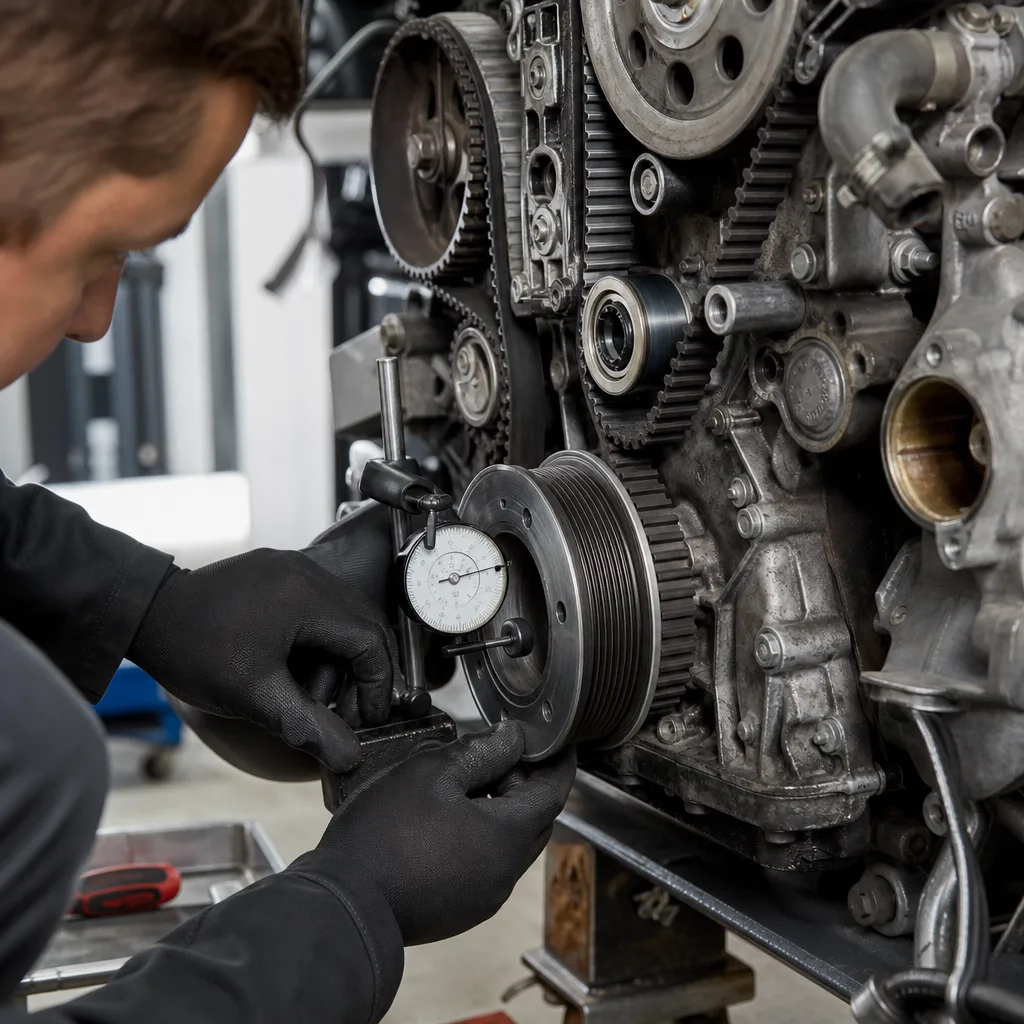
If the application is linked to an OE reference, ask for dimensional confirmation against the stated number, for example OE 06A107065 when the customer request uses that format. Do not rely on visual similarity alone. A pulley that fits on the shaft can still create belt noise, accessory misalignment, or premature bearing wear if offset or runout is out of tolerance.
For buyers managing multiple SKUs, our catalog should be used as a starting point only. Final approval should follow sample measurement and, where required, vehicle-level validation.
Technical specification items to request from the factory
A supplier should be able to provide a written specification sheet before tooling release or mass production. For this product family, request the following:
Item
Typical procurement requirement
Material
Cast iron, steel, or stamped steel assembly, depending on OE design
Dimensional tolerance
Controlled to drawing; critical fits commonly held within ±0.05 mm to ±0.10 mm on key interfaces
Radial runout
Measured and recorded per lot
Balance
Static/dynamic balance evidence for rotating parts
Surface treatment
Phosphate, black e-coat, or equivalent corrosion control
Traceability
Lot code, date code, and packing record
Compliance documents
IATF 16949:2016, ISO 9001:2015, material declaration, inspection report
</tr></thead><tbody> </tbody></table>For Europe-bound shipments, ask whether the supplied materials and coatings can support REACH (EC) No 1907/2006 documentation where applicable. If the pulley is part of a noise or vibration-sensitive assembly, request validation data relevant to torsional durability. Some buyers also ask for test references aligned with SAE J2527 for corrosion exposure when the coating system is critical to service life. Not every pulley requires the same test pack, but the supplier should explain what was tested and why.
How Driventus supports supplier qualification
Driventus is set up for B2B programs that need stable production and audit-ready records. The factory operates under IATF 16949:2016 and ISO 9001:2015 control systems, with incoming inspection, in-process checks, and final dimensional verification tied to lot traceability. For procurement teams, that matters because crankshaft pulleys are not commodity castings. They are rotating components that affect belt drive alignment and accessory reliability.
What buyers can request during qualification:
1. Drawing review and fitment confirmation against customer sample or OE reference. 2. First article inspection report with critical dimensions highlighted. 3. Material and process declaration. 4. Packaging specification for ocean or air freight. 5. Sample submission before production release.
If the application needs a non-standard bore, offset, coating, or balancing requirement, our custom manufacturing service can be used to develop a controlled variant. For standard lines and related engine parts, see our catalog and engine components.
Lead times, MOQ, and commercial structure
China sourcing is usually attractive when the supplier can combine tooling control with workable minimum order quantities. For a Renault crankshaft pulley program, commercial terms should be discussed early because MOQ depends on material type, machining complexity, and whether a new die, mould, or balancing fixture is needed.
Typical buyer questions:
What is the MOQ per part number or per application family?
Is the lead time based on stock, semi-finished inventory, or full production?
Can the supplier support mixed-SKU container consolidation?
What inspection documents ship with each batch?
How are warranty claims handled for dimensional or balancing defects?
For aftermarket distributors and repair chain buyers, a steady replenishment plan is often better than large one-time buys. For OEM and Tier-1 sourcing, production planning should include sample approval, PPAP-style documentation where requested, and agreed change-control rules. Pricing should be reviewed together with freight terms, packing density, and reject exposure, not in isolation.
If you are benchmarking suppliers, ask for landed cost by shipment mode, not just EXW pricing. That gives a clearer picture of real supply cost.
Factory audit points that reduce sourcing risk
A factory audit should confirm that the supplier can make the same part repeatedly, not only once. For crankshaft pulleys, focus on process control at the machining, balancing, and final inspection stages.
Audit checklist:
Incoming material verification and heat/batch traceability
CNC machining capability for bore and groove geometry
Balance equipment calibration records
Gauge control for critical dimensions
Nonconformance segregation and rework rules
Packaging protection for machined faces and belt contact surfaces
Change-management process for tooling, coating, and subcontracted operations
Ask whether the factory keeps inspection records by lot and whether it can link complaints back to production data. That is often more important than a sales presentation. Buyers in the EU, UK, US, Canada, Australia, and Brazil usually want the same answer: can the supplier ship the same dimensional result quarter after quarter? A supplier that can answer with records, not promises, is easier to approve.
For procurement teams setting up a new source, the most reliable workflow is sample approval, pilot lot, then volume order under controlled documentation.
When to use a custom or OE-equivalent program
A standard part is appropriate when the OE geometry, belt path, and damping requirement are already known and the customer accepts an aftermarket equivalent. A custom program is better when the application includes one of the following:
A revised accessory drive layout
Non-standard offset or pulley depth
Special coating for corrosion exposure
Different balancing limit for NVH control
Packaging or labeling requirements for a specific distribution channel
For these cases, a supplier should propose controlled engineering review rather than forcing a catalogue match. Driventus can support custom manufacturing for special fitments while keeping documentation aligned to procurement needs. The goal is a part that installs correctly, runs within tolerance, and supports the buyer’s service-level targets.
Driventus is an independent aftermarket manufacturer; brand names are referenced for fitment only. If you need a source for a Renault crankshaft pulley, the next step is usually a drawing review, sample comparison, and a quote based on your annual demand forecast.
Frequently asked questions
Yes, if the application data, dimensions, and fitment reference are provided. We verify critical measurements, balance, and surface treatment before production release.
Request a dimensional report, material declaration, lot traceability, and proof of quality control under IATF 16949:2016 and ISO 9001:2015.
Yes. We can review non-standard bore, offset, coating, or balancing needs through our custom manufacturing process before quote and tooling confirmation.
If you are evaluating a crankshaft pulley Renault manufacturer China source, send your drawing, OE reference, and forecast for review. Request a quote at /contact.html