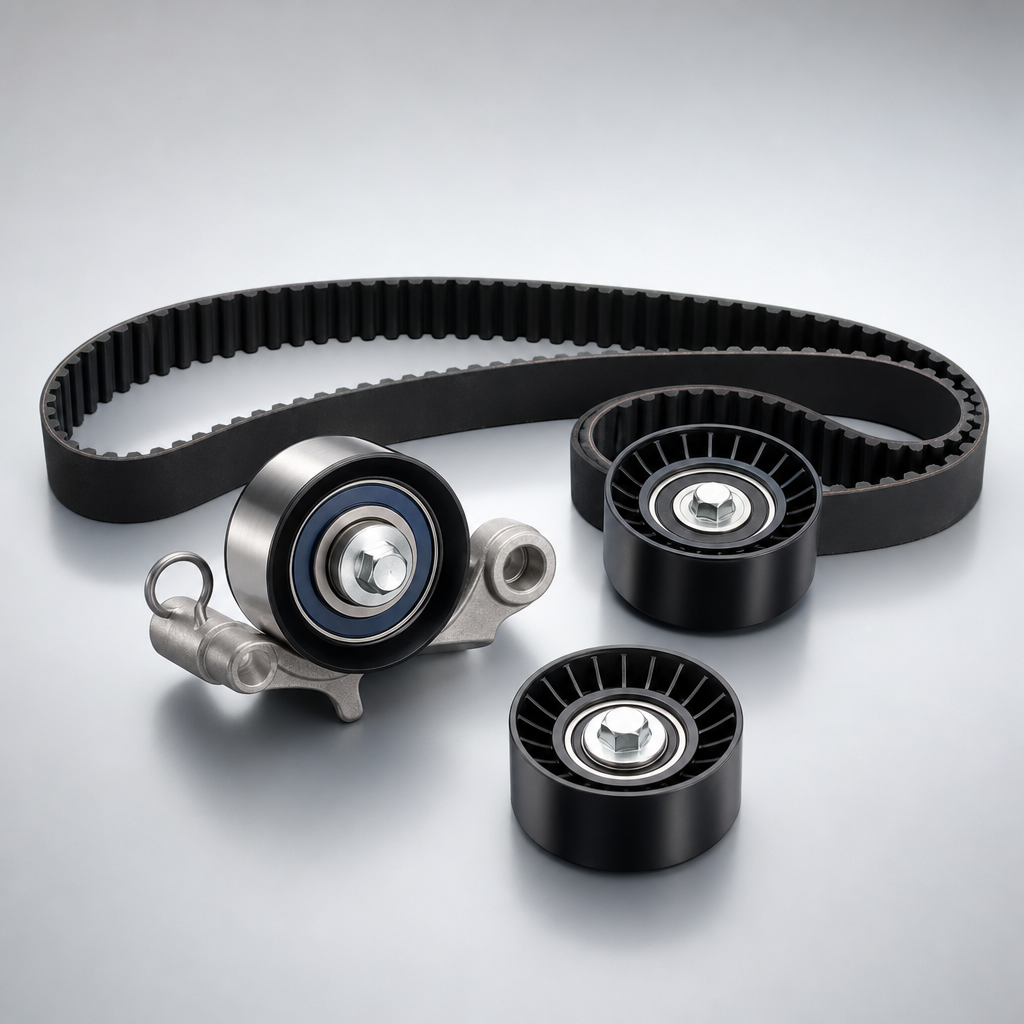
How to Vet a Crankshaft Pulley Chevrolet OEM Supplier Without Buying on Hype
Sourcing a crankshaft pulley for Chevrolet applications is rarely a price-first decision once warranty exposure is on the table. The real issue is control: control of runout, balance, bond integrity on damped designs, coating consistency, traceability, and fitment accuracy across repeated batches. A part that looks acceptable in a sample carton can still create returns if groove geometry drifts, corrosion protection is weak, or the supplier cannot hold stable machining and balancing limits in volume production.
This article is built for buyers comparing manufacturers, not collecting generic supplier claims. It breaks down how to assess a crankshaft pulley Chevrolet OEM supplier through the evidence that actually changes sourcing risk: failure modes, factory audit signals, RFQ structure, validation records, customization economics, and long-term supplier fit. Driventus is an independent aftermarket manufacturer; brand names are referenced for fitment only.
Start With the Failure Modes, Not the Brochure
The fastest way to screen a supplier is to begin with what can go wrong in the field. For crankshaft pulleys, the main risks are not abstract quality concerns; they are specific mechanical failures that turn into claims: runout, imbalance, elastomer separation on damped assemblies, belt-groove instability, coating breakdown, and hub-interface corrosion.
A credible crankshaft pulley Chevrolet OEM supplier should be able to show evidence for:
Dimensional control on bore diameter, keyway profile, offset, groove pitch, and axial runout
Material traceability for steel, cast iron, or nodular iron parts, plus elastomer compound records where harmonic damper construction is used
Dynamic balance verification by batch or model family
Bonding process control for rubber-to-metal assemblies, including cure parameters and adhesion checks
Surface protection data for salt spray or equivalent corrosion-resistance testing where coated pulleys are supplied
Lot identification from raw material receipt through final packing
Before comparing quotations, force a basic classification. Ask whether the part is:
Solid pulley: usually stamped steel, machined steel, or cast iron; simpler process, lower validation burden
Damped pulley / harmonic balancer: hub, inertia ring, and elastomer element; more validation required, especially on bond and durability performance
This distinction matters. A supplier quoting a damped pulley as if it were a simple solid pulley is already showing weak application control. That is one of the most common early warning signs in this category.
In RFQ review, ask for measurable limits instead of vague statements like "OEM quality." Typical checkpoints include:
Bore tolerance: often within +/-0.01 to +/-0.03 mm depending on design and fit class
Keyway width tolerance: often +/-0.02 mm or per drawing
Axial runout: commonly controlled to <=0.10 mm, with tighter internal targets such as 0.05 mm for stable production
Radial runout: frequently controlled to <=0.15 mm at the belt-groove datum
Dynamic balance residual: often specified by diameter and mass, for example <=20-50 g.mm after correction on damped assemblies
Coating thickness: typically 8-15 um for zinc-flake or phosphate/oil systems, depending on corrosion target
Rubber hardness: often within +/-5 Shore A of approved compound spec for damped pulleys
If the supplier cannot quote against OE number, drawing, sample, and engine code together, the sourcing process is still too loose. For buyers consolidating multiple references, it is also useful to confirm whether the factory can support mixed-model supply from our catalog rather than single-part buying only.
What a Real Factory Audit Should Expose
Certificates matter, but they do not settle the question. IATF 16949:2016 and ISO 9001:2015 are useful starting points; they are not substitutes for process evidence. The audit should answer a simpler question: does the supplier's control plan actually exist on the shop floor?
A serious review of a crankshaft pulley Chevrolet OEM supplier should cover the points below:
Audit area
What to check
Why it matters
Incoming inspection
Material certificates, hardness checks, visual segregation
Prevents mixed grades and unapproved substitutions
Machining control
SPC records on bore, OD, groove geometry, face runout
Reduces fitment and belt-tracking issues
Bonding process
Time, temperature, and cure records for damped pulleys
Critical for torsional damper durability
Balancing
Equipment calibration and control limits
Limits NVH and premature front-end wear
Final inspection
Runout, appearance, coating-thickness, and marking checks
Confirms shipment consistency
Traceability
Batch coding linked to production date and raw-material lot
Supports fast containment if field issues occur
Packaging
Anti-rust measures, partition design, carton drop resistance
Reduces export-lane damage
</tr></thead><tbody> </tbody></table>Then review the real production sequence. A typical route for machined pulleys or damped assemblies often looks like this:
1. Raw casting or forging receipt with heat-number verification and chemical/mechanical cert review 2. Incoming dimensional and hardness check, often AQL-based plus full verification during launch 3. CNC turning / boring / groove machining with first-piece approval and in-process SPC every 30-60 minutes or at defined lot intervals 4. Broaching or keyway machining using dedicated go/no-go gauges 5. Deburring and washing to control contamination and burr carryover 6. Surface treatment such as black phosphate, e-coat, or zinc-flake through approved in-house or subcontract process 7. Rubber bonding and curing for damped types, with adhesive-application control and cure-window records 8. Dynamic balancing at 100% or defined batch frequency depending on programme requirement 9. Final inspection and marking including lot code and line trace where applicable 10. Packaging with VCI or anti-rust protection and palletized export loading
Ask for live records, not presentation slides. A capable source should be able to show:
Cp/Cpk data on critical dimensions, with many buyers expecting Cpk >=1.33 after SOP and >=1.67 on special characteristics where feasible
Gauge R&R results, typically <10% for key dimensional gauges
Balance-machine calibration frequency, commonly every 12 months with interim verification by master part
Coating-thickness checks per lot, for example 5 pcs / batch minimum
Rubber-bond records including adhesive batch, cure temperature, press time, and operator or line traceability
Containment reaction plans defining 100% inspection, segregation, and customer-notification timing if a trend exceeds limit
If the supplier claims compliance with REACH (EC) No 1907/2006, ask exactly which materials and finishes are covered and how declarations are maintained. Buyers often review quality system materials alongside the audit to compare documentation discipline with actual process behavior.
How to Compare Quotes So the Cheap Offer Does Not Win by Accident
Commercial comparison breaks down when buyers let each supplier answer in a different format. The fix is simple: structure the RFQ so MOQ, tooling, lead time, packaging, and documentation are all visible in one pass.
Request these items in the first round:
MOQ by part number and by consolidated order
Tooling requirement if the pulley needs new fixtures, broaches, or balancing setup
Sample lead time for first articles
Mass production lead time from PO and from approved sample
Monthly capacity by machining line and assembly line
Packaging specification including units per carton, pallet pattern, and anti-corrosion protection
Document package such as dimensional report, material cert, balance report, and appearance standard
Private-label options for barcode, carton artwork, and pallet marking
A fixed comparison table makes supplier ranking more honest:
RFQ item
Typical range buyers may see
What changes the number
MOQ for stocked pulley
100-300 pcs/PN
Existing stock, common Chevrolet applications, standard carton pack
</tr></thead><tbody> </tbody></table>A few buying rules help here:
Low MOQ is not automatically better. It may mean irregular production frequency and longer replenishment intervals later.
Short lead time is only meaningful if upstream controls are stable. Check raw-material supply and subcontract coating discipline.
Packaging minimums can distort the real order economics. For private-label programmes, 1,000-3,000 boxes may be the actual packaging threshold even when part MOQ is lower.
Upgraded anti-rust export packing such as VCI bag + divider + desiccant + pallet wrap usually increases piece cost but lowers claim risk on 25-40 day sea shipments.
Buyers planning broader range expansion should also ask whether the supplier can support related programmes under custom manufacturing. That often matters more than saving a small amount on a single line item. Where OE references are exchanged, use the exact cross-reference format provided in market data, such as OE 11251..., and do not assume interchangeability before drawing or approved-sample confirmation.
The Validation File That Separates a Capable Supplier From a Sales Team
For export programmes, the approval file is where vague claims stop working. A Chevrolet-fitment pulley may enter the EU, UK, North America, Australia, Brazil, or multiple parallel channels, but in every case the importer needs records that support approval, repeat buying, and corrective action if something fails later.
Most buyers expect evidence in these areas:
Dimensional inspection reports against approved drawing or master sample
Material and hardness reports for hub and outer-ring components
Bond adhesion or durability checks for damped assemblies
Dynamic balance records with defined acceptance criteria
Salt spray test data where coated metal surfaces need corrosion protection
Packaging validation for export transport conditions
Even when full OEM PPAP is not mandatory, a PPAP-style file is often the practical standard. A useful package usually contains:
Approved drawing or signed master-sample reference
Ballooned dimensional report with 100% of critical dimensions and sampled non-critical dimensions
Material cert linked to heat or melt number
Hardness results, such as Brinell or Rockwell depending on substrate
Coating report with measured thickness and corrosion-test summary
Balance report with machine ID, operator, date, and residual value
Bond-process or durability report for damped pulleys
Packaging photos and carton/pallet specification
Traceability-label sample and batch-code logic
Validation limits should be aligned before sample approval, not argued over afterward. Common checkpoints include:
Validation item
Common buyer expectation
Notes
Bore / keyway / offset dimensions
Per drawing, often full layout on first samples
Critical for fitment release
Axial runout
<=0.10 mm typical
Tighter target may be used internally
Radial runout at groove
<=0.15 mm typical
Depends on design and diameter
Dynamic balance residual
Project-specific, often <=20-50 g.mm
Confirm correction method and datum
Salt spray resistance
72-240 h typical depending on finish
Red-rust criterion should be defined
Coating thickness
Often 8-15 um or per finish spec
Verify by lot, not visual only
Rubber hardness
Per compound spec, often +/-5 Shore A
Relevant only to damped types
Packaging drop / compression
Carton integrity after defined test
Useful for export distributor programmes
</tr></thead><tbody> </tbody></table>Published standards may shape the framework, especially IATF 16949:2016, ISO 9001:2015, and REACH (EC) No 1907/2006. They still do not replace part-specific evidence. If unrelated standards appear in a supplier deck, treat them carefully; for example, SAE J2527 is not relevant substitute evidence for crankshaft-pulley validation.
One more signal matters: response discipline. Ask whether the supplier can issue retained-sample records, nonconformance reports, and 8D responses inside agreed windows. Many buyers use 24-48 hours for initial containment feedback and 5-10 working days for formal 8D status. That operational speed often predicts future programme support better than a polished capability brochure.
When a Custom Programme Is Worth the Extra Work
Not every sourcing programme should stay inside the catalog. In some cases, customization is the rational choice because it lowers downstream cost, sharpens channel fit, or fixes a recurring field issue. In others, it only adds tooling and delay without enough volume to justify the effort.
A manufacturer is better positioned for custom work when it can support:
Drawing review from sample or customer print
Fixture adaptation for revised dimensions
Rubber compound adjustment for damped pulley applications
Laser marking or batch-coding changes
Branded or plain-box export packaging
Mixed-container planning across engine and powertrain components
This is where custom manufacturing becomes relevant for private-label or programme-based purchasing rather than one-off spot buying.
Custom supply usually makes sense when:
The buyer needs a non-standard bore, offset, or marking format and annual demand is high enough to absorb tooling and validation cost
The standard finish is insufficient and the programme needs higher corrosion resistance, such as upgraded coating plus VCI packaging for humid markets
The buyer wants to consolidate Chevrolet-fitment references under one label with uniform packaging, barcode logic, and pallet labels across SKUs
The market has repeated complaints around a known weak design, and the buyer wants tighter runout screening, stronger packaging, or another controlled improvement
Before approving customization, ask for cost logic in plain terms:
Custom item
Typical cost driver
Buyer question
New broach / fixture
One-time tooling charge
Is tooling amortized or paid separately?
New balance setup
Engineering + trial pieces
Does this affect MOQ or sample lead time?
Custom box / label
Print plate and carton MOQ
Can neutral stock carton be used for pilot orders?
Rubber compound change
Validation and durability testing
What revalidation data will be supplied?
Special coating
Subcontract process minimums
What salt-spray target is guaranteed?
</tr></thead><tbody> </tbody></table>For buyers sourcing across a wider engine range, it may also be practical to combine pulley procurement with related lines from /products/engine-components.html to reduce supplier-management overhead and align incoming-quality procedures.
Driventus is an independent aftermarket manufacturer; brand names are referenced for fitment only.
A Simple Decision Framework for Choosing the Long-Term Supplier
The best supplier is rarely the one with the lowest line-item price. A better test is whether the source can reduce total sourcing friction over time: fewer fitment disputes, stable replenishment, usable validation files, fast containment, and predictable export execution.
A practical shortlist for a crankshaft pulley Chevrolet OEM supplier should answer five questions cleanly:
1. Can the factory hold runout, balance, and bond quality consistently? 2. Are certification, traceability, and inspection records available when requested? 3. Is the MOQ workable for the turnover model in your channel? 4. Can lead times stay stable during seasonal peaks or range expansion? 5. Does the supplier communicate clearly on engineering questions and corrective action?
Many procurement teams score candidates on a weighted basis such as:
A low quoted price becomes much less attractive when it comes with any of these conditions:
MOQ too high for realistic turnover, creating dead-stock risk
Production lead time above 60 days with no buffer strategy
No measurable balance or runout criteria on inspection reports
Subcontract coating or bonding process with weak traceability
No retained sample, no batch-code logic, or slow claim response
That is the point of a disciplined sourcing review: to make the hidden cost visible before the PO is issued. Buyers looking for a crankshaft pulley Chevrolet OEM supplier can review fitment coverage, factory capability, and export terms through our catalog and then request a quote for an application-specific discussion.
Frequently asked questions
MOQ varies by design complexity, tooling status, and packaging format. For stock items, buyers often see **100-300 pcs per part number**. For new-production or damped pulley programmes, MOQ more often falls in the **300-1,500 pcs per part number** range. Always confirm whether a lower MOQ changes unit cost, production frequency, or replenishment timing.
At minimum, request a dimensional report, material certificate, hardness data where relevant, balance verification, appearance standard, and packing details. For damped pulleys, ask for bond-process records or durability evidence as well. Many buyers also request coating-thickness data, salt-spray summary, traceability-label format, and a first-article report linked to the exact sample batch.
Use OE cross-reference data, approved drawings, key dimensions, and sample testing. Do not rely on catalog text alone. Final interchangeability should be confirmed through dimensional match and application review before release. At minimum, compare bore size, keyway form, offset, pulley diameter, groove count/profile, and whether the design is solid or damped.
If you are qualifying a new source for crankshaft pulleys or related engine components, we can provide application review, factory documentation, and quotation support. Please [request a quote](/contact.html).