crankshaft pulley · 2026-06-17

Crankshaft Pulley Jaguar OEM Supplier: Sourcing Guide

Choosing a crankshaft pulley Jaguar OEM supplier is not just a part-number exercise. The component has to match the correct engine family, hold dimensional tolerances, control vibration, and perform reliably across repeat orders. For Jaguar applications, buyers usually begin with an OE reference, then confirm groove profile, hub offset, bore, bolt pattern, damping construction, and balance requirements before approving supply.

Driventus is an independent aftermarket manufacturer; Jaguar and other brand names are referenced for fitment identification only. From Taizhou, Zhejiang, we supply engine and powertrain components under IATF 16949:2016 and ISO 9001:2015 quality systems. For procurement teams in the EU, UK, US, Canada, Australia, Brazil, and other export markets, the key concerns are fitment confidence, lot consistency, compliance support, and stable delivery. This guide explains how to source by OE reference, compare qualified suppliers, and build the right documentation into a purchase order.

What to verify before price shopping

A Jaguar crankshaft pulley should be screened against the exact engine application first, not the catalog headline. The OE reference gets you close; the fit-critical details decide whether the part installs cleanly and survives real service.

Check these items before you ask for a quote:

  • OE cross-reference, for example `OE 06A107065` when the application list uses that format
  • Outside diameter, hub diameter, bore, keyway, and bolt circle
  • Belt groove count, section type, and alignment with adjacent drive components
  • Mass, concentricity, axial runout, and dynamic balance requirement
  • Material grade, surface treatment, and corrosion protection
  • Damper construction, including bonded elastomer design where applicable

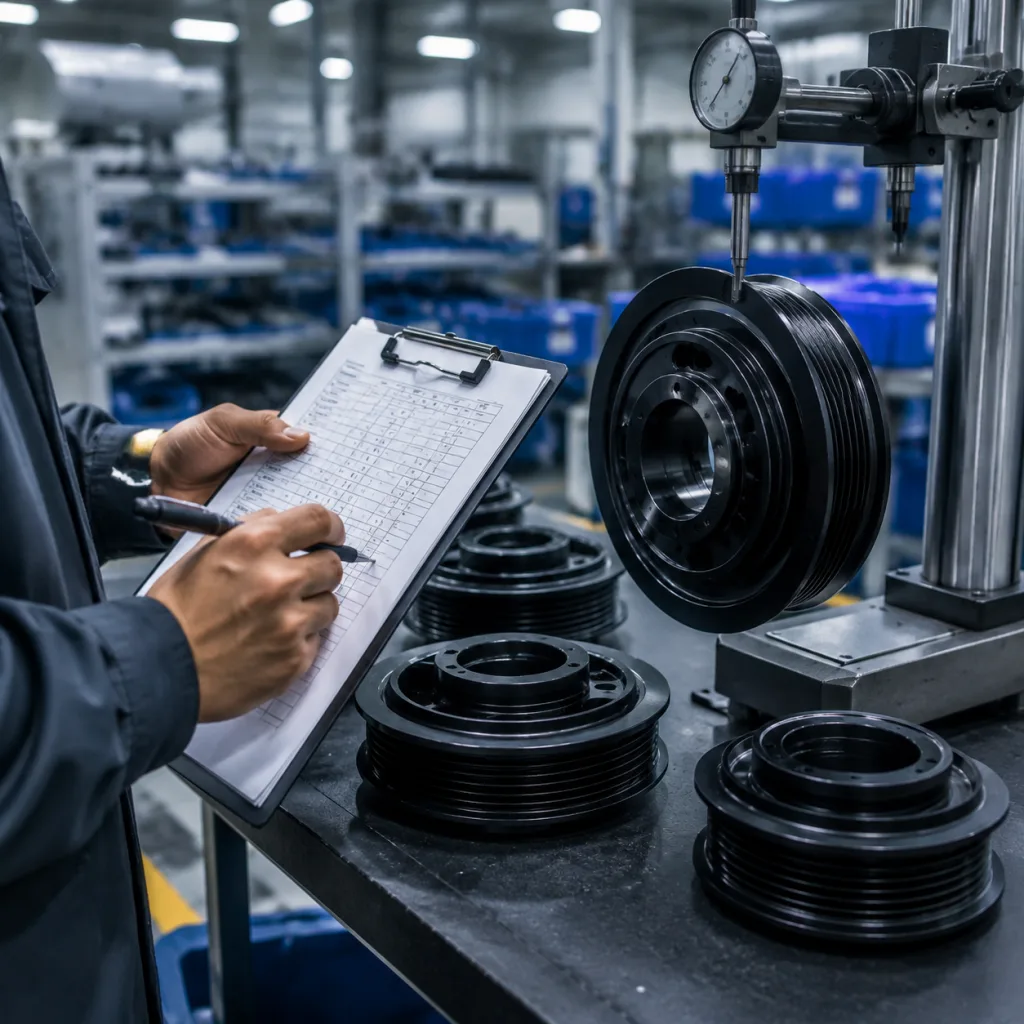
For repeat orders, first-article dimensions matter as much as the first approved sample. Ask for inspection records, a retained-master policy, and the supplier’s method for comparing later lots against the approved unit. If the pulley uses a bonded damper, request the rubber compound family and the ageing or thermal-cycle evidence behind it. Heat, oil, and torsional loading usually define service life faster than the finish does.

Put tolerances in the RFQ, not in follow-up emails. Many buyers specify bore and hub diameter to drawing tolerance, groove width and depth within ±0.05 mm on critical belt interfaces, total indicated runout within 0.03-0.08 mm depending on engine family, and static balance to the approved assembly standard. If the part is a torsional damper style pulley, require the nominal damping angle or stiffness window, test frequency, and ageing condition used to validate it.

Where suppliers usually fail

A crankshaft pulley lives in a high-load rotating assembly, so small process errors turn into big field problems. The usual failures are not dramatic at first. They start as belt noise, tracking issues, vibration, or accessory wear, then become returns and warranty claims.

That is why supplier qualification needs to cover the process, not just the sample part. A supplier can machine one good pulley and still struggle to repeat it at volume if spindle wear, tool change discipline, balance correction, or adhesive cure are not controlled.

Driventus operates under `IATF 16949:2016` and `ISO 9001:2015`, with inspection controls at incoming, in-process, and final stages. For export programmes, buyers should also confirm material declarations, restricted-substance controls, and document availability. If your compliance file requires it, request REACH screening aligned with `REACH (EC) No 1907/2006`.

Prioritize suppliers that can show:

  • Audit readiness and controlled quality documentation
  • Lot traceability from raw material, casting, or forging through shipment
  • Recorded runout, concentricity, and balance results
  • Process controls for machining, bonding, coating, and final inspection
  • Packaging that protects machined faces, hub surfaces, and belt grooves
  • Stable monthly output for forecasted replenishment orders

If the factory cannot show work instructions, gauge calibration status, and a nonconformance containment process, the quote is not really comparable yet. Low price means little when the production process cannot hold the same dimensions lot after lot.
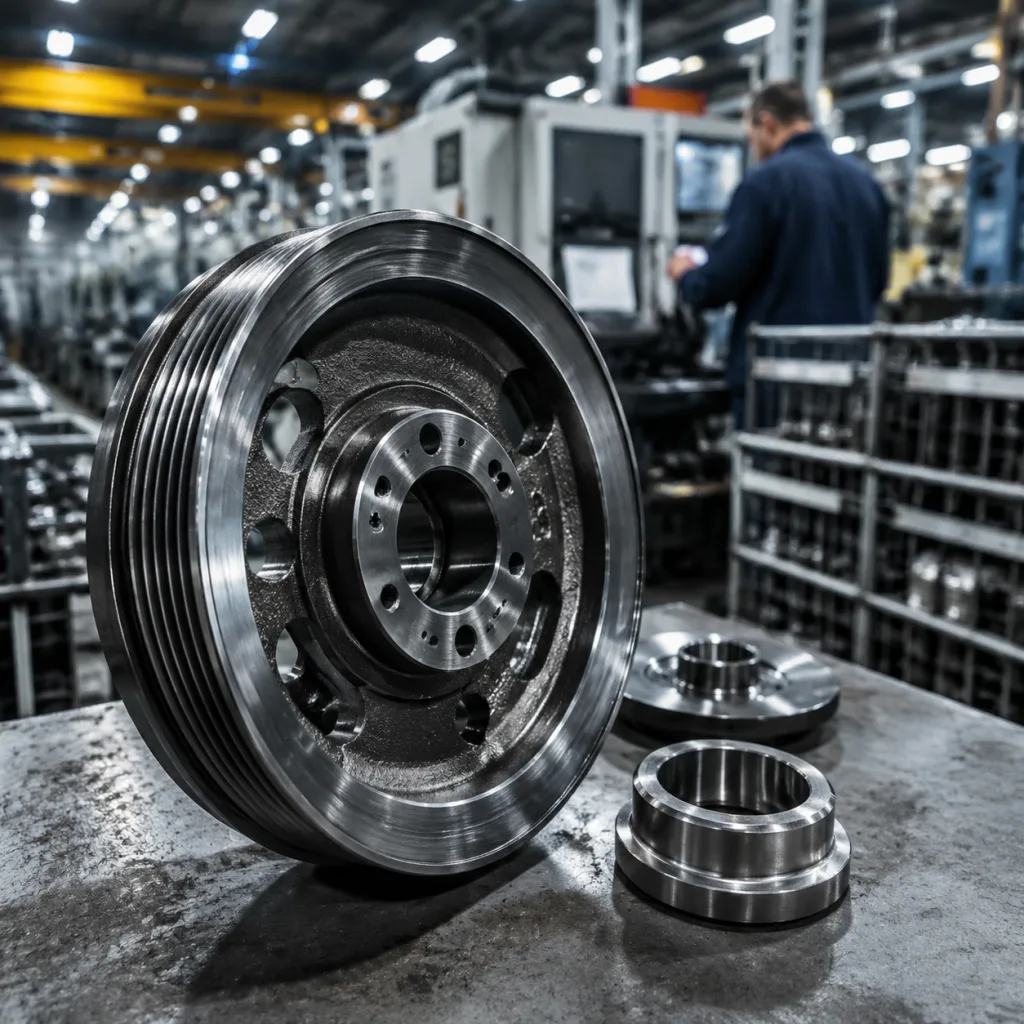
Where suppliers usually fail

Which sourcing path fits the job?

</tr></thead><tbody> </tbody></table>The right route depends on demand stability, application coverage, and documentation demands. If your programme spans several Jaguar engine variants, a mixed model is often the cleanest answer: standard parts from our catalog for fast-moving SKUs, then custom manufacturing for volume programmes, private-label packaging, or tighter inspection control. Buyers with a broader engine portfolio can also review engine components to consolidate sourcing across related assemblies.

In practice, the decision usually comes down to control versus speed. Catalogue stock helps when the order is urgent, but the revision level and documentation may be thin. OEM-equivalent aftermarket supply often gives distributors the best balance when the supplier can commit to stable drawings, traceable lots, and repeatable inspection. Custom manufacturing makes sense when you need exact packaging, customer part-number labels, a defined corrosion finish, or inspection records tied to each shipment.

A simple way to compare options is to price the landed cost, sample fee, MOQ, and 30-60 days of safety stock against the cost of a stockout on a fast-moving SKU.

A practical release checklist

Before you approve a crankshaft pulley supplier, ask for samples and test them against the way the part will actually be used. The goal is not just visual acceptance. It is correct fit, correct alignment, and acceptable vibration behavior in the real assembly.

Recommended checks

  • Visual inspection for casting, machining, coating, and bonding defects
  • Dimensional inspection against drawing, OE sample, or approved master sample
  • Concentricity, bore accuracy, and axial runout measurement
  • Static or dynamic balance verification, depending on programme requirements
  • Belt fit, groove engagement, and accessory alignment on an engine build fixture
  • Torque-fit check for mounting surfaces, bolt holes, and hub location
  • Corrosion resistance or salt-spray evidence where the market or storage route requires it

If your internal plan references published methods, align the supplier evidence with the actual programme scope. `SAE J2527` is often associated with corrosion-related durability evaluation, while `ECE R-83` may matter only when vehicle-level emissions or accessory-load integration is being assessed in a broader development context. The test matrix should reflect the engine, the vehicle, and the warranty risk, not a generic catalogue statement.

Set numeric pass criteria before the sample arrives. Many buyers start with 3-5 pieces for fit checks, 8-15 pieces for dimensional capability review, and one retained golden sample per revision. If the factory can provide it, request a `Cp/Cpk` summary on the critical-to-fit dimensions. Also ask for a report showing actual values for outside diameter, bore, groove geometry, runout, and balance correction. For a damper assembly, request torsional test data or equivalent durability evidence; vibration control is not proven by appearance alone.

A practical release checklist

Commercial terms to lock in early

Technical approval is only half the job. The purchase agreement should settle MOQ, lead time, packaging, labeling, inspection documents, and change-notification rules before the first production order.

Driventus supports B2B supply for aftermarket distributors, OEM and Tier-1 programmes, and multi-location repair chains. Useful questions include:

  • What is the MOQ by part number and by packaging format?
  • What is the standard production lead time after order confirmation?
  • Can packaging carry barcode labels, customer part numbers, or private branding?
  • How are material, process, tooling, or drawing changes communicated and approved?
  • What PPAP-style, first-article, or inspection documentation can be supplied when required?
  • How are nonconforming parts contained, replaced, and analyzed?

To make quotations comparable, write the commercial logic into the RFQ. For example, ask for MOQ by finished piece count and carton configuration, a sample lead time of 10-15 days if tooling is ready, a production lead time of 25-45 days depending on finish and inspection load, and price breaks at 500, 1,000, and 3,000 units. Put every supplier on the same Incoterm, then compare landed cost instead of ex-works price alone.

Also ask whether the supplier holds buffer stock of raw forgings, castings, or machining blanks. That detail often explains why one quote looks like a 30-day lead time on paper and another turns into a 45-day ship date once demand spikes. For long-term sourcing, that difference matters as much as the unit price.

If you are qualifying a crankshaft pulley Jaguar OEM supplier, send your OE reference, annual volume, target market, and documentation requirements. Request a quote at /contact.html.

Frequently asked questions

Yes. We work from OE references and engine data, then verify dimensions, groove form, hub location, and balance before production. Brand names are referenced for fitment identification only.

Ask for dimensional inspection records, material declarations, traceability details, quality certificates, and sample approval records. For regulated markets, include REACH screening and any programme-specific test reports.

Yes. Custom packaging, barcode labels, customer part numbers, and private branding can be supported through our OEM service workflow, subject to programme scope and MOQ.

If you are qualifying a crankshaft pulley Jaguar OEM supplier, send your OE reference, annual volume, target market, and documentation requirements. Request a quote at /contact.html.

Request a Quote
Sourcing route Typical use Main advantage Main risk
Catalogue partFast replenishment and distributor stockShorter lead timeLimited control over engineering changes
OEM-equivalent aftermarketRepair chains, wholesalers, and regional programmesLower landed cost with practical availabilityRequires fitment, material, and balance verification
Custom manufacturingVolume contracts, special engines, or private-label supplyControlled specification, packaging, and inspection planLonger sampling and approval cycle