Crankshaft Nissan Wholesale: What Buyers Should Verify
For procurement teams buying crankshaft Nissan wholesale, the main risk is not finding a part number. It is confirming the right material route, machining stability, and documentation for the target market. Driventus supplies crankshafts for aftermarket distribution, repair chains, and export programmes, with production aligned to IATF 16949:2016 and ISO 9001:2015. Buyers should compare journal geometry, surface finish, runout, balancing, packaging, and lead time before placing repeat orders. Driventus is an independent aftermarket manufacturer; brand names are referenced for fitment only. If you need a sourcing partner for repeat supply, the decision should be based on measurable tolerances, inspection records, and the supplier's ability to support stable replenishment across model years and markets.
What wholesale buyers should verify first
A Nissan crankshaft programme should start with fitment control, not brochure claims. For wholesale supply, the buyer usually needs three things: correct engine-family coverage, stable machining quality, and export-ready paperwork.
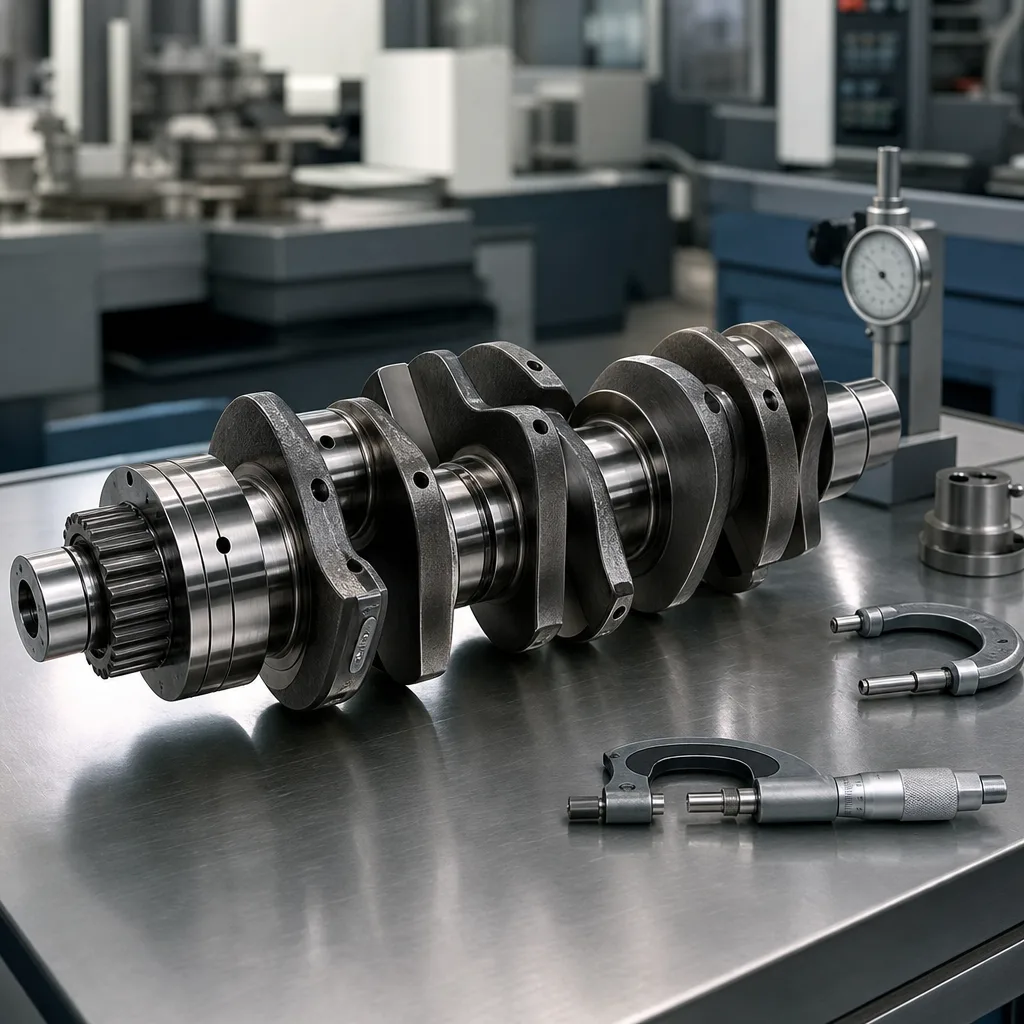
Start by confirming the engine code, bearing count, stroke, keyway or tone-wheel requirement, and whether the application uses a cast, nodular-iron, or forged steel crankshaft. Then check whether the supplier can hold repeatable dimensions across batches. If the supplier cannot provide traceable inspection data, the buying risk rises quickly when the same item is shipped to multiple countries.
For current stock and adjacent engine parts, see our catalog and engine components.
Specification points that matter in procurement
Wholesale buyers should request a written specification sheet before price comparison. The list below covers the minimum points that usually affect field performance and claims cost:
- Journal diameter and width with the stated tolerance class
- Main bearing and rod journal surface finish
- Total indicated runout and straightness
- Fillet radius control at crank throws
- Dynamic balance target and balancing method
- Hardness range after heat treatment
- Oil hole alignment and deburring standard
- Cleanliness level before packing
- Packaging method for sea freight and palletised export
If the supplier cannot state these values clearly, the part may still fit, but repeatability is harder to manage. That is why buyers should ask for dimensional reports on first articles and on production lots, not only sample photos.
Supply routes by application
Different Nissan programmes require different buying logic. A single wholesale contract can cover several routes if the supplier is organised by platform rather than by loose part number.
| Buying need | Recommended supply route | Procurement note |
|---|---|---|
| High-volume replacement | Stocked standard crankshaft | Best when demand is recurring and lead time must stay short |
| Mixed-market aftermarket | Model-specific production | Useful when one engine family serves several vehicle lines |
| Private label programme | Custom manufacturing | Better when packaging, marking, or documentation needs to be standardised |
| Workshop and distributor replenishment | Consolidated SKU range | Reduces inventory spread across slow-moving references |