Audi A4 Replacement Connecting Rod Sourcing Guide
A connecting rod for Audi A4 replacement is a precision engine component, not a commodity line item. The part may look right in photos and still fail the job: wrong centre distance, unstable big-end roundness, weak bolt preload, missing material traceability, or catalogue data that blends engine variants under one vehicle name. Those gaps become bearing-clearance claims, deck-height variation, knock, vibration, or fatigue failure under turbocharged loads. For importers, repair-chain buyers, engine rebuilders, and parts distributors, the buying decision should start with engineering evidence rather than a model-year listing. This guide shows how to define the Audi A4 application, compare OE-equivalent replacement rods, validate samples, and control MOQ, price, lead time, and batch records. Driventus supplies engine components for aftermarket distribution and B2B replacement programmes, with manufacturing controls aligned to IATF 16949:2016 and ISO 9001:2015. Driventus is an independent aftermarket manufacturer; brand names are referenced for fitment only.
Start With the Engine, Not the Vehicle Name
Audi A4 coverage spans several petrol and diesel engine families, including naturally aspirated and turbocharged versions sold across different markets and model years. That is the first sourcing trap. A vehicle-name search may return a rod that appears compatible, while the engine code, crank journal, piston pin, rod width, or bearing package says otherwise.
For a clean RFQ, define the rod by application evidence:
- Engine code, displacement, fuel type, and production range
- Turbo or non-turbo layout
- Crankshaft journal diameter and bearing reference
- Piston-pin diameter and piston reference
- Centre-to-centre rod length
- Big-end width and side-clearance requirement
- Bushed or non-bushed small-end design
- Individual rod, matched set, or repair-kit supply format
The rod has five jobs that the purchasing file must protect: transfer combustion force, hold piston travel geometry, preserve bearing crush and oil-film clearance, survive high-cycle tensile and compressive loads, and keep engine-set mass variation under control.
Most fitment disputes are not caused by bad intent. They come from incomplete mapping. One catalogue line can hide multiple crankshaft journal diameters, pin sizes, widths, or bearing specifications depending on market and production date. If OE-style cross-references are used, treat them as identification aids, for example OE 06A… style references, not as proof of vehicle manufacturer approval. Driventus is an independent aftermarket manufacturer; brand names are referenced for fitment only.
Decision Framework: What Makes a Rod OE-Equivalent?
OE-equivalence means the replacement rod matches the functional dimensions, material performance, and durability requirements of the intended engine. It does not mean endorsement by the vehicle manufacturer. For a connecting rod for Audi A4 replacement programme, the buyer should approve the evidence, not the claim.
| Control point | Typical procurement requirement | Buying risk if missed |
|---|---|---|
| Centre-to-centre length | Drawing tolerance commonly ±0.02 mm to ±0.05 mm | Compression-height shift and piston deck variation |
| Big-end bore diameter | Measured after cap assembly at specified bolt torque; roundness target commonly ≤0.008 mm to ≤0.015 mm | Bearing clearance error, poor crush, hot running |
| Small-end bore or bush ID | Matched to piston-pin design; clearance often controlled in the 0.005–0.020 mm range depending on design | Pin seizure, knock, or excessive clearance noise |
| Big-end width | Matched to crankshaft journal spacing, commonly within ±0.03 mm to ±0.05 mm | Incorrect side clearance and oil-flow behaviour |
| Rod mass and end-to-end balance | Matched sets often controlled within 2–5 g total mass and tighter end-balance where specified | Vibration and uneven bearing loading |
| Bolt specification | Material grade, thread quality, seating face, torque angle, and reuse rule defined | Cap movement or clamp-load loss under cyclic load |
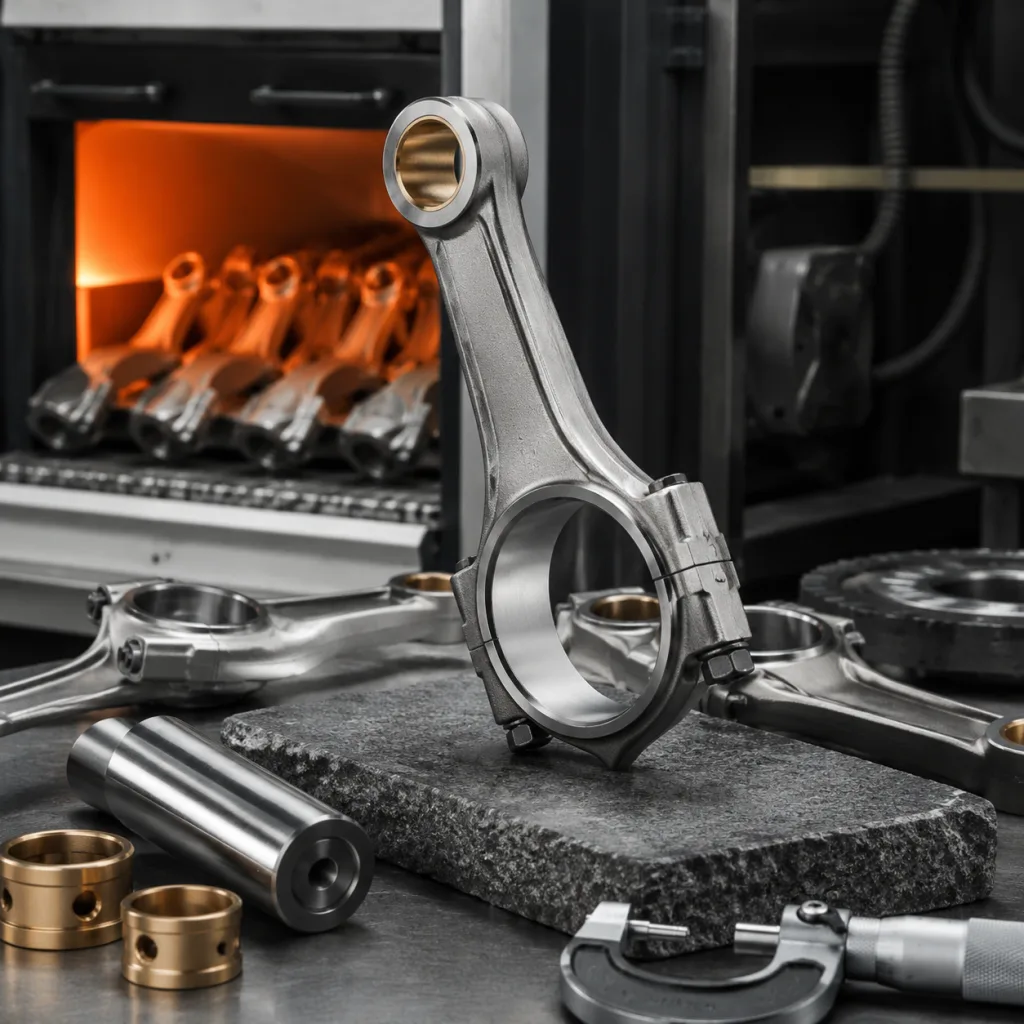
| Failure mode | Likely cause | Release check |
|---|---|---|
| Bearing noise or seizure | Big-end bore size, roundness, or crush error | Bore and cylindricity check after correct bolt torque or torque angle |
| Piston height mismatch | Centre distance out of tolerance | CMM or height-gauge centre-distance report |
| Pin knock or tight pin | Small-end bore or bush ID error | Pin-fit and bore measurement against drawing |
| Cap shift under load | Bolt quality, seating face, or clamp-load inconsistency | Bolt thread, under-head radius, seating surface, and torque procedure review |
| Engine vibration | Poor total mass or end balance | Matched-set weight and end-balance report |
| Early fatigue cracking | Material, heat treatment, shot peening, or radius issue | Material certificate, hardness data, crack inspection, and process review |