Crankshaft Mazda Manufacturer China Sourcing Guide
Choosing a crankshaft Mazda manufacturer China supplier should involve far more than comparing unit prices. Importers, distributors, and category buyers need proof that the factory can control metallurgy, machining accuracy, dynamic balance, traceability, packaging, and export documentation across repeat orders. Mazda-fit crankshafts are used across petrol and diesel engine families where bearing journals, oil holes, flange interfaces, reluctor features, and thrust faces must match the application precisely. Even a small dimensional or surface-finish error can create bearing wear, vibration, oil-pressure problems, or warranty exposure for repair chains and aftermarket distributors. Driventus manufactures crankshafts and related engine components in Taizhou, Zhejiang, for B2B aftermarket, OEM, and Tier-1 supply programmes. This guide explains the procurement checks buyers should use when qualifying a Chinese crankshaft source, including certification, material route, inspection records, MOQ, packaging, compliance documentation, and lead-time planning. Driventus is an independent aftermarket manufacturer; brand names are referenced for fitment only.
What Buyers Should Verify Before Sourcing
A qualified crankshaft supplier should be able to provide more than a quotation sheet. For Mazda-fit applications, procurement teams should confirm the part by engine data and technical evidence before approving a purchase order.
Key verification points include:
- Application coverage: petrol and diesel crankshafts matched by engine code, displacement, stroke, journal layout, flange pattern, and thrust bearing position.
- Material route: forged steel, cast iron, or ductile iron selected according to the original design, load requirement, and target market segment.
- Heat treatment: induction hardening, nitriding, or other specified process where required, supported by hardness and effective depth records.
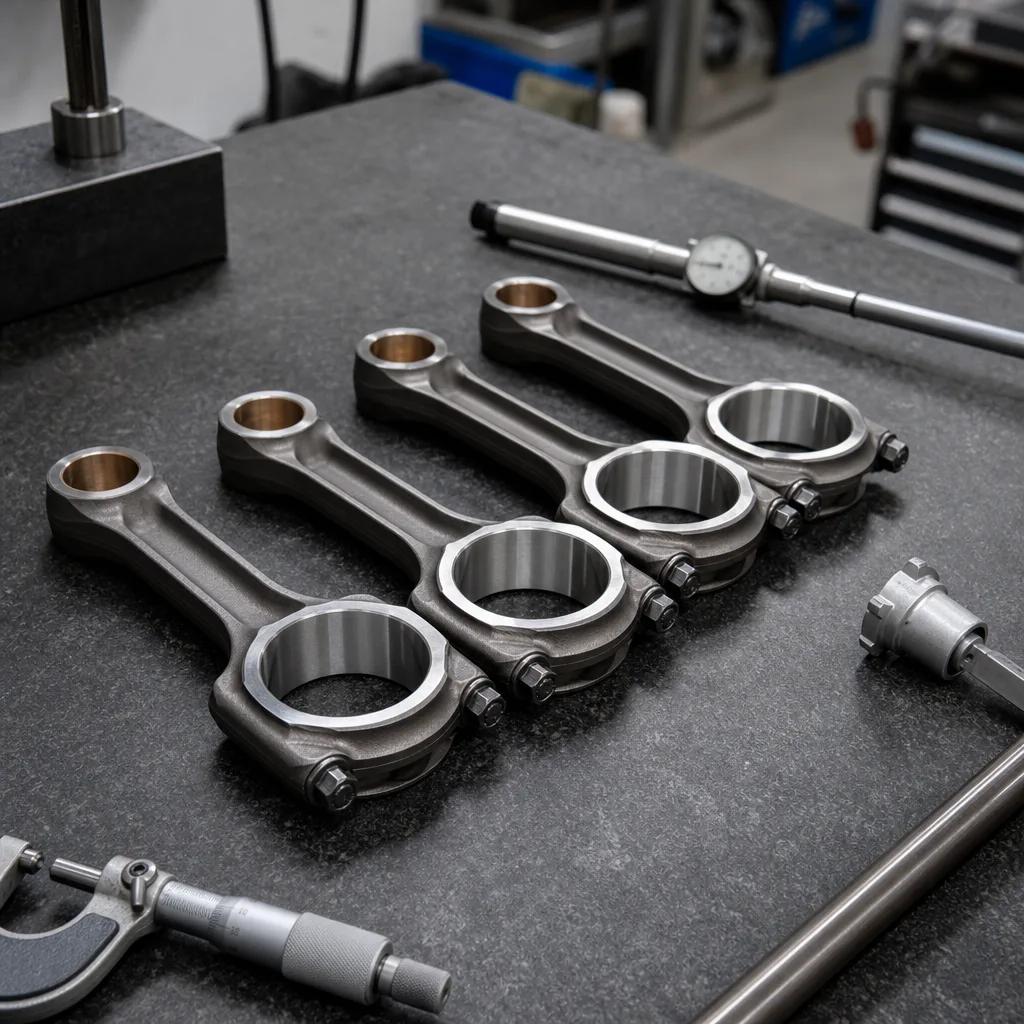
- Machining control: main journal, rod journal, flange, keyway, oil hole, counterweight, and end-face dimensions measured with calibrated gauges.
- Surface condition: journal roughness, fillet finish, oil-hole deburring, and anti-corrosion protection checked before packing.
- Balancing: dynamic balance control for rotating assemblies, especially on higher-speed petrol applications and engines sensitive to NVH.
- Traceability: batch number, material lot, heat-treatment lot, inspection date, operator record, and packing reference.
Buyers can review related engine component coverage in our catalog and the engine component section at /products/engine-components.html. For private-label, drawing-based, or exclusive regional programmes, Driventus also supports custom manufacturing.
Factory Capability and Certification Requirements
For a crankshaft mazda manufacturer china sourcing project, certification should be treated as the starting point, not the final approval. IATF 16949:2016 and ISO 9001:2015 show that a supplier has a quality-management framework for process control, risk management, corrective action, document control, and traceability. Buyers still need evidence that these systems are active on the crankshaft line and not limited to general factory procedures.
Driventus operates under IATF 16949:2016 and ISO 9001:2015 quality management systems. For export buyers, this supports structured supplier approval, incoming material control, production inspection, nonconforming product handling, and continuous improvement records. The practical audit question is whether the supplier can connect a finished crankshaft back to its material batch, processing route, inspection record, and shipment.
A factory audit should cover:
| Audit area | What to check | Procurement relevance |
|---|---|---|
| Material incoming control | Mill certificates, chemical analysis, hardness baseline, lot separation | Reduces the risk of mixed-grade or undocumented material |
| Machining line | CNC turning, grinding, drilling, deburring, washing, and handling methods | Confirms repeatable journal geometry and clean oil passages |
| Heat treatment | Furnace or induction records, hardness mapping, case-depth checks | Supports wear resistance and fatigue performance |
| Metrology | CMM, roundness tester, roughness tester, micrometers, air gauges | Confirms dimensional capability and inspection consistency |
| Balance process | Dynamic balancing equipment, correction method, retained records | Reduces vibration, noise, and return risk |
| Traceability | Batch codes on labels, inspection files, and packing documents | Enables containment if a field issue occurs |
| Control item | Typical inspection method | Why it matters |
|---|---|---|
| Main journal diameter | Micrometer or air gauge | Controls bearing oil clearance |
| Rod journal diameter | Micrometer and roundness tester | Supports bearing load distribution |
| Journal roundness | Roundness tester | Protects oil-film stability |
| Surface roughness | Roughness tester | Reduces bearing wear risk |
| Runout | Dial indicator or CMM | Supports alignment and vibration control |
| Oil hole finish | Visual, probe, and burr inspection | Helps maintain lubrication reliability |
| Thrust face width | Micrometer or CMM | Controls axial clearance |
| Flange and keyway geometry | CMM, fixture, or gauge check | Confirms correct assembly interface |
| Item | Typical approach | Buyer note |
|---|---|---|
| MOQ | Depends on part number, tooling status, material route, and packaging format | Lower MOQ may be possible for existing applications |
| Sample lead time | Usually shorter for stocked or previously developed references | Confirm whether the part is existing, modified, or new development |
| Mass production lead time | Driven by forging or casting availability, machining capacity, heat treatment, and inspection load | Forecasting helps reduce urgent air-freight cost |
| Packaging | Neutral, private-label, or buyer-specified export carton | Confirm label language, barcode, and pallet requirements |
| Incoterms | FOB, CIF, or other agreed trade terms | Align terms with the buyer’s freight-control policy |
| Documentation | Standard export documents or expanded engineering package | Confirm requirements before production to avoid shipment delays |
| Evaluation factor | Weight suggestion | What good evidence looks like |
|---|---|---|
| Certification and audit readiness | 15% | IATF 16949:2016, ISO 9001:2015, recent audit records |
| Dimensional capability | 25% | Inspection reports, gauge calibration, capability data, retained samples |
| Material and heat-treatment control | 20% | Material certificates, hardness records, lot traceability, controlled process parameters |
| Application knowledge | 15% | Engine-code matching, sample comparison, cross-reference discipline, clear fitment notes |
| Commercial fit | 10% | MOQ, lead time, payment terms, packaging options, forecast flexibility |
| Export execution | 15% | Packing quality, documentation accuracy, shipment experience, responsive communication |