Connecting Rod for Ford Focus Aftermarket Replacement
A connecting rod for Ford Focus aftermarket replacement has to reproduce the original engine’s functional geometry, bore quality, mass balance, surface condition and fastener performance. For procurement teams, the decision goes beyond unit price. The part must install without rework, hold bearing clearance under real workshop conditions and arrive with repeatable inspection records from lot to lot.
Ford Focus applications cover several petrol and diesel engine families, with differences by engine code, displacement, fuel system, market and model year. Buyers should define the engine code, piston pin specification, big-end arrangement and target application boundary before requesting samples or publishing catalogue coverage.
Driventus manufactures engine and powertrain components in Taizhou, Zhejiang, for aftermarket distributors, repair-chain supply programmes and OEM/Tier-1 projects. We support IATF 16949:2016 and ISO 9001:2015 controlled processes, material traceability and dimensional inspection for connecting rod supply. Driventus is an independent aftermarket manufacturer; brand names are referenced for fitment only.
Replacement fitment requirements for Ford Focus engines
Ford Focus connecting rod demand is usually driven by engine rebuilds after bearing failure, hydrolock, piston damage, high-mileage wear or crankshaft repair. Selection should be based on the exact engine platform rather than the vehicle name alone. Within the Focus range, rods can vary by centre-to-centre length, piston pin diameter, big-end housing size, side width, bearing shell arrangement and cap design.
For a sourcing file, confirm these items before sample approval:
Vehicle application: Ford Focus model year range and market region
Engine details: petrol or diesel, displacement, engine code and emission market where available
Rod construction: forged steel, powder metal, fracture-split or machined-cap design
Small-end system: bushed or non-bushed, full-floating or press-fit piston pin
Big-end design: fracture-split or machined cap, bolt size and cap location method
Service configuration: individual rod, matched engine set, rod with bolts, or rod with bushings
Cross-reference basis: OE-style or aftermarket reference numbers only when verified by the buyer
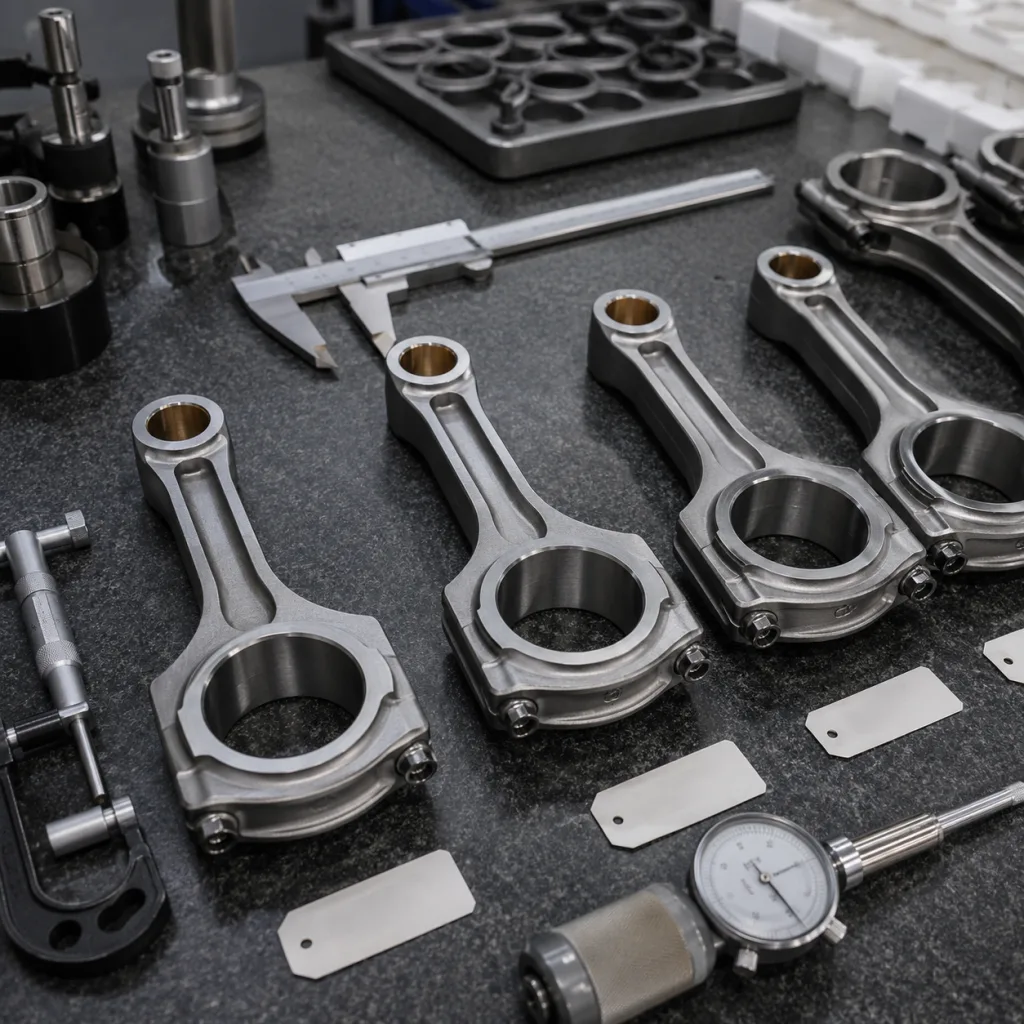
A visual comparison is not enough for procurement approval. Critical checks include centre-to-centre length, big-end bore, small-end bore, side width, cap alignment, bolt clamp load, hardness, surface condition and final mass. A rod that appears similar but misses bore roundness or cap stability targets can reduce oil-film control and create bearing failure in service.
OE-equivalence criteria buyers should specify
OE-equivalence means the replacement part is engineered to meet the same functional requirements as the original design. It does not mean approval, endorsement or supply authorisation from the vehicle manufacturer. For aftermarket sourcing, the specification should focus on measurable characteristics that can be checked during sample approval and incoming inspection.
Check point
Typical buyer requirement
Why it matters
Centre-to-centre length
Controlled to approved drawing or sample tolerance
Maintains piston position and compression consistency
Big-end bore geometry
Roundness and cylindricity checked after final bolt torque
Protects bearing oil clearance and crankshaft journal life
Small-end bore
Pin fit, bushing condition and surface finish verified
Reduces pin noise, seizure risk and uneven wear
Rod weight
Batch matching or graded sets where required
Limits imbalance in multi-cylinder rebuilds
Bolt performance
Torque-angle, proof-load or clamp-load validation
Controls cap movement under combustion and inertia loads
Material and hardness
Material certificate, heat-treatment record and hardness test
Confirms strength and fatigue resistance
Surface condition
Machined, shot-peened or specified finish inspected
Reduces stress raisers and crack initiation risk
</tr></thead><tbody> </tbody></table>For a connecting rod for Ford Focus aftermarket replacement, Driventus can review buyer drawings, sample parts and application lists against production capability. If a distributor sells rods as engine sets, the weight-matching and set-packing rules should be written into the purchase specification, not left to informal selection during packing.
Materials, manufacturing routes and inspection controls
Common connecting rod manufacturing routes include forged steel, powder metal and billet or fully machined steel for special applications. The right route depends on the original engine design, expected duty cycle, target price position and aftermarket risk profile. A forged steel rod may be selected for fatigue margin and service robustness, while a powder metal fracture-split rod can deliver accurate cap alignment when the forming, heat treatment and machining processes are tightly controlled.
Driventus production controls for connecting rods can include:
Incoming steel verification with supplier certificate review and batch traceability
Forging, forming or machining process monitoring according to the approved route
Heat treatment with lot-based hardness checks
CNC machining of big-end, small-end and side-face features
Cap matching, bolt installation and tightening-sequence controls
Bore gauging after the specified final tightening condition
Magnetic particle inspection or other crack detection when required by the programme
Final visual inspection, anti-corrosion protection, packing checks and lot identification
The purchasing file should state whether rods are supplied individually, as balanced sets, or with bolts and bushings included. Bolt reuse policies differ by engine design and repair procedure. If the target application uses torque-to-yield or otherwise single-use rod bolts, the aftermarket kit should include the required fasteners or specify them as a separate line item.
Our broader engine component range is listed under our catalog and engine components, including pistons, crankshafts, gaskets, water pumps and related powertrain parts.
Validation testing for aftermarket replacement supply
A reliable Ford Focus replacement rod programme should be validated before bulk release. Buyers should request the test plan, measurement method and inspection report format rather than relying on sample photographs. The depth of validation should reflect order volume, field-return risk, market regulations and whether the part is a catalogue item or a new development.
Recommended validation evidence includes:
Dimensional layout report against the buyer drawing, approved sample or agreed specification
Material certificate, heat-treatment record and hardness readings
Big-end bore measurement before and after the required bolt-tightening sequence
Small-end bushing retention and piston-pin fit check where applicable
Rod bolt torque, torque-angle, proof-load or clamp-load test records
Surface defect inspection, including crack detection when specified
Salt spray, oiling or packaging corrosion checks where sea freight storage risk is high
Trial assembly feedback from a controlled engine rebuild where feasible
For formal supplier control, Driventus operates under IATF 16949:2016 and ISO 9001:2015 based systems. Environmental and material compliance can also be reviewed against REACH (EC) No 1907/2006 when required for EU distribution. Buyers can review our quality system for certification and process-control expectations.
Validation should reflect aftermarket realities. Repair chains may install rods into engines with worn crankshaft journals, mixed-brand bearings, reused peripheral parts and variable workshop cleanliness. That makes bore finish, cap seating, fastener quality and packaging cleanliness commercial risk controls as well as engineering requirements.
Procurement checklist for distributors and repair chains
Before placing a production order, combine the commercial and technical requirements in one sourcing document. A clear file reduces sample loops, prevents catalogue overreach and helps both teams control changes across vehicle applications.
Buyer checklist
Confirm engine code, displacement, fuel type, model year range and market region
Provide a drawing, approved sample, verified application list or measured reference part
Define whether the rod is sold individually, in cylinder sets or as a balanced engine set
Specify included components: bolts, bushings, bearing shells, labels or no accessories
Set inspection requirements for bore geometry, weight matching, hardness and surface condition
Confirm packaging: oiled individual pack, anti-corrosion sleeve, set box or bulk export carton
Require batch traceability on product labels, cartons and delivery documents
Agree acceptable quality limit, inspection sampling and nonconformance response process
Review import documentation, tariff classification support and carton labelling needs
For private-label or specification-driven projects, Driventus supports custom manufacturing based on buyer drawings, sample reverse engineering or controlled application development. We do not claim vehicle manufacturer approval. The objective is to manufacture an aftermarket replacement part that meets the agreed dimensional, material, packaging and validation requirements.
Common sourcing risks and how to reduce them
The main sourcing risks for connecting rods are catalogue mismatch, unstable cap machining, poor bolt control, inconsistent bore finish, inadequate corrosion protection and weak lot traceability. These issues often remain hidden during sample review and appear after the first container shipment, when repair-chain returns begin to show installation problems, bearing noise or premature wear.
Risk reduction should be built into the launch process:
1. Approve samples using measured reports, not visual comparison only. 2. Test at least one complete set for weight matching, bolt tightening and trial assembly. 3. Require production lot records for material, heat treatment, hardness and final bore inspection. 4. Specify packaging that protects machined bores and cap faces during ocean freight and warehouse storage. 5. Keep application data conservative until field feedback confirms coverage. 6. Separate SKUs when design splits exist by engine code, model year, fuel system or emissions market.
A connecting rod for Ford Focus aftermarket replacement should enter the catalogue only after the buyer and manufacturer agree the application boundary. If one rod covers several engine codes, document that coverage with verified dimensional data and approved cross-references. If the platform has design changes by year or market, separate the listings instead of relying on notes in a sales spreadsheet.
Frequently asked questions
Sometimes, but fitment must be confirmed by engine code, rod length, big-end bore, big-end width, pin size, cap design and bolt specification. Vehicle model name alone is not enough for procurement approval.
Request a dimensional layout report, material and hardness records, big-end and small-end bore readings, bolt-tightening validation, surface inspection results and weight-matching data if rods are supplied as sets.
No. Driventus is an independent aftermarket manufacturer; brand names are referenced for fitment only. Parts are supplied to agreed aftermarket specifications and validation requirements.
If you are building a Ford Focus engine parts programme, share the engine code, sample or drawing, target market and order quantity. Our team can review fitment, validation and supply requirements when you [request a quote](/contact.html).