Crankshaft Kia Wholesale: Sourcing Guide for Buyers
Procurement teams sourcing a crankshaft Kia wholesale programme need more than a part-number match. They need OE cross-reference control, dimensional verification, packaging that survives export, and a supplier that can keep process consistency across batches. For engine rebuilders, distributors, and multi-location repair chains, the real risk is not price alone. It is variation in journal size, fillet geometry, runout, and heat treatment.
Driventus is an independent aftermarket manufacturer; brand names are referenced for fitment only. We supply crankshafts under controlled production methods for B2B buyers who need repeatable delivery, documented inspection, and clear MOQ and lead-time terms. This article explains what to check before you place a wholesale order, how to compare supplier claims, and which quality documents should be available before shipment. If you are building a sourcing shortlist, use it as a procurement checklist rather than a sales pitch.
What wholesale buyers should verify first
For a wholesale crankshaft programme, the first screen is fitment control. The supplier should confirm the engine code, OE cross-reference, bearing count, flange pattern, sensor tone wheel details where applicable, and any machining variant tied to displacement or emissions version. Do not approve a part on vehicle name alone.
A practical buyer checklist:
OE cross-reference recorded in writing, for example `OE 06A107065` only when the application already uses that identifier
Journal diameters and widths checked against drawing or sample
Main and rod bearing surface finish stated
Runout and straightness limits documented
Heat treatment and hardness method identified
Packaging and corrosion protection defined for export
For Kia applications, a distributor usually needs more than one reference confirmation because the same model family may use different engines across markets. Ask for sample approval before the first mass order, especially when the crankshaft is part of a broader engine-service range. You can review related engine-part categories in our catalog and engine components.
MOQ, lead time, and supply planning
Wholesale buyers typically compare minimum order quantity, batch stability, and replenishment speed before they compare landed unit price. A lower MOQ can help test a new market, but it only matters if the supplier can repeat the same dimensions and surface quality in the next batch.
Procurement item
What to confirm
Why it matters
MOQ
Trial order and repeat order thresholds
Supports market testing without overstock
Lead time
Sample, pilot, and mass-production timing
Prevents stock-outs in peak repair cycles
Packaging
VCI, carton strength, pallet method
Reduces transit damage and corrosion
Batch traceability
Heat number, lot code, inspection record
Helps with claims and recalls
Incoterms
EXW, FOB, CIF, or DAP
Clarifies landed-cost responsibility
</tr></thead><tbody> </tbody></table>For large repeat orders, ask for a rolling forecast model. That gives the plant time to allocate forging, machining, balancing, and final inspection capacity. A supplier with stable output should be able to explain whether the bottleneck is forging, grinding, or heat treatment. That answer matters more than a generic promise of fast delivery.
Quality documents that matter in procurement
A credible wholesale supplier should operate under IATF 16949:2016 and ISO 9001:2015, with inspection records available by lot. For export markets, material and compliance files may also need to reference REACH (EC) No 1907/2006 where applicable. If your programme includes emissions-sensitive applications, check whether the part family is used in engines subject to ECE R-83 related vehicle configurations, but do not treat that as a performance endorsement.
Request these documents before first shipment:
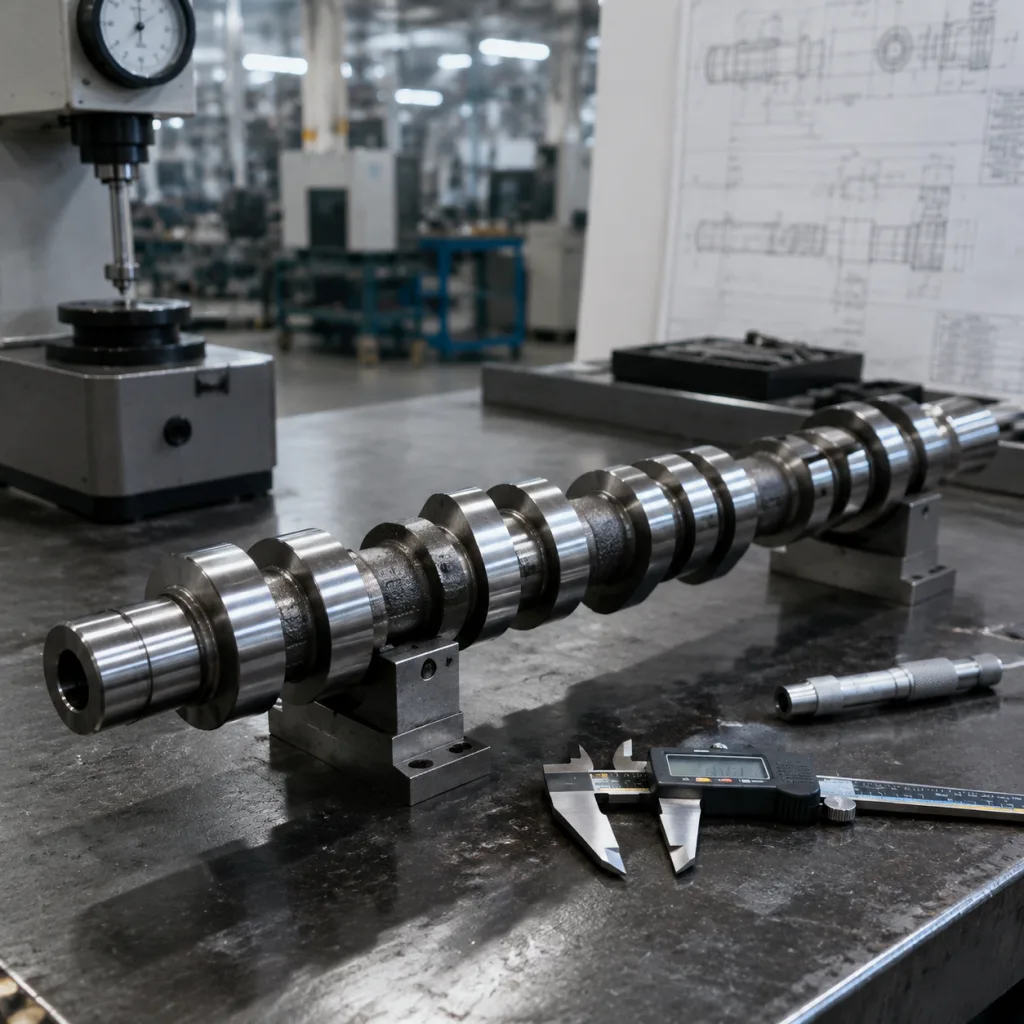
Dimensional inspection report
Material certificate
Hardness test record
Runout or straightness record
Surface roughness data, where specified
Packing inspection and carton list
If the supplier offers a production audit, use it to check measurement equipment calibration, final inspection frequency, and how nonconforming parts are segregated. Driventus publishes its quality system so buyers can review the control approach before requesting samples. For buyers that need variant machining or private-label supply, custom manufacturing is the right starting point.
Why dimensional control affects engine life
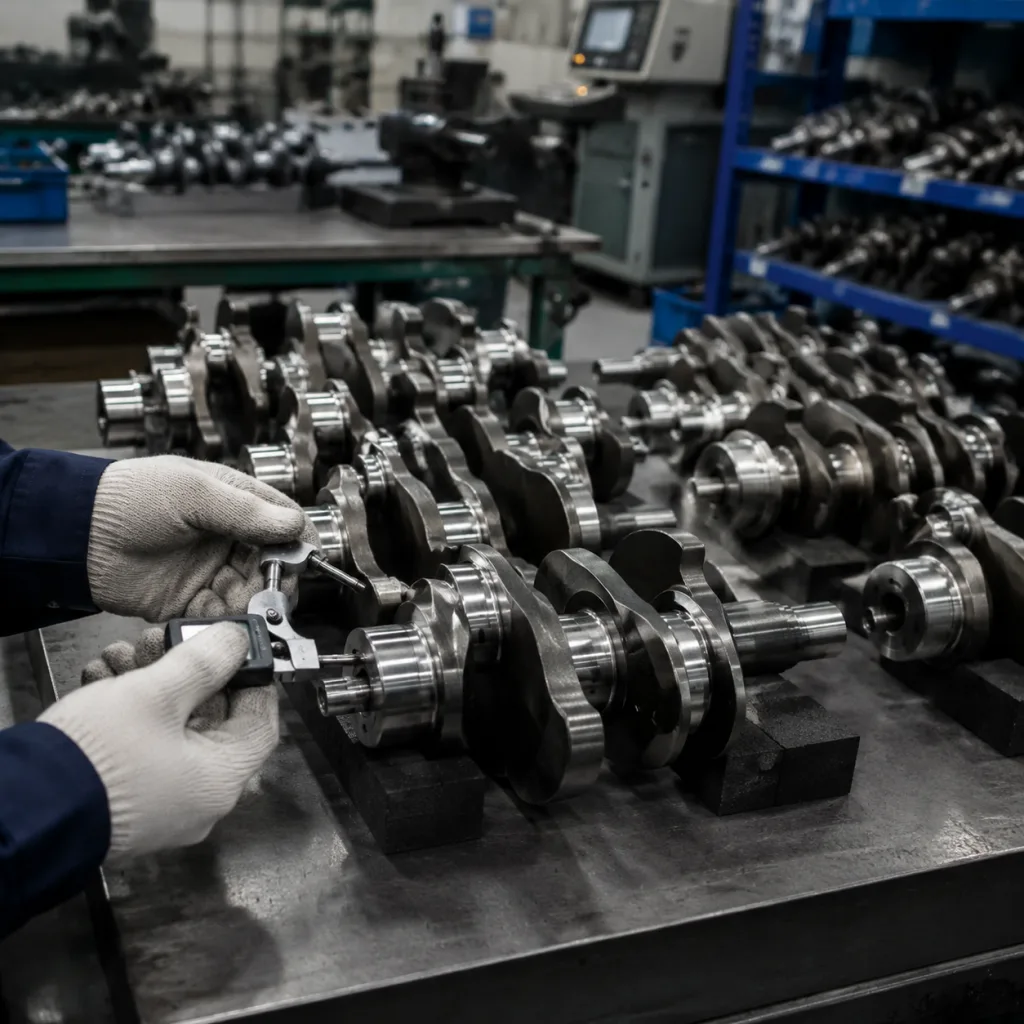
A crankshaft is not a commodity casting once it reaches the engine builder. Small errors in geometry can create oil-film instability, bearing wear, vibration, or repeated seal failure. In wholesale sourcing, the key risk is not only a visible defect. It is an out-of-spec feature that still appears acceptable in a quick visual check.
Typical control points include:
Main journal diameter
Rod journal diameter
Journal taper and ovality
Fillet radius consistency
Axial thrust surface finish
Total indicated runout
If a supplier cannot state how these features are measured, the buyer should assume the process is not yet mature enough for a repeat order. For rebuilt engines, dimensional consistency matters as much as metallurgical quality because the part must match the bearing set, oil clearance, and machining practice used by the workshop. Buyers should also ask whether the crankshaft is balanced as a bare shaft or with a specified bobweight target. That detail affects installation consistency across different rebuild networks.
How to compare suppliers on a like-for-like basis
A fair comparison starts with the same reference data. Ask every supplier to quote against the same engine code, OE cross-reference, and packaging specification. Then compare manufacturing scope rather than marketing claims.
Use this scoring approach:
1. Fitment evidence: OE cross-reference, drawing, sample report 2. Process evidence: forging route, machining control, balancing method 3. Quality evidence: certifications, lot traceability, final inspection 4. Commercial evidence: MOQ, lead time, warranty terms, export support 5. Service evidence: response time, document turnaround, claim handling
If one quote is lower but lacks inspection detail, the apparent saving can disappear in returns, rebuild downtime, and freight claims. For procurement teams, the safest wholesale choice is the supplier that can prove stable output and document control, not the supplier with the lowest first price.
What to ask before placing the first order
Before you open a new supplier file, send a structured request. That saves time and filters out vendors that cannot support export business.
Include these questions:
Which engine codes and OE references are covered?
What is the MOQ for sample, trial, and repeat orders?
What inspection checkpoints are recorded for every batch?
Can you provide IATF 16949:2016 and ISO 9001:2015 certificates?
What is the standard lead time for stock and non-stock items?
Can you support private-label packing and carton marking?
If your target market includes multiple countries, ask for export references and documentation in English. For buyers sourcing from China, a factory that already ships to 60+ countries is usually better prepared for packaging, customs paperwork, and claim follow-up. Driventus serves B2B buyers through standard product lines and request a quote channels when the application needs a defined build spec or volume pricing.
Frequently asked questions
Match the engine code, OE cross-reference, journal sizes, and any sensor or thrust-surface variant. Do not buy on vehicle model alone. Always request a dimensional report or sample approval before volume purchase.
MOQ depends on whether the part is stock or custom, but buyers should ask for sample, pilot, and repeat-order thresholds separately. A workable MOQ supports testing without forcing excess inventory.
At minimum, ask for dimensional inspection data, material certificate, hardness record, runout report, and traceability by lot. For export programmes, confirm the supplier’s IATF 16949:2016 and ISO 9001:2015 status.
If you are building a sourcing list for Kia crankshaft supply, we can review fitment, volume, and packaging requirements with you. Start with [request a quote](/contact.html).