Crankshaft Ford Manufacturer China: Sourcing Guide
Choosing a crankshaft Ford manufacturer China supply partner is not a price-list exercise. The real question is whether the supplier can repeat the same metallurgy, journal geometry, hardness profile, oil-passage finish and packing discipline across every lot you import. A cheap sample is useful. A stable replenishment programme is what protects margin.
For distributors and repair-chain buyers, the exposure is visible fast: bearing noise claims, corrosion after sea freight, wrong fitment coverage, weak cartons, or delayed replenishment. For OEM and Tier-1 sourcing teams, the discussion moves to APQP, PPAP readiness, traceability, capability data, change control and audited process discipline.
Driventus manufactures engine and powertrain components in Taizhou, Zhejiang, supplying B2B customers in more than 60 countries. Our crankshaft programmes are developed for aftermarket and custom applications where dimensional equivalence, stable metallurgy and controlled surface finish matter. Driventus is an independent aftermarket manufacturer; brand names are used only for fitment identification.
Use this guide as a sourcing decision tool, not a generic supplier checklist. It shows what to ask, what evidence to verify, and where crankshaft sourcing from China usually fails if the RFQ is too vague.
Decision framework: approve the supplier, not just the sample
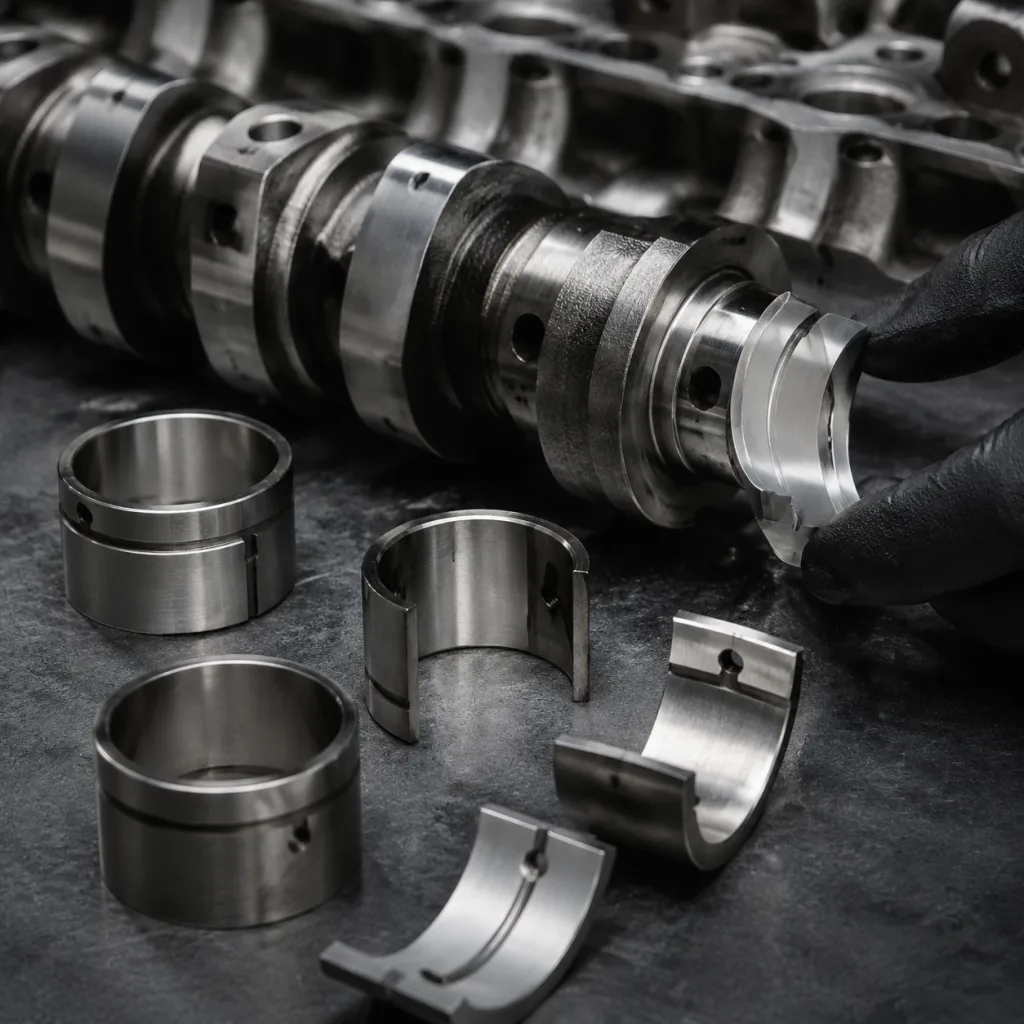
A crankshaft is a fatigue-critical rotating component. The sample on your desk may look correct, but the commercial risk sits in production repeatability: journal roundness, fillet radius, oil-hole chamfering, surface finish, heat-treatment depth and batch traceability. One weak control point can shorten bearing life or create noise, vibration and harshness complaints.
When evaluating a crankshaft Ford manufacturer China supplier, start with evidence. Do not ask, “Can you make this?” Ask, “Show me how this part is controlled from blank to carton.”
Use these approval gates:
Core capability: crankshaft or engine-component production should be a real manufacturing activity, not a trading sideline. Confirm which steps are in-house: turning, grinding, drilling, polishing, washing, balancing and final inspection.
Certificate relevance: check current IATF 16949:2016 and ISO 9001:2015 certificates, including site address, issuing body, scope and expiry date. The scope should cover engine components, machining or related manufacturing activity.
Manufacturing route: casting, forging or billet machining must match the application, duty cycle and price position. Nodular cast iron may suit many standard aftermarket passenger applications; heavy-duty or performance use may require forged steel or alloy steel.
Machining discipline: CNC turning, journal grinding, oil-hole drilling, chamfering, polishing and balancing should be governed by work instructions. Ask whether grinding tolerance, wheel dressing, feed rate and final polishing are recorded by operation.
Heat-treatment proof: induction hardening, nitriding or other specified processes need parameter records, equipment calibration and hardness verification. Request surface hardness, effective case depth and a recent hardness map.
Traceability speed: the supplier should connect carton label, batch number, material heat number, inspection lot and packing list. A practical system should trace a packed crankshaft back to production records within 24 hours.
Export packing control: sea freight is not gentle. Confirm anti-rust method, VCI use where required, journal protection, reinforced cartons or crates, palletisation and warehouse handling suitability for 30–45 days in transit.
Before approval, request one complete sample file: material certificate, dimensional layout, roughness report, hardness report, balance report, packing photos and a traceability example. If warranty exposure is high, define receiving inspection before shipment: AQL level, critical-characteristic sampling, rejection process and claim documentation.
Driventus publishes engine-component categories through our catalog. Buyers can use catalog availability as a starting point, then confirm application, engine code, dimensional requirements and documentation level before supplier approval.
Spec deep-dive: materials, journals, hardness and cleanliness
Ford-fitment crankshaft demand can cover petrol engines, diesel engines, light commercial vehicles and repair-market replacements. The correct specification depends on load, expected service life, cost target and whether the order is a standard aftermarket item or a custom programme.
Item
Common procurement requirement
What to request from the supplier
Material
Nodular cast iron, forged steel or alloy steel depending on application
Material certificate and chemical composition report
Journal finish
Typically Ra 0.2–0.4 μm for main and pin journals unless drawing states otherwise
Surface roughness report by journal location
Hardness
Defined surface hardness and effective hardened depth, commonly checked at journals and fillets
Hardness map and heat-treatment record
Geometry
Runout, roundness, cylindricity and taper control; buyers often specify critical limits in the 0.005–0.030 mm range depending on feature
Final inspection report and gauge method
Balance
Dynamic balance within agreed specification, recorded by part number and lot
Balance report and machine record
Cleanliness
Oil passages free of burrs, abrasive residue and machining chips
Washing process record and visual inspection criteria
</tr></thead><tbody> </tbody></table>Inspection scope should be written into the control plan, not improvised after machining. Full inspection of every feature may be unnecessary once the process is stable, but critical characteristics must be named. These usually include main journal diameter, crankpin diameter, journal runout, thrust face width, oil-hole finish, gear or pulley interface, flange face and keyway position where applicable.
Also ask how measurements are taken. A single reading is not enough for some features. Buyers should confirm clock positions, measurement points along the journal, gauge type and calibration status. For new or changed parts, request a full dimensional layout for at least 3–5 samples plus capability data for key characteristics when production volume justifies it.
A typical controlled route may include blank receipt, normalising or stress relief where applicable, rough turning, centre-hole control, semi-finish machining, heat treatment, straightening, finish grinding, oil-hole drilling and chamfering, washing, magnetic particle inspection where required, dynamic balancing, polishing, final inspection, anti-rust treatment and packing. Any outsourced step should appear in the process flow and be covered by incoming verification.
Driventus uses controlled machining and inspection processes within its quality system, aligned with IATF 16949:2016 and ISO 9001:2015 requirements. These standards do not certify a specific crankshaft part number or imply approval by any vehicle manufacturer, but they provide a framework for process control, corrective action, internal auditing and monitoring.
Ordering scenarios: stock item, low-volume fitment or custom programme
MOQ and lead-time are often misunderstood because buyers compare unit prices before they understand the order structure behind them. Crankshaft pricing changes sharply with volume because blank procurement, set-up time, inspection labour, packing and export documentation are spread across the order.
Think in scenarios:
Existing aftermarket item: lowest friction. If tooling and process records already exist, MOQ is usually lower and samples can move faster. For stocked or recently produced items, sample timing may be 7–15 days and production may be 30–45 days after deposit and label confirmation.
Low-volume or regional fitment: feasible, but economics depend on blank availability, casting or forging batch size, machining set-up and packing requirements. Practical MOQ may be 50–200 pieces per part number if blanks are available, or 300–800 pieces if a new blank run is needed.
Custom crankshaft programme: slower and more documentation-heavy. Drawing review, engineering confirmation, tooling, prototype validation, dimensional approval and production release are required. Prototype timing may be 45–75 days after drawing freeze; mass production may need another 45–90 days after sample approval.
Mixed container shipment: useful for distributors buying crankshafts with gaskets, pistons, water pumps or other engine components. Check carton size, gross weight, pallet height and loading plan. Crankshafts are dense; shipments may hit weight limits before cube limits.
A quotation should separate the cost drivers. Ask for tooling or fixture cost, sample cost, quantity-tier unit price, packaging cost, inspection-document cost if extra, and Incoterms. The quote should state currency, validity period, MOQ per part number, lead-time from deposit, payment terms and whether the price includes neutral packaging, customer labels, VCI bag, wooden crate or fumigation-compliant pallet.
A strong RFQ includes annual forecast, first-order quantity, target market, packaging requirements, inspection documents, Incoterms, destination port and any drawings or samples. If the application references an OE-style number, use it only as a neutral fitment cross-reference, such as OE 06A… or OE 11251…. Do not present a cross-reference as vehicle-maker approval, endorsement or supply authorisation.
For new development, custom manufacturing should start with feasibility review, 2D or 3D drawing analysis, process flow, control plan, sample report and production timing. Confirm PPAP documentation, material test reports, capability studies, dimensional layouts and packaging approvals before issuing the purchase order. Otherwise, samples may be ready while the required records are not.
Failure-mode audit: where crankshaft suppliers usually lose control
A factory audit should answer one question: can this supplier repeat production quality after the sample order is over? Remote audits can screen a shortlist. On-site audits are still valuable for high-value programmes, safety-sensitive applications and multi-year agreements.
Look for failure modes, not showroom strengths:
1. Mixed or weakly identified blanks: verify approved-supplier records, material certificates, heat-number identification and storage. Blanks should be marked and segregated by lot, not piled in open bins. 2. Oil-hole burrs and poor deburring discipline: review CNC turning, grinding, drilling, polishing, washing and deburring stations. Ask the operator to show the work instruction and the actual gauge or visual standard used. 3. Uncontrolled heat treatment: check parameter records, equipment maintenance, calibration status and hardness results. Confirm how load position, heating time, quench media and temperature are recorded. 4. Metrology gaps: inspect micrometers, height gauges, surface roughness testers, hardness testers, balancing machines and CMM where applicable. Calibration labels should show ID number, status and due date. 5. Rejected parts drifting back into production: inspect red-tag areas, rework procedures, scrap authorisation and segregation of suspect material. A rejected crankshaft should not move without documented disposition. 6. Traceability that works only on paper: choose one packed crankshaft and trace it back to machining records, inspection records, heat-treatment data and material heat. A strong supplier can complete this during the audit. 7. Packaging designed for appearance, not export: review corrosion protection, drop resistance, moisture control, carton strength, crate design and palletisation. Request anti-rust duration, VCI method and pallet load limit. 8. Complaint handling without root cause: ask for an 8D example. Look for containment, cause verification, corrective action and recurrence prevention. A polite email is not corrective action.
For scoring, rate each area from 1 to 5. Require corrective action before approval for any score below 3 on heat treatment, metrology, traceability or nonconforming-product control. During the audit, compare at least three recent lots for drift in journal size, runout and hardness. If data are handwritten, watch for repeated identical values, missing signatures or measurements recorded before the stated production time.
IATF 16949:2016 and ISO 9001:2015 are useful audit frameworks, but the shop floor must prove the system is alive. EU importers may also need to consider REACH (EC) No 1907/2006 for coatings, rust preventives and packaging materials. If your company has restricted-substance limits beyond legal minimums, write them into the purchasing specification.
Importer Q-and-A: documents, labels and change control
What documents should arrive with a professional crankshaft shipment?
Agree the document package before production. Some records must be created during manufacturing and cannot be reconstructed reliably after shipment.
Common documents include:
Commercial invoice, packing list and bill of lading or airway bill.
Certificate of origin where required by the importing country.
Material certificate with grade, chemical composition and heat number.
Hardness and heat-treatment report with test method, test location and batch reference.
Dynamic balance report where applicable, including residual unbalance limit and actual result.
Surface roughness data for journals, ideally by main journal and crankpin position.
Control plan and process flow for programme customers.
PPAP elements when required by OEM or Tier-1 customers.
Packaging photos and carton or crate specification, including unit weight, carton dimensions, pallet quantity and anti-rust method.
Why can packaging create warranty cost even when the part is machined correctly?
Because crankshafts are heavy, corrosion-sensitive and easy to misidentify in a warehouse. A dimensionally correct part can still generate claims if rust appears after sea freight, the carton collapses, a journal is damaged in handling, or a picker selects the wrong item due to unclear labels.
A practical packing specification should state whether each crankshaft is wrapped with anti-rust paper or a VCI bag, protected at journals and threaded ends, supported by foam or inner carton, then packed into an export carton or wooden crate. Define barcode type, part-number format, batch code, country-of-origin marking, gross and net weight, carton dimensions and drop-handling expectations. For LCL shipments or long storage, ask for photos after packing and before loading.
What change-control rules should be written into the purchase agreement?
For controlled programmes, the supplier should not change material source, heat-treatment process, machining sequence, coating, anti-rust oil, packaging, inspection method or outsourced process without written approval. This protects both sides. The importer avoids unexpected field variation; the manufacturer avoids disputes caused by undocumented assumptions across repeat orders.
Comparison: distributor, OEM programme and repair-chain fit
The same crankshaft supplier may be suitable for one buyer and wrong for another. Match the evidence to your business model.
HS code confirmation, packing list accuracy, lead-time history
</tr></thead><tbody> </tbody></table>A distributor may prioritise broad part-number coverage, shelf-ready packaging, pallet efficiency and predictable replenishment. An OEM or Tier-1 sourcing team may require APQP, PPAP, special characteristics, capacity studies and formal change control. A repair-chain buyer usually cares most about fitment clarity, low warranty rate, batch traceability and fast replacement availability.
Driventus supplies crankshafts and related engine components for B2B programmes from China, with export experience across Europe, North America, South America, Australia and other markets. We do not claim approval or endorsement by any vehicle manufacturer. Driventus is an independent aftermarket manufacturer; brand names are referenced only for fitment identification.
Compare total landed cost, not ex-works price alone. Include defect handling terms, inspection cost, payment terms, shipment consolidation, documentation workload, packaging durability, reorder lead-time and the supplier’s habit of communicating problems before they affect delivery. A useful cost model includes unit price, inland transport, export packaging, sea freight, duty, customs broker fee, receiving inspection, warranty reserve and inventory carrying cost.
Set commercial rules before the first shipment: price validity, raw-material adjustment trigger, reorder MOQ, production lead-time, sample approval validity, spare cartons or labels, claim response time and credit or replacement policy. A distributor may accept a 45-day lead-time if MOQ is low and packaging is shelf-ready. A repair chain may prefer higher MOQ if it secures 30-day replenishment and reliable traceability. The lowest quoted price can become the highest programme cost when repeatability, packaging or documentation fails.
Frequently asked questions
Provide the application, engine code if available, OE-style cross-reference such as OE 06A… where relevant, drawings or samples, annual forecast, first-order quantity, destination port, Incoterms, packaging requirements and required inspection documents. This allows feasibility, MOQ, pricing and lead-time to be assessed correctly.
Yes. Driventus can review drawings, samples and performance requirements for custom crankshaft manufacturing. Development timing depends on material route, tooling, prototype validation, inspection requirements and production quantity. PPAP-related documentation can be discussed for programme business.
No. IATF 16949:2016 and ISO 9001:2015 relate to quality management systems, not vehicle-maker approval of a specific aftermarket part. Driventus is an independent aftermarket manufacturer; brand names are referenced for fitment identification only.
For drawings, samples, MOQ review or shipment planning, contact Driventus to [request a quote](/contact.html).