Crankshaft Chevrolet Wholesale: Supplier Guide for Buyers
Buyers sourcing crankshaft Chevrolet wholesale need more than a part number match. They need consistent metallurgy, controlled runout, correct journal geometry, and stable supply from a factory that can support audit, documentation, and repeat orders. For distributor and OEM purchasing teams, the key questions are straightforward: can the supplier hold dimensional tolerance, what is the minimum order quantity, how long is the lead time, and which tests support the shipment? Driventus manufactures crankshafts in Taizhou, Zhejiang, and supplies B2B buyers in more than 60 countries. Our process follows IATF 16949:2016 and ISO 9001:2015, with material and compliance controls aligned to export markets. Driventus is an independent aftermarket manufacturer; brand names are referenced for fitment only. Buyers can review [our catalog](/products.html), check the [quality system](/quality.html), or use [custom manufacturing](/oem-services.html) when an existing OE cross-reference is not enough.
Quick decision checklist: is this supplier release-ready?
When buyers evaluate crankshaft Chevrolet wholesale offers, the fastest mistake is treating every quote as equivalent. A release-ready supplier should answer four questions without delay: does the part match the engine geometry, can the factory prove process control, can it ship in your commercial window, and can it back the shipment with inspection data.
Use this short checklist before price comparison:
- Geometry: stroke, main and rod journal sizes, thrust position, and key features match the drawing.
- Process proof: heat treatment, machining controls, and final grind inspection are documented.
- Commercial fit: MOQ, lead time, packaging, and repeat-order capacity align with your inventory plan.
- Quality support: traceability, test reports, and corrective-action handling are available on request.
If any answer is vague, treat the quote as a sourcing lead rather than a qualified option.
Where wholesale programs fail first
Most sourcing problems do not start with the metal. They start with assumptions.
A crankshaft can look correct in a catalog and still fail a program because the supplier missed a late OE revision, quoted the wrong thrust configuration, or substituted a similar-looking journal layout. The other common failure mode is commercial drift: a sample is available quickly, but repeat production slips because the plant has no stable batch plan or traceability discipline.
Watch for these red flags:
- inconsistent journal dimensions across samples
- no drawing revision control
- vague material wording like “standard steel”
- missing hardness or runout records
- packaging that does not protect machined surfaces
If a supplier cannot state what changes between sample, pilot, and production, the program is not ready for scale.
Spec deep-dive: what the crankshaft must control
For Chevrolet applications, a wholesale buyer should ask for the exact characteristics that define performance, not just the vehicle model.
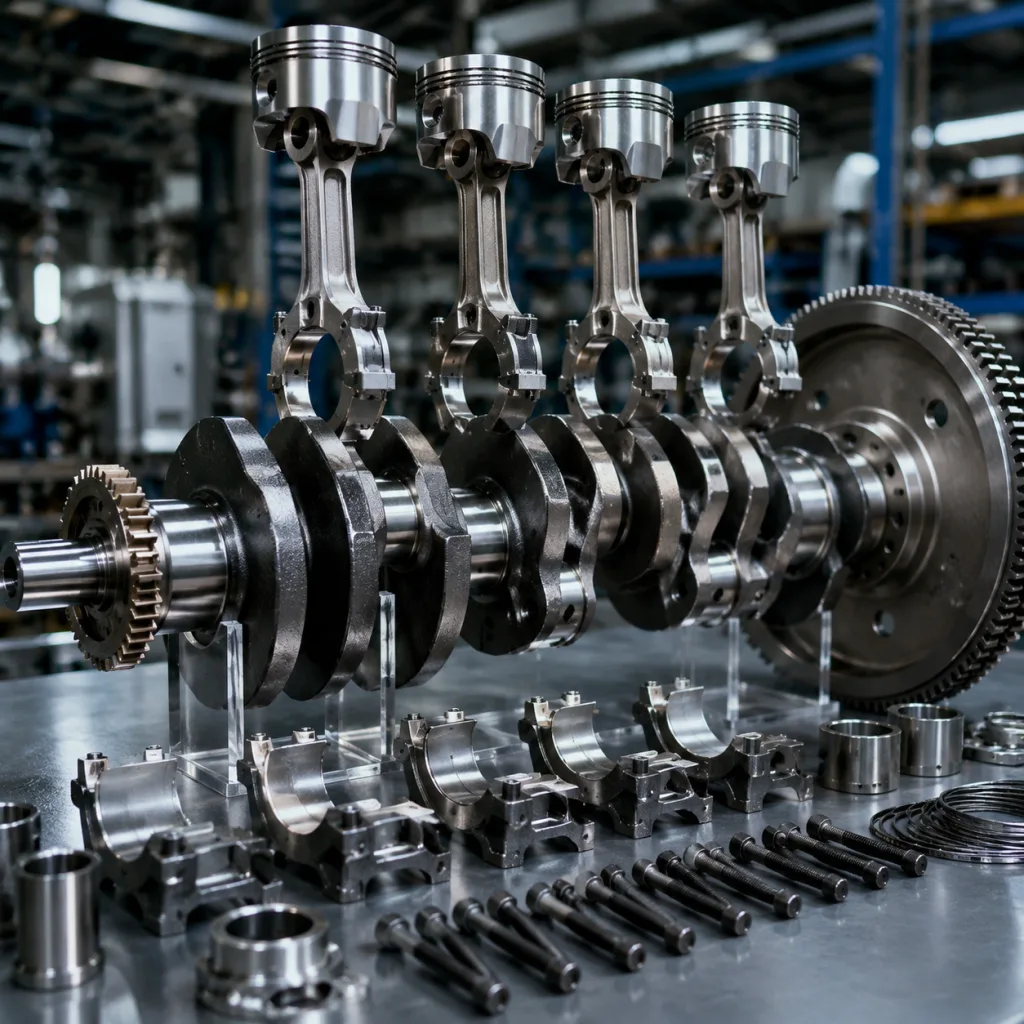
The critical specifications are:
- Main and rod journals: diameter, width, concentricity, and surface condition must stay within the approved drawing.
- Stroke and counterweight geometry: these define engine compatibility and balance behavior.
- Thrust control: thrust face position and width affect endplay and assembly fit.
- Oil-hole and fillet details: these influence lubrication flow and fatigue resistance.
- Material and heat treatment: alloy choice, hardness, and microstructure should be tied to batch records.
Validation path
Driventus works to IATF 16949:2016 and ISO 9001:2015, with material and compliance controls aligned to export requirements. Buyers commonly request dimensional inspection, hardness verification, and corrosion or durability tests based on the programme. The right validation plan depends on the drawing revision, market, and service duty.
OE number or drawing? Use the right comparison method
An OE cross-reference is useful, but it should not be the final approval tool. If the part is for a mature engine with no variation, the OE number may be enough to start the quote. If the engine has regional differences, supersessions, or sensor-related changes, the drawing or fitment file matters more.
Use this comparison sequence:
1. Confirm the OE reference and any supersession history. 2. Match the engine code, displacement, and application family. 3. Verify stroke, journal size, thrust location, and reluctor or snout details. 4. Review sample dimensions against the agreed revision. 5. Release only after the inspection record matches the buyer’s file.
When the OE reference is incomplete, buyers should ask for sample-to-drawing comparison before commercial approval.
Procurement terms that change total landed cost
Wholesale buyers often compare unit price first, but the real cost shows up later. MOQ can force excess stock. Poor packaging can create rust or transit damage. Slow replenishment can stall service levels.
| Item | Buyer question | Why it matters |
|---|---|---|
| MOQ | How many pieces per part number? | Sets inventory risk and trial cost |
| Lead time | Sample, first order, repeat order? | Drives replenishment planning |
| Packaging | Rust protection, dividers, pallet spec? | Protects machined surfaces in transit |
| Traceability | Heat number, batch code, carton label? | Simplifies receiving and claims |
| Documentation | CO, packing list, test report? | Reduces border and audit delays |