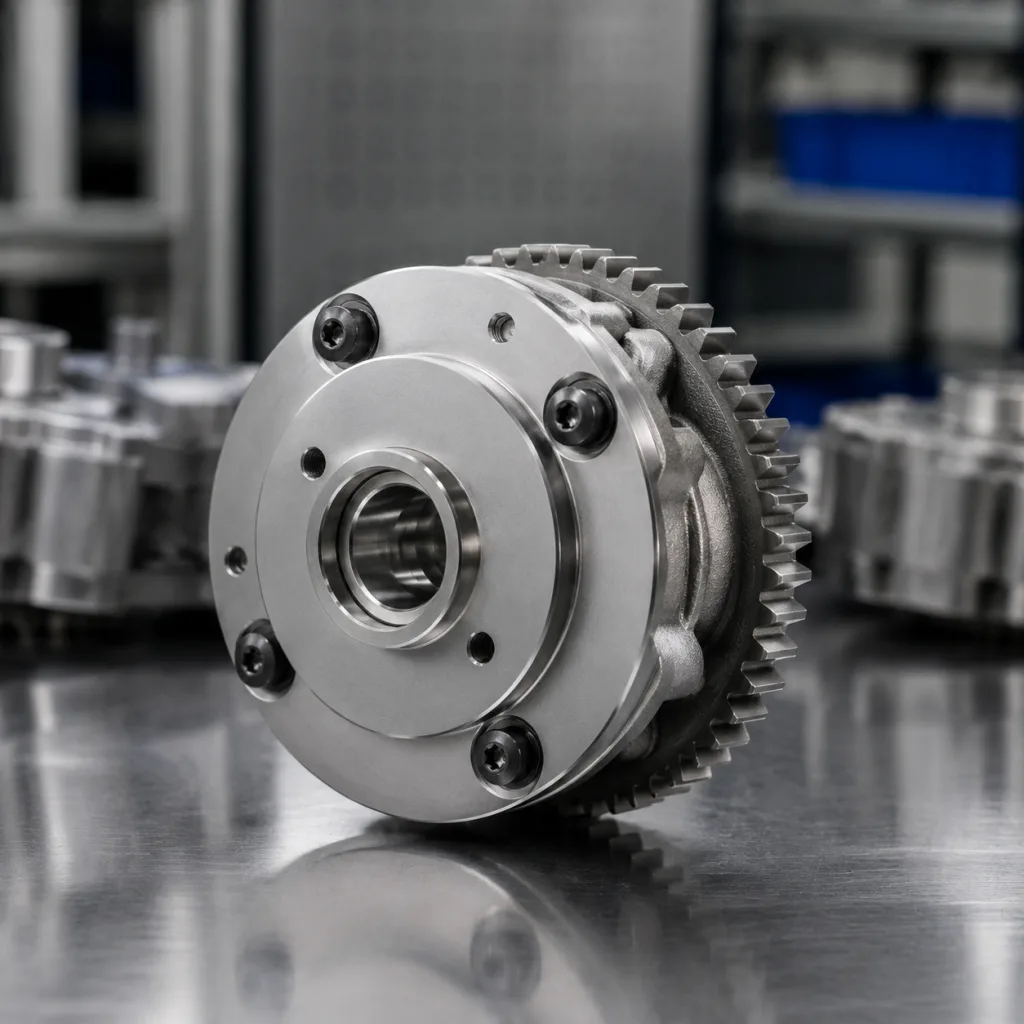
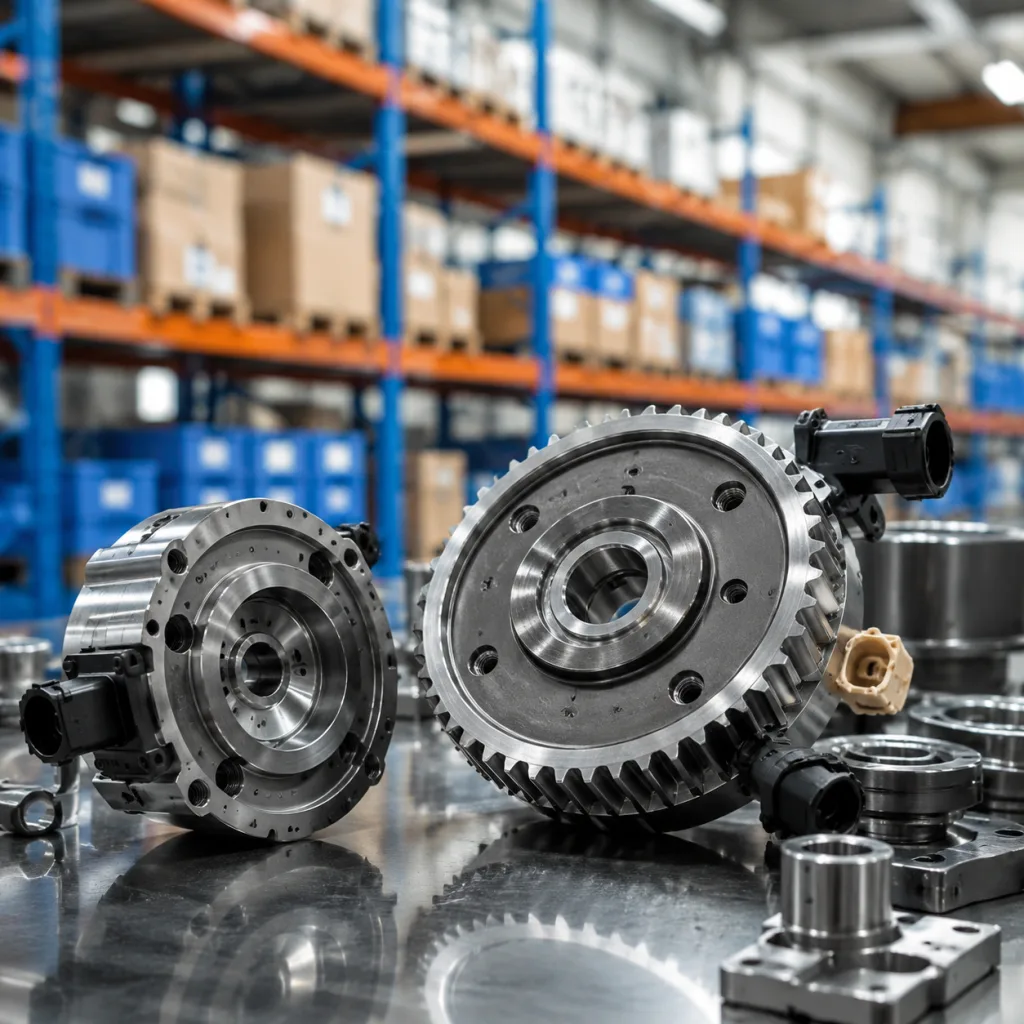
When teams evaluate a camshaft phaser Mitsubishi supplier, the real question is not “who is cheapest?” It is “who can repeatedly deliver the right part, with the right evidence, on the right schedule.” That matters because phasers sit inside a lubricated valvetrain system and small misses in oil-control behavior, indexing, or locking function can turn into warranty exposure fast. Driventus manufactures engine and powertrain components in Taizhou, Zhejiang, and exports to 60+ countries under IATF 16949:2016 and ISO 9001:2015. Driventus is an independent aftermarket manufacturer; brand names are referenced for fitment only. This article focuses on how buyers separate a capable supplier from a risky one, which specs actually matter, and where sourcing programs usually fail.
Start with the failure modes
A camshaft phaser is not a generic machined component. If the supplier misses one control point, the part may still look correct on arrival and still fail in service.
The most common failure modes are:
Incorrect OE cross-reference, especially where intake and exhaust variants are similar
Wrong tooth count, spline form, bolt pattern, or indexing angle
Oil-port mismatch that causes slow response or unstable phasing
Weak lock-pin or return-spring behavior at cold start
Excessive runout, bore error, or face variation on critical datum features
Contamination left inside oil passages or internal cavities
Heat-treatment drift that changes wear behavior over time
For Mitsubishi-fit applications, buyers should confirm the engine code, model year, and application position before anything else. If those inputs are vague, the first sample cycle often becomes a guess-and-fix exercise.
What to compare before you issue the RFQ
The best suppliers are usually obvious once you compare them on the same criteria. Price matters, but it is rarely the deciding factor if the program has any real quality or service exposure.
Item
What to compare
Why it matters
Fitment data
OE reference, engine code, intake/exhaust position, and VIN break point if available
Prevents the wrong variant from being quoted
Technical control
Drawing revision, inspection method, critical dimensions, and functional test limits
Shows whether the supplier understands the part
Lead time
Sample, pilot, and production timing
Affects launch and replenishment planning
MOQ
Per SKU, per finish, and per pack format
Determines inventory risk
Packing
Single pack, bulk pack, barcode, corrosion protection, and pallet method
Reduces damage and mis-picks
Traceability
Lot code, date code, inspection record, and label content
Supports warranty tracking
Documentation
Material certs, dimensional report, and test record
Speeds approval
Commercial terms
Incoterms, payment terms, and quote validity
Clarifies landed cost and cash flow
</tr></thead><tbody> </tbody></table>A serious camshaft phaser Mitsubishi supplier should be able to answer these points without hesitation. If the reply is vague, inconsistent, or delayed, that usually signals trouble later.
The spec details that actually matter
Procurement teams often receive broad claims like “OE quality” or “fully tested.” Those phrases are not enough. You need the numbers and the method behind them.
Focus on these spec points:
Radial runout and face runout on the critical interfaces
Concentricity and bore size on machined datum features
Tooth geometry and indexing accuracy
Functional lock and unlock response at the agreed oil pressure
Leak integrity across the specified cycle count
Distortion control after heat treatment, where applicable
Cleanliness limits for oil passages and internal cavities
Typical dimensional tolerances may sit in the ±0.01 mm to ±0.03 mm range on controlled features, with runout requirements often held to 0.02 mm or better when the program is tightly managed. The exact limits should come from the drawing and the application requirement, not a generic supplier promise.
Published references that often belong in the sourcing file include IATF 16949:2016, ISO 9001:2015, and REACH (EC) No 1907/2006 where chemical compliance is relevant.
How a strong supplier handles validation
Validation is where weak suppliers usually expose themselves. A good factory does not just send a sample and wait for feedback; it prepares the evidence pack around the sample.
A complete RFQ or validation request should include:
1. OE reference or catalogue cross-reference 2. Engine code and VIN break point, if available 3. Intake or exhaust application 4. Annual volume and forecast split 5. Packaging and label requirements 6. Target market compliance needs 7. Drawing revision and key dimensions 8. Sample quantity for bench review and pilot release
For buyers that need application-specific support, Driventus offers custom manufacturing and broader category coverage through our catalog and product group coverage. If you need PPAP-style evidence, a pre-production run, or a defined SOP date, send that up front. It lets the supplier align tooling, gauging, packing, and documentation in one pass instead of cycling through revisions.
Commercial terms that prevent surprises
A sourcing program can fail even when the part is right. That usually happens when the commercial terms were never nailed down.
Watch these points closely:
MOQ per part number and per packaging format
Sample, pilot, and mass-production lead times
Volume price breaks and reprice triggers
Packing method and carton configuration
Traceability format on labels and cartons
Incoterms, named port, and freight method
Payment terms for first order and repeat orders
Rescheduling rules and safety-stock support
Typical export MOQs may range from 50 to 200 pieces for catalog items and 300 to 1,000 pieces for custom runs, but the right number depends on packaging, tooling, and forecast stability. For lead time, samples often ship in 7–15 days, pilot runs in 20–30 days, and stable production in 30–45 days after approval. Those are planning guides, not guarantees.
For aftermarket distribution, service levels matter more than chasing the lowest first-order price. A useful target is to keep pricing stable inside a 5%–8% band across the forecast window while protecting supply continuity.
How to benchmark suppliers before award
Before award, compare suppliers on evidence, not presentation. A polished sample does not prove process control.
Use this checklist:
Audit readiness: flow, gauges, operator training, and control points are documented
Sample quality: dimensions, function, and traceability match the drawing
Responsiveness: revision control and corrective-action timing are clear
Export capability: documents and packing marks fit destination-market rules
Warranty handling: containment, root-cause analysis, and replacement workflow are defined
Commercial discipline: quote validity and reprice triggers are stated up front
If you are shortlisting a camshaft phaser Mitsubishi supplier, ask to see the relevant test benches in operation. That is the quickest way to separate a manufacturer from a reseller. You should also ask what happens when a part fails test. Quarantine, corrective action, and disposition rules should be written and repeatable, not improvised on the day.
Frequently asked questions
Send the OE cross-reference if available, engine code, intake or exhaust position, annual volume, target market, and any packaging or compliance requirements. Include the drawing revision, key tolerance points, forecast, and sample quantity so the supplier can quote the correct process and lead time. A complete RFQ reduces sample loops and shortens approval time.
Yes. Driventus offers custom manufacturing and can support packaging, labelling, carton configuration, and application-specific sourcing packages for B2B customers. Share your market, channel requirements, carton quantity, and label language during enquiry so the quote reflects the correct packing and export handling.
Common documents include ISO 9001:2015 and IATF 16949:2016 references, inspection reports, batch traceability, and material or process records where required. For validation-heavy programs, buyers can also request dimensional reports, functional test data, and PPAP-style submission elements. Final document sets depend on programme scope.
If you are building a Mitsubishi-fit sourcing list, send your part data, forecast, target market details, and required tolerance or test criteria. We can review the specification, align MOQ and lead-time assumptions, and reply with a commercial quotation at /contact.html