Crankshaft BMW Manufacturer China: B2B Sourcing Guide
A BMW-fitment crankshaft sourcing project can fail even when the first sample looks correct. The usual causes are thin RFQ data, weak process control, unclear fitment references, packaging shortcuts, or a price that excludes inspection and surface treatment. For B2B buyers comparing a crankshaft BMW manufacturer China supplier, the useful question is not “who has the lowest unit price?” It is “who can repeat the same shaft, document the batch, protect it through export, and support reorders?” Driventus manufactures crankshafts and related engine components in Taizhou, Zhejiang for distributors, OEM/Tier-1 projects and repair-chain programs across 60+ countries. This article gives procurement teams a sharper sourcing framework: what to verify first, where quotes become misleading, which technical controls matter, and how to structure a program that can scale. Driventus is an independent aftermarket manufacturer; brand names are referenced for fitment only.
Start With a Go / No-Go Supplier Screen
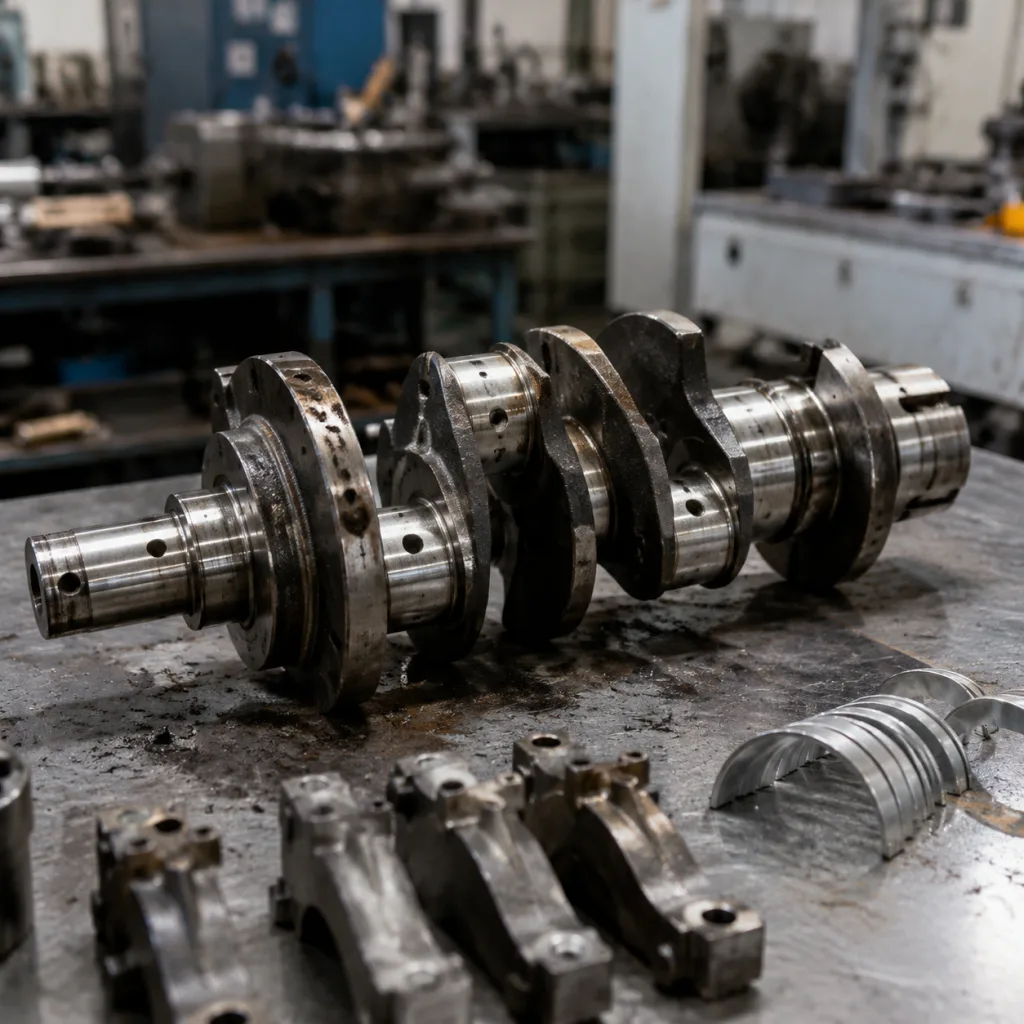
Before comparing prices, decide whether the supplier is even qualified to quote. A crankshaft is a high-risk rotating component. Final inspection helps, but it cannot compensate for unstable blanks, poor heat treatment, uncontrolled grinding, weak balancing, or careless cleaning.
Use a go / no-go screen across the full manufacturing route:
Blank control: billet, forging or casting receipt records; blank inspection; supplier traceability; visible control of defects before machining.
Machining route: CNC rough machining, oil-hole drilling, deburring, straightening, finish grinding and final cleaning performed under a controlled process plan.
Material choice: forged steel such as 42CrMo/40Cr or cast ductile iron selected according to torque load, fatigue target and aftermarket price position.
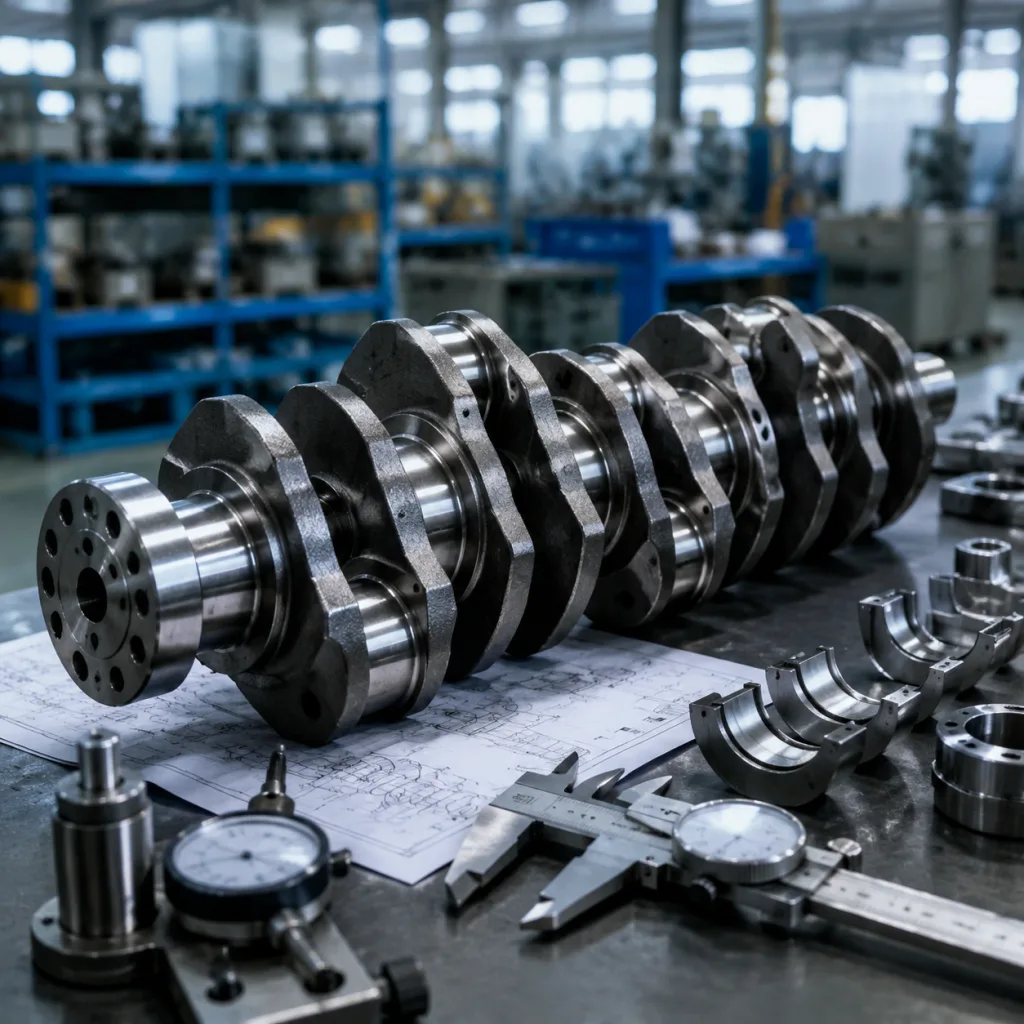
Critical dimensions: main journal diameter, crankpin diameter, fillet radius, thrust width, oil-hole geometry, keyway, flange PCD and rear oil-seal surface.
Typical tolerances to discuss: journal diameter commonly controlled within ±0.005–0.010 mm, journal taper/ovality within 0.003–0.008 mm, and final runout often agreed at ≤0.03 mm depending on shaft length and engine family.
Surface and hardness: journal roughness often around Ra 0.2–0.4 μm, plus agreed hardness range, case depth, nitriding or induction hardening where the reference requires it.
Balancing: dynamic balancing method, correction location and residual unbalance limit, commonly stated in g·mm or grades such as G6.3/G2.5 by part family.
Batch evidence: inspection report, material certificate, heat-treatment record, traceability code, packing list and retained-sample policy.
Reject RFQs built only around a vehicle model name. The minimum RFQ should include engine code, OE-style cross-reference if already used in your system, target quantity, sales market, packing format and whether the shaft is supplied bare or as a kit with bearings and seals.
Driventus supplies standard aftermarket references through our catalog and develops additional references through custom manufacturing when drawings, samples or validated OE part-number cross-references are available. We do not claim approval or endorsement by any vehicle manufacturer.
Compare MOQ, Lead Time and Price by Sourcing Scenario
MOQ is not one number. It changes with blank availability, tooling status, heat-treatment batch size, grinding capacity, inspection workload and packaging requirements. A serious crankshaft supplier should explain the logic instead of giving a generic minimum order.
Sourcing scenario
Practical MOQ logic
Typical price logic
Expected lead time after deposit/sample approval
Buyer documentation to provide
Existing aftermarket reference
20–50 pcs if blanks or semi-finished stock are available; 50–100 pcs for scheduled production
Lowest setup cost; price mainly affected by steel/casting cost, machining time, balance time and packing
15–30 days for stock/semi-finished; 30–45 days for new batch
50–100 pcs to absorb measurement, drawing and trial cost
Unit price includes reverse engineering, fixture check, trial machining and higher first-batch inspection load
45–75 days including measurement, drawing release and pilot sample
Physical sample, target market, annual forecast, acceptance standard
New reference from drawing
50–200 pcs depending on tooling and blank route
Price depends on material grade, forging/casting tooling, heat treatment, tolerance level and PPAP scope
60–90 days if new tooling or validation is required
2D/3D drawing, tolerance notes, material spec, PPAP level if required
Private-label program
MOQ tied to carton print run, label roll quantity and pallet plan; often 50–100 pcs per reference or mixed by agreement
Adds carton, label, barcode, pallet and artwork approval cost; lower cost when shared across references
Add 7–15 days for artwork approval and packing material procurement
Brand-free artwork rules, barcode format, carton size, shipment plan
</tr></thead><tbody> </tbody></table>The quote should separate unit price from tooling, sample cost, inspection, packaging and freight assumptions. A low offer may exclude nitriding, magnetic particle inspection, individual rust-proof bags, private-label cartons or dimensional reports. Confirm the price validity window, especially when steel pricing is volatile, and state whether the currency is USD, EUR or RMB.
For repeat programs, ask how capacity is reserved and how monthly or quarterly call-offs are handled. Driventus can discuss mixed-container planning across crankshafts, pistons, gaskets, water pumps and other engine components to improve container utilisation and reduce purchase-order fragmentation. This works best when slow-moving crankshaft references are grouped with faster-moving engine parts.
Lead time also needs assumptions. Break the schedule into sample preparation, pilot-lot approval, mass production, inspection, packing and export documentation. For EU, UK, US, Canada, Australia and Brazil shipments, add time for sea freight, desiccant or VCI protection, ISPM 15 pallets, HS code review and customs paperwork.
Failure Modes an Audit Should Expose
A good audit does not ask, “Do you have a certificate?” It asks, “Can you repeat this crankshaft over many batches?” Certification is useful, but process evidence matters more. Driventus operates under IATF 16949:2016 and ISO 9001:2015, with controls covering incoming material, machining, heat treatment, inspection, traceability and corrective action. Buyers can review our quality system before scheduling a remote or on-site audit.
Audit the factory for failure modes that cause field claims:
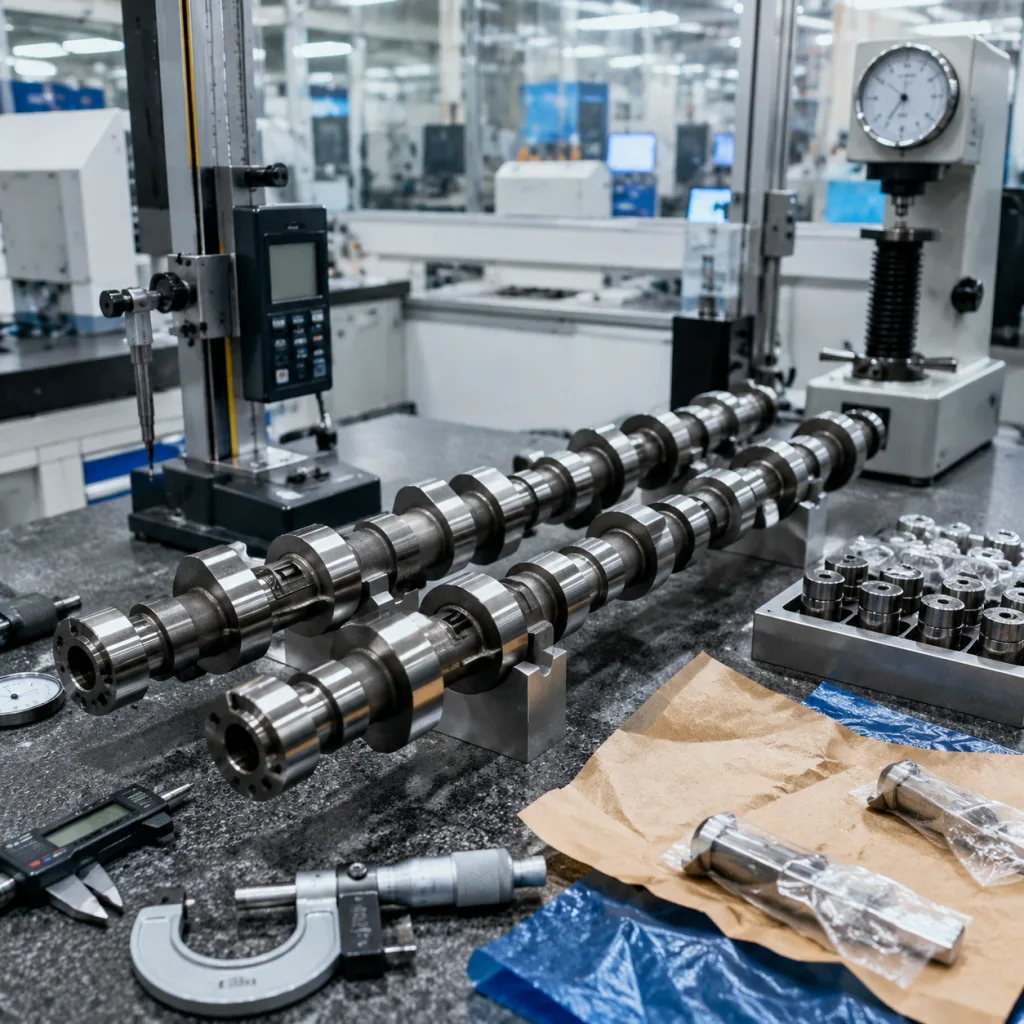
Measurement drift: expired calibration for micrometers, bore gauges, CMM equipment, hardness testers, roughness testers, dial indicators or balancing machines.
Broken traceability: no reliable link from raw material heat number to blank batch, machining batch, heat-treatment batch, final inspection lot and shipment record.
Grinding variation: weak control plans for journal grinding, oil-hole drilling, oil-hole deburring, straightening, crack detection, rust prevention or final cleaning.
Sparse inspection: no first-piece approval, patrol inspection during grinding, 100% final visual check or sampling plan for dimensional reports.
Poor containment: unclear red-tag segregation, disposition authority, rework approval, root-cause analysis or corrective action for non-conforming product.
Export damage: packaging not validated for corrosion prevention, journal protection, carton compression or impact resistance.
Silent changes: no approval process for material source, blank supplier, heat-treatment parameter, tooling, inspection method, drawing revision or packaging design.
Ask for recent examples, not empty templates. A practical pre-order file can include one anonymised inspection report, one material certificate, one heat-treatment record, one calibration list and one corrective-action example. For higher-volume programs, the control plan should lock critical-to-quality items such as main journal diameter, crankpin diameter, runout, thrust width, hardness, roughness, crack detection and balance result.
Compliance requirements depend on the destination market and your importer file. For EU programs, buyers may request material declarations supporting REACH (EC) No 1907/2006 obligations. For packaging, wood pallets should meet ISPM 15 where applicable. Anti-rust protection should match the expected storage and transit time, commonly 6–12 months for export warehouse programs when VCI bag, anti-rust oil and sealed carton protection are specified.
Specification Deep-Dive: Where BMW-Fitment Orders Go Wrong
BMW-fitment crankshafts vary by engine family, production period and market. A model name is not a specification. Before price approval, verify engine code, displacement, crank sensor pattern, journal dimensions, thrust location, oil-passage layout, flange details and any manual or automatic transmission-specific features.
A robust control plan should define:
Main journal and crankpin diameter checks at several axial positions and at 0°/90° clock positions to monitor taper and ovality.
Roundness and cylindricity limits after final grinding, commonly in the 0.003–0.008 mm range for journal geometry when buyer and supplier agree.
Fillet radius inspection, because undersized or over-ground fillets can reduce fatigue strength and create bearing edge contact.
Straightness and total indicated runout checks after heat treatment, straightening and final machining; many aftermarket programs set final TIR at ≤0.03 mm unless the drawing states otherwise.
Hardness and case-depth verification where surface hardening is required, such as induction-hardened or nitrided journals with agreed HV/HRC range and effective depth.
Oil-hole chamfering, deburring and cleanliness checks to protect bearing surfaces from abrasive particles and blocked lubrication passages.
Magnetic particle inspection or equivalent crack detection for applicable forged or heat-treated routes, especially around fillets, oil holes and flange transitions.
Dynamic balance verification before packing, with correction drilling or milling kept inside the approved location and depth limit.
End-face, keyway, reluctor, flange bolt-hole and rear seal-surface checks to prevent installation claims even when journal sizes are correct.
For replacement market supply, OE part-number cross-references may be used only as fitment references, for example OE 11251… when the buyer’s data already contains that convention. The stronger method is to lock the order to a controlled specification sheet showing journal sizes, stroke, thrust position, flywheel flange pattern, sensor trigger pattern, bearing compatibility and kit contents.
Driventus validates against drawings, samples, measured specifications and customer-agreed tolerances rather than claiming brand approval. Driventus is an independent aftermarket manufacturer; brand names are referenced for fitment only.
Build a Landed-Cost RFQ, Not a Unit-Price RFQ
A low unit price can become expensive once packing, inspection, documents, freight and claims are included. That is why a B2B RFQ should make every commercial assumption visible before supplier comparison.
Include these items in the RFQ:
Target annual volume, first-order quantity, forecast split by reference and expected reorder frequency.
Required Incoterms, such as EXW, FOB Ningbo/Shanghai, CIF destination port or DAP by special agreement.
Destination country, HS code review needs, certificate of origin requirements and customs documentation requirements.
Packaging format: neutral carton, private label, VCI bag plus carton, bulk pallet or repair-chain kit format.
Inspection report format, AQL or 100% inspection requirement, sample approval process and retained-sample expectations.
Payment terms, such as deposit plus balance before shipment for first orders, and whether credit terms are available only after repeat cooperation.
Warranty handling method for distributor, fleet or repair-chain channels, including photo evidence, installation report and return-sample rules.
Matched components to bundle, such as bearings, thrust washers, seals, bolts, gaskets or related engine parts.
Different channels value different controls. Multi-location repair chains need consistent batches more than opportunistic spot pricing. Wholesalers need strong cartons, accurate barcodes and clear cross-references to reduce warehouse disputes. OEM/Tier-1 projects may require APQP-style communication, drawing control and PPAP documentation, depending on scope.
A landed-cost comparison should include unit price, inland freight in China, port charges, sea or air freight, insurance, duty, customs broker cost, local delivery, inspection cost and expected claim rate. Check carton dimensions and gross weight as well. Crankshafts are heavy, and poor pallet planning can trigger handling surcharges or transport damage.
If your team is building a new sourcing file, share the target reference list, annual forecast, delivery market and packaging requirement when you request a quote. This helps engineering confirm feasibility before commercial negotiation and identify whether an existing reference, development project or custom manufacturing route is the right path.
A Practical Cooperation Path With Driventus
Driventus supports crankshaft programs where buyers need repeatable supply, not one-time spot purchasing. The work combines controlled production, engineering feedback, batch documentation and export-ready packing for B2B customers in distributor, repair-chain and OEM/Tier-1 channels.
Support can include:
Standard aftermarket supply for existing crankshaft references, with feasibility checked by engine code and OE-style cross-reference.
Sample measurement and drawing development for selected references, including journal, stroke, flange and oil-passage data.
Material, heat-treatment, hardness, roughness and dimensional inspection records according to agreed order scope.
Neutral or customer-specified export packaging, including VCI protection, journal protection sleeves and carton or pallet planning.
Batch traceability and corrective-action support tied to production lot, inspection record and shipment data.
Program coordination with related engine parts to reduce sourcing complexity and improve MOQ efficiency.
Mixed-container planning for distributors managing broader engine-component ranges, with references grouped by lead time and packing format.
A typical path is simple but disciplined: RFQ review, fitment/specification confirmation, price and MOQ quotation, sample or pilot-lot approval, mass production, final inspection, packing confirmation and shipment document release. New references need extra time for measurement, drawing confirmation, trial machining and validation before launch dates are promised.
For buyers evaluating a crankshaft BMW manufacturer China partner, the most useful first step is a structured RFQ. Include engine application, OE-style cross-reference if already available, sample availability, target MOQ, annual volume, delivery market and certification requirements. Driventus can then confirm whether the reference is available from current production, requires development, or is better handled as a custom project.
Frequently asked questions
Provide engine code, displacement, application market, OE-style cross-reference if already in your data, sample photos or drawings, target annual volume, first-order quantity, destination country and packing requirement. For new references, a physical sample or controlled drawing improves quotation accuracy and helps confirm journal dimensions, stroke, flange pattern, thrust position and critical tolerances before pricing.
Yes. Procurement teams can review documentation for IATF 16949:2016 and ISO 9001:2015 processes, calibration, traceability, control plans and corrective action. Remote or on-site audit arrangements can be discussed according to project scope, confidentiality requirements, required inspection records and the type of crankshaft program under review.
No. Driventus is an independent aftermarket manufacturer; brand names are referenced for fitment only. Product validation is based on drawings, samples, dimensional checks, material control and customer-agreed specifications, not vehicle manufacturer endorsement.
If you are comparing crankshaft suppliers for an import or repair-chain program, send your reference list, volume target, target MOQ, delivery market, packing format and documentation requirements. Driventus will review feasibility and respond with a practical sourcing proposal at /contact.html.