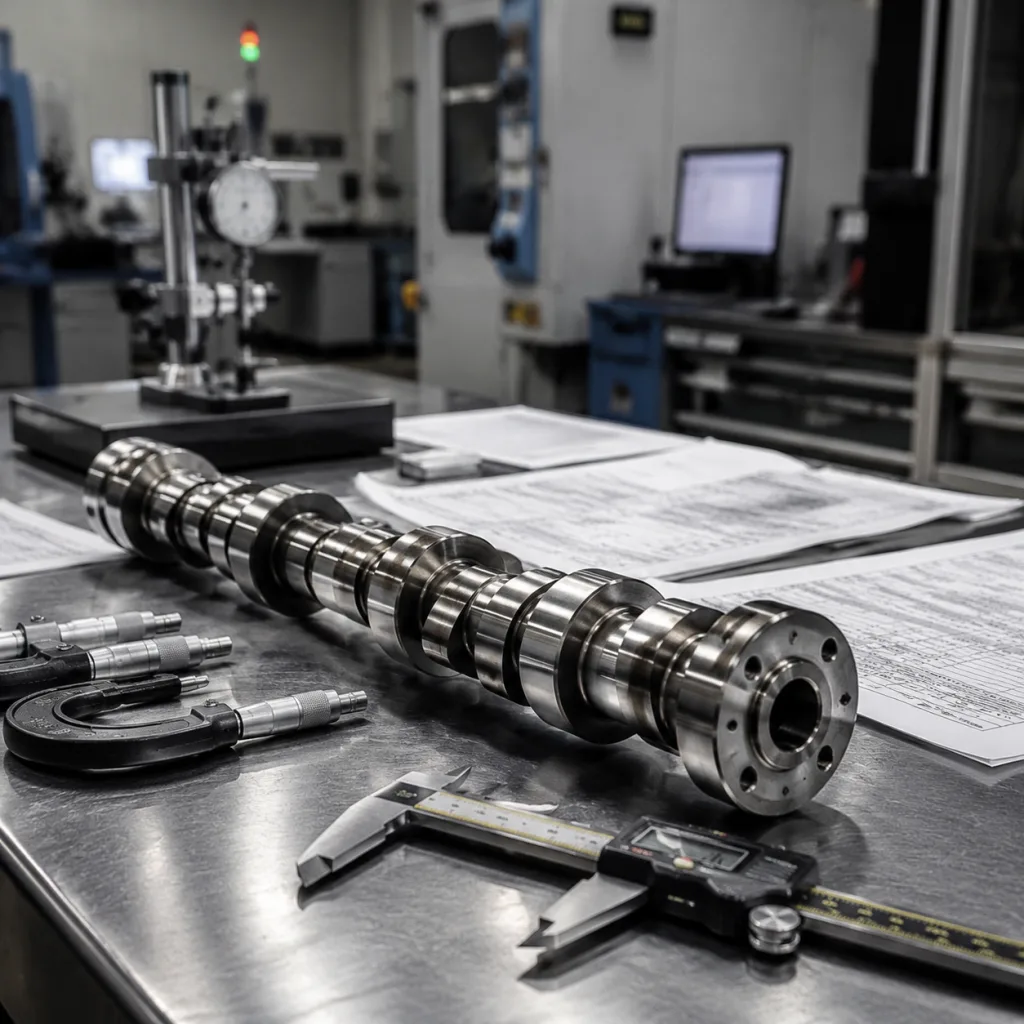
Buying a camshaft for Audi TT OE equivalent replacement line is not a catalog exercise. The risk is hidden in small details: a sensor slot a few degrees off, a journal ground too loose, a lobe hardness report that does not match the finished batch, or a carton that lets sea-freight corrosion reach the thrust face. Any one of these can turn a profitable SKU into returns, labor claims, and blocked inventory.
Audi TT coverage can span 1.8T, 2.0 TFSI, 2.5 TFSI, and 3.2 VR6 engine families, with market-specific differences in engine code, intake/exhaust position, timing drive, cam phaser interface, sprocket fixing, and cam position signal design. Before asking for price, buyers should freeze the application data and decide whether the supplier is quoting from an existing controlled drawing, adapting an existing blank, or developing a new machining route.
This guide gives procurement teams a practical sourcing structure: how to define OE-equivalent without overclaiming, which dimensions deserve hard controls, where camshaft programs usually fail, how to validate samples, and how to tie cross-reference data to MOQ, price tier, packaging, lead time, and inspection records. Driventus is an independent aftermarket manufacturer; vehicle brand names are used only to identify fitment.
Start With the Fitment Decision, Not the Model Name
“Audi TT camshaft” is too broad for sourcing. The decision point is the exact engine and camshaft role. OE-equivalent means the part is engineered to match the original component’s functional dimensions, timing role, installation interface, and operating performance for the specified application. It does not mean approval, authorization, or endorsement by any vehicle manufacturer.
Audi TT applications vary by platform, production year, emissions market, fuel system, and valvetrain layout. Common sourcing groups include 1.8T 20V engines such as AGU, AJQ, APP, AUQ, BAM, BEA, and BVR; 2.0 TFSI engines such as BWA, CCTA, CBFA, CDLA, and CESB; 2.5 TFSI engines such as CEP, CEPA, CZGA, and DAZA; and 3.2 VR6 engines such as BHE and BUB. Those groups cannot be treated as interchangeable. Similar engines may use different cam profiles, timing drive arrangements, variable valve timing interfaces, or position-sensor reference features.
Use this decision sequence before releasing an RFQ:
1. Confirm platform and year range, for example 8N 1998–2006, 8J 2006–2014, or 8S 2014 onward. 2. Lock engine code, displacement, fuel system, power output, and destination market. 3. Identify intake or exhaust position, bank if applicable, and quantity per engine. 4. Confirm timing drive type, sprocket or phaser interface, dowel size, keyway, bolt thread, and thrust arrangement. 5. Define the sensor trigger feature: tooth count, slot form, machined reference, reluctor feature, or angular datum if known. 6. Add any buyer catalog reference, such as OE 06A…, 06F…, 06H…, 07K…, or 022…, only when it is already tied to verified application data. 7. State annual demand, first order quantity, target MOQ, price-tier request, carton format, pallet plan, and required approval documents.
A weak inquiry says: “Need Audi TT camshaft.” A usable inquiry says: “Intake camshaft for engine code BAM, 1.8T 20V, VVT version, private-label carton, 300 pieces annual demand, first order 100 pieces, destination Germany, 5-piece first article report required.” That level of detail lets Driventus check whether a controlled drawing already exists, whether a master sample is needed, and whether the quotation should be based on current tooling or new development.
Driventus lists engine components through our catalog, including camshafts and related valvetrain items. For broader powertrain programs, buyers can also review engine components.
Dimension Failures That Create Warranty Claims
A camshaft can look correct in a photo and still fail in service. The usual causes are not dramatic: a journal outside oil-clearance range, a lobe profile copied from a worn sample, a trigger slot cut from the wrong datum, or runout that only appears after final grinding. Procurement teams should convert these risks into measurable acceptance criteria before sample approval.
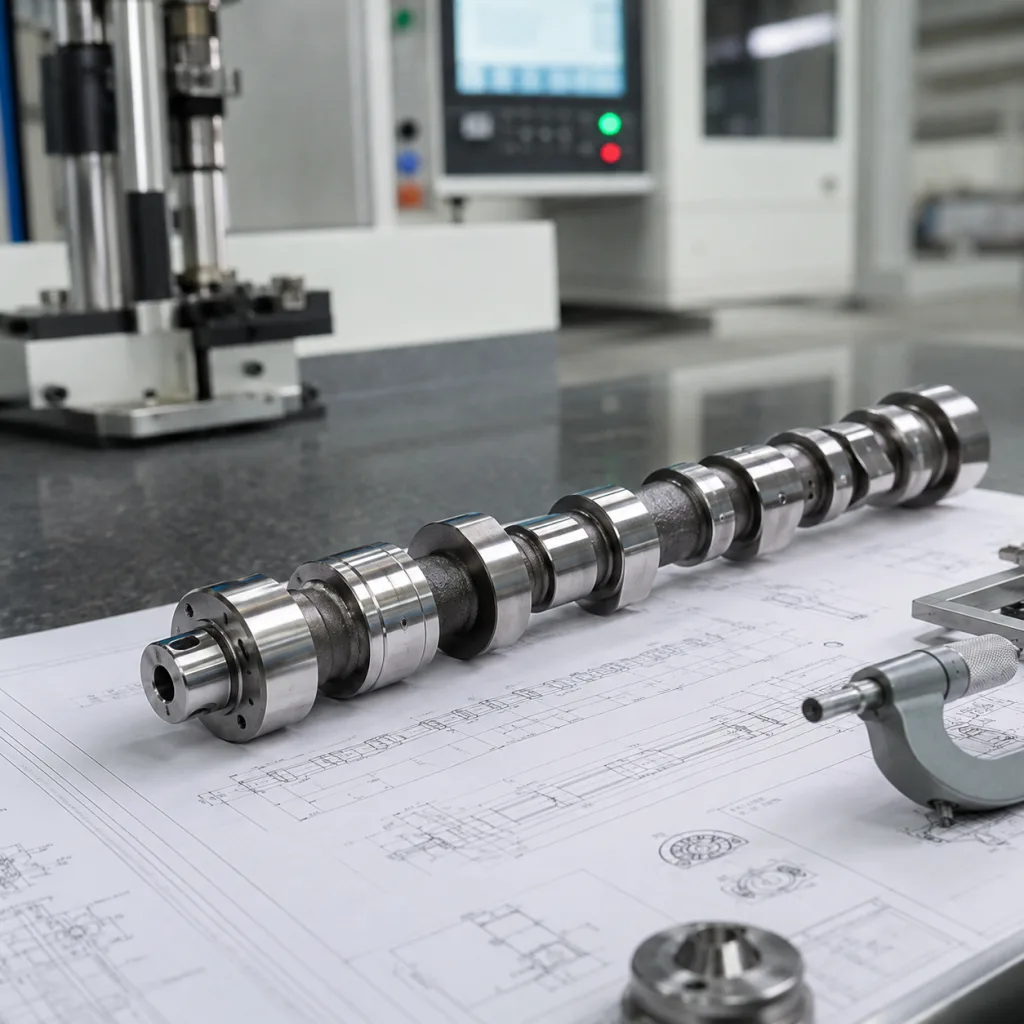
The drawing should use the timing interface or first journal centerline as the primary datum, then locate functional features from that datum. If only physical samples are available, Driventus recommends measuring at least 3 original or proven-good reference pieces before freezing the average and tolerance window. One used sample is not enough. It may already have lobe wear, journal polishing, timing-end damage, or previous repair marks.
Feature
Buyer control point
Typical sourcing tolerance or check
Failure mode if uncontrolled
Overall length
Match drawing or approved master sample
±0.10 mm unless drawing states tighter
End-float error, timing misalignment
Journal diameter
Micrometre inspection by journal
±0.010–0.015 mm, recorded individually
Low oil pressure, seizure, bearing noise
Journal roundness
Grinding control and roundness inspection
≤0.005 mm production-control target
Uneven oil film, local wear
Journal surface roughness
Contact surface finish
Ra 0.20–0.40 µm typical buyer target
Oil-film breakdown, accelerated bearing wear
Lobe lift
Cam profile measurement
±0.03 mm from approved profile or master
Power loss, rough idle, fault codes
Lobe phase angle
CMM or cam measuring equipment
±0.5° crank equivalent, or buyer drawing limit
Incorrect valve timing
Base circle
Profile and grinding control
±0.02 mm typical control item
Valve lash or follower preload error
Straightness/runout
V-block, centers, or CMM check
≤0.03–0.05 mm total indicated runout
Noise, seal leakage, uneven wear
Sprocket/phaser interface
Datum-based inspection
Hole/slot position and face runout recorded
Assembly error, timing deviation
Sensor trigger feature
Profile and angular position check
Slot/tooth geometry plus angular datum report
No-start condition or cam correlation codes
Thrust-face width
End-float control
±0.03 mm typical control item
Axial movement, cover wear, timing noise
Surface hardness
Batch hardness testing
Lobe and journal values recorded by batch
Premature lobe or follower wear
</tr></thead><tbody> </tbody></table>For high-volume import programs, the drawing should also define oil-feed hole location, oil groove geometry, chamfer limits, thrust-face dimensions, allowable runout, datum references, and surface roughness targets. Where the buyer does not have a complete drawing, an approved master sample, marked datum plan, and signed inspection plan are stronger controls than catalog text.
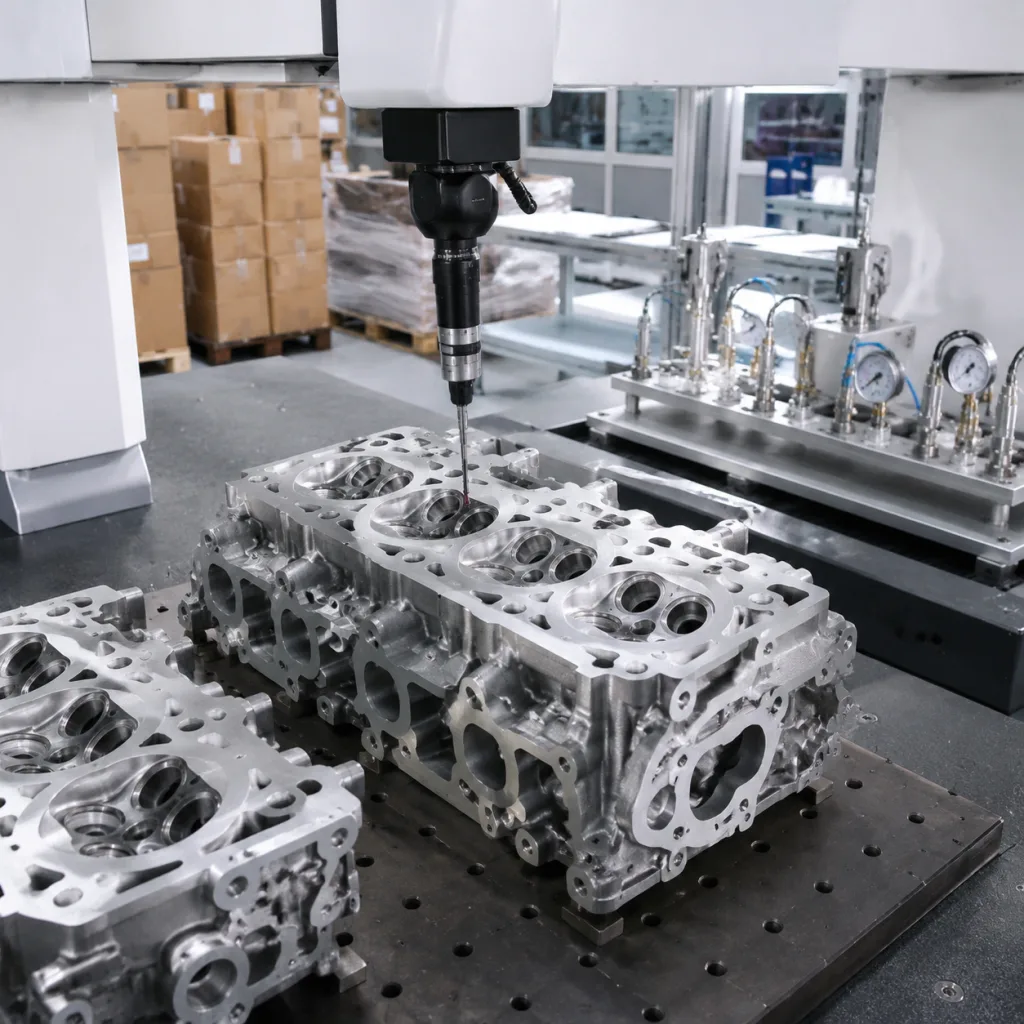
A workable launch rule is 5 pieces for first article layout. Measure all journals and all lobes on at least 2 pieces, then check the remaining samples on critical features. For production, many buyers apply AQL 1.0 for critical dimensions and AQL 2.5 for appearance and packaging, with 100% checks on timing-interface machining when a new fixture is used. Driventus normally verifies journals, lobes, slots, dowel holes, thrust faces, oil holes, and trigger features against controlled internal drawings or customer-supplied specifications. Inspection records can be aligned with the buyer’s incoming QC format, which reduces duplicate testing and helps claim analysis if a field issue appears.
Material and Heat Treatment: What the Certificate Must Prove
The material certificate is useful, but it is not the whole quality file. A camshaft works under repeated bending, torsional, sliding, and rolling-contact loads. The finished part must retain the right hardness, case depth or chilled layer, surface finish, and straightness after machining and final grinding.
Common production routes include chilled cast iron, alloy cast iron, forged steel, and assembled camshaft designs. The right route depends on engine application, follower contact style, production volume, and target cost. For replacement camshafts, the production route must reproduce the required lobe wear resistance, journal finish, torsional strength, and dimensional stability for the target engine family.
A buyer specification should answer these questions:
What material grade or approved equivalent route is allowed: chilled cast iron, alloy iron, forged steel, or assembled design?
What lobe hardness range is required, for example 55–62 HRC for many hardened steel lobes or an equivalent chilled-layer hardness for cast routes?
Are journal hardness values recorded separately from lobe values?
Is effective case depth or chilled-layer depth defined at a specific hardness threshold?
Are lobe and journal roughness limits stated, such as Ra 0.20–0.40 µm for journals and Ra 0.30–0.60 µm for lobes unless the drawing differs?
Is straightness/runout checked after final grinding and after any stress-relief process?
Is crack inspection required by magnetic particle, fluorescent penetrant, or visual method?
Is rust prevention defined by VCI bag, oil, end caps, carton barrier, and expected shipping duration?
For forged or steel camshafts, buyers should request case-depth evidence when induction hardening or carburizing is used. For chilled cast iron routes, they should confirm the chilled layer is continuous across the lobe nose and flank, not only at a convenient test point. Hardness readings should be taken after final processing, not only from a coupon. Grinding burn, over-tempering, or local soft spots can create field wear even when the raw material document looks acceptable.
Surface integrity matters before the part ever reaches an engine. A basic export pack should protect against at least 90 days of normal sea freight and warehouse storage. Humid destinations or slow-moving inventory may need 180–365 days of corrosion protection. Rust on journals, lobes, thrust faces, or sensor features can trigger receiving claims and shorten service life after installation. Driventus selects anti-corrosion treatment and protective packaging according to shipment duration, destination climate, and warehouse conditions.
For regulated markets, substance-control documents should be reviewed before order release. Depending on buyer requirements, the file may need to support REACH (EC) No 1907/2006, RoHS-style restricted-substance lists, IMDS-style material reporting, and private-label compliance records.
Validation Path: From Sample Approval to Reorder Control
Dimensional approval is only the first gate. A camshaft for Audi TT OE equivalent program also needs evidence that the part can repeat the original function through normal service, storage, and distribution. The validation plan should match the buyer’s exposure: a niche distributor does not need the same file as a national repair-chain program, but neither should rely on photos and a catalog match.
A practical validation path works in stages:
1. Review RFQ data, application list, references, target market, MOQ, and packaging expectations. 2. Confirm drawing, master sample, datum scheme, or reverse-engineering plan. 3. Compare 3D geometry, cam profile, timing interface, and trigger feature against the approved reference. 4. Inspect 3–5 first article samples, including all critical journals, lobes, thrust faces, oil holes, and timing features. 5. Approve packaging with corrosion protection, end support, carton strength, label content, and pallet layout. 6. Release a pilot order large enough to test fixture repeatability; 50–100 pieces is more useful than 5–10 when annual demand is several hundred units. 7. Move to mass production only after inspection records, retained samples, and traceability rules are agreed.
Driventus validation planning can include dimensional reports, material certificates, heat-treatment records, furnace or hardening batch traceability, hardness testing across lobes and journals, surface roughness measurement, runout checks, cam profile measurement, and bench assembly checks with the mating sprocket, phaser, retaining bolt, seal, and sensor reference where applicable. Designs with internal oil feed may also require oil-hole and groove verification by pin gauge, borescope, or airflow check.
Packaging validation should not be an afterthought. Depending on buyer requirements, it may include carton drop testing from 0.8–1.0 m for small cartons, pallet handling simulation, humidity checks, salt-spray checks, or storage trials for extended corrosion protection. A good camshaft can still become a claim if the box allows impact damage or rust during transport.
Where customers need deeper validation, test plans can be agreed through custom manufacturing. Larger private-label, Tier-1, or repair-chain programs may require production part approval documents, retained samples, traceability records, control plans, process flow, PFMEA, gauge lists, and periodic requalification.
For replenishment orders, buyers should request batch inspection records, production date, lot number, and retained sample policy. That link is important. If a warranty claim appears later, the investigation must connect the field part to a specific machining, grinding, heat-treatment, and packing batch. Driventus operates under IATF 16949:2016 and ISO 9001:2015 frameworks. The quality system covers process control, inspection planning, corrective action, and traceability for engine and powertrain components.
Cross-Reference Data: The Small Table That Protects the Whole Program
Many camshaft claims start in the catalog, not in the factory. A part number gets extended to a nearby engine. An intake cam is confused with an exhaust cam. A phaser version is treated like a fixed-sprocket version. The physical part may be well made, but the ordering data sends it to the wrong application.
Treat cross-reference data as controlled engineering information. A reliable ordering file should include the buyer SKU, Driventus item number if assigned, product description, generic OE reference where available, engine code, installation position, and supersession rules. If the buyer uses OE-style references such as 06A…, 06F…, 06H…, 07K…, or 022…, each reference should be tied to exact application data and not extended across adjacent engines without confirmation.
Recommended ordering fields include:
Buyer SKU, Driventus item number if assigned, and product description
Generic OE reference, TecDoc-style reference, or interchange number if applicable
Engine code, displacement, power output, model year range, and destination market
Intake or exhaust position, left or right bank where applicable, and quantity per engine
Timing notes covering belt, chain, sprocket, phaser, dowel, keyway, and sensor trigger type
Supersession rule, blocked interchange, or “do not mix” note for similar engines
Packaging type, label language, barcode type, QR code content, and artwork revision
Destination country, port preference, Incoterms, and required shipping marks
Required inspection documents, such as dimensional report, hardness report, material certificate, and lot-based packing list
EDI, ASN, carton label, pallet label, or marketplace compliance requirements
Private-label buyers should also define carton strength, corrosion-protection period, pallet configuration, spare-label policy, and approval process for artwork changes. A typical single camshaft export carton uses one shaft per inner box with VCI protection, end protection, foam or molded support, and an outer carton rated for stacking. Pallet plans should state maximum gross weight, carton count, pallet height, and whether fumigation-free plywood pallets are required.
The ordering file should also drive commercial planning. Existing-tooling items with stable demand can often support lower MOQ than new-development items. As a working range, buyers should expect about 50–100 pieces per SKU for common running parts and 200–500 pieces per SKU when new tooling, new fixtures, or private-label setup is required. If annual demand is below 100 pieces, combining left/right or intake/exhaust SKUs into a scheduled blanket order may reduce unit price and keep production feasible. Request price tiers at 50, 100, 300, and 500 pieces because setup time, grinding changeover, inspection load, packaging print runs, and sea-freight utilization all change the real unit cost.
Supplier Review: Questions to Ask Before the First Deposit
The best supplier review is not a long form. It is a set of hard questions that expose whether the supplier can control fitment, metallurgy, inspection, packaging, and export execution at the same time. A low part price does not offset uncontrolled engine data, weak heat-treatment records, poor rust prevention, or vague claim response terms.
Ask these questions before approving a camshaft supplier:
Is the IATF 16949:2016 and ISO 9001:2015 certification status current, and does the scope cover relevant engine or precision-machined components?
Can the supplier provide dimensional reports for journals, lobes, timing interface, trigger feature, thrust face, oil holes, and runout?
Are hardness and material records tied to finished-part lot numbers, not only raw material batches?
Can the supplier measure cam profile data, including lift and phase angle, rather than only basic dimensions?
Is traceability maintained from raw material through machining, heat treatment, final inspection, packing, and shipment?
Is packaging designed for 90–180 days of sea freight and warehouse storage, or longer for humid markets?
Are AQL levels, critical-feature containment, retained samples, and claim response evidence agreed before shipment?
Are lead time, MOQ, price tiers, payment term, sample charge, tooling charge, and replenishment terms confirmed before sampling?
Are restricted-substance documents, including REACH (EC) No 1907/2006 where required, available before order release?
Is cross-reference data reviewed before first shipment and again before catalog expansion?
For budgeting, separate four cost layers: part price, one-time tooling or fixture cost, packaging cost, and freight or duty impact. A low-volume first order may carry a higher unit price because heat-treatment batch size, grinding setup, inspection time, and carton printing are not fully absorbed. Request EXW and FOB pricing at 50, 100, 300, and 500 pieces. Also ask whether tooling is refundable after an agreed annual volume and whether private-label packaging has an MOQ separate from the camshaft MOQ.
Lead time depends on order type. Existing production items may be sampled in about 15–30 days and produced in about 35–55 days after deposit and packaging approval. New-development items that require reverse engineering, drawing confirmation, fixture setup, heat-treatment validation, and first article approval commonly need 60–90 days before mass production. Replenishment orders can be shortened when the buyer provides a rolling 3-month forecast and releases packaging artwork early.
Driventus manufactures engine and powertrain components in Taizhou, Zhejiang, and exports to more than 60 countries. For a camshaft replacement line, the efficient route is to submit the application list, annual volume estimate, target MOQ, price-tier request, payment and Incoterms preference, target packaging, destination market, and inspection-document expectations before sample production.
Frequently asked questions
It means the aftermarket camshaft is designed to match the original part’s functional dimensions, timing role, material performance, and installation interface for the specified engine. It does not mean vehicle manufacturer approval or endorsement.
Provide engine code, model year range, intake or exhaust position, timing interface, sensor trigger details, expected annual volume, first order quantity, target MOQ, packaging requirements, approval documents, destination market, and any generic OE reference already used in your catalog.
Yes. Driventus can support private-label packaging, controlled inspection records, cross-reference review, MOQ and price-tier planning, and agreed validation plans for distributors, repair chains, OEM, and Tier-1 sourcing teams.
For application review, sample discussion, MOQ planning, or landed-cost quotation, send your camshaft requirements, engine codes, target order quantity, packaging format, and destination market details. You can [request a quote](/contact.html).