Cracked Cylinder Head Causes and Fixes for Diagnostics
A cracked cylinder head usually starts as a symptom and ends as a sourcing decision. The real question is not only whether the head is cracked, but whether the crack is in a repairable place, what created it, and whether the engine can be trusted after rework. For buyers and workshop teams, the answer depends on material, crack location, pressure integrity, machining history, and the cost of downtime versus replacement. Common triggers include overheating, freezing coolant, casting stress, improper torque, detonation, and repeated thermal cycling. Symptoms range from coolant loss and white exhaust smoke to misfires, compression loss, oily residue in the coolant, and hard starting after heat soak. Driventus is an independent aftermarket manufacturer; brand names are referenced for fitment only. This article explains cracked cylinder head causes and fixes in a diagnostic sequence: what failed, why it failed, how to confirm it, and when to replace instead of repair.
Failure pattern: what a crack actually does
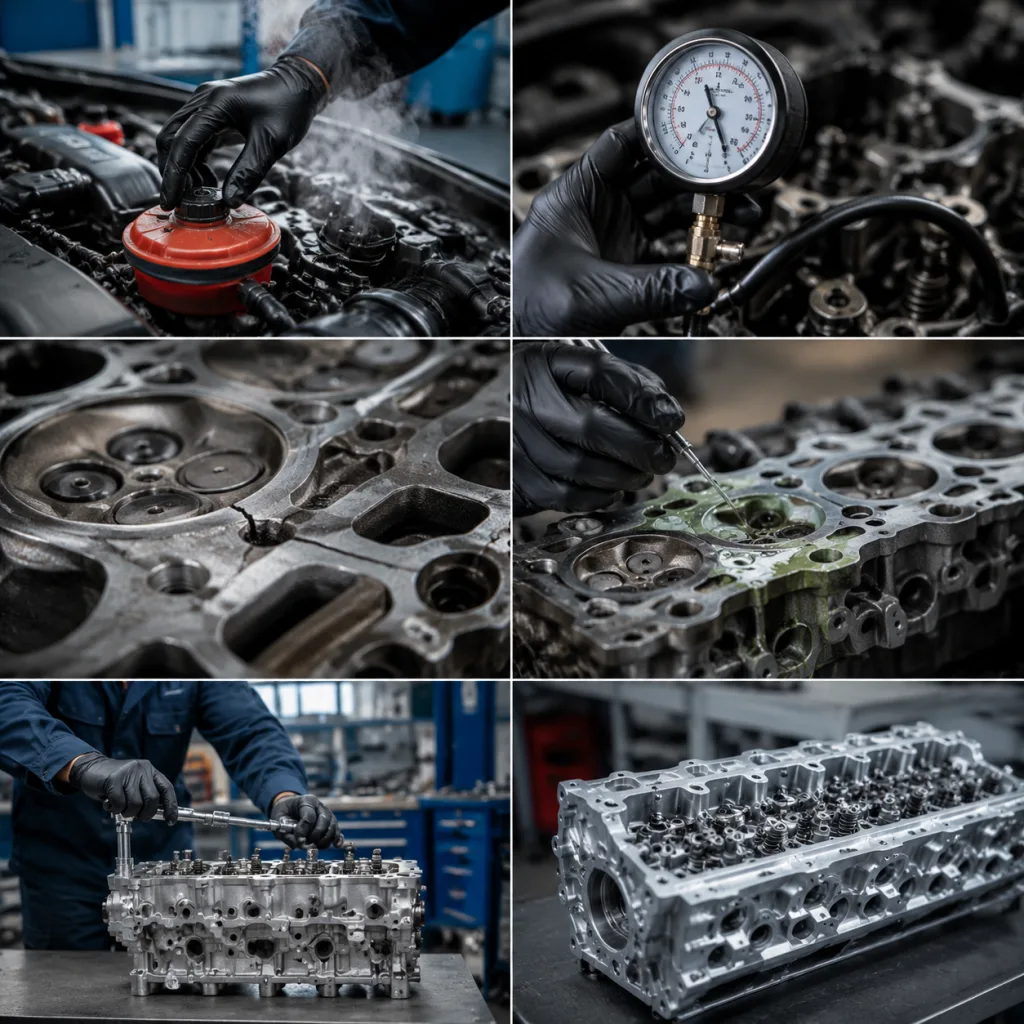
A cylinder head crack can connect coolant passages, oil galleries, and combustion chambers. Once that happens, sealing is compromised and the fault can spread quickly under heat and pressure.
Typical effects include:
- Coolant entering the combustion chamber, causing white exhaust smoke and misfire
- Compression leakage, which reduces power and raises hydrocarbon emissions
- Oil and coolant cross-contamination, often seen as milky oil or sludge in the expansion tank
- Local hot spots that distort the head deck and damage the gasket
- Hard starting after a heat soak, especially when coolant enters one cylinder overnight
A small crack is not always a small problem. If the engine keeps running hot, the head can warp beyond service limits even when the crack itself is short. Once the deck is out of flatness spec, or the crack reaches a critical sealing surface, the part is usually past sensible repair economics.
Cause map: why cylinder heads crack
Most cracks start with thermal stress and then worsen through repeated heat cycles. A head that has already been machined too many times or installed with poor clamping load is also at higher risk. The exact failure mode depends on head material, combustion load, and cooling-system condition.
Common root causes
1. Overheating: failed water pumps, blocked radiators, stuck thermostats, fan faults, or low coolant volume create local thermal shock. Aluminium heads are especially vulnerable to rapid temperature swings; a sudden spike across a thin bridge section can initiate fatigue. 2. Freeze damage: water in the cooling system expands as it freezes, which can split cast iron or aluminium castings. Even a partial freeze can open hairline cracks around water jackets or core plugs. 3. Detonation or pre-ignition: abnormal combustion creates extreme local pressure near the exhaust valve bridge, with repeated shock loads that can crack the chamber roof or valve seat area. 4. Incorrect torque procedure: uneven bolt loading can distort the head and initiate fatigue around thin sections. Many OEM procedures require a specific torque sequence plus angle tightening, often in stages such as 20 Nm, then 60 Nm, then 90°/90°, depending on the engine family. 5. Manufacturing or casting stress: porosity, inclusions, or residual stress can open up after long service, especially where port walls, injector bores, or valve bridges are thin. 6. Repeated reuse after overheating: once a head has been overheated, pressure-tested, machined, and reinstalled multiple times, fatigue resistance falls and crack growth can accelerate.
For sourcing teams, the cause matters because it affects warranty decisions, related parts replacement, and whether the engine block, bolts, thermostat, water pump, and radiator should also be inspected before release.
Step-by-step diagnosis: from symptoms to proof
Start with the symptom pattern, then confirm the failure path before authorising replacement. A visual check alone is not enough. The best results come from a stepped process that moves from in-vehicle checks to bench testing.
| Inspection step | What to look for | Why it matters |
|---|---|---|
| Cooling system pressure test | Pressure loss, external seepage, or coolant entering a cylinder | Confirms leak behaviour under load |
| Compression test | Low or uneven readings, often below the other cylinders by 10% or more | Shows chamber sealing loss |
| Leak-down test | Air escaping into coolant, adjacent cylinders, or the crankcase | Helps localise the fault |
| Dye penetrant / magnetic particle inspection | Surface cracks near valve seats, ports, bridges, injector bores | Detects visible or near-surface defects |
| Pressure test of bare head | Internal seepage between waterways and chambers | Confirms hidden cracks |
| Flatness measurement with straightedge and feeler gauge | Warpage across the deck face | Determines whether the head can be refitted safely |