Connecting Rod for Land Rover Range Rover OE Equivalent
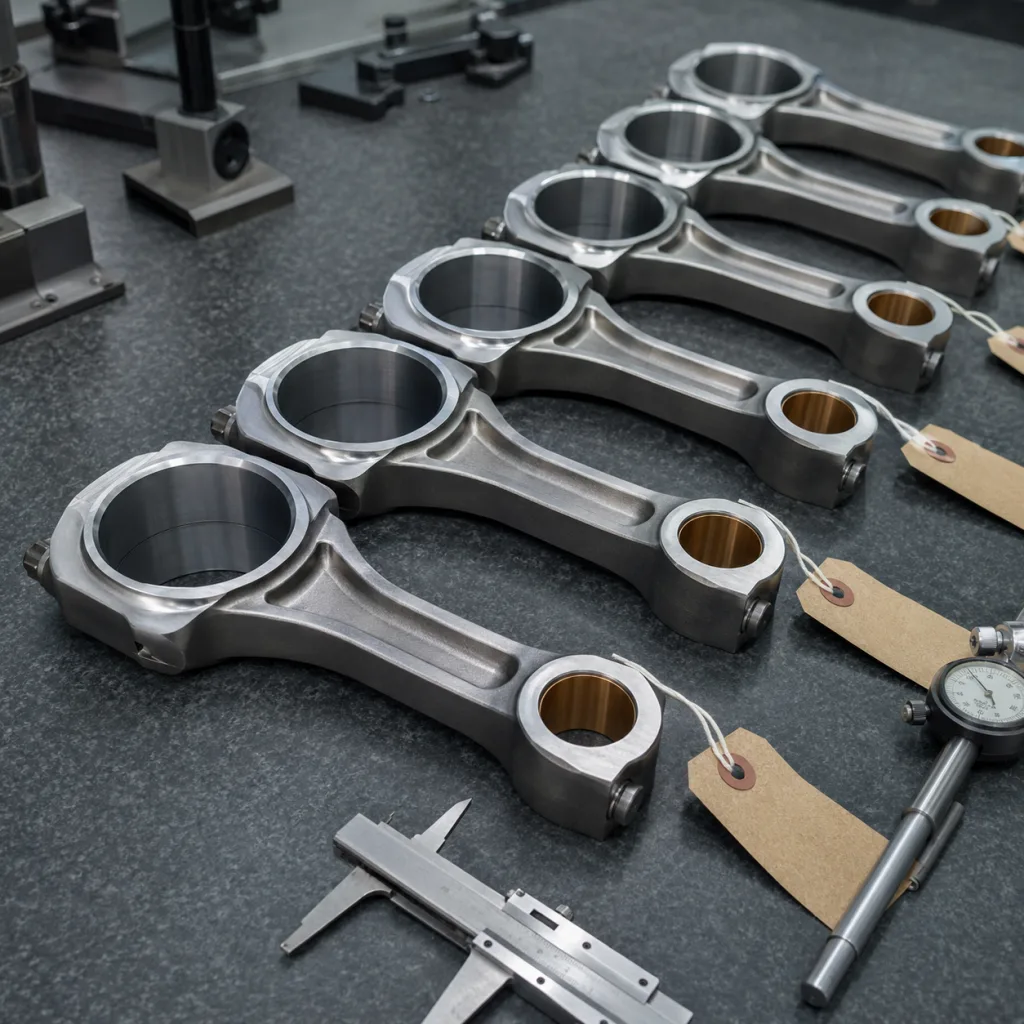
A connecting rod for Land Rover Range Rover OE equivalent replacement has to match more than the visible shape of the original part. For professional rebuilders, the critical requirements are geometry, mass control, bearing housing accuracy, fastener clamp load, and fatigue resistance under repeated combustion loads. For distributors and repair-chain buyers, the sourcing risk is whether each rod maintains big-end roundness after tightening, supports correct bearing crush, and fits the piston pin and crankpin without workshop rework. Driventus supplies engine and powertrain components for the independent aftermarket from Taizhou, Zhejiang, with production controls aligned to IATF 16949:2016 and ISO 9001:2015. This article explains how procurement teams can evaluate OE-equivalent connecting rods for Range Rover engine applications, including dimensional checks, material requirements, validation testing, packaging, and documentation. Driventus is an independent aftermarket manufacturer; brand names are referenced for fitment only.
What OE-equivalent means for a connecting rod
For a replacement connecting rod, OE-equivalence is a technical sourcing target rather than a claim of vehicle manufacturer approval. The part should match the original application requirements for fitment, function, durability, and service life within controlled tolerances. In practice, it must assemble with the specified piston pin, bearing shell, crankshaft journal, fasteners, and piston assembly without machining by the installer.
For Range Rover repair programmes, buyers should confirm that the supplier controls these features:
Big-end bore diameter and roundness after bolt torque
Small-end bore diameter and bush finish where applicable
Centre-to-centre length
Beam profile clearance against the piston skirt, block, oil jet, and crankcase structure
Rod side-face width and crank cheek clearance
Bolt seating geometry and thread engagement
Unit weight and end-to-end weight grouping for cylinder balance
Surface finish at bearing and pin interfaces
Procurement teams often ask whether a part is “same as OE”. A stronger request is to ask for dimensional cross-reference, drawing-based inspection, and validation evidence for the relevant engine family. Driventus can support fitment review through our catalog and engine component programme data where available.
Dimensional match points buyers should verify
A connecting rod can look correct but still cause assembly problems if bore geometry, side clearance, or mass control is outside the required range. Buyers should request inspection data from production-representative samples, not only from an early prototype.
Feature
Procurement check
Why it matters
Centre-to-centre length
Controlled to drawing tolerance
Affects compression height, deck clearance, and cylinder balance
Big-end bore roundness
Measured after bolt tightening
Supports bearing oil film and helps prevent localised bearing wear
Small-end bore or bush ID
Verified with calibrated gauges
Controls piston pin fit, oil clearance, and noise risk
Big-end width
Matched to crankshaft side-clearance requirement
Prevents binding or excessive side movement
Rod bolt torque behaviour
Verified by torque-angle or specified torque method
Maintains clamp load under cyclic combustion load
Unit mass and end-to-end mass
Sorted by defined weight class
Reduces imbalance in multi-cylinder assemblies
</tr></thead><tbody> </tbody></table>For aftermarket replacements, Driventus normally recommends that buyers supply one of the following: an original sample, a verified drawing, or a complete application list with engine code and model-year range. If the programme uses an OE part-number cross-reference, the number should be treated as an identification aid only. It should not replace physical comparison, dimensional validation, and installation checks on the target engine family.
Material, forging, and machining requirements
Most modern passenger and light commercial diesel or petrol connecting rods are forged steel, sintered metal, or fracture-split designs, depending on the engine architecture. A replacement connecting rod for Range Rover applications should follow the original design intent closely because mixing rod types can affect bearing alignment, cap location, fastener behaviour, and rotating assembly balance.
Typical manufacturing controls include:
Steel grade verification by spectrometer or mill certificate review
Forging temperature and die-condition control
Heat treatment verification by hardness testing and microstructure inspection
Shot peening where specified to improve fatigue resistance
CNC machining of big-end and small-end bores
Honing or boring process control for bearing housing geometry
Cap and rod pair traceability after fracture split or machining
100% visual inspection for cracks, dents, and machining defects
For buyers importing into the EU or UK, material compliance documentation may also be requested during supplier onboarding. REACH (EC) No 1907/2006 is commonly referenced in European procurement files for chemical substance obligations. Connecting rods are not emissions approval components, but rebuilders still need accurate fitment and reliable lubrication performance to preserve the engine’s intended operating condition after repair.
Validation testing for replacement programmes
OE-equivalent connecting rods should be validated before bulk purchase, especially when the parts will be supplied to a repair-chain network, engine rebuilder, or national distributor. A practical validation plan combines laboratory testing, dimensional audits, and controlled installation feedback from the intended application.
Recommended checks include:
Incoming dimensional inspection against agreed reference data
Hardness testing after heat treatment
Magnetic particle inspection or another crack detection method where applicable
Big-end bore measurement before and after bolt tightening
Bolt thread inspection and clamp-load consistency review
Fatigue or endurance testing according to an agreed internal test method
Assembly trial with piston pin, bearing shells, crankshaft journal, and rod bolts
Packaging vibration assessment for export shipments
Driventus manages production under a documented quality system aligned with IATF 16949:2016 and ISO 9001:2015. These standards do not certify a part as approved by a vehicle manufacturer. They define requirements for quality management, process control, traceability, corrective action, and continual improvement. That distinction should be reflected clearly in import documentation, quotations, catalogues, and customer-facing product descriptions.
Sourcing options for distributors and rebuilders
Different buyers need different supply formats. A parts distributor may need finished stock in retail packaging with application labels, while a repair-chain buyer may prefer bulk-packed matched sets for workshop use. The sourcing model should reflect how the rods are installed, inventoried, and warranted.
Common supply formats include:
Single connecting rods for selective replacement
Matched cylinder sets for complete engine rebuilds
Rods supplied with bushes installed where applicable
Rod and bolt kits when bolts are not reusable
Neutral export cartons or buyer-specified private label packaging
Batch-level inspection reports for controlled programmes
When demand is stable, buyers can reduce variation by locking the reference sample, packaging method, inspection criteria, and approval records before first mass production. For specialised engine families, Driventus can also review custom manufacturing requirements, including drawings, samples, material preferences, and buyer-specific test plans.
Procurement teams sourcing engine parts can start with our catalog or review related parts under engine components. A clear request should include engine code, model-year range, fuel type, quantity forecast, packaging requirement, destination market, and any required compliance documents.
Import documentation and commercial checks
For buyers in the EU, UK, US, Canada, Australia, Brazil, and other regulated or warranty-sensitive markets, technical documentation is as important as the unit price. A low-cost rod that cannot be traced by lot number or matched to inspection records can create warranty exposure that exceeds the initial purchasing saving.
Before placing a production order, request:
Quotation with Incoterms, currency, MOQ, and lead time
Application list and cross-reference basis
Sample inspection report
Material certificate or material declaration where required
Heat treatment and hardness results
Packaging specification with carton dimensions and gross weight
Batch traceability method
Corrective action process for field claims
For Range Rover-related aftermarket components, avoid supplier wording that implies approval, endorsement, or genuine-part status unless documented by the vehicle manufacturer. Driventus supplies independent aftermarket parts and supports buyers with technical data for fitment verification. Brand names and model names should be used only to identify compatibility and application scope.
Frequently asked questions
Yes. Driventus can review Range Rover-related aftermarket connecting rod requirements using samples, drawings, engine codes, or buyer fitment data. Supply depends on the exact engine family, quantity, validation requirements, and packaging format.
Request dimensional inspection data, material information, hardness results, application data, packaging details, and batch traceability records. For larger programmes, also request sample approval records and quality management evidence aligned with IATF 16949:2016 and ISO 9001:2015.
No. Driventus does not claim vehicle manufacturer approval or endorsement. The parts are supplied for the independent aftermarket and should be validated by fitment, dimensional inspection, and buyer-specific requirements before sale or installation.
If you are comparing OE-equivalent connecting rods for a distributor or repair-chain programme, share the engine application, sample details, and target volume to [request a quote](/contact.html).