Connecting Rod for Jeep Wrangler OE Equivalent: Sourcing Guide
A connecting rod for Jeep Wrangler OE equivalent has to match the original part’s geometry, mass, material behavior, and fatigue performance, not just its catalogue description. For procurement teams, the main risk is accepting a rod that fits the engine but changes compression height, bearing alignment, or big-end roundness. Those differences can lead to repeat warranty claims after installation. Driventus supplies engine components for aftermarket and professional repair channels, and every replacement programme should be validated against the engine code, OE reference, and measured dimensions. Driventus is an independent aftermarket manufacturer; brand names are referenced for fitment only. For buyers comparing sources, the practical question is whether the rod can pass dimensional inspection, traceable material control, and lot-level consistency under standards such as IATF 16949:2016 and ISO 9001:2015.
Match the part to the engine, not the vehicle name
“Jeep Wrangler” is too broad for sourcing. The rod has to match the exact engine family, model-year range, and any running changes in pin size, rod length, bolt design, or bearing package.
Use this quick decision frame before you approve a supplier:
Confirm the engine code first, then the vehicle fitment.
Check whether the rod is for a single service part or a matched set.
Verify whether the application is naturally aspirated, turbocharged, or otherwise load-specific.
Ask for the OE reference mapping, not just a catalogue cross-listing.
Reject any quote that cannot tie the part back to measurable dimensions.
For procurement, the useful question is simple: will this rod preserve the original assembly geometry and service life, or only slide into the engine? If the supplier cannot answer that in writing, the part is not ready for production use.
Typical OE-equivalent acceptance targets buyers can request:
Centre-to-centre length within ±0.02 mm of the approved reference
Big-end bore size within ±0.01 mm after final honing
Big-end out-of-round and taper no greater than 0.005 mm
Small-end bore within ±0.01 mm with pin fit confirmed on the approved wrist pin
Rod-to-rod mass spread within 1.5–2.0 g for a matched set
Rod bolt torque or torque-angle procedure documented to the approved spec
OE-equivalent does not mean OEM-approved. Driventus is an independent aftermarket manufacturer; brand names are referenced for fitment only.
Dimensional control: the numbers that decide fit
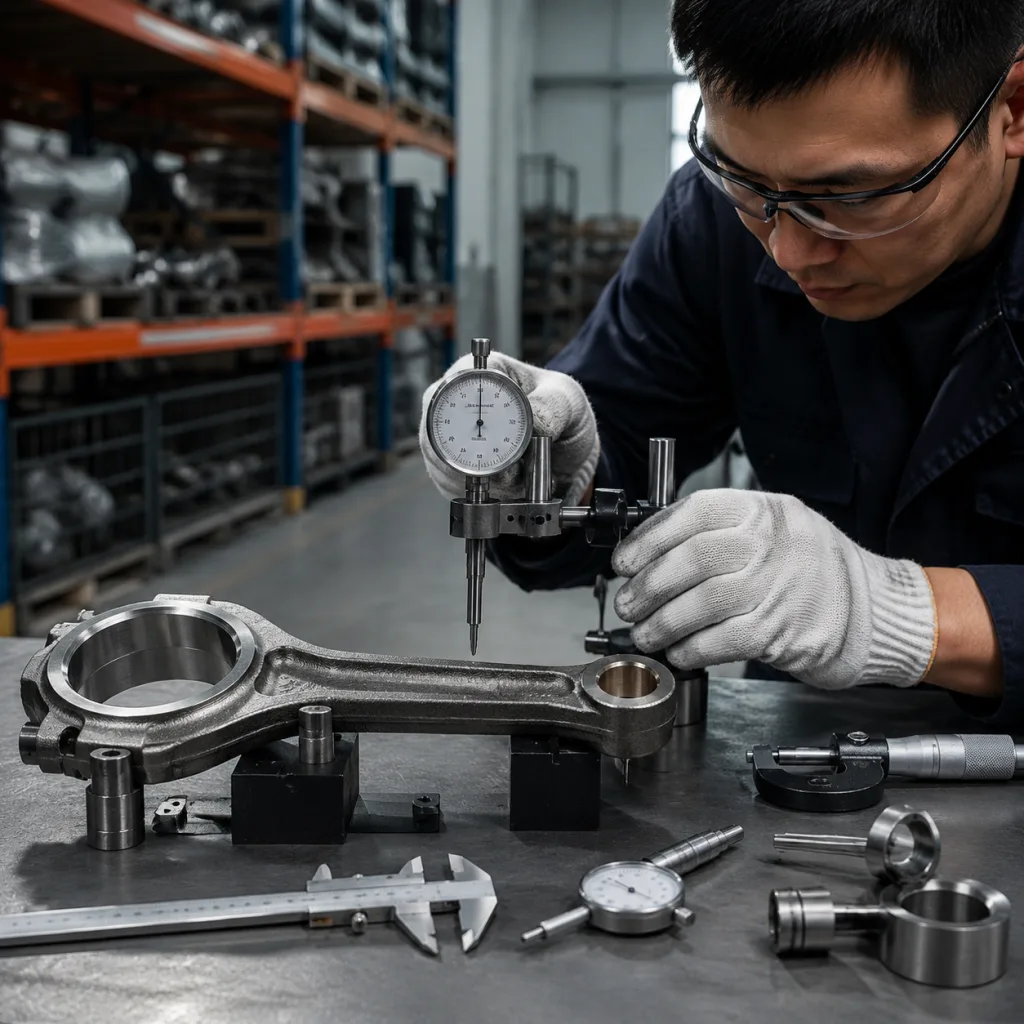
Procurement teams should ask for measured data, not only a part listing. A supplier should provide inspection records for critical features and confirm whether the rod is forged or powder-forged, because the process affects grain flow, fatigue resistance, and cost structure. For high-risk programmes, request a first-article sample, a production sample, and a control plan that defines how often dimensions are checked during mass production.
Control item
Buyer acceptance target
Why it matters
Typical buyer request
Centre-to-centre length
±0.02 mm
Preserves piston position and compression geometry
Measurement report for each batch
Big-end bore
±0.01 mm
Protects bearing fit and oil clearance
Roundness and bore size data
Big-end roundness
≤0.005 mm
Prevents hot spots and bearing wipe
CMM or bore gauge record
Small-end bore
±0.01 mm
Ensures pin fit and oil film stability
Bushing material and final bore size
Rod weight variation
≤2.0 g per set
Reduces imbalance between cylinders
Set-to-set mass tolerance
Bolt length and thread engagement
Match approved spec exactly
Affects clamp load and fatigue life
Bolt material, torque/yield method
</tr></thead><tbody> </tbody></table>For OE reference matching, cross-check the part number format used in your internal system, such as `OE 06A107065` when applicable, and confirm the exact engine variant before purchase. If the part crosses model years, ask for a mapping table that shows year, engine code, and any running changes in rod length, pin size, or bolt design.
Materials and heat treatment: what separates durable from merely usable
A replacement rod should be controlled from raw material through final heat treatment. Common production routes include forged carbon steel or forged alloy steel, with process selection based on engine load, duty cycle, and target cost. For high-volume replacement supply, the supplier should disclose steel grade, heat treatment hardness band, and any shot peening or surface treatment used to improve fatigue resistance.
A buyer-ready material spec should include a measurable hardness range, not a generic statement. For example, request a hardness window such as 28–36 HRC for a forged steel rod body or the equivalent internal standard used by the supplier, plus confirmation that hardness is sampled by lot and recorded on the inspection report. If the rod uses a pressed-pin or bushed small end, ask for bushing alloy details and the final bore finish requirement, since pin scuffing often comes from poor small-end control rather than beam failure.
From a buyer’s perspective, the important technical points are:
Material traceability back to heat or batch number
Heat treatment records and hardness verification by lot
Crack detection on critical lots, typically magnetic particle inspection for ferrous parts
Surface finish control at bearing and pin interfaces, with an approved roughness target such as Ra 0.8–1.6 μm where applicable
Packaging that prevents corrosion before warehouse receipt
Corrosion protection duration clearly stated, such as 6–12 months indoor storage protection
If your programme includes export markets, confirm conformity with REACH (EC) No 1907/2006 where applicable to subcomponents, coatings, and packaging materials. If the rod is supplied with fasteners, request fastener grade disclosure and whether the bolts are reusable or one-time-yield items, because that affects service kit planning and warranty exposure.
Validation before approval: a step-by-step gate
A supplier sample should be checked against the engine’s service requirements, not only against a drawing. For aftermarket replacement, validation usually combines dimensional inspection, bench checks, and fitment review on the actual engine family. Buyers should define the acceptance gate before sample review so that every supplier is judged on the same criteria.
Recommended validation steps:
1. Verify the rod against the OE sample or trusted reference part. 2. Measure critical dimensions with calibrated gauges and compare to the approved tolerance window. 3. Confirm bearing shell fit, side clearance, and pin articulation. 4. Check bolt preload procedure and reuse policy for rod fasteners. 5. Review fatigue and corrosion controls, especially for export storage. 6. Run a trial assembly on at least one engine build or fixture set, then record any interference, noise, or clearance deviations. 7. Request a production capability snapshot, including sample size, Cp/Cpk if available, and the inspection frequency used during normal output.
For practical sourcing, a minimum approval package should include: material certificate, dimensional report, hardness results, bolt specification, sample photos, and packaging spec. If the supplier cannot supply those documents on request, treat the quotation as preliminary rather than production-ready.
If the vehicle programme includes emissions-related engine components, align the part review process with relevant service and durability expectations under ECE R-83 where applicable to the broader powertrain system. When the programme is for field service, also confirm whether the customer requires traceability down to individual part serialisation or only to lot and carton level.
Where Driventus fits in the sourcing process
Driventus supports B2B buyers with application matching, batch traceability, and custom programme support for engine components. For procurement teams, that means a shorter path from enquiry to approved sample, especially when the buying brief includes multiple engine codes or regional variants.
Use these internal resources during sourcing:
Browse our catalog for current engine component coverage.
Review our quality system for IATF 16949:2016 and ISO 9001:2015 controls.
Use custom manufacturing when the required rod is not a standard catalogue item.
Reach the team to request a quote with engine code, OE reference, annual demand, and target market.
For commercial planning, buyers should expect MOQ and pricing to move with tooling status, finish requirements, and packaging level. Standard replacement rods are typically quoted with a lower MOQ when the part already exists in production, while custom or engine-specific variants usually require a higher MOQ because of fixture setup and validation cost. As a practical benchmark, request three tiers in every RFQ: sample quantity, pilot order, and annual contract volume. That lets the supplier quote piece price, sample charge, and amortised setup cost separately.
A useful quote request should ask for:
MOQ for stocked production versus new tooling
Sample lead time in calendar days
Mass-production lead time after PO and deposit
Price breakpoints at 100, 500, 1,000, and 5,000 pieces
Packaging option and any add-on cost for barcoding, corrosion paper, or master-carton labelling
Validity period for the quotation, such as 30 or 60 days
If the programme extends beyond a single rod, the optional engine components page can help align pistons, bearings, gaskets, and related parts in one supply package. For buyers consolidating multiple SKUs, bundling can reduce freight cost per unit and improve lead-time reliability by combining one QA release with one export shipment.
Frequently asked questions
It must match the original engine application in length, bore sizes, fastener spec, weight, and functional fit. Procurement should also confirm process control and traceable inspection data, not only catalogue fitment. For sourcing approval, ask for the exact engine code, dimensional report, hardness record, and fastener specification before placing a production order.
Yes, if the part is validated against the correct engine code and passes dimensional, material, and fit checks. The supplier should provide batch traceability and test records before approval. For fleet use, buyers should also set a repair standard that covers bolt reuse rules, set-matching tolerance, and the maximum allowed mass variation between cylinders.
Send the engine code, OE reference if available, annual volume, market destination, and any sample or drawing data. That helps confirm fitment and pricing faster. If possible, include your target MOQ, required monthly call-off quantity, packaging expectations, and whether you need sample, pilot, or production pricing.
For application matching, sample evaluation, or programme pricing, contact Driventus and send your OE reference, engine code, and target volume. Start here: /contact.html