Connecting Rod for Jeep Compass Aftermarket Replacement Sourcing
A connecting rod for Jeep Compass aftermarket replacement has to do more than physically fit the crankpin and piston pin. For importers, engine rebuilders and repair-chain buyers, the commercial risk sits in dimensional consistency, batch traceability and validation under real combustion loads. Small variation in big-end bore geometry, pin-bush clearance, cap alignment or rod weight can create bearing noise, oil-film failure, imbalance and repeat warranty claims.
Driventus manufactures engine and powertrain components in Taizhou, Zhejiang, for B2B aftermarket and OEM-service customers in more than 60 countries. Our replacement connecting rod programs are built around OE-equivalent geometry, controlled steel sourcing, CNC machining, heat treatment, non-destructive inspection and documented quality controls. Driventus is an independent aftermarket manufacturer; brand names are referenced for fitment only.
Fitment Scope and OE-Equivalent Positioning
Jeep Compass applications differ by market, engine family and production year. Buyers should confirm engine code, displacement, crankshaft journal size, piston pin diameter, rod length and cap design before releasing a production order. For catalogued aftermarket references, Driventus can support cross-reference checks against buyer-supplied OE numbers using generic formats such as OE 06A... or OE 11251... where applicable. We do not claim approval or endorsement by any vehicle manufacturer.
For a connecting rod for Jeep Compass aftermarket replacement, OE-equivalence means the part is developed to match the functional dimensions and material performance of the original rod. It does not mean the part is supplied through the vehicle brand's authorised channel. Procurement teams should separate three requirements:
Dimensional interchangeability: centre-to-centre length, big-end bore, small-end bore, side clearance, bolt position and cap alignment.
Mechanical performance: tensile strength, fatigue resistance, bolt clamp retention, hardness range and controlled surface condition.
Service compatibility: bearing shell fit, piston pin fit, crankshaft clearance, installation procedure and engine balance requirements.
Driventus supports program screening through our catalog and engine component family review at /products/engine-components.html. For buyers consolidating several engine hard-part lines, connecting rods can be sourced with pistons, crankshafts, gasket kits, bearings and related repair components.
Dimensional Controls Buyers Should Specify
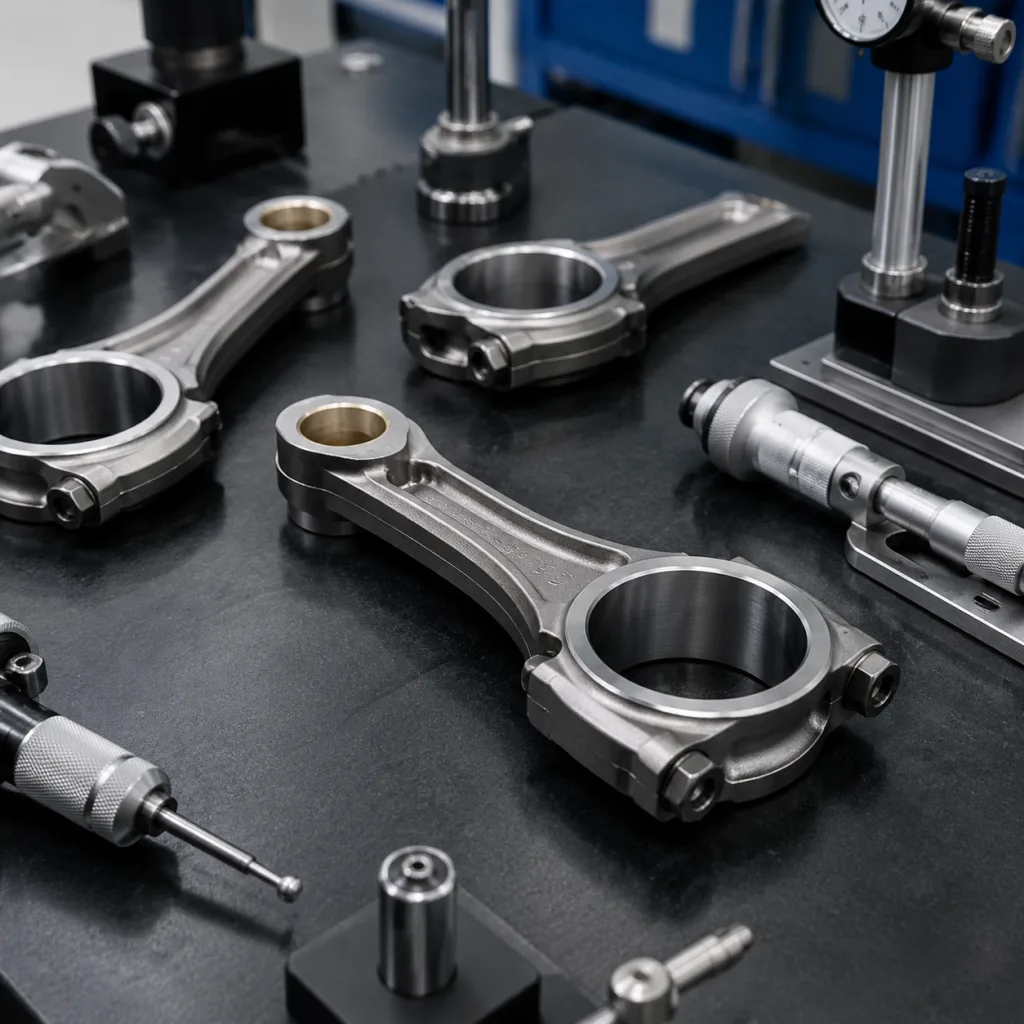
A replacement connecting rod is a precision load-bearing part, not a simple metal link. The inspection plan should focus on geometry that affects bearing oil film, piston travel, rotating balance and clamp stability. A low unit price is quickly lost if bore ovality, cap mismatch or excessive weight spread leads to engine noise or field failures.
Control point
Procurement relevance
Typical verification method
Centre-to-centre length
Controls piston deck position and compression consistency
CMM or dedicated rod gauge
Big-end bore size and roundness
Affects bearing crush and oil clearance
Air gauge, bore gauge, roundness check
Small-end bore / bush ID
Controls piston pin clearance and floating-pin movement
Plug gauge, bore gauge
Big-end width and side face finish
Affects crankshaft side clearance and lubrication path
Micrometer, surface roughness check
Rod and cap mating faces
Helps prevent cap shift under bolt load
Visual, flatness and assembly inspection
Rod weight and balance pads
Supports engine balance in single rods or sets
Precision scale and set matching
Bolt thread and seating
Maintains clamp load after tightening
Thread gauge, torque-angle audit
</tr></thead><tbody> </tbody></table>For export programs, Driventus can align inspection reporting with customer drawings or approved samples. Where the buyer does not hold drawings, we recommend sample measurement, first-article inspection and retained master samples before mass production. Critical-to-quality dimensions should be listed on the purchase specification, drawing or inspection checklist, rather than left as informal email notes.
Material, Forging and Machining Requirements
Most passenger-vehicle replacement connecting rods are made from alloy steel or microalloyed steel, depending on the original design, engine output and manufacturing route. The material choice should be linked to load requirement, heat treatment, machinability and fatigue performance. Procurement teams should ask for material grade, mill certificate availability, heat-treatment records and the target hardness range.
A robust aftermarket replacement program normally includes the following production controls:
Closed-die forging or controlled forming route suitable for the application.
Normalising, quenching, tempering or other heat treatment as required by the design.
CNC machining of big-end and small-end bores after cap processing.
Controlled fracture-split or machined-cap process, depending on rod design.
Shot peening where specified for fatigue improvement.
Magnetic particle inspection or other non-destructive testing for surface defects.
Final cleaning to reduce abrasive residue before packaging.
Driventus manufactures engine hard parts under a documented quality system aligned with IATF 16949:2016 and ISO 9001:2015 principles. These standards do not replace part validation, but they do support repeatable process control, traceability, corrective action and supplier management. For custom drawings, private-label programs or modified specifications, buyers can review custom manufacturing options before tooling or sample release.
Validation Testing for Replacement Confidence
Validation should reflect the main ways a connecting rod can fail in service: fatigue cracking, bore distortion, bolt relaxation, lubrication breakdown, overheating or overload damage. For a connecting rod for Jeep Compass aftermarket replacement, the approval plan should include both laboratory checks and assembly-level confirmation.
Recommended validation package:
Dimensional first-article report: full measurement against drawing, sample or agreed master part.
Material confirmation: chemical composition and hardness testing for each controlled batch.
Metallographic review: grain flow, heat-treatment condition, inclusion level and surface condition where required.
Fatigue or load testing: cyclic loading based on the agreed application requirement.
Trial engine assembly: bearing fit, crank rotation, piston pin fit and deck-height observation.
Packaging transit test: protection from corrosion, impact and mixed-set errors.
Where repair-chain programs need lower warranty exposure, Driventus recommends set-level weight sorting and batch-coded packaging. This allows distributors to supply matched sets instead of mixed single rods from unrelated production batches. For importers serving multiple markets, documentation should also consider REACH (EC) No 1907/2006 for applicable substances in materials, coatings and packaging supplied into the European market.
Commercial Sourcing Considerations
Replacement connecting rods are often slow-moving but high-consequence parts. The sourcing decision should therefore balance unit cost with warranty handling, stock accuracy, packaging control and repeatability across future batches. A part that looks correct on the shelf can still create cost if its cross-reference file, labels or batch records are weak.
Buyers should confirm the following before placing volume orders:
Confirmed application list by engine code, model year and market.
Cross-reference file supplied by the buyer or agreed through sample validation.
MOQ by finished part number and by private-label package.
Lead time for sample, pilot lot and repeat production.
Batch traceability format on product, box label and carton label.
Anti-corrosion packaging method for sea freight and long storage.
Incoterms, inspection point and documentation requirements.
Spare capacity for forecast increases or repair-chain rollouts.
Driventus can support neutral branding, customer label formats and export documentation for distributors, wholesalers and multi-location repair groups. We also recommend buyers define acceptable substitution rules in advance. A connecting rod with similar appearance should not be substituted unless all controlled dimensions, material requirements and cap, bolt and bush design features are confirmed.
How to Reduce Fitment and Warranty Risk
Most preventable claims come from incomplete fitment data, inconsistent installation practices, worn mating parts or mixed components. Procurement and technical teams can reduce risk by treating the connecting rod as part of an engine system rather than a standalone steel part.
Practical controls include:
Build application tables from engine code and displacement, not model name alone.
Require bearing shell compatibility checks during sample approval.
Keep rod caps paired and marked through all inspection and packing steps.
Specify whether rods are supplied individually or as weight-matched sets.
Confirm torque procedure for rod bolts with the repair information used by the installer.
Avoid reusing damaged bolts where the engine service procedure requires replacement.
Inspect crankshaft journals and piston pins before assigning noise or seizure to the rod.
A well-specified connecting rod for Jeep Compass aftermarket replacement program should give the buyer a repeatable route from sample approval to reorder. The strongest evidence is not a broad claim of fitment, but controlled measurement, clear traceability and field feedback that can be tied back to production batches.
Frequently asked questions
Yes. Depending on the program, Driventus can supply individual rods or matched sets. For repair-chain and engine-rebuild customers, set-level weight matching and batch-coded packaging are recommended to reduce balance and traceability issues.
Please provide engine code, displacement, model year, market, sample photos, measured dimensions or buyer-supplied OE cross-references if available. Model name alone is not enough because Jeep Compass applications differ by region and engine family.
No. Driventus is an independent aftermarket manufacturer; brand names are referenced for fitment only. Replacement parts are developed for dimensional and functional equivalence based on agreed specifications, samples and validation requirements.
For drawings, sample review, MOQ, lead time and private-label packaging options, contact Driventus to [request a quote](/contact.html).