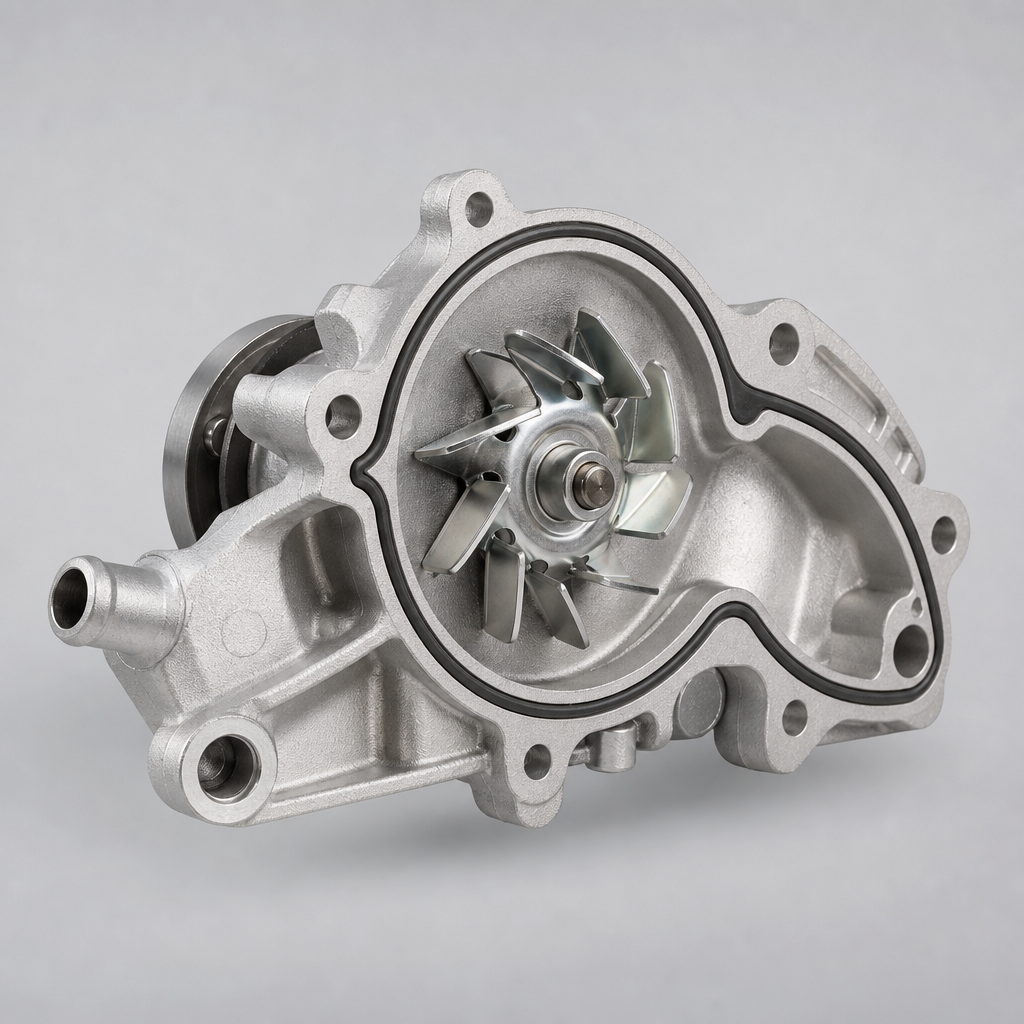
An EGR cooler vs INA alternative decision should not start with brand preference. It should start with risk: will the substitute fit the vehicle, cool exhaust gas correctly, seal under pressure, survive heat cycling, and remain available when branches need replenishment?
Small differences matter. A cooler can look correct in a catalog and still fail approval because a bracket is 2 mm out, a hose port is clocked differently, a gasket face is not flat enough, or the body does not clear nearby engine-bay packaging. The real comparison is geometry, material control, heat-transfer design, weld integrity, validation evidence, and supply discipline.
Driventus is an independent aftermarket manufacturer; brand names are referenced for fitment identification only. We supply EGR coolers for B2B channels that need OE-style interchange, controlled dimensions, and documented quality control. For buyers serving Europe, the UK, North America, Australia, Brazil, and other export markets, this article turns the comparison into practical approval work: what to measure, what can fail, what documents to request, and when a lower unit price becomes the more expensive choice.
Decision Frame: What Are You Really Approving?
In procurement terms, an EGR cooler vs INA alternative comparison is a substitute approval, not a catalog match. The buyer is deciding whether an aftermarket cooler can replace the listed application without creating fitment claims, emissions faults, coolant leaks, or branch-level confusion.
Start with the required outcome. The part must match the mounting pattern, coolant connections, exhaust gas path, sealing method, packaging envelope, and thermal duty of the target application. That requires both physical checks and functional evidence.
Key variables to confirm:
overall envelope, including clearance to firewall, turbo, intake pipe, wiring loom, and heat shields
mounting-hole center distance, bracket offset, fastener size, and access for installation tools
inlet and outlet port angle, checked by clocking against the removed or approved reference part
coolant hose outer diameter, bead profile, quick-connector type, and seal material
tube or plate core design, including gas-side flow path and coolant pass layout
brazed, welded, or mechanically joined joints with controlled penetration
heat-transfer capacity under real operating load, not only visual similarity
soot and corrosion resistance across repeated hot-cold cycles
Treat the term "INA alternative" as an application reference, not proof of identical performance. Before approval, verify the vehicle line, engine code, production range, OE reference data, and emission level where available. This is critical when the same engine family uses different cooler layouts across Euro 4, Euro 5, Euro 6, EPA, or regional calibration variants.
Comparison Table: Where The Substitute Wins Or Fails
Item
OE-Style Requirement
What To Verify In An Aftermarket Cooler
Fitment
Same mounting points and hose routing
Hole spacing within agreed tolerance, bracket offset, port clocking
Thermal duty
Stable exhaust gas cooling under load
Core design, fin density, gas path, coolant flow path
Sealing
No coolant or exhaust leakage
Gasket face finish, weld quality, pressure and leak test records
Cycling test data, vibration resistance, bracket fatigue control
Supply
Predictable replenishment
MOQ, lead time, packing, revision control, inspection plan
</tr></thead><tbody> </tbody></table>The buying rule is simple: the lower-risk cooler is the one with better evidence. If two parts cover the same application but one has stronger validation, cleaner documentation, and tighter dimensional control, it may still be the better commercial choice at a 3-8% higher unit price.
That price gap can disappear fast. Add 20 minutes of extra fitting time, one coolant-leak claim, or inconsistent replenishment across several branches, and the cheaper cooler stops being cheaper. For slow movers, unit price may carry more weight. For fleet work, high-failure applications, and workshop programs, first-time fit and return rate usually decide the outcome.
Spec Deep-Dive: Materials, Joints, And Heat Paths
An EGR cooler works in a punishing environment. Exhaust gas brings heat, soot, condensate, and corrosive by-products into the cooler body. The coolant side must hold pressure while transferring heat efficiently. A weak joint or poor material choice can contaminate the intake, reduce cooling performance, trigger emissions faults, or cause coolant loss.
Construction details worth reviewing:
stainless steel core tubes, often in 300-series grades, for heat and corrosion resistance
aluminium housings only where coolant chemistry, temperature, and galvanic risk are controlled
TIG welding, laser welding, or controlled brazing with repeatable penetration and no burn-through
gasket faces machined or formed to maintain flatness within a defined tolerance
mounts and brackets designed to reduce vibration cracking at the flange or tube-to-header joint
tube and plate thickness matched to pressure, heat, and packaging constraints, not copied by eye
coolant-side seals selected for glycol coolant, temperature cycling, and compression set resistance
A supplier should be able to explain the base materials, joint method, wall-thickness range, sealing approach, and anti-corrosion treatment. If they cannot, the sourcing risk is high.
For repeat orders, request material declarations and traceability tied to lot number. Under REACH (EC) No 1907/2006, material disclosure also supports compliance screening for regulated substances in European-market supply chains. For private-label programs, lock the approved material and joining specification after PPAP-style approval unless a written engineering change is released.
Failure Modes: Tests That Catch Problems Before Shipment
A credible EGR cooler supplier should document test coverage. A statement that the part has been "checked" is not enough. The useful question is: checked for what, at what pressure, by which method, and with what reaction plan if a unit fails?
Ask for evidence covering these controls:
coolant-side pressure testing at production level, with test pressure defined against the service requirement
exhaust-side leak checks after assembly to detect weld pores, tube cracks, or header leakage
thermal cycling across repeated hot and cold transitions to expose joint fatigue
vibration or shake testing for mounting durability, especially on long cooler bodies with cantilevered brackets
salt spray or corrosion exposure where the design has exposed steel hardware or mixed metals
dimensional inspection against the approved drawing, sample, or CMM report
gasket-face, flange, and tube-end checks for burrs, dents, and flatness variation
inspection records linked to batch, lot, production date, and operator or line number
Process standards help, but they do not replace part validation. IATF 16949:2016 and ISO 9001:2015 indicate a controlled environment for corrective action, change management, calibration, and traceability. They do not prove that a cooler fits a specific engine variant.
The supplier's reaction plan is just as important as the test list. If one unit fails pressure testing, how is the lot contained? Is retesting required? What evidence is supplied before shipment? Buyers should resolve those questions before the first production order, not after the first warranty claim.
Scenario: Clean The Old Cooler Or Replace It?
Cleaning can make sense when soot loading is light and the cooler is structurally sound. In many commercial service environments, however, cleaning moves uncertainty from the part supplier to the installer, branch, or warranty desk.
Replacement is usually the better choice when:
the core shows internal leakage between coolant and exhaust passages
soot blockage is severe, oily, hardened, or uneven across the core
flange faces are distorted enough to compromise gasket compression
coolant contamination has already occurred or the vehicle has unexplained coolant loss
corrosion is visible around seams, tubes, brackets, or welded joints
pressure testing cannot be performed after cleaning
vehicle downtime cost exceeds the part savings from reuse
the repair chain needs a repeatable installation outcome and consistent warranty position
A new unit also gives the buyer a known revision state. That matters when the installed vehicle population includes mixed model years, region-specific variants, or running changes in hose routing and brackets.
For fast-moving service parts, controlled replacement is usually easier to stock, train, and support than a rebuilt core with unknown remaining life. The commercial test is direct: if cleaning labor, test time, comeback risk, and downtime exceed the replacement margin, replacement is the stronger sourcing decision.
Step-By-Step: How Driventus Controls Fitment And Launch
Driventus manufactures engine and powertrain parts in Taizhou, Zhejiang, with export supply into more than 60 countries. For EGR cooler programs, our focus is dimensional consistency, stable production control, and practical support for B2B sourcing teams that need repeatable fitment across multiple service locations.
Our working process for B2B buyers:
1. Confirm application, OE reference, cross-reference, vehicle build data, emission level, and market region. 2. Review key dimensions, port orientation, bracket position, sealing interfaces, and connector type against a drawing or sample. 3. Validate the drawing against the existing sample or approved reference part, including hole centers, flange height, tube routing, and hose-end geometry. 4. Define sample quantity, packaging, label format, barcode content, inspection requirements, and target launch quantity. 5. Provide samples or a pilot lot for bench comparison, pressure check, and installation feedback. 6. Move into production only after the buyer signs off on the approved reference set and commercial terms.
This is where custom manufacturing becomes useful for fleets, distributors, and private-label programmes. Where a catalogue item already fits the requirement, buyers can start from our catalog and the broader engine components range. Where the fitment window is narrow or the housing must be adjusted, our quality system and process controls provide the basis for a controlled launch, including revision control so later shipments match the approved reference unless a change is formally released.
Commercial Trade-Offs: MOQ, Price, Lead Time, And Packaging
Technical fit is only one part of the approval decision. Category buyers also have to protect landed cost, replenishment reliability, warehouse handling, and branch-level usability.
Commercial factors that affect source approval:
MOQ and batch size, with standard items normally easier to consolidate than custom variants
lead time for standard stock, first production, and revised tooling or fixture changes
unit price by quantity break, separated from mold, sample, or special packaging cost where relevant
carton design, inner protection, and master pack count to reduce dented tubes or bent brackets
barcode, label format, country-of-origin marking, and customer part number for warehouse intake
export documentation, HS code handling, palletization, and container or LCL planning
revision control when the application list changes or a bracket, port, or gasket face is updated
sample availability, pre-shipment inspection, AQL level, and pressure-test sampling plan
Read MOQ and price together. A lower unit price may require a larger batch, higher inventory exposure, or a longer production slot. A custom cooler may need sample approval plus tooling or fixture confirmation before mass production. A catalog cooler can often move faster if packaging and labels are standard.
For multi-location repair chains, mis-picks can cost more than the supplier price difference. Stable part numbers, clear labels, durable packaging, and low installation failure rates are not admin details. They are part of the margin calculation.
Final Approval Checklist For An EGR Cooler Substitute
Before releasing a substitute cooler into stock, run the approval as a controlled checklist:
vehicle model, engine code, production range, emission level, and market region confirmed
OE or cross-reference number verified in the service catalogue and against the removed part where possible
mounting holes, ports, brackets, tube routing, and sealing surfaces measured against the reference part
material, wall-thickness range, weld or brazing method, and surface protection documented
coolant-side pressure test and exhaust-side leak test evidence available
thermal cycling, vibration, or corrosion data reviewed for higher-risk applications
carton, label, barcode, and master pack format aligned with warehouse process
MOQ, lead time, price break, sample charge, and inspection terms recorded before release
compliance screening completed for target markets, including REACH where applicable
sample installation or bench comparison completed where fitment risk is high
If the supplier cannot support these items, expect return risk. For a buyer comparing an EGR cooler vs INA alternative, the lowest-friction path is to request a sample, compare it to the removed part or approved reference, and verify performance data against the application demands.
Catalog wording can narrow the search. Approval should rest on measured fit, documented testing, and supply controls: known dimensions, clear tolerances, traceable production, realistic lead times, and packaging that reaches the installer without damage.
Frequently asked questions
No. Interchangeability depends on mounting points, port geometry, seal design, coolant routing, thermal capacity, and the exact vehicle build range. Application data must be checked against the vehicle, engine code, production date, and removed or approved reference part.
IATF 16949:2016 and ISO 9001:2015 are useful process standards to ask about. Buyers should also request pressure-test records, traceability, material declarations, dimensional evidence, and REACH (EC) No 1907/2006 screening for European supply chains.
Replacement is usually lower risk when there is leakage, distortion, heavy soot blockage, corrosion, coolant contamination, or no reliable way to pressure-test after cleaning. Rebuilds can work in limited cases, but they add labour and remaining-life uncertainty.
Yes. We support drawing review, sample comparison, pilot samples, packaging definition, and custom production for B2B programmes where the catalogue item is close but not exact. Start with a fitment check and an approved reference part.
For fitment checks, sourcing questions, sample review, MOQ, lead-time planning, or a controlled quote request, contact Driventus through /contact.html.