Connecting Rod Cadillac Aftermarket Replacement: OE Match Guide
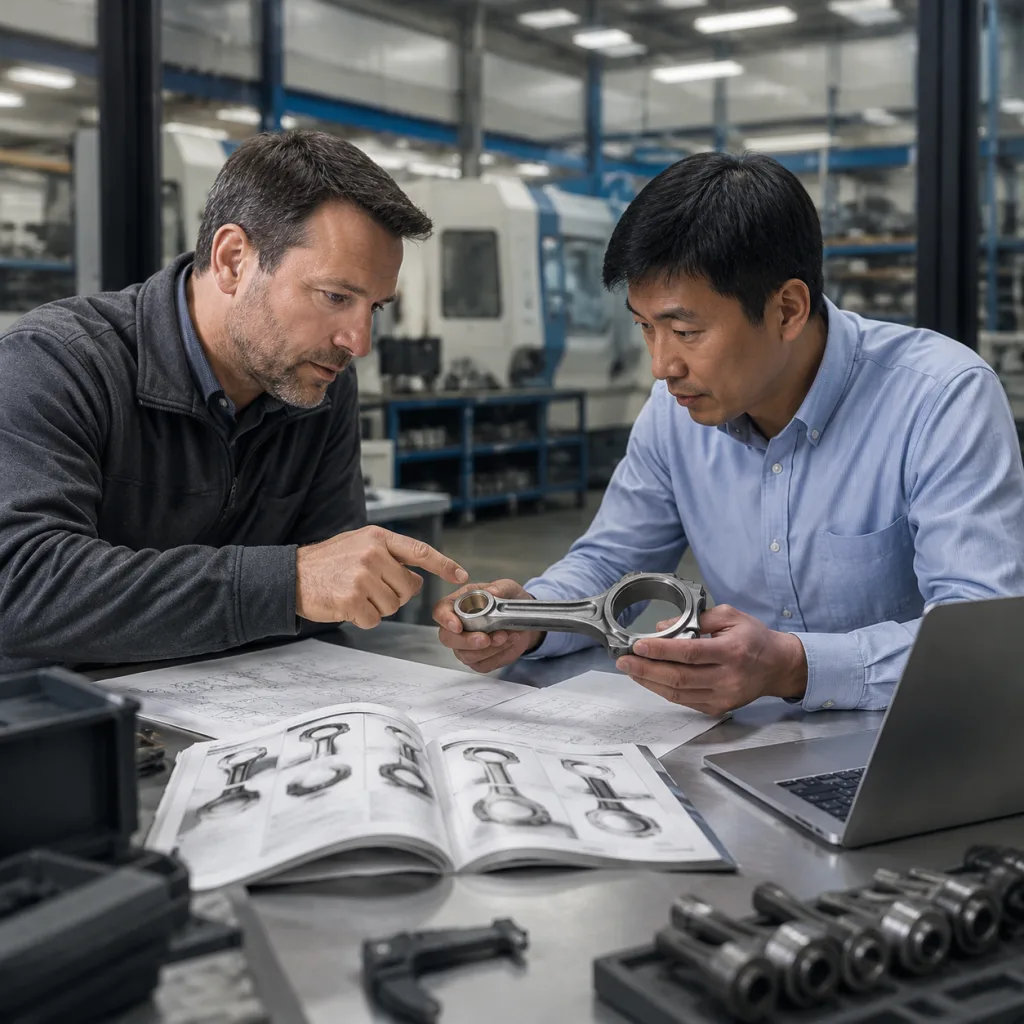
A Cadillac connecting rod replacement has to match the engine’s original geometry, mass, material behaviour, and assembly requirements. For procurement teams, the issue is not only whether the part fits, but whether it can hold dimensional consistency across batches, survive the target duty cycle, and pass validation testing that reflects the application. Driventus supplies connecting rods for aftermarket engine rebuilds and B2B distribution, with production controlled under IATF 16949:2016 and ISO 9001:2015. Driventus is an independent aftermarket manufacturer; brand names are referenced for fitment only. When a buyer searches for a connecting rod Cadillac aftermarket replacement, the real requirement is an OE-equivalent part with verified centre-to-centre length, big-end and pin-end bore control, correct beam profile, and stable balancing. That is the standard used by distributors, workshops, and engine remanufacturers when they want to reduce return risk and keep rebuilds on schedule.
What buyers should verify first
For a Cadillac application, start with the exact engine code, model year, and OE part number if available rather than the vehicle badge alone. The same badge can cover multiple rod lengths, journal sizes, piston pin diameters, and bolt packages.
Key checks:
Centre-to-centre length, typically verified to ±0.01 mm on matched replacement lots
Big-end bore and small-end bore, including roundness and taper limits on the finished rod
Rod bolt specification, torque angle, and whether final clamp load is controlled by torque-to-yield or stretch
Beam offset, cap orientation, and part marking to avoid reversed assembly
As-supplied weight tolerance for the set, commonly controlled within a 1–3 g spread for balanced kits
Surface finish, shot-peen coverage, and any coating or oiling requirements for storage and installation
If the source part number is known, cross-reference it against the replacement listing before purchase. For mixed fleets or reman lines, ask for dimensional drawings, material certificates, and incoming inspection records. In practice, that is faster than correcting a mismatch after the engine is assembled, especially when the journal size or rod length differs by only a few tenths of a millimetre.
OE-equivalence matters more than appearance
A connecting rod that looks correct can still fail the build if the dimensions drift outside tolerance. In replacement sourcing, OE-equivalence means the rod matches the original in geometry, load path, and assembly interfaces, not just overall shape.
Verification point
Why it matters
Typical procurement check
Centre-to-centre length
Controls compression height and geometry
Compare against OE drawing or sample measurement; many programmes hold ±0.01 to ±0.02 mm
Big-end bore
Affects bearing crush and oil film
Measure bore after cap torque; confirm ovality and taper stay within print limits, often under 0.01 mm
Small-end bore
Governs pin fit and bushing life
Check pin clearance range, commonly around 0.004–0.018 mm depending on pin design
Rod weight
Supports cylinder-to-cylinder balance
Require matched sets by gram range, often 2 g or less for passenger-car kits
Bolt quality
Influences clamp load retention
Confirm material grade, proof load, and torque/stretch method before release
</tr></thead><tbody> </tbody></table>For rebuild programmes, ask for control plans and PPAP-style documentation where needed. If your sourcing standard includes REACH (EC) No 1907/2006 compliance for the finished article, confirm material declarations before release. For fleets with tight NVH targets, also request small-end and big-end weight split data, not only total rod mass, so the balancing house can reduce final correction time.
Materials and manufacturing controls
Most aftermarket rods for passenger-vehicle engines are made from forged steel, then machined, shot-peened, and checked for crack-free structure and dimensional stability. The exact alloy and finish depend on the engine duty cycle, the intended service life, and the target price point.
A practical buyer specification usually includes:
Forged steel or an equivalent specified alloy, with chemistry declared by heat number or batch code
CNC-machined bores with documented roundness, coaxiality, and centre-distance targets
Shot peening on the beam for fatigue resistance, typically specified by coverage and intensity rather than a generic yes/no callout
Controlled rod bolt source and torque method, including whether bolts are supplied loose or pre-installed
Traceable batch coding for defect containment and field recall control
Protective packaging that prevents fretting, corrosion, or cap mix-up during transit
For Cadillac aftermarket replacement programmes, buyers often request a finished-part spec that lists bore finish roughness, usually in the Ra 0.8–1.6 μm range depending on bearing design, and a hardness target suitable for the application, commonly around HRC 28–36 for forged steel rods. Driventus manufactures under IATF 16949:2016 and ISO 9001:2015, with process control aligned to repeatable production for distributors and remanufacturers. For export programmes, this matters especially when the same part number ships to multiple regions with different packaging, labelling, and inspection requirements.
Validation testing for replacement programmes
Replacement rods should be validated before volume release, especially where the vehicle is used for towing, hot climates, or frequent stop-start service. Testing should reflect the application rather than the catalogue description.
Recommended checks:
Dimensional inspection on first article samples, including pin-end and big-end bores, beam straightness, and center-to-center length
Hardness and material verification, with incoming and finished-part checks tied to heat lot traceability
Rod bolt tensile or clamp-load verification, using the actual torque procedure the plant or repair shop will follow
Fatigue or endurance screening on the beam and cap interface, with test cycles matched to the intended duty profile
Fitment audit against the target piston and crankshaft combination, including bearing shell crush and side clearance
Packaging validation for corrosion protection and transit damage, especially for ocean freight or warehouse storage
A buyer should also define acceptance criteria before sample approval. For example, set max allowable bore variation, balance spread, and surface defect limits in the RFQ so the supplier quotes to the same target. Where test plans call for corrosion or surface durability data, buyers may also request alignment with published methods such as SAE J2527 for corrosion-related evaluation where relevant to coating or finish claims. For emission-related applications, avoid inferring engine approval from the rod itself; the component is only one element in the assembly.
How Driventus supports sourcing teams
Procurement teams usually need three things: consistent supply, predictable inspection, and the ability to customise packaging or specification details for local markets. A vertically integrated manufacturer helps with all three.
Driventus supports B2B buyers with:
OE-number cross-referencing for fitment confirmation before tooling or order release
Batch traceability and controlled inspection records, including dimensional reports on request
Export packaging for distributors and repair chains, with barcode, label, and carton-count options
Custom manufacturing through custom manufacturing when an application needs a specific rod length, pin bore, or bolt package
For buyers consolidating sources, this reduces the risk of split supply between rod, piston, gasket, and ancillary engine parts. It also simplifies vendor approval when the same factory can support multiple engine component families. In many programmes, Driventus can support pilot quantities first, then scale to repeat production once the approved sample matches the released specification and packaging standard.
When to request a quote
Request pricing once the target engine code, quantity, and required validation level are clear. If you already hold an OE reference, include it in the inquiry so the matching step is faster.
Best practice for the RFQ package:
Engine model, year, displacement, and engine code
OE part number, if known
Required annual volume, forecast, and order cadence
Packaging and barcode requirements
Test or documentation requests, including PPAP level, C of C, or material cert needs
Destination country and Incoterms
For programmes with recurring demand, a controlled sample approval process is usually the fastest route to release. For pricing, buyers should also state the target MOQ, because unit cost can change materially by batch size. As a practical guide, prototype or sample lots are often priced higher, while production pricing improves at the 500–1,000 set level and again at multi-thousand-set annual commitments; lead time also shortens once the drawing and inspection plan are frozen. If you need a supplier review pack, request a quote and include the target vehicle list plus the expected service environment. If the programme has a hard launch date, ask for an initial sample lead time, a production lead time, and the earliest repeat-order window so purchasing can align inventory and avoid line stoppages.
Frequently asked questions
Match the engine code, OE part number, rod length, bore sizes, and bolt specification. Visual similarity is not enough. Ask for dimensional data, weight data, and material records, then compare them with the original sample or drawing before release.
Yes, if it is dimensionally equivalent, uses the correct material and bolt package, and passes validation testing. Buyers should confirm traceability and inspection records before approving volume supply. For higher-risk builds, require first-article approval and a retained sample from the approved batch.
Yes. Driventus can support custom manufacturing for non-standard rod dimensions, packaging, or programme-specific requirements. Send the engine details, target volumes, required tolerances, and the desired lead time through the contact form.
If you are sourcing a replacement rod for a Cadillac programme, send the OE reference, volume, target tolerance requirements, and market details. We can review fitment, MOQ, pricing, and supply options through /contact.html