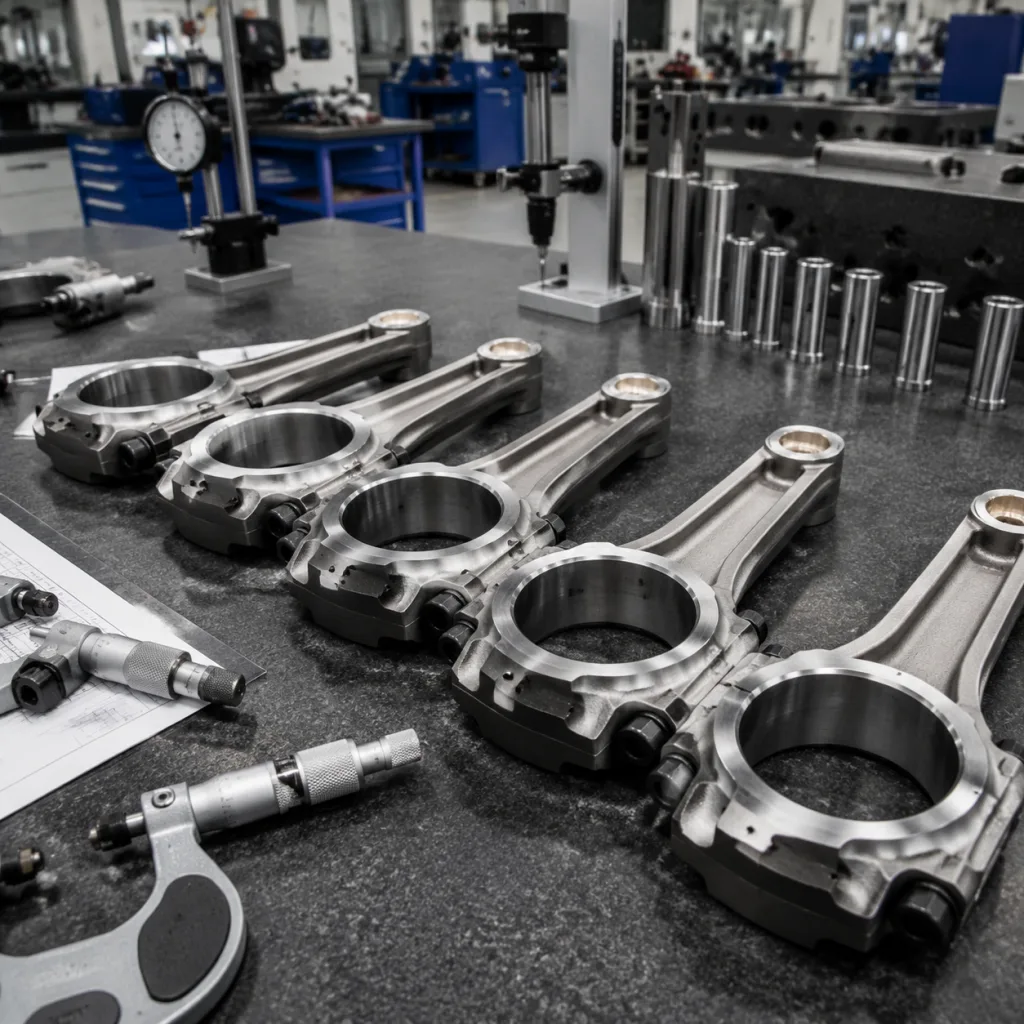
A connecting rod Infiniti wholesale programme fails fast when it is treated as a catalogue match. The part sits inside a fatigue-loaded assembly, so the purchase decision has to cover material route, heat treatment, machining capability, bolt control, inspection evidence, corrosion protection, fitment data, and replenishment discipline.
The commercial issue is just as important. Engine repair chains, regional wholesalers, and importers carrying Nissan- and Infiniti-fit coverage for VQ, QR, and related engine families need parts that can be reordered without resetting the approval process every time. The target is OE-equivalent rebuild performance with traceable lots, practical MOQ, clean labels, and incoming-QC criteria that warehouse teams can actually use.
Driventus Auto Parts manufactures engine and powertrain components in Taizhou, Zhejiang, under IATF 16949:2016 and ISO 9001:2015 certified production controls. We supply B2B customers in more than 60 countries, including distributors, OEM/Tier-1 buyers, and multi-location repair groups. Driventus is an independent aftermarket manufacturer; brand names are referenced for fitment only.
Use this guide as a procurement filter before releasing wholesale orders. The figures below are RFQ checkpoints, not universal fitment values. Final dimensions, torque data, material grades, and test frequency must be confirmed against the agreed drawing, approved sample, or purchase specification for each part number.
First decide what type of connecting rod programme you are buying
Not every connecting rod Infiniti wholesale enquiry should be handled the same way. A fast-moving catalogue SKU, a low-volume coverage item, and a new development part create different risks. Put the project in the right lane before comparing prices.
1. Catalogue replacement programme Use this route when the supplier already has tooling, fixtures, inspection plans, and export history for the part number. The buyer’s work is to confirm fitment data, critical dimensions, material evidence, packaging, MOQ, and repeat lead-time.
2. Coverage expansion programme This applies when a distributor wants to fill gaps across related Infiniti-fit and Nissan-fit engine families. Mixed-SKU planning matters here. The supplier should show whether parts share material, forging sources, bolts, bushings, machining routes, or packaging formats.
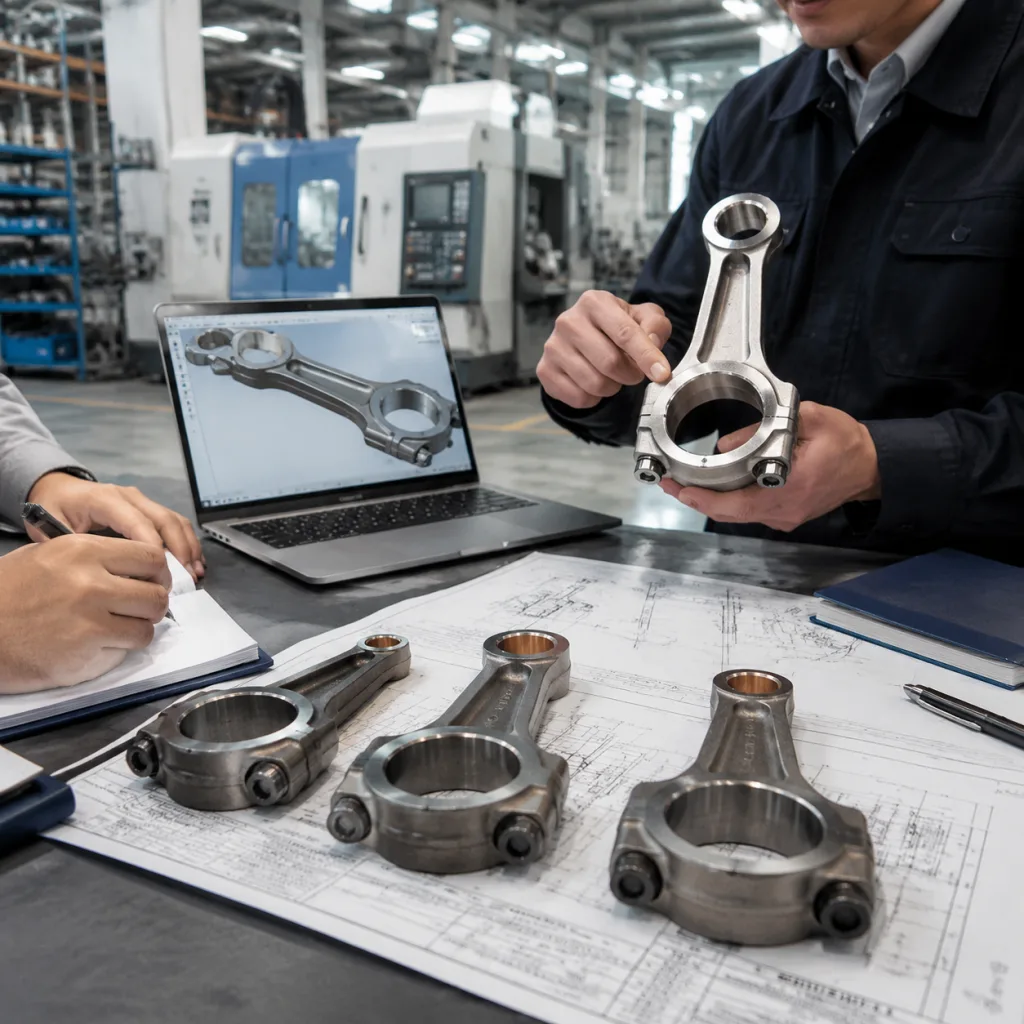
3. Development or sample-based programme Choose this route when drawings are missing, samples need reverse engineering, or the buyer wants a private specification. Expect extra work: sample measurement, drawing confirmation, fixture review, bolt sourcing, pilot-lot inspection, and retained-sample approval.
The shortlist should test both technical and commercial fit:
Application coverage: engine code, bore, stroke, pin diameter, big-end journal configuration, bearing width, rod bolt size, side width, and cap design.
Manufacturing control: forging, heat treatment, CNC machining, cap cutting, bushing installation, final honing, washing, inspection, and export packing.
Material route: forged 40Cr, 42CrMo, C70S6, or equivalent steel where specified, with heat number, chemistry, and mechanical-property evidence tied to the lot.
Critical tolerances: big-end bore roundness and taper often controlled in the 0.005–0.010 mm range when required by drawing; centre-to-centre length commonly held within ±0.02–0.05 mm; pin-end bushing ID, side clearance, bolt guidance, and weight grouping must be agreed before release.
Commercial fit: MOQ per part family, mixed-SKU shipment planning, sample timing, reorder lead-time, forecast flexibility, and price breaks at realistic annual volumes.
Buyers can review broad engine component coverage through our catalog and assess connecting rods alongside pistons, crankshafts, gaskets, timing kits, and water pumps. Supplier consolidation only helps if the same quality system, export documentation style, and complaint-handling process carry across categories.
Where connecting rod RFQs usually go wrong
Most bad RFQs are not missing a price request. They are missing the controls that make two prices comparable. A connecting rod is a fatigue-loaded component, so visual similarity and vehicle-model fitment are not enough.
Failure mode
What it causes
How to prevent it
Quoting from model name only
Wrong engine variant, wrong bearing width, wrong pin size, or wrong cap design
Quote by engine code, interchange reference, sample, or controlled drawing
Material stated without evidence
Grade substitution or unlinked certificates
Require steel grade, mill certificate, heat number, forging route, and lot-linked records
Hardness range not defined
Inconsistent strength, machinability, or fatigue performance
Confirm HRC or HB range after heat treatment; drawing ranges may sit around HRC 28–36 or equivalent, but the approved spec controls
Big-end bore checked casually
Bearing fit issues, noise, seizure risk, or early wear
Define diameter, roundness, taper, housing-bore finish, and go/no-go limits; many buyers request roundness/taper ≤0.010 mm for critical batches
Pin-end bushing ignored
Wrist-pin clearance problems or oiling issues
Confirm bushing material, interference, final ID, oil-hole position, and surface finish after installation
Centre distance left open
Compression-height and balance variation across sets
Set the acceptance band, commonly ±0.02–0.05 mm depending on application and process capability
Rod bolt data missing
Assembly risk and inconsistent clamping load
Require bolt grade, thread form, lot traceability, torque, angle, lubricant, or stretch guidance; do not mix unspecified aftermarket bolts
Weight matching unspecified
Vibration complaints in rebuild programmes
Define total and end-to-end weight bands, often within 1–3 g per set where required
Surface protection treated as packing
Rust after sea freight or warehouse storage
Confirm shot peening, cleaning, phosphating, oiling, VCI, desiccant, and corrosion records where required
</tr></thead><tbody> </tbody></table>Published management standards such as IATF 16949:2016 and ISO 9001:2015 do not define connecting rod dimensions. They define the management and process-control framework used to make parts consistently. The part-level requirements still have to be agreed through drawings, control plans, purchase specifications, or approved samples.
When comparing suppliers, force the RFQ onto the same inspection level. A low unit price may exclude hardness testing, 100% big-end bore checks, private-label packaging, anti-rust film, or pre-shipment inspection. For importers, REACH (EC) No 1907/2006 should also be considered for applicable substances in packaging, surface treatments, preservatives, and supplied components entering the EU market.
Build MOQ and lead-time around approval stages, not one date
Wholesale buyers usually need depth on fast movers and flexibility on catalogue coverage. One high-volume SKU may not fill a shipment; ten related Infiniti-fit SKUs may strain approval, packaging, and inspection capacity if they are released at once. Treat MOQ and lead-time as a staged plan.
Stage 1: sample or pilot check Use 1–5 sets per part number for dimensional inspection, engine-builder review, catalogue confirmation, and packaging approval. A 2–6 week planning window is common when drawings, samples, and fixtures are ready. Add time for reverse engineering, bolt validation, or new bushing specifications.
Stage 2: first controlled order A pilot order often sits around 20–50 sets per SKU when existing tooling and material are available. Development SKUs may need higher quantities to absorb fixture and testing cost. The first wholesale release commonly needs 6–10 weeks after sample approval, depending on forging, heat treatment, bushing, bolt, inspection, and packaging availability.
Stage 3: repeat wholesale replenishment Wholesale MOQ is commonly 100–300 sets per SKU for stable pricing, with mixed-SKU LCL or container planning where part families share material and process routes. For repeat SKUs, 4–8 weeks is a practical reorder target when forecasts are shared and raw material or semi-finished forgings can be reserved.
Price normally falls as volume moves from sample to pilot to repeat batch because setup, inspection, packaging artwork, and export documentation are spread across more sets. Keep payment and release logic equally clear: tooling or development cost, sample approval, production deposit, balance payment, and pre-shipment inspection should not be blurred into one milestone.
For urgent programmes, ask whether semi-finished forgings or machined blanks are already available. This can reduce the calendar only when the final specification matches the buyer’s approved drawing or sample file. For application-family development beyond catalogue items, Driventus supports custom manufacturing using drawings, samples, or agreed performance requirements, including private-label specifications, revised weight grouping, and coverage not yet listed in a standard catalogue.
Audit the process chain from steel heat to carton label
A supplier claim becomes useful only when the physical part can be linked to a controlled process. For connecting rods, the audit trail should run from steel heat number to forging batch, heat-treatment batch, machining record, inspection result, and carton label.
Ask for these documents during qualification:
Valid IATF 16949:2016 and ISO 9001:2015 certificates within their stated scope.
Process flow chart from incoming material to final packing.
Control plan covering forging, trimming, normalising or quenching/tempering, shot blasting, rough machining, cap cutting, bolt installation, final honing, bushing, washing, inspection, anti-corrosion protection, and packing.
Material certificate and heat-treatment record for the sampled lot, including furnace batch and hardness result.
Dimensional inspection report for big-end bore, pin-end bore, centre distance, side faces, bolt-hole position, and cap alignment.
Hardness, surface-finish, torque audit, bolt-thread, and metallographic checks where specified.
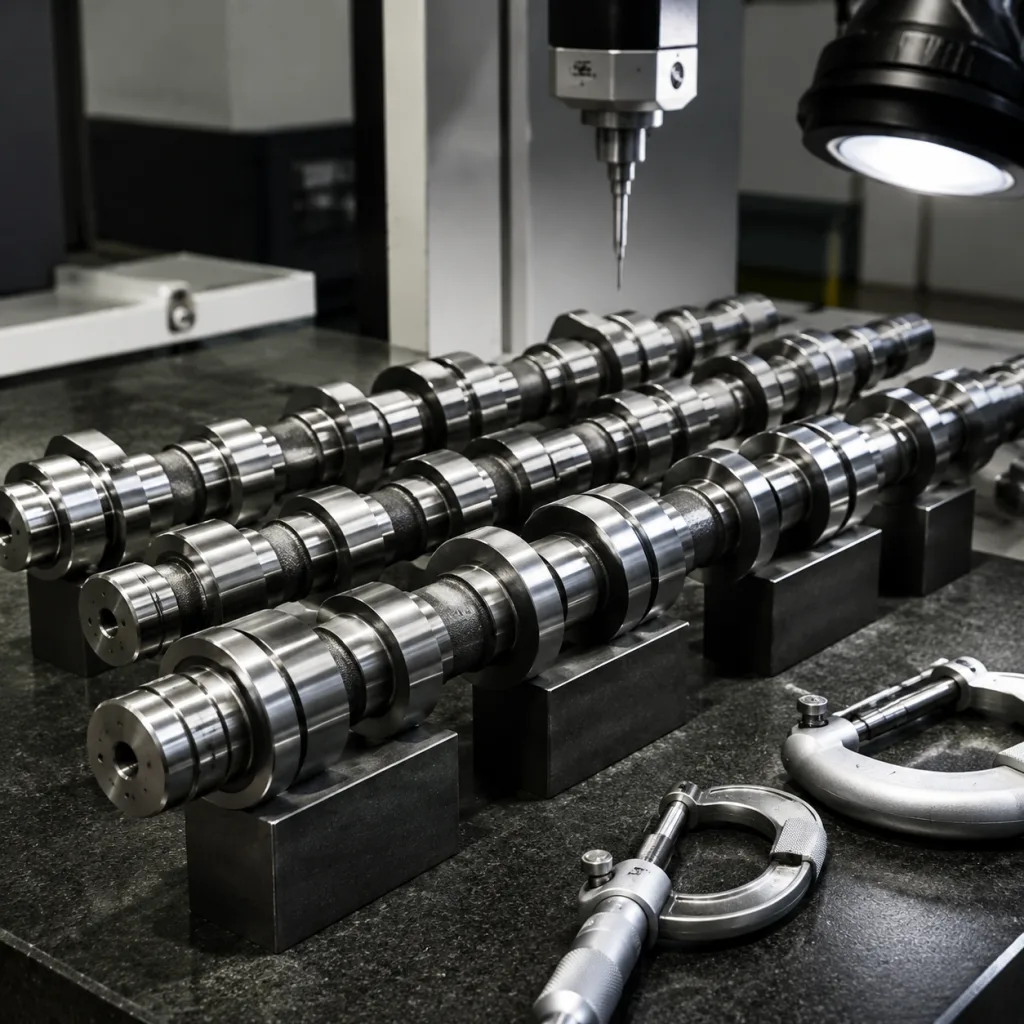
Gauge calibration list for bore gauges, micrometers, height gauges, hardness testers, and CMM or contour equipment where used.
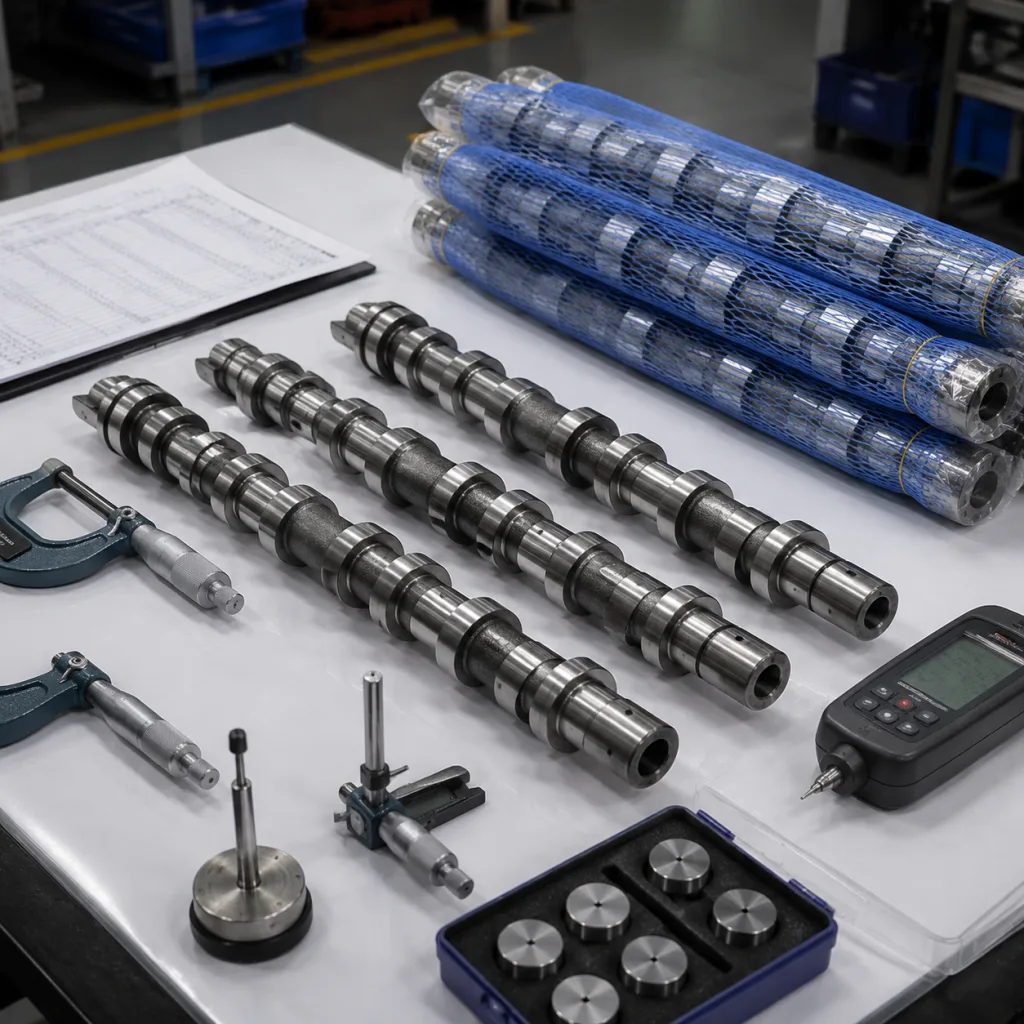
Packaging protection method information for export shipments, including anti-rust oil, VCI bag, desiccant, carton strength, and pallet wrapping.
Corrective action procedure for nonconforming lots and customer complaints.
Buyers can review our quality system before scheduling a remote or on-site audit. During the audit, check calibration records, gauge repeatability, operator work instructions, nonconforming material segregation, final inspection sampling, and traceability from carton label back to production batch.
For high-risk or first-time programmes, require a first-article inspection report, a retained golden sample, and pre-shipment AQL inspection. Common commercial practice is to set critical defects at zero tolerance while checking major and minor defects to an agreed AQL level. If any process is subcontracted, the audit should confirm approved supplier lists, incoming verification, and periodic performance review.
Scenario: the part is correct but the shipment still fails
A technically correct connecting rod can still create commercial problems if data, packing, or import documents are weak. This is common when a buyer approves the metal part but leaves catalogue and warehouse requirements until the shipment is ready.
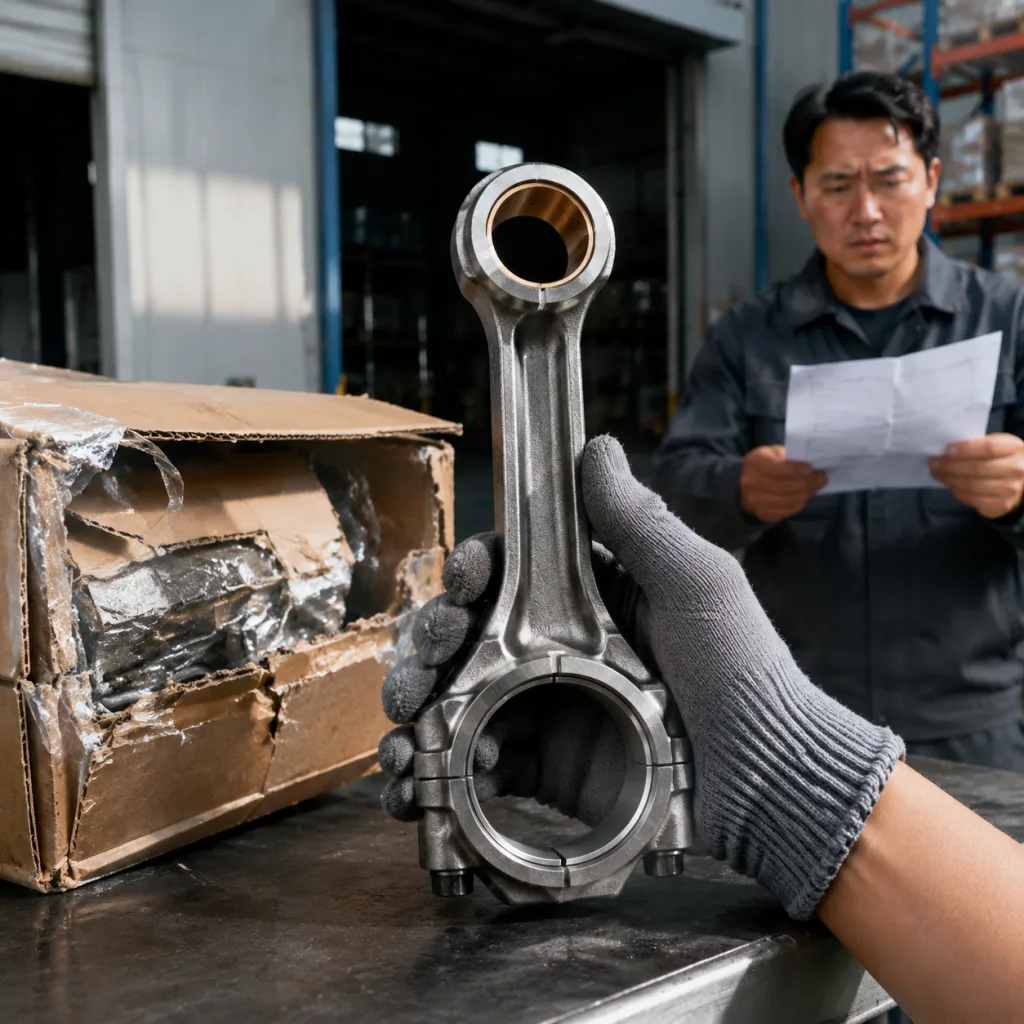
Picture a regional repair-chain buyer receiving a mixed Infiniti-fit order. The rods pass dimensional inspection. Then problems appear: cartons do not separate batches clearly, labels use vehicle names instead of engine codes, weights do not match the packing list, and some inner boxes show light corrosion after sea freight. None of these issues requires a new forging die. All of them can delay receiving, branch transfers, and workshop installation.
Prevent that failure by approving the data package with the part:
Part description, engine-family fitment, production-year notes, and market exceptions.
Interchange notes that do not imply vehicle manufacturer endorsement.
Dimensional summary for procurement and incoming QC teams, including nominal big-end bore, pin-end bore, centre distance, width, and weight group.
Net weight and gross weight per rod, per set, per inner box, and per master carton.
Inner box, master carton, and pallet quantities; common planning formats are 1 set per inner box and 4–10 sets per master carton depending on rod weight and carton strength.
Country of origin, HS code support, and commercial invoice description.
Barcode, QR code, or private-label packing options where agreed.
Batch traceability format printed on the label or included in the carton.
Packing-list logic that separates SKU, quantity, batch number, gross weight, net weight, carton count, and pallet count.
Vehicle model names alone are not reliable because the same model may use different engine variants across markets, production years, or trim levels. For sea freight, define anti-corrosion protection by route: oil or VCI protection, sealed inner packaging, moisture control, carton strength, and pallet wrapping for 30–60 days of transport and warehousing. Cap-and-rod pairing control, bolt retention, and clear orientation marking reduce avoidable handling errors. For EU and UK importers, packaging material declarations and substance compliance checks should align with internal policies, including REACH (EC) No 1907/2006 where relevant.
What to send Driventus for a faster B2B quote
A strong RFQ lets the supplier answer quickly without guessing. For a connecting rod Infiniti wholesale enquiry, send the information that fixes application, specification, volume, and logistics in one file.
Minimum RFQ pack
Engine code and OE or interchange reference if available.
Sample photos or drawings.
Target annual volume and first-order quantity.
Destination country and preferred Incoterms.
Packing format, label requirements, and private-label needs.
Incoming-QC standard or inspection report format.
Technical details if available
Big-end bore, pin-end bore, centre distance, side width, and weight grouping.
Material grade, heat treatment, hardness range, surface finish, and anti-corrosion requirement.
Rod bolt grade, thread form, torque, angle, lubricant, or stretch guidance.
Any special marking, cap-pairing, or set-matching rules.
Driventus supplies aftermarket distributors, wholesalers, OEM/Tier-1 customers, and multi-location repair chains. Our connecting rod supply is part of a broader engine component manufacturing base that includes pistons, piston rings, crankshafts, gaskets, water pumps, turbochargers, and related powertrain parts. Buyers building multi-category programmes can review the engine range at engine components.
A practical review sequence is simple: confirm application data, check existing tooling and material route, quote sample and wholesale quantities, approve packaging and label format, produce or inspect pilot samples, issue dimensional and material records, then release the initial wholesale order after buyer approval. For repeat orders, forecast sharing helps reserve forging capacity, standard bolts, bushings, cartons, and inspection time before demand peaks.
We do not claim approval or endorsement by any vehicle manufacturer. Driventus is an independent aftermarket manufacturer; brand names are referenced for fitment only. The intended buyer outcome is a documented, repeatable supply chain with clear specifications, practical MOQ, export-ready packaging, and inspection evidence that supports distributor confidence.
Frequently asked questions
Provide engine code, target annual volume, first-order quantity, destination market, Incoterms, packing format, inspection requirements, and any drawings or samples. If available, include dimensions for big-end bore, pin-end bore, centre distance, side width, bolt specification, material grade, heat treatment, surface finish, and weight tolerance.
Yes. Private-label packaging can be discussed for qualified B2B orders. Requirements should define box structure, label data, barcode format, carton quantity, pallet layout, corrosion protection, batch traceability, country-of-origin marking, and any compliance markings needed for the destination market.
No. IATF 16949:2016 and ISO 9001:2015 support process control, but buyers should still approve samples, dimensional reports, material records, critical-feature tolerances, bolt requirements, packaging, and corrosion protection before wholesale release.
If you are building a wholesale Infiniti-fit connecting rod programme, send your engine codes, forecast, drawings or samples, target MOQ, inspection requirements, and packing needs to [request a quote](/contact.html).