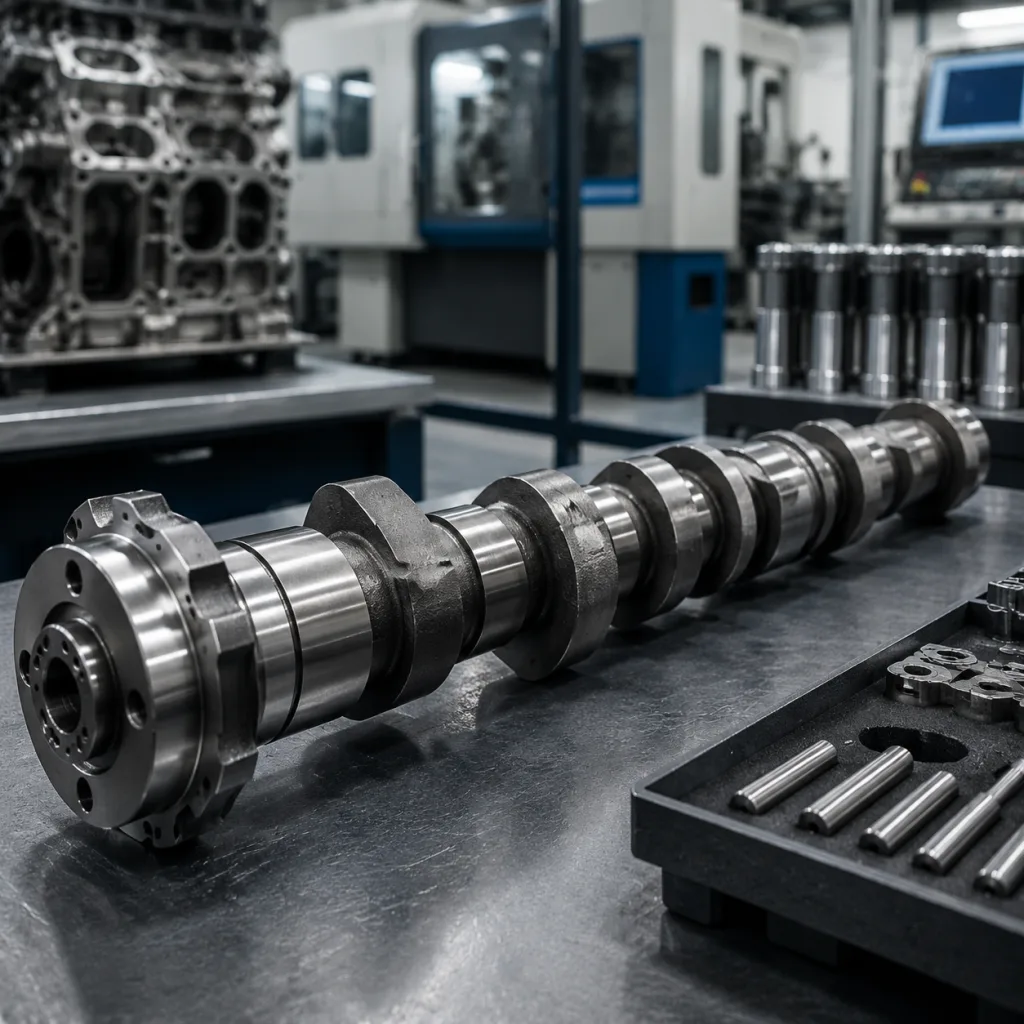
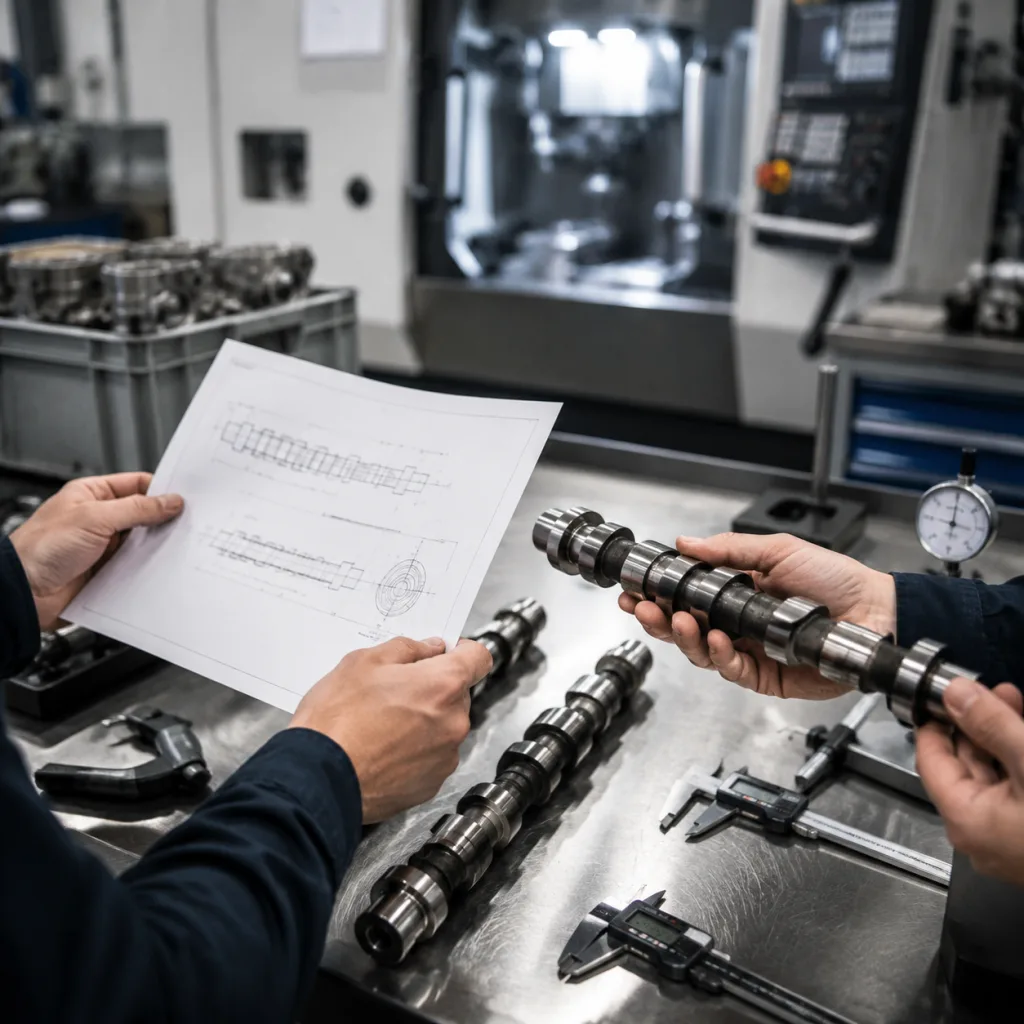
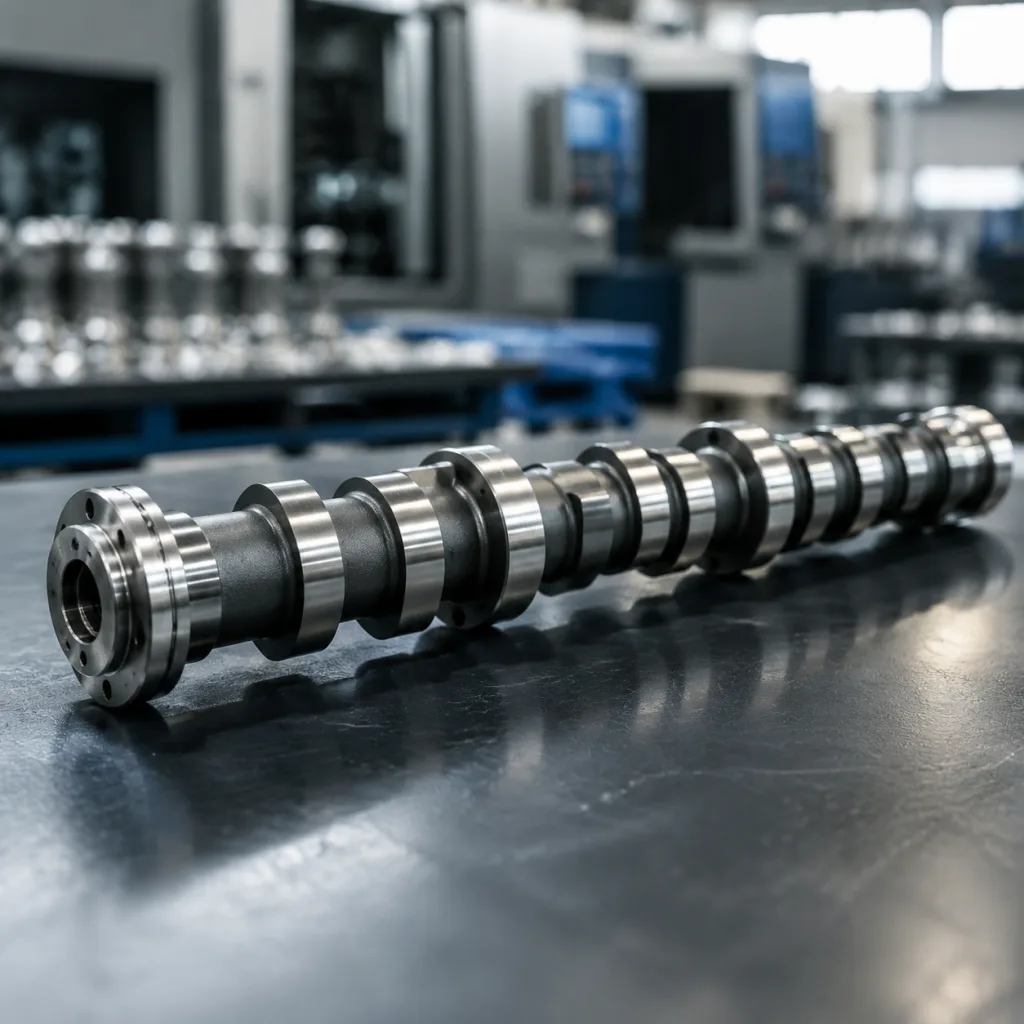
A camshaft Porsche OE equivalent programme is not won by matching a catalogue line. It is won by proving that the part repeats the same timing behaviour, bearing fit, wear resistance and traceability shipment after shipment. For distributors, Tier-1 sourcing teams and repair-chain category managers, the risk is specific: a shaft can install correctly and still fail commercially because the lobe profile is slightly off, the heat treatment is inconsistent, or the intake/exhaust packaging is easy to mix. Before RFQ release, define the evidence you will accept: critical dimensions, profile overlays, hardness and case-depth limits, inspection frequency, sample quantity, MOQ logic, price breaks and lead-time gates. This article shows how Driventus evaluates Porsche-fitment aftermarket camshafts for B2B sourcing, from dimensional equivalence and process control to validation, documentation and supplier briefing. Driventus is an independent aftermarket manufacturer; brand names are referenced for fitment identification only.
Decision Framework: When Is an OE-Equivalent Camshaft Good Enough?
OE-equivalence is not a marketing label. For a replacement camshaft, it means the part matches the reference component’s function, durability target and installation envelope closely enough to control warranty risk. It does not mean approval, endorsement or authorised supply status from the vehicle manufacturer.
For Porsche-fitment engine applications, approve the part only when the evidence answers three questions: will it fit the cylinder head, will it reproduce the intended valve events, and will the surface system survive the follower contact load?
Use these purchasing gates before sampling or production:
Journal diameter must match the buyer drawing, commonly within ±0.005–0.010 mm for finished bearing journals where oil-clearance control is tight.
Journal cylindricity and roundness should be verified separately, with typical RFQ targets of ≤0.003–0.006 mm depending on bearing design and measurement method.
Lobe lift, base circle, flank geometry and phasing must match the target application, with lift variation often controlled within ±0.02 mm and angular phasing within ±0.25–0.50° when reference data is available.
Oil-hole position, groove width and chamfer geometry need to align with the bearing and cylinder-head design, usually checked by CMM or go/no-go functional gauges.
Thrust face width and axial location should be controlled to prevent end-float issues after installation.
Surface hardness and case depth must be specified separately for lobes and journals rather than inferred from one convenient test point.
Straightness and runout should be verified after heat treatment and finish grinding, using between-centres inspection with a defined datum scheme.
Part marking, batch coding and packaging separation must prevent intake/exhaust or left/right mix-ups where relevant.
Driventus can review buyer drawings, samples or application data against parts listed in our catalog and the engine-components range at /products/engine-components.html. If a distributor needs a private-label programme or revised specification, the same gates apply through custom manufacturing. State early whether the request is for prototype samples, a pilot lot or repeat production; tooling, inspection depth and price assumptions change at each stage.
Failure Modes Hidden in Small Dimension Changes
Most camshaft sourcing problems do not start with an obviously wrong part. They start with small differences that pass a visual check: a journal a few microns large, a lobe flank that opens the valve differently, an oil hole with a burr, or a shaft that moves after heat treatment.
Those differences become field symptoms. Tight oil clearance can create heat and bearing distress. Loose clearance can reduce oil-film stability and raise noise. Lobe-profile drift can change idle quality, cylinder balance and emissions-related operating behaviour. Poor runout adds uneven loading before the installer knows anything is wrong.
Use the table below to link each risk to a verification method.
Contact or optical roughness tester; Ra/Rz target agreed by surface
Hardness and case depth
Lobe wear, cracking, follower damage
Rockwell/Vickers test, metallographic section; lot-based heat-treatment record
Straightness and runout
Binding, noise, uneven follower loading
Between-centres runout inspection after heat treatment and final grinding
Oil-feed feature location
Lubrication loss at start-up or load
CMM, optical inspection, functional gauge; burr and blockage check
</tr></thead><tbody> </tbody></table>For production, Driventus normally uses controlled machining, heat treatment, grinding and final inspection plans under IATF 16949:2016 and ISO 9001:2015 quality systems. The control plan should name the CTQs, measurement equipment, sampling frequency and reaction rules. First-off and last-off checks may be required for every grinding setup. Journal diameter and lobe lift can then be monitored through SPC at fixed intervals, such as every 20–50 pieces depending on volume and risk.
Do not treat a certificate as proof of capability. For high-volume orders, request Cpk or Ppk data for journal diameter, lobe lift, lobe phasing and final runout after the pilot lot. A common launch target is Cpk ≥1.33 for stable critical dimensions. If capability data is unavailable, require raw inspection results from the sample and pilot lots before confirming blanket orders.
Spec Deep-Dive: Material, Heat Treatment and Finish
A camshaft porsche oe equivalent specification should describe the surface system, not just the base material. Material, heat treatment, grinding and lubrication geometry work together. Changing one can make the part cheaper, stronger, noisier or less durable depending on the engine architecture and follower type.
Common aftermarket routes include chilled cast iron, alloy cast iron, forged steel and steel billet. None is automatically superior. The correct route depends on contact stress, wear mechanism, mass target, machining cost, validation burden and the buyer’s warranty exposure.
Lock down these items in the RFQ:
Material certificate: Chemical composition should match the agreed grade and be traceable to the melt or batch, with certificate numbers linked to production lots.
Microstructure: Cast camshafts should show controlled carbide distribution; steel camshafts should show suitable grain structure after heat treatment.
Hardness range: Lobe and journal hardness must be specified separately where required. Buyer specifications may call for hardened lobe surfaces in the 50–62 HRC equivalent range, but the correct value depends on material route and follower design.
Case depth: If induction hardening, nitriding or carburising is used, effective case depth should be validated by section testing or an agreed equivalent method. RFQs should define total case depth and effective case depth at a stated hardness threshold.
Grinding burn control: Magnetic particle inspection, Barkhausen noise testing or etching may be needed depending on risk level and material route. Suspect parts should be segregated before packing.
Surface finish: Lobe and journal roughness should be defined by Ra, Rz or another agreed parameter. Lobes, bearing journals and thrust faces often need different limits.
Hardness readings alone are not enough. Excessive hardness with poor microstructure can raise cracking risk or damage the follower surface. Insufficient hardness can cause rapid lobe wear, metal debris and repeat repairs.
For fair RFQ comparison, ask each supplier to quote the same material and heat-treatment route. A chilled-cast camshaft, induction-hardened steel camshaft and nitrided billet camshaft may all be valid in different contexts, but they do not carry the same tooling cost, machining cycle time, MOQ or validation burden. If a supplier proposes a substitute material, require a written deviation note covering hardness, case depth, wear-test evidence, price effect and lead-time effect.
Step-by-Step Validation Before Production Release
Validation should match channel risk. A regional distributor may need dimensional reports, corrosion checks and packaging verification. A Tier-1, fleet or repair-chain programme may require endurance evidence, PPAP-style documentation and a formal warranty-return workflow.
A practical launch sequence has three gates: sample approval, pilot-lot approval and production release. Do not move to bulk production because the first sample looks right.
1. First-article inspection: Measure the sample against the buyer drawing, reference sample or agreed CTQ list. A typical submission includes 3–10 pieces per part number, all CTQs measured, plus photographs of markings and packaging. 2. Profile comparison: Compare lift curve, base circle and angular position against the reference part. Request curve overlays and numeric delta tables, not only a pass/fail statement. 3. Material verification: Confirm chemical analysis, hardness readings, microstructure images and heat-treatment traceability. At minimum, link test records to the sample lot and furnace batch. 4. Endurance testing: Use bench or engine-based wear evaluation where volume, labour cost or application risk justifies it. Define test duration, oil grade, follower type, speed/load cycle and allowable wear before testing starts. 5. Oil compatibility review: Confirm surface finish, lubrication holes and grooves suit the intended engine oil specification and service environment. Include burr, blockage and corrosion-protection checks for all oil-feed features. 6. Packaging transit test: Protect journals and lobes from corrosion, impact damage and mixed-part errors. For export programmes, specify VCI bag or oil film, end caps, divider strength and a corrosion-protection target such as 6–12 months in normal warehouse storage.
Sample lead time is commonly 30–60 days where tooling or fixture changes are required. Repeat production is often quoted at 45–90 days after deposit, depending on material availability, heat-treatment capacity and inspection workload. Keep the timing honest by separating sample manufacture, sample inspection, buyer approval, pilot lot, mass production and freight.
Emissions regulations such as ECE R-83 and US EPA rules are vehicle-level requirements rather than direct camshaft product approvals. Still, valve timing influences combustion behaviour. Buyers supplying regulated markets should avoid undocumented lobe-profile or phasing deviations that could create downstream compliance exposure, drivability complaints or customer claims.
Audit Q&A: Evidence to Request Before Approval
Documentation is part of the product. If inspection records are missing, lot codes are weak or drawings are unclear, a field issue becomes harder to contain months after delivery. Good records help separate a manufacturing fault from installation error, lubrication failure or incorrect application selection.
Use these audit questions before approving a camshaft Porsche OE equivalent supplier:
Are the quality certificates current? Confirm IATF 16949:2016 and ISO 9001:2015 status, scope and expiry date.
Is there a part-specific control plan? Ask for the process flow, inspection checklist and CTQ list for the relevant camshaft family.
Are measurements reliable? Critical dimensions should be checked with calibrated equipment under a documented calibration system. Gauge R&R studies should be available for key CTQs where programme risk justifies them.
Can each lot be traced? Heat-treatment lots should link to material batch, furnace cycle, hardness result and final inspection record.
Are market compliance needs covered? Substances, coatings and surface treatments should be reviewed against REACH (EC) No 1907/2006 for EU shipments, with RoHS or IMDS-style declarations available if required by the buyer.
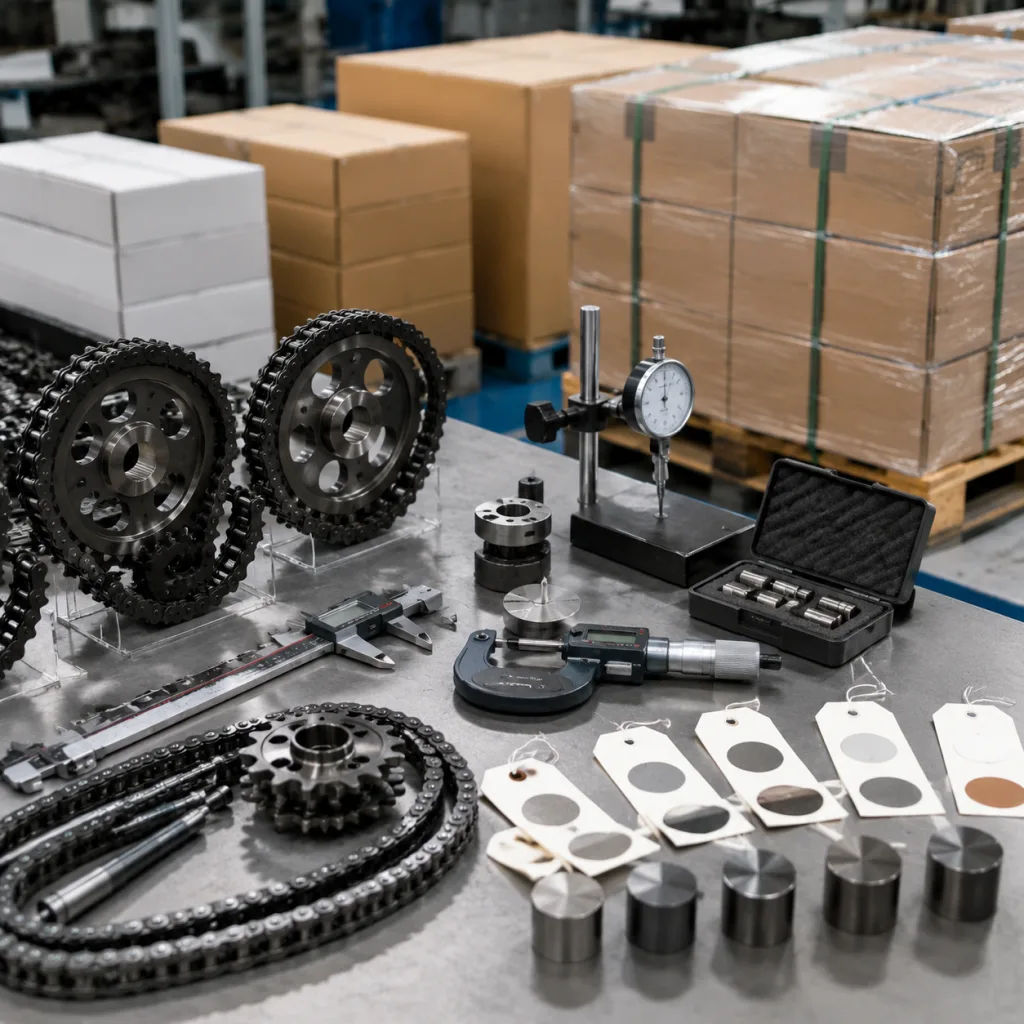
Will labels work in the buyer’s warehouse? Packaging should support scanning, mixed-model segregation and private-label requirements, including barcode, batch number, part number, quantity and country-of-origin fields.
How are claims handled? Define the evidence required for dimensional, noise, installation-fit or early-wear complaints, plus the process for 8D or corrective-action response.
Driventus maintains a documented quality system covering production control, inspection records and continuous-improvement procedures. For factory audit support, the most useful evidence is practical: equipment lists, gauge calibration status, process capability data, non-conformance handling, change-control records and sample-retention rules.
Scale the audit to spend and warranty risk. For a low-volume trial order, document review and sample inspection may be enough. For an annual programme, confirm change-control rules for material grade, heat-treatment supplier, grinding wheel specification, inspection equipment and packaging. Require advance written notification before any process change that could affect lobe profile, hardness, surface finish, oil-feed geometry or traceability.
RFQ Scenario: Turning a Part Number Into a Stable Programme
A weak RFQ says, “quote this part number.” A strong RFQ explains the application, the evidence required and the commercial assumptions. That difference prevents sampling loops and makes supplier pricing comparable.
For a Porsche-fitment camshaft enquiry, include:
Target application and engine-code range where available
Reference sample, drawing or critical dimensions list, with CTQs marked clearly
Required material grade or permission for supplier recommendation
Required inspection report format and critical-characteristic marking
Packaging specification, corrosion-protection period and label format
Expected order quantity, forecast split and delivery destination
Compliance requirements for the EU, UK, US, Canada, Australia or Brazil
Required documents, such as certificate of conformity, material certificate and dimensional report
Commercial assumptions, including MOQ, target price range, Incoterms, currency, payment terms and delivery window
Ask the supplier to show MOQ and price logic. For existing designs with available tooling, trial MOQs may start at tens of pieces per reference. Repeat production usually needs higher quantities to cover setup, heat treatment and inspection cost. New development or private-label programmes are typically driven by raw-material batch size, fixture/tooling amortisation, packaging print quantity and validation workload. Request price breaks at practical tiers such as sample lot, pilot lot, 100 pieces, 300 pieces and 500+ pieces.
Lead time should be quoted by stage: technical review, sample manufacture, sample inspection, buyer approval, pilot lot, mass production and sea or air freight. A single delivery date often hides approval dependencies. Agree who approves drawings, how deviations are recorded, how long samples can wait for buyer feedback, and whether production material can be purchased before final approval.
If an OE part-number style reference is already used in your internal system, provide it in the generic format agreed for the enquiry and only where it supports the application data. Do not rely on part numbers alone. Supersessions, regional variants and engine-code differences can create errors. Physical and functional verification remains necessary before approval. To discuss current applications or a new development project, buyers can request a quote with drawings, samples or a target specification.
Frequently asked questions
No. OE-equivalent means the aftermarket part is engineered to match the function, dimensions and installation requirements of the reference component. It does not mean approval, endorsement or supply status from the vehicle manufacturer.
Request a first-article inspection report, material certificate, hardness report, surface-finish data, heat-treatment traceability and packaging specification. For higher-volume programmes, also request a control plan, process flow, sample-retention plan and CTQ inspection results from the sample lot.
Yes. Driventus can review drawings, samples and application data for private-label or custom manufacturing programmes, subject to technical feasibility, minimum order quantity and validation requirements.
If you are comparing Porsche-fitment camshaft suppliers, send the application scope, drawings or sample details for review. Driventus can confirm feasibility, MOQ, documentation, validation and quotation steps at /contact.html