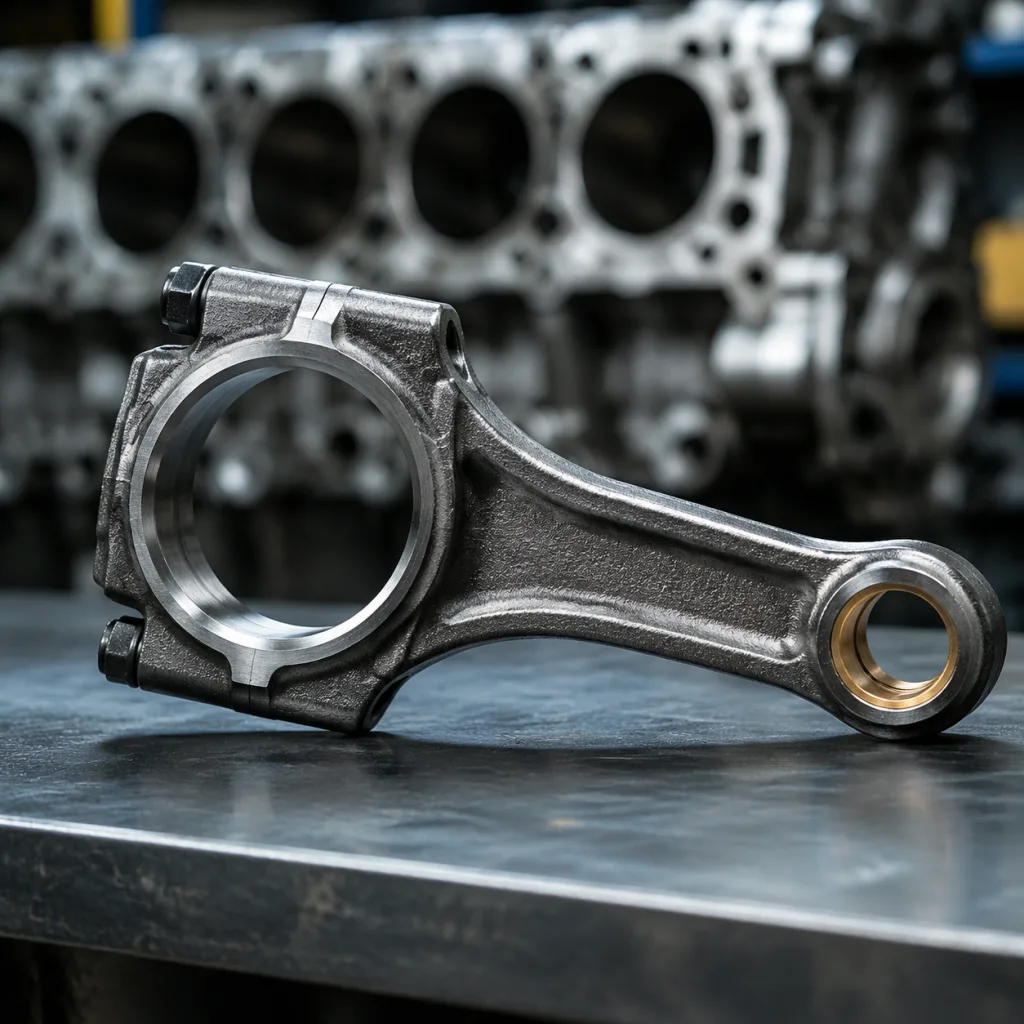
A connecting rod Honda wholesale program fails when buyers treat rods like simple catalogue items. They are not. A low quote can hide loose fitment mapping, inconsistent bore control, weak traceability, poor rust protection, or MOQ terms that overload inventory. The better buying question is not “Who has the cheapest rod?” but “Which supplier can repeat the approved part, lot after lot, with documents my team can verify?”
For distributors, the main risks are mixed references, regional engine confusion, slow-moving stock, carton errors, and uneven batch quality. For OEM-style, Tier-1, and engineering-led buyers, the focus shifts to process capability, material evidence, sample approval, change control, and audit readiness. Driventus manufactures engine and powertrain components in Taizhou, Zhejiang, exports to more than 60 countries, and operates certified management systems under IATF 16949:2016 and ISO 9001:2015. This guide shows how to assess Honda-fitment connecting rod suppliers, what to include in an RFQ, and where quality control should be proven before a wholesale order is released. Driventus is an independent aftermarket manufacturer; brand names are referenced for fitment only.
Start With the Buying Decision, Not the Catalogue
Catalogue coverage is useful, but it should not lead the sourcing decision. A connecting rod works under repeated tensile, compressive, and bending loads. Small variation in big-end roundness, centre-to-centre length, bore finish, side clearance, weight matching, or bolt preload can shorten bearing life, disturb oil film stability, increase imbalance, or create noise, vibration, and harshness issues.
Use this decision framework before comparing prices:
Fitment confidence: quote by engine code, displacement, fuel type, production year range, and regional variation. Vehicle model name alone is not enough.
Critical dimensions: confirm big-end bore, small-end bore, centre-to-centre length, side clearance, bore finish, and weight grouping.
Construction route: define forged steel, sintered steel, cracked-cap design, bushed small end, or other required application-specific design.
Traceability depth: require heat number, machining lot, inspection record, packing lot, and shipment reference.
Documentation readiness: check whether commercial invoice, packing list, certificate of origin, compliance declarations, and inspection reports can be supplied in the format your receiving team expects.
Audit access: confirm availability of process flow, control plan, incoming inspection, final inspection, calibration status, and nonconforming product records.
The strongest connecting rod Honda wholesale suppliers separate distribution programs from engineering-controlled programs. Distribution orders usually need stock continuity, cross-reference accuracy, carton-level labelling, barcode control, and replenishment within agreed MOQ and lead-time bands. Engineering-controlled programs need drawing review, material confirmation, sample approval, deviation control, and stricter reporting.
Driventus supports standard wholesale supply through our catalog and application-specific development through custom manufacturing. The right path depends on whether your reference is already stable, needs sample matching, or requires engineering review.
Where Rod Quality Actually Breaks Down
Most connecting rod problems do not begin at final inspection. They start earlier: wrong steel route, unstable heat treatment, tool wear in machining, cap mismatch, weak cleaning, poor rust protection, or a packaging process that allows similar references to mix. Final sorting helps, but it cannot replace controlled production.
Use the table below to locate the real failure points before approving a supplier:
Process stage
Failure mode to prevent
Evidence to request
Raw material receipt
Wrong steel grade, untraceable heat
Mill certificate and incoming inspection record
Forging or forming
Poor grain flow, blank defects, geometry drift
Process parameters and visual inspection criteria
Heat treatment
Hardness variation, unsuitable microstructure
Furnace record and hardness report
CNC machining
Bore error, roundness loss, centre-distance drift
In-process inspection sheet
Bolt assembly or cap matching
Reversed cap, wrong torque, mixed pair
Assembly instruction and lot traveller
Shot peening or surface finishing
Surface damage, stress concentration
Surface inspection and process record
Final inspection
Weight mismatch, bore finish issue, marking error
Final quality report by lot
Packing
Corrosion, carton failure, label mismatch
Packing specification and export photo record
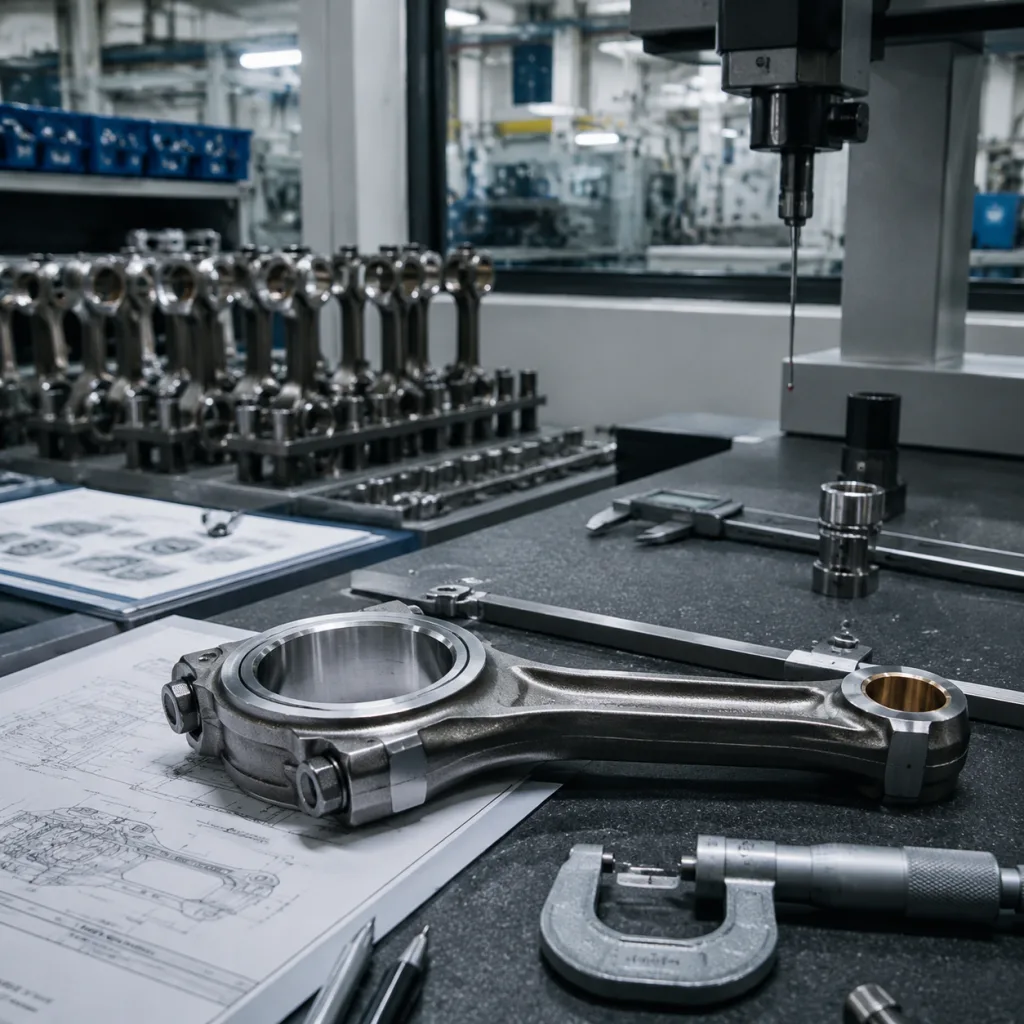
</tr></thead><tbody> </tbody></table>For dimensional checks, define the measurement method, gauge resolution, sampling level, and report format. A practical RFQ baseline is big-end bore size, big-end roundness, small-end bore size, centre-to-centre length, side face width, total weight, and visual condition. Drawing-controlled programs may hold bore and centre-distance features in the ±0.005 mm to ±0.02 mm range depending on design and datum scheme. Aftermarket distribution programs may use supplier-controlled tolerances agreed against an approved sample or drawing. Do not copy these ranges into a purchase order without review; use them to force a technical discussion, then freeze the approved tolerance table.
Measurement discipline matters. Bore gauges and micrometers should normally resolve to 0.001 mm for critical bores. Hardness should be recorded by lot after heat treatment. Surface roughness should be checked where the drawing defines bearing or bushing contact surfaces. If bearing shells, bushings, bolts, or matched sets are included, their interface fit belongs in the inspection plan.
For AQL-style final inspection, many buyers use tightened sampling on first orders and move to normal sampling only after several acceptable lots. Driventus operates under a documented quality system aligned with IATF 16949:2016 and ISO 9001:2015. These standards do not replace part validation, but they support document control, traceability, corrective action, supplier management, and change control.
Build the Order Around Real Inventory Behavior
MOQ is not only a supplier number. It is an inventory decision. A low unit price can be expensive if it leaves branches holding slow-moving references, mixed engine variants, or packaging that does not match the sales channel.
Start by choosing the order configuration:
Loose pieces: useful for broad distribution coverage, but requires stronger picking and labelling discipline.
Matched sets: preferred by many repair chains because workshops spend less time sorting and checking weight groups.
Engine-set kits: easier for planned rebuilding programs, but less flexible when demand varies by reference.
Mixed-reference shipments: efficient for importers, provided carton labels, packing lists, and batch separation are controlled.
Then separate commercial terms from technical approval:
MOQ: define by part number, engine family, matched set, or mixed-container program. For standard active references, request price breaks at 100, 300, 500, and 1,000 pieces or equivalent engine-set quantities.
Sample quantity: request dimensional samples and installation trial samples before mass production. A common approach is 3 to 10 sample pieces per reference, plus one retained golden sample after approval.
Lead time: separate tooling, development, sample approval, first production, and repeat production timing.
Packaging: specify neutral, customer-brand, anti-corrosion, or bulk export packaging. For private-label cartons, confirm print MOQ, artwork approval time, and whether mixed labels can run in one shipment.
Labelling: include part number, quantity, batch code, country of origin, barcode format, and customer reference.
Incoterms: state FOB, CIF, DAP, EXW, or other required terms clearly. Compare ex-works price, inland freight, export charges, ocean or air freight, insurance, duty, and destination handling separately.
Annual volume: provide forecast ranges so material planning and capacity can be reserved.
Price logic should be visible. Unit price often falls when setup time, inspection reporting, packaging preparation, and export paperwork are spread across more pieces. Still, the lowest unit price may not be the lowest landed cost. Compare unit price, MOQ, payment term, scrap allowance, sample cost, packaging cost, inspection report cost, freight density, and stock risk together.
For a mixed-reference connecting rod Honda wholesale order, request one quote table showing price by reference, price break, MOQ, sample lead time, mass-production lead time, carton quantity, gross weight, and CBM. For standard aftermarket rods, repeat orders can often be planned around stable production windows. As a working range, allow 2 to 4 weeks for repeat production when inventory and capacity are available, 4 to 8 weeks for first mass production after sample approval, and longer when new tooling, blanks, or customer-brand packaging are required.
If your team is consolidating several engine component lines, the related range at /products/engine-components.html can help align connecting rods with pistons, crankshafts, gaskets, and other powertrain components.
Audit the Factory by Tracing One Carton Backward
A useful audit does not stop at certificates. Pick one finished carton and trace it backward. The factory should be able to connect that carton to the finished part number, packing record, final inspection record, machining lot, heat number, and shipment documents. If that chain breaks, the wholesale program carries avoidable risk.
During the audit, check:
IATF 16949:2016 and ISO 9001:2015 certificate scope, expiry date, and issuing body.
Control plans for incoming material, heat treatment, machining, cleaning, packing, and final inspection.
Calibration records for bore gauges, micrometers, hardness testers, height gauges, torque wrenches, and surface roughness instruments. Confirm gauge resolution and calibration interval, not only the sticker.
Nonconforming material segregation, root-cause analysis, rework approval, and corrective action records. Ask for one closed 8D or corrective action case and check whether the action changed the process or only sorted stock.
Lot traceability from raw material and machining batch to finished cartons and shipment documents.
Engineering change control for drawing revisions, customer specifications, material, bolt source, heat treatment, machining datum, surface treatment, and packaging labels.
Ask process-specific questions while walking the line. At incoming inspection, ask how steel grade and heat numbers are checked against the purchase order. At machining, ask whether first-off, in-process, and last-off inspections are recorded for each setup. At final inspection, ask which dimensions are checked 100% and which are sampled. At packing, ask how mixed references are prevented when rods differ only by small bore, width, or cap design.
For sea freight, confirm anti-corrosion oil, VCI bag or equivalent protection where specified, desiccant use where needed, pallet wrap, and carton drop or compression expectations. If a supplier claims REACH compliance for materials or packaging supplied into the EU, request declarations aligned with REACH (EC) No 1907/2006 where applicable.
Engine emissions regulations such as ECE R-83 affect vehicle type approval rather than direct connecting rod certification. Even so, material consistency and dimensional control support reliable repair, rebuilding, and remanufacturing outcomes. For private-label programs, add questions on artwork approval, label control, carton change control, barcode verification, and destination-language requirements. A wrong label can create the same commercial damage as a wrong dimension: returns, warranty administration, stock corrections, and lost customer confidence.
RFQ Data That Prevents Wrong Assumptions
The phrase connecting rod Honda wholesale is too broad for a reliable quotation. It tells the supplier the market category, not the part. A strong RFQ removes guesswork and lets the supplier separate standard references from items that need sample matching or engineering review.
Include this information in the first RFQ package:
Engine family, displacement, fuel type, aspiration type where relevant, and model year range.
Destination market or regional application, since engine specifications can vary by market.
Existing aftermarket reference, buyer part number, drawing, or sample part if available.
OE-style cross-reference only when already used in your system, such as OE 13210… or OE 13211… conventions.
Required construction: forged steel, cracked cap, bushed small end, bolt specification, or other design features.
Critical dimensions and tolerances: big-end bore, small-end bore, centre-to-centre length, side width, pin bore condition, weight target, roundness, cylindricity, and surface roughness limits where required.
Quantity by reference, expected annual demand, and reorder frequency. State whether the first order is a market test, branch replenishment, repair-chain rollout, or long-term stocking program.
Target price or landed-cost objective where available. If no target can be shared, request structured price breaks by quantity and packaging format.
Required packaging format, carton quantity, palletisation, and label content. Include barcode type, country-of-origin wording, customer SKU, and retail-language requirements.
Destination market and compliance documentation required.
Inspection report format, including key dimensions, sampling plan, measurement units, and whether metric-only reporting is required.
PPAP-style documentation, material report, heat-treatment record, IMDS-related data, sample approval, or retained sample control if needed.
A one-page RFQ matrix speeds screening. Use columns for reference, engine code, quantity, target MOQ, packaging, required documents, sample requirement, and requested Incoterm. This prevents one difficult reference from delaying the whole quote and helps the supplier separate catalogue items from engineering-review items.
Do not rely on vehicle brand or model name alone. Engines can vary by region, emissions specification, production period, and service replacement practice. For wholesale supply, Driventus can review samples, drawings, or buyer reference data before quotation. That reduces fitment disputes, avoids incorrect substitutions, and supports stable replenishment planning.
A Practical Sourcing Sequence With Driventus
A connecting rod program moves faster when each approval gate is clear. For standard references, the work is mostly confirmation: fitment, MOQ, packaging, inspection records, and delivery schedule. For non-standard parts, engineering review comes first; price and lead time should not be treated as final until the reference is confirmed.
A workable sequence is:
1. Send the RFQ matrix, engine codes, buyer references, drawings, or samples. 2. Confirm which items are standard and which require technical review. 3. Agree MOQ, price breaks, sample quantity, inspection scope, and Incoterm. 4. Approve samples or retained references before mass production. 5. Freeze packaging artwork, carton labels, barcode fields, and batch-code format. 6. Release production and receive agreed pre-shipment inspection data. 7. Book shipment with matching commercial documents and packing records. 8. Review claim history, fast-moving references, slow-moving references, and forecast changes each quarter.
Driventus support can include application review against buyer-supplied references, samples, or drawings; sample production or sample matching for selected references; dimensional feedback before mass production where agreed; lot-level inspection reporting for controlled dimensions; neutral, bulk, or customer-specified export packaging; mixed engine component consolidation where order volume and production timing allow; export coordination for commercial documents; and corrective action response when nonconformity is verified.
Corrective action should be practical, not ceremonial. When a verified issue occurs, the response should cover containment, affected-lot review, root-cause analysis, process correction, and agreed replacement or credit handling. For ongoing wholesale supply, quarterly review keeps production planning aligned with real demand instead of old forecasts.
Driventus is an independent aftermarket manufacturer; brand names are referenced for fitment only. No vehicle manufacturer approval or endorsement is implied. Buyers preparing a connecting rod Honda wholesale project can share target references, annual demand, destination market, packaging requirements, and inspection expectations through request a quote.
Frequently asked questions
MOQ depends on the reference, packaging format, order configuration, and whether the part is already in production. For standard active references, buyers should request price breaks such as 100, 300, 500, and 1,000 pieces or equivalent engine-set quantities. New or inactive references may require higher MOQ because of forging blanks, heat-treatment batch size, fixture setup, or packaging print runs.
Yes. Inspection reporting can be agreed during quotation. Buyers should define the required dimensions, sampling level, report format, measurement units, and whether material, hardness, heat-treatment, or retained-sample records are needed for each shipment.
No. Driventus supplies standard aftermarket references and can review custom projects when drawings, samples, material requirements, target volume, packaging needs, validation expectations, and inspection criteria are provided.
If you are comparing connecting rod suppliers for wholesale distribution or controlled sourcing, send your application list, engine codes, annual volume, target MOQ, destination market, packaging needs, Incoterm, inspection expectations, and documentation requirements. Driventus can review the project and respond with sourcing options at /contact.html